- The paper identifies SN 2020bij as a Type IIP supernova with a ~14-day slow rise to plateau and expansion velocities exceeding typical values.
- It employs detailed photometric and spectroscopic analysis combined with hydrodynamical models and SNEmcee MCMC fitting to constrain explosion parameters and CSM properties.
- The study proposes a distinct subclass of SNe IIP, suggesting canonical RSG progenitors with limited or confined circumstellar material influencing early light curves.
A Slow-Rise, High-Velocity Subclass of Type IIP Supernovae: The Case of SN 2020bij
Introduction and Motivation
The paper "SN 2020bij and a Possible Slow-Rise High-Velocity Subclass of Type IIP Supernovae" (2607.02253) presents comprehensive photometric and spectroscopic observations of SN 2020bij, a Type IIP supernova (SN IIP) discovered in galaxy NGC 3463. The study extends its analysis to a handful of additional SNe IIP exhibiting similar behaviors. Historically, SNe IIP are identified by a hydrogen-rich spectrum and a characteristic light curve with a plateau phase, typically traced to the core-collapse of red supergiant (RSG) progenitors. Recent hydrodynamical and analytical modeling has demonstrated that circumstellar material (CSM) surrounding progenitors can significantly modify the early-time light curve, especially shortening the rise time to the plateau.
This work presents SN 2020bij as a counterexample: it possesses a notably slow rise to plateau, as predicted by models with little or no CSM. Furthermore, the paper posits the existence of a new subclass within SNe IIP, characterized by slow photometric rise and high ejecta velocities, supported by the addition of four similar historical events.
Discovery and Photometry
SN 2020bij was discovered at a magnitude of approximately 17.5 in the unfiltered band. The explosion epoch was robustly constrained to MJD 58876.54 via the interval between last non-detection and first detection, limiting the rise-time uncertainty.
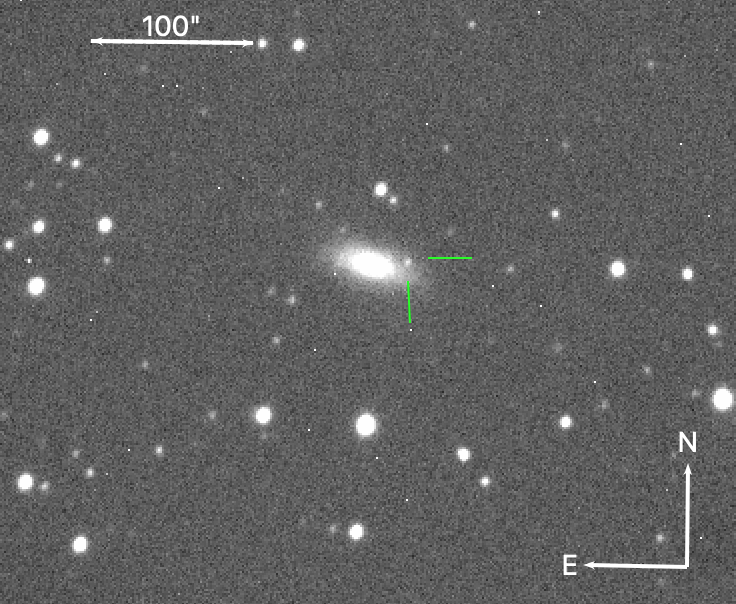
Figure 1: Unfiltered discovery image of SN 2020bij in NGC 3463.
Follow-up observations combined multi-band photometry from Las Cumbres Observatory, ATLAS, Gaia, and the Itagaki Astronomical Observatory. The dataset provided daily cadence and high signal-to-noise during the rise and plateau phases.
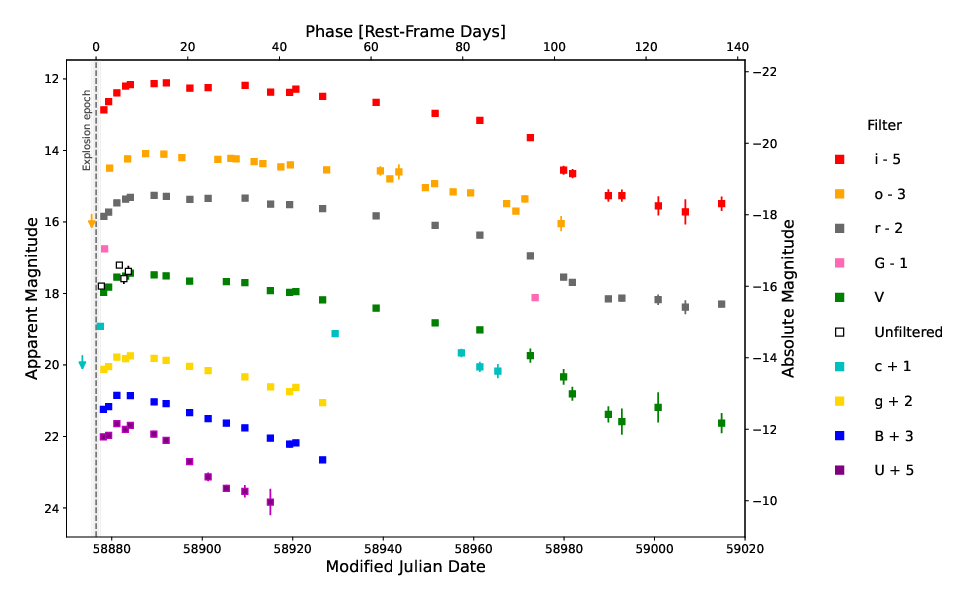
Figure 2: Light curves of SN 2020bij, corrected for Milky Way extinction, showing its slow and prolonged rise to plateau.
The r-band light curve for SN 2020bij shows a rise time of ∼14 days to plateau, compared to the typical ≲10 days seen in the bulk of SNe IIP. A systematic search identified four additional SNe—ASASSN-14kg, SN 2018fif, SN 2021yja, and SN 2023axu—with similarly slow rises.
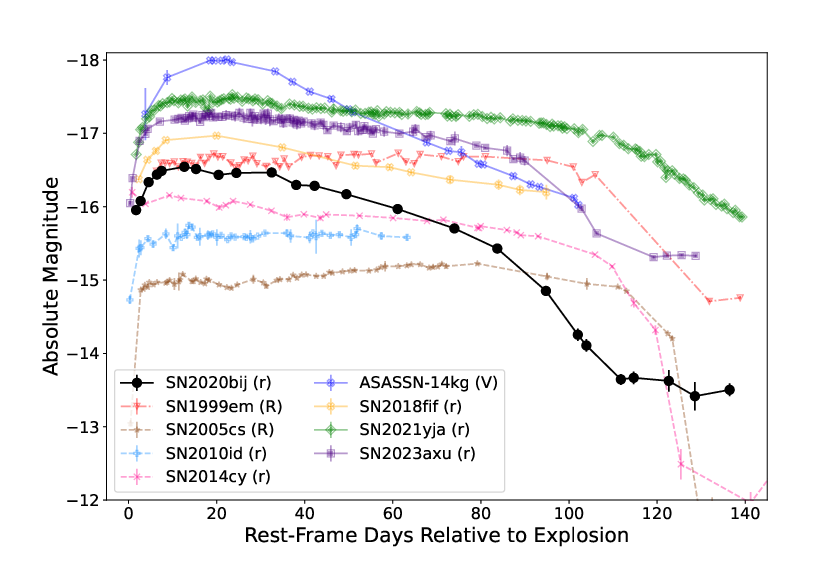
Figure 4: r-band light curve comparison highlighting the slow rise of SN 2020bij relative to prototypical and other slowly rising SNe IIP.
Color evolution analysis (V−r) placed SN 2020bij at the red end of the slow-risers, but consistent with expectations for Type IIP events.
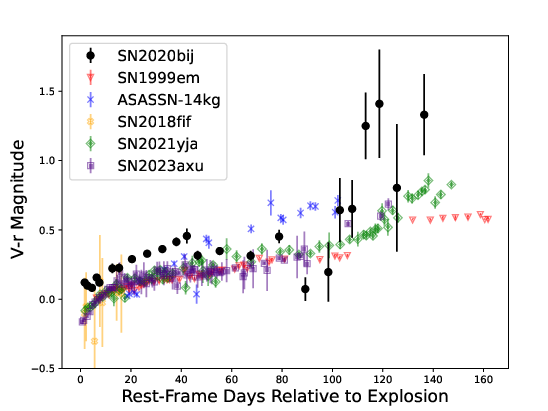
Figure 6: V-r color evolution of SN 2020bij and comparison SNe, all falling within the distribution observed for Type IIP SNe.
Spectroscopic Properties
The available spectroscopic sequence samples SN 2020bij from approximately 4.7 to 51 days post-explosion. The spectra show canonical Type II signatures, namely broad Balmer lines and Fe II λ5169, with no persistent flash features—likely a consequence of the earliest spectrum still missing the very short-lived flash-ionized episode.
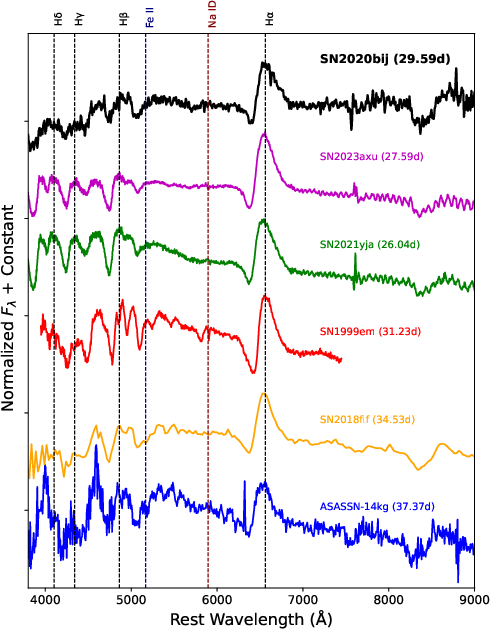
Figure 3: Spectroscopic evolution of SN 2020bij, showing typical H, He, and Fe spectral features throughout the plateau.
A direct spectral comparison at ~30 days post-explosion with both normal and slow-rise SNe IIP reveals shared features, including an absence of strong, narrow Na ID absorption—indicative of low host extinction for these SNe.
Figure 8: Comparison spectrum at ∼30 days post-explosion; all slowly rising SNe exhibit typical IIP features and low Na ID absorption.
Most notably, SN 2020bij and the other slow-rising events display expansion velocities (from both Hα and Fe II λ5169) systematically exceeding the mean for Type IIP SNe by >1σ, with SN 2020bij at the high extreme.
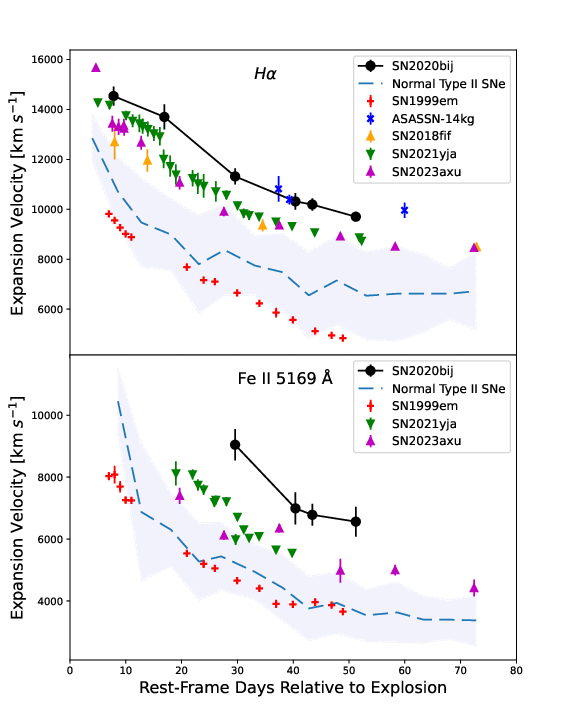
Figure 5: Evolution of expansion velocities for slow-rising SNe vs. typical SN 1999em and the Type II distribution, highlighting systematic velocity excess.
Physical Modeling and CSM Constraints
The paper employs both analytic shock cooling models [Sapir & Waxman; Morag et al.] and the SNEmcee MCMC fitting tool applied to grids of hydrodynamical models. Two critical findings arise:
- Shock cooling models alone accurately reproduce the early light curves (rise phase) of SN 2020bij and similarly slow-rising SNe.
- Adding CSM to the models provides no significant improvement for SN 2020bij or SN 2018fif, whereas for some others, fits statistically favor the presence of a dense but confined CSM (i.e., high ∼0, low ∼1), rather than the extended envelopes typically invoked for regular SNe IIP.
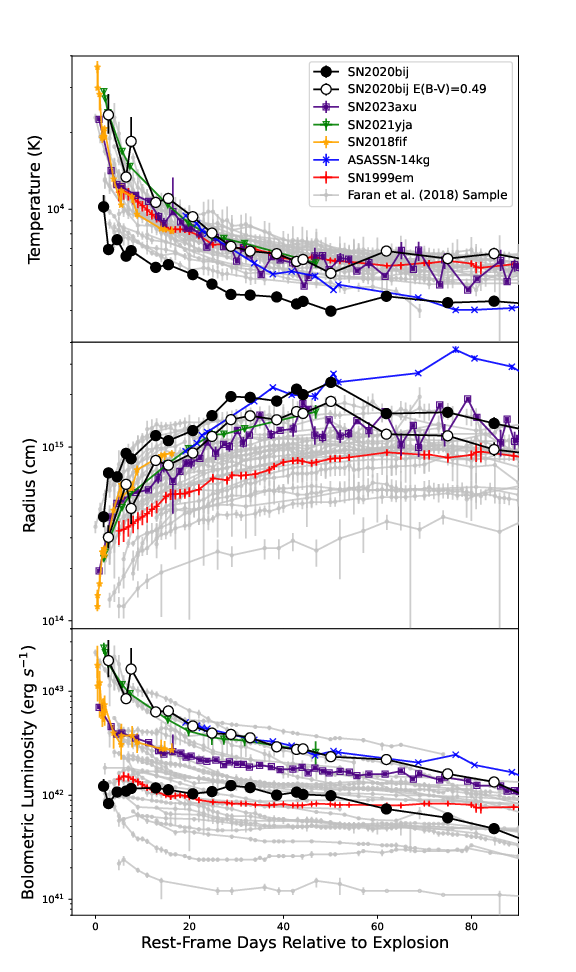
Figure 10: Best-fit blackbody temperature, radius, and bolometric luminosity for SN 2020bij, bracketed by other SNe IIP.
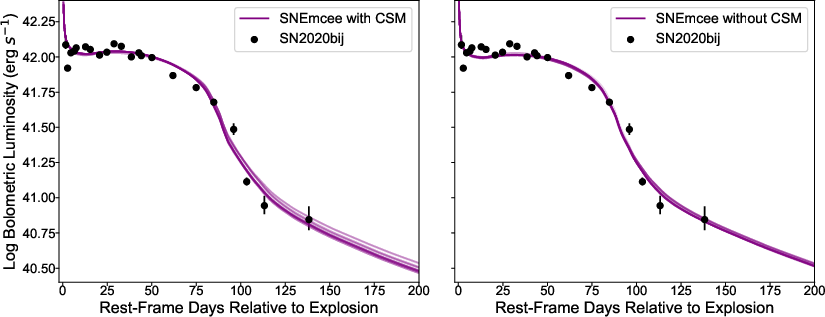
Figure 12: SNEmcee light curve fits (with and without CSM); both match the observed bolometric light curve of SN 2020bij equally well.
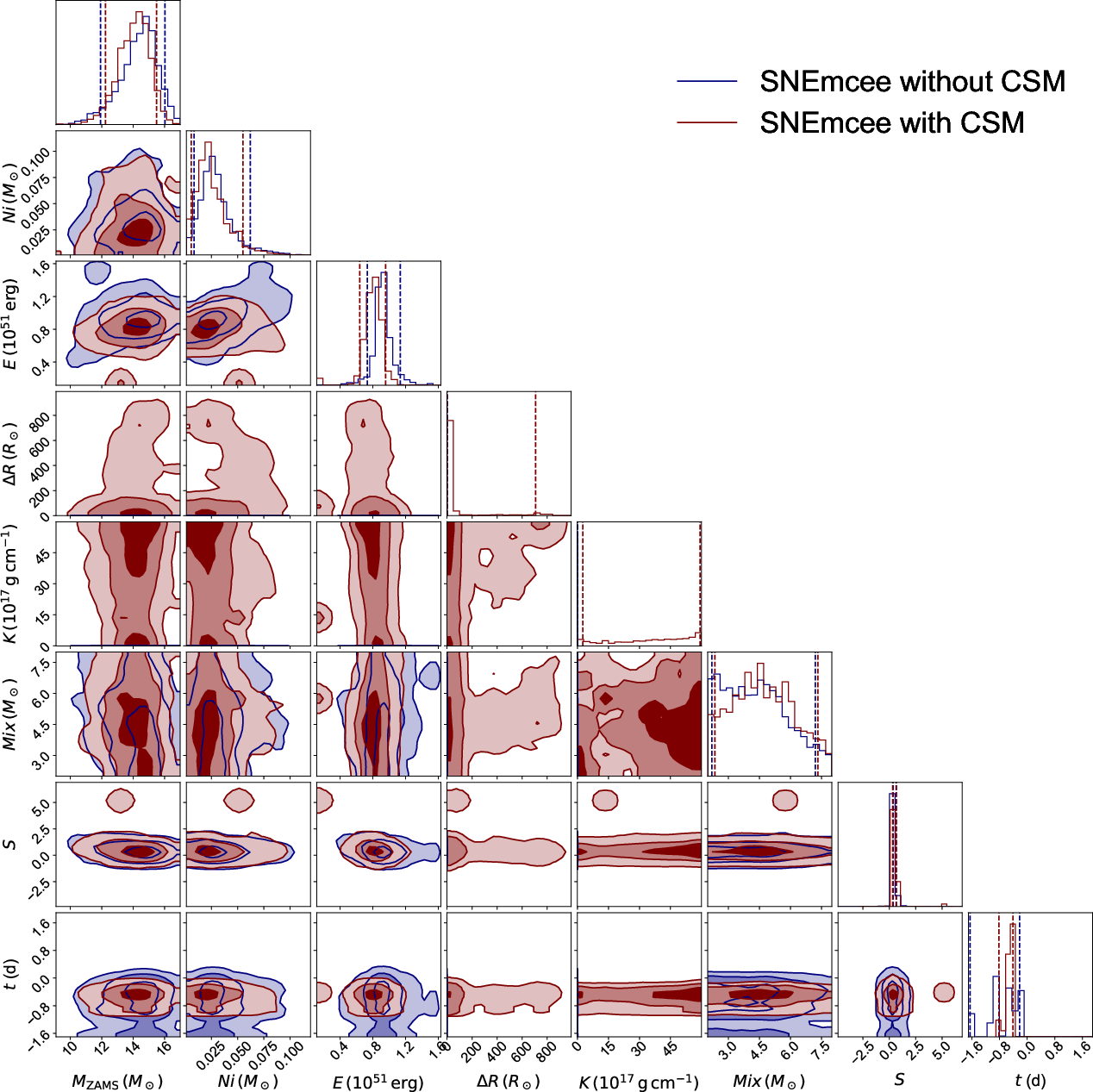
Figure 14: Posterior distributions showing lack of significant CSM in SN 2020bij (blue/zero thickness is favored).
The best-fit physical parameters for SN 2020bij include a progenitor radius of ∼2 (Sapir & Waxman), envelope masses of ∼3–∼4, and explosion energies near ∼5–∼6 erg—entirely within the canonical RSG progenitor parameter space for SNe IIP.
Comparison against a large sample (Morozova et al. 2018) situates the slowly rising events in the lower half of the CSM thickness-density phase space.
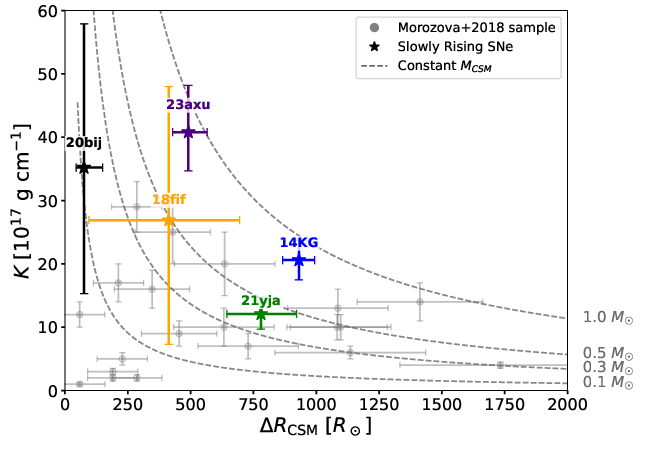
Figure 16: Parameter space of CSM density (∼7) vs. thickness (∼8) for slowly rising SNe, highlighting their tendency toward high-density, confined CSM (small ∼9).
Interpretation and Implications
The central results of this work constitute several assertive claims:
- SN 2020bij and a handful of comparison SNe comprise a distinct subclass of SNe IIP, defined by:
- Slow (≲014 days) photometric rise to plateau;
- High expansion velocities (≲1 above typical SNe IIP) measured in both H≲2 and Fe II;
- Little to no detectable extended CSM affecting the early light curve.
- Analytic and numerical models demonstrate that the plateau-phase light curves and spectra can be explained by canonical RSG progenitors with confined or absent CSM, requiring adjustments only in the radial extent but not the global mass of circumstellar envelopes.
- The link between slow rise and high velocity may reflect a correlation between pre-SN mass loss characteristics and the supernova explosion parameters (explosion energy or ejecta mass), though the precise physical mechanism remains to be elucidated.
Potential explanations for the observed high velocities include decreased deceleration from CSM, lower ejecta mass, or relatively higher explosion energy; however, in this sample, explosion energies are not systematically large and ≲3Ni yields remain typical, favoring the CSM interpretation.
Theoretical and Observational Outlook
This subclass poses non-trivial constraints on late-stage mass loss processes in RSGs. If confined, dense CSM is present but with limited radial extent, this suggests a diversity in pre-SN envelope structure and mass-loss timescales within the progenitor population. The paradigm that most SNe IIP require CSM interaction to explain rapid rise is robust, but this study demonstrates rare but significant exceptions where canonical pure shock cooling is sufficient.
The identification of this subclass has several key implications:
- Progenitor inference: Future samples and individual cases must allow for both CSM-dominated and CSM-free scenarios in early light curve interpretations.
- Explosion modeling: Variations in observed ejecta velocities should be interpreted within the context of CSM properties, not merely explosion energy or progenitor mass.
- Survey strategy: High-cadence, multi-band photometry coupled with spectra taken within days of explosion is necessary to robustly classify the diversity of SNe IIP rise times and to distinguish subclasses.
- Population studies: Statistical samples, free from CSM-selection bias, will be required to quantify the fraction and physical origins of the slow-rise, high-velocity events.
Conclusion
The paper establishes the existence of a slow-rise, high-velocity subclass within SNe IIP, exemplified by SN 2020bij and four well-observed analogues. For these events, early-time emission is fully explained by shock cooling in the absence of—or with very confined—CSM, in contrast to the majority of SNe IIP which demand significant CSM interaction to account for their rapid rise. The subclass is further distinguished by systematically high expansion velocities. This provides strong empirical evidence for diversity in the pre-explosion environments and the final stages of mass loss in RSG progenitors. To further constrain the physics governing massive star death and map the true diversity of core-collapse phenomena, increased early photometric and spectroscopic monitoring is required on new and forthcoming samples.