- The paper demonstrates a scalable protocol for STEM-EELS simulations using torched-TACAW, achieving near ab initio accuracy for supercells up to hundreds of thousands of atoms.
- It employs advanced MLIPs, GPU acceleration, and supercell partitioning to effectively reduce computational bottlenecks and memory constraints.
- The study highlights effective artifact control through optimized windowing and validates minimal spectral distortions, paving the way for future quantum and magnetic simulation extensions.
Efficient Large-Scale STEM-EELS Simulations with torched-TACAW
Introduction and Motivation
The accurate simulation of vibrational and magnonic excitations in scanning transmission electron microscopy electron energy loss spectroscopy (STEM-EELS) remains a critical challenge, particularly for structurally complex systems such as interfaces, grain boundaries, and materials with extended defects. Traditional approaches, including the first-order Born approximation and inelastic multislice or Bloch wave techniques, typically do not scale favorably to the large, non-periodic supercells demanded by these systems. The time auto-correlation of auxiliary wave functions (TACAW) method provides an efficient, physically intuitive alternative that leverages molecular dynamics (MD) and multislice simulations to approximate EELS spectra, inherently accounting for multiple elastic and inelastic scattering events without requiring explicit mode decomposition.
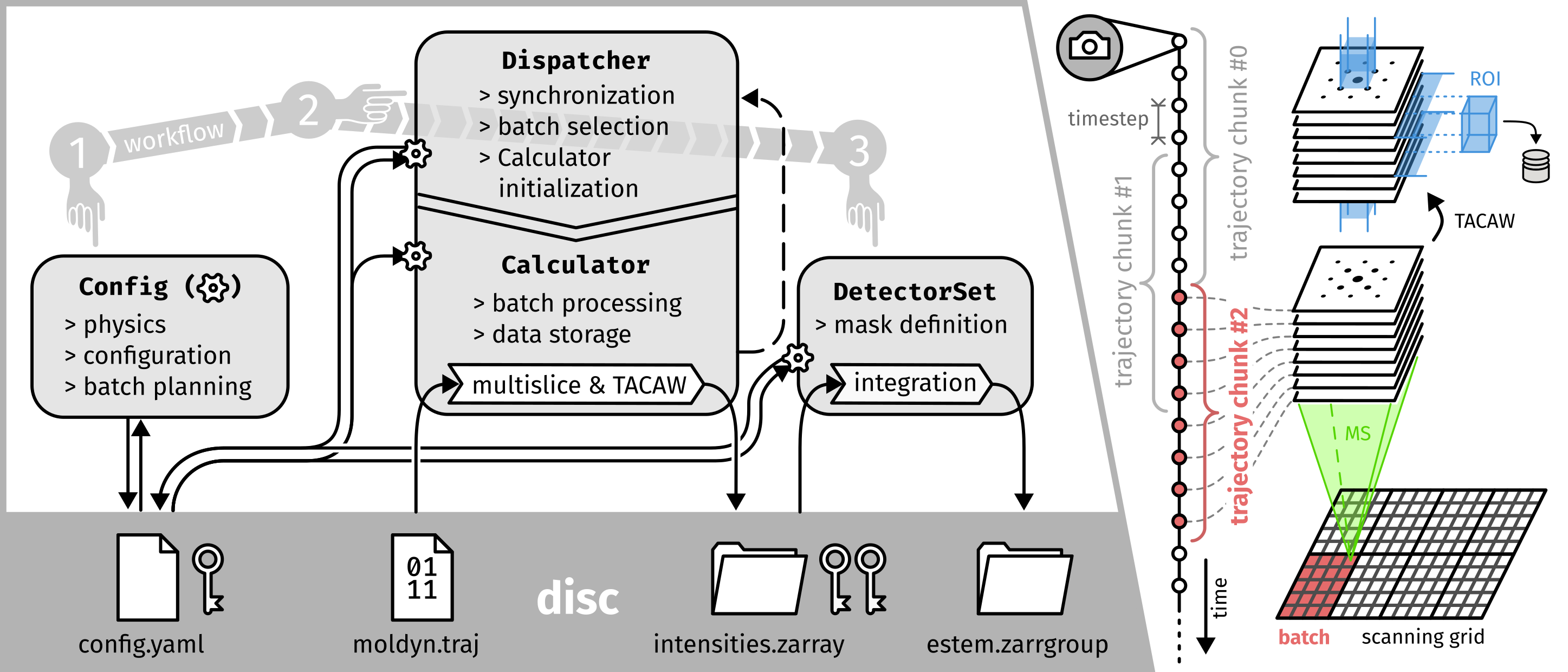
The present work develops a practical framework for scaling TACAW calculations to supercells containing up to hundreds of thousands of atoms while maintaining near ab initio accuracy. The authors introduce torched-TACAW, an open-source Python package delivering a highly parallelized and memory-efficient implementation, explicitly designed for GPU acceleration. The workflow incorporates machine-learned interatomic potentials (MLIPs), supercell partitioning along the beam direction, and on-the-fly reduction of multislice output, thereby addressing both computational and data throughput bottlenecks.
Methodological Framework
Molecular Dynamics and Foundational Potentials
The generation of statistically meaningful MD trajectories is foundational for TACAW. The use of MLIPs trained on extensive ab initio datasets, especially universal (foundational) models such as ORB, MACE, and M3GNET, enables simulations of large supercells with high fidelity to first-principles energetics but at drastically reduced cost compared to direct ab initio MD. However, memory limitations remain a practical constraint even with the most performant MLIPs, as exemplified by the ∼25,000-atom limit for ORB on a 64 GB GPU.
Supercell Partitioning
To circumvent these hardware limitations, the authors implement a strategy of partitioning the supercell along the electron beam (typically the z-axis), simulating each segment independently via MD, and subsequently concatenating these segments for downstream TACAW calculations. This procedure trades off minor loss of qz-correlated vibrational information for a substantial gain in scalability.
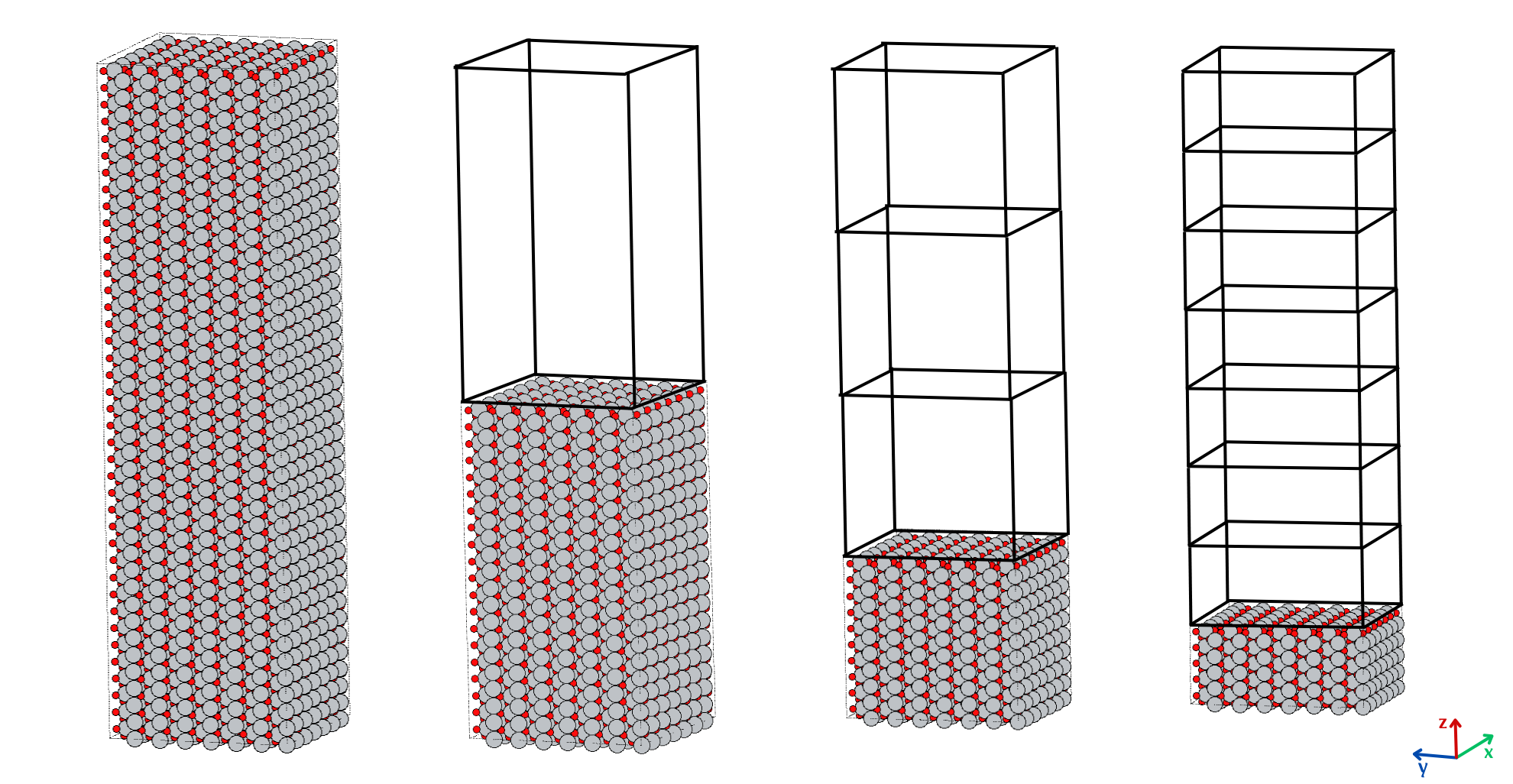
Figure 1: Visualization of a TiO2 supercell (left) and its three different partitionings: in halves, quarters, and eights.
Numerical analysis demonstrates that the resultant errors introduced by interface discontinuities between subcells are largely noise-like and negligible except for low-frequency, long-wavelength acoustic modes at high scattering angles.
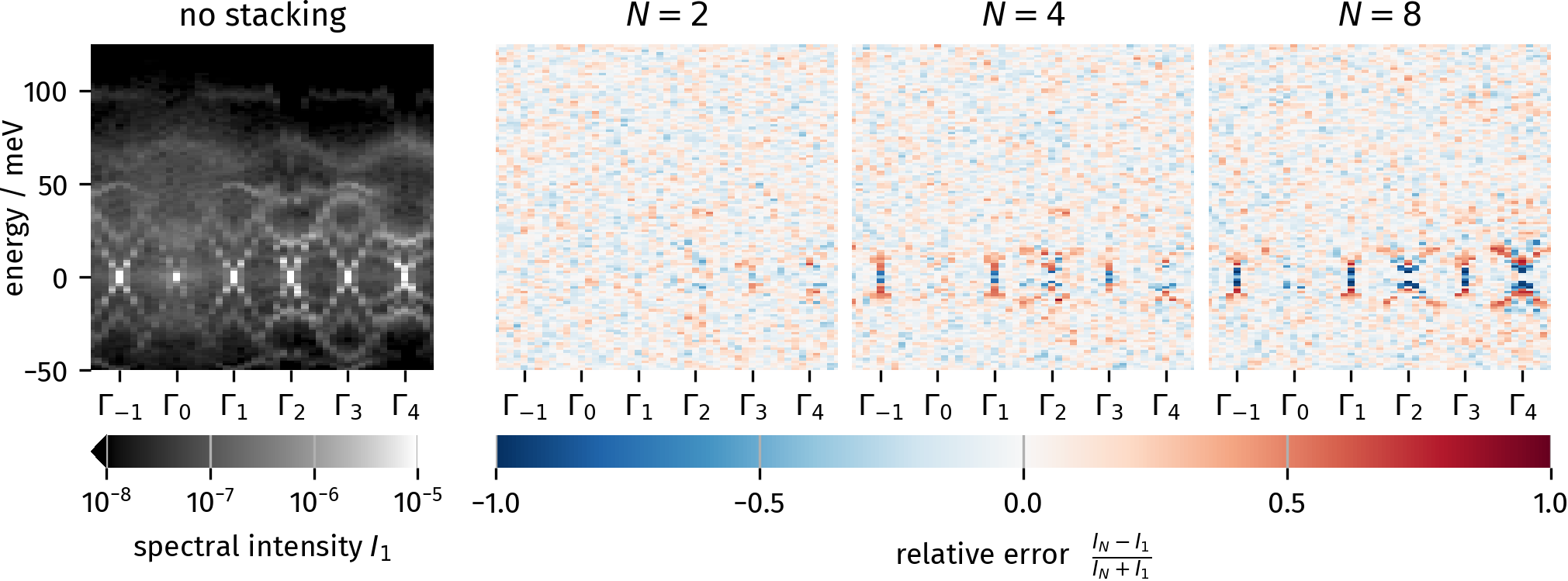
Figure 2: Pixel-wise relative differences in energy-momentum-resolved spectra show that partitioning introduces predominantly noise-like errors, negligible in practice.
TACAW Computational Pipeline
Torched-TACAW is engineered to exploit GPU resources by parallelizing the computational domain across both MD trajectory chunks and probe scan positions. The core computational workflow handles the simulation in distinct, manageable batches, minimizing both memory pressure and disk I/O by performing on-the-fly processing of auxiliary wave functions.
The pipeline includes:
The use of a region-of-interest (ROI) selection in both reciprocal space and energy further constrains memory and storage needs without sacrificing relevant physical information.
Numerical Artifacts and Practical Considerations
Windowing Functions and Spectral Artifacts
Spectral leakage induced by the finite windowing of MD trajectory segments is a crucial concern in obtaining artifact-free EELS spectra. Window functions, especially the Hann window, are shown to effectively eliminate spurious vertical streaks and high-frequency artifacts that otherwise contaminate the retrieved I(q,E) maps. In contrast, the use of Tukey or rectangular windows may result in prominent leakage and overestimation of high-energy intensity, particularly adjacent to Bragg peaks.
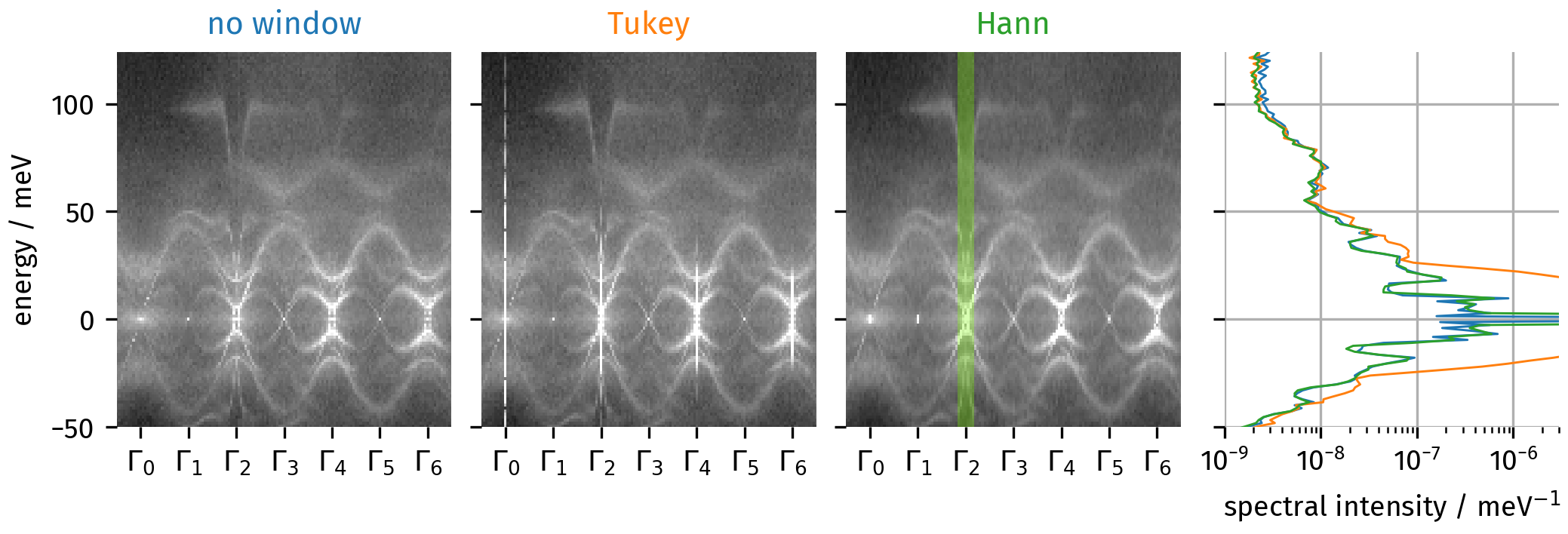
Figure 4: Energy-momentum intensity maps for different windowing choices reveal strong artifact suppression with Hann windowing.
The selection of window function is thus a decisive component of the numerical protocol, balancing between artifact suppression and manageable spectral broadening.
Supercell Partitioning Error Quantification
Through systematic benchmarking against full supercell trajectories, the partitioning procedure is verified to introduce only minor errors, predominantly confined to noise. Spectra extracted from detectors positioned both on-axis and off-axis confirm that the spectral shapes remain robust to partitioning—even when splitting the supercell into as many as eight sub-cells.
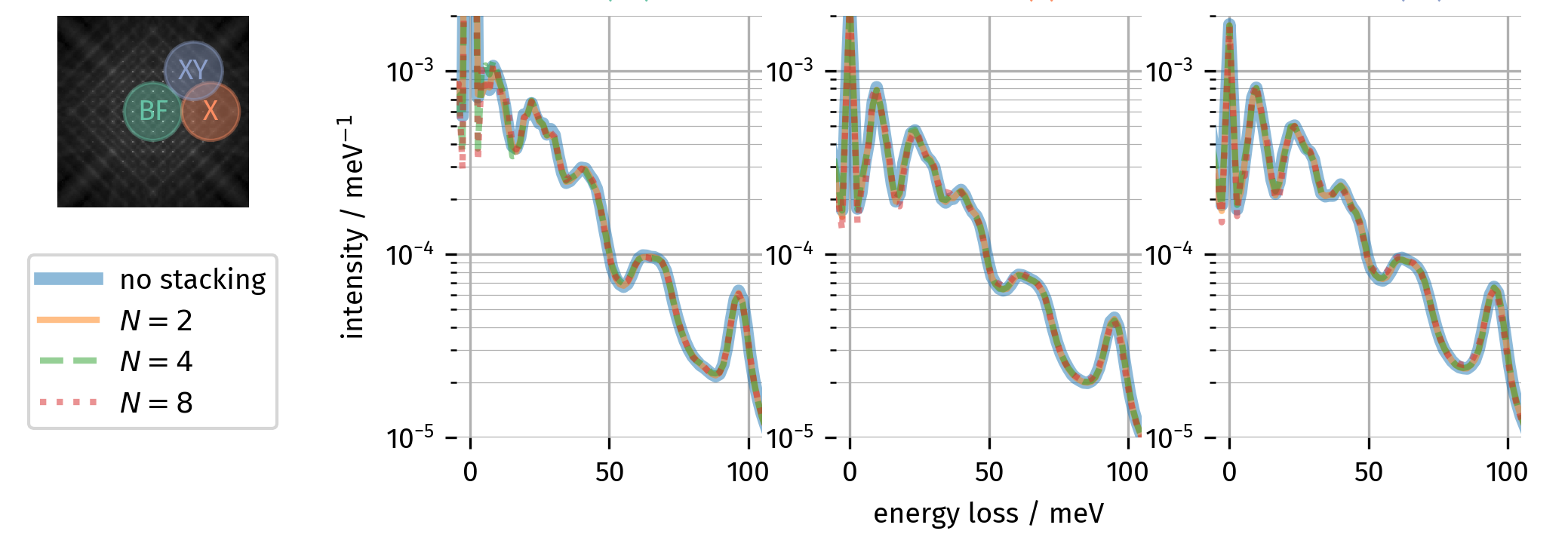
Figure 5: Detector spectra remain virtually unchanged as the number of supercell partitions increases, confirming minimal physical impact of the partitioning approximation.
Best Practices in MD Simulation
Several practical issues that can induce unphysical artifacts in TACAW simulations are addressed:
- Center-of-mass drift in the MD trajectory can induce Doppler-like effects in the energy dimension, leading to non-physical elastic scattering broadening. Fixing the center-of-mass is necessary.
- Atoms near supercell boundaries may "jump" across periodic boundaries during MD, producing artifactual intensity changes. This is mitigated by shifting atomic layers away from boundaries and ensuring a vacuum buffer.
Demonstration: Atomic-Resolution STEM-EELS Simulations
The full capabilities of torched-TACAW are exemplified by simulating atomic-resolution vibrational STEM-EELS for a 24 nm thick rutile TiO2 sample, constructed by stacking eight independently simulated sub-supercells (∼192,000 atoms total). The workflow leverages circular and annular virtual detectors and energy filtering to resolve atomic-column contrast at different energy loss ranges and collection angles.
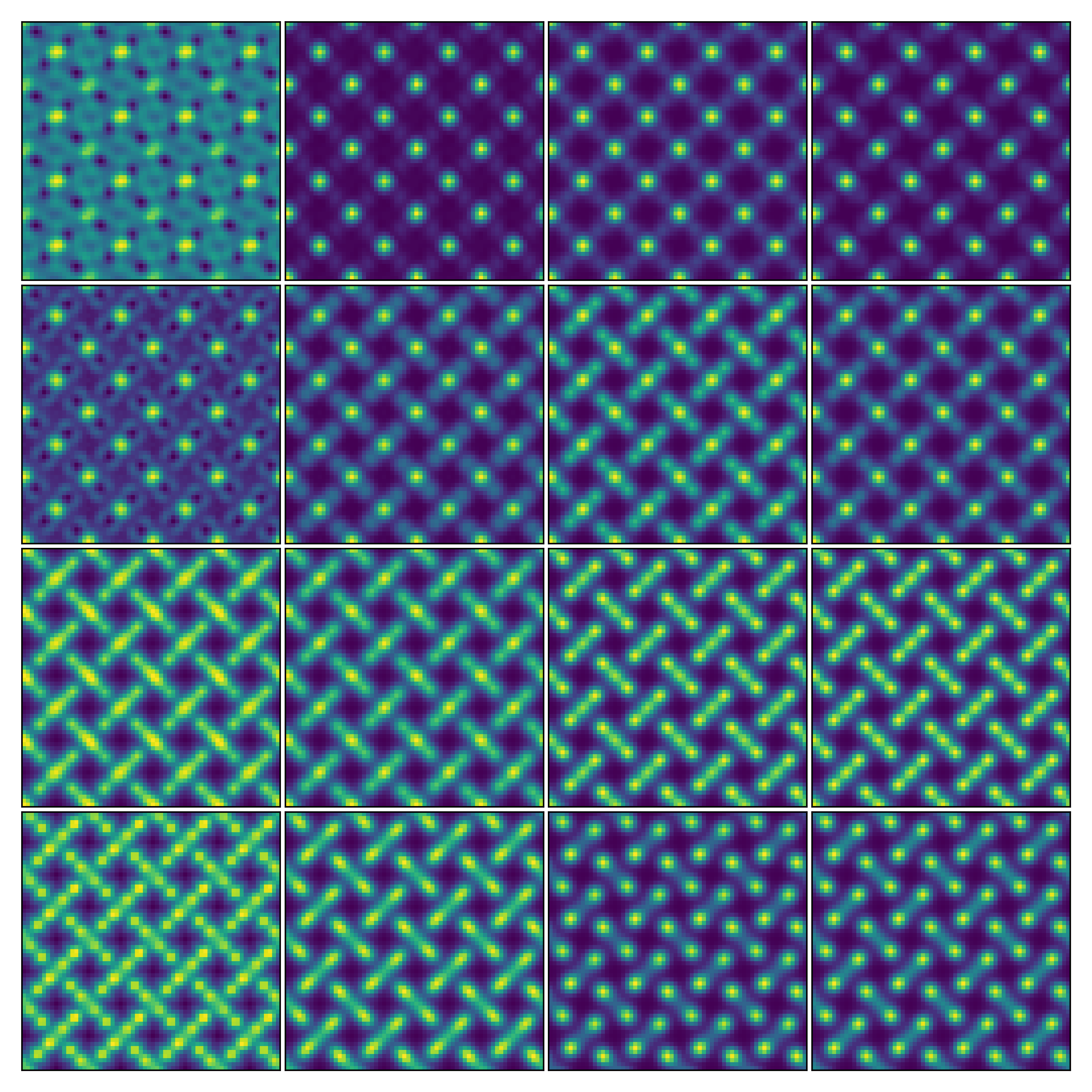
Figure 6: Energy-filtered STEM-EELS images at atomic resolution for bright-field and annular detectors show clear evolution of Ti and O column contrast as a function of energy and scattering angle.
The results reproduce expected physical trends, such as increasing O-column visibility at higher energy losses and larger scattering angles, and demonstrate the practical tractability of large-scale, near ab initio STEM-EELS simulation using TACAW with partitioned supercells and MLIPs.
Implications and Future Directions
This work establishes a scalable, numerically robust protocol for low-loss inelastic STEM-EELS simulation applicable to materials models with realistic system sizes and structural complexity. The GPU-efficient, batch-oriented design of torched-TACAW allows for routine calculations on hundreds of thousands of atoms, democratizing access to near ab initio vibrational spectroscopy modeling for experimental interpretation and design.
Practical implications include:
- Routine simulation of vibrational and magnonic EELS in complex heterostructures, interfaces, and low-dimensional systems.
- Quantitative evaluation of atomic-resolution EELS imaging and detector design.
The ongoing development of torched-TACAW is expected to enable:
- The addition of thermostated ring-polymer molecular dynamics (TRPMD) for quantum nuclear effects at low temperatures, critical for simulating zero-point motion and its signatures in EELS.
- The integration of spin dynamics for efficient simulation of magnon EELS and spin-lattice coupling phenomena using GPU-accelerated multislice propagation.
Conclusion
Torched-TACAW delivers an efficient, physically transparent, and highly scalable solution for large-scale STEM-EELS simulation, overcoming previous bottlenecks in both computational cost and data handling. Its demonstrated reliability in modeling vibrational EELS at atomic resolution for experimentally relevant sample thicknesses marks a significant step towards quantitative, predictive electron spectroscopies in complex materials systems. The methodological innovations—particularly in supercell partitioning and artifact control via optimized windowing—are broadly relevant and lay the groundwork for future extensions into quantum and magnetic inelastic processes.