- The paper establishes a Floquet–Bloch formulation that systematically classifies axion-photon sidebands and their resonant structures.
- It employs a symplectic analysis to differentiate stable avoided crossings from parametric instabilities, with confirmation via numerical transfer matrix integration.
- The study unifies phenomena such as Bragg stop-bands, Rabi oscillations, and MAS resonances, offering insights for both laboratory and astrophysical applications.
Sideband Structure and Mode Classification in Axion Electrodynamics
The paper "Sideband Structure of Axion Electrodynamics" (2607.02232) develops a rigorous Floquet–Bloch formulation for the linearized Maxwell–axion system in coherent, periodic axion backgrounds. It systematically classifies the resonant structures and stability properties of axion–photon systems by exploiting the underlying symplectic structure and conserved signatures, offering a unified perspective on various phenomena—birefringent propagation, axion–photon conversion, parametric instabilities, Bragg/stop-band formation, and beyond.
Floquet–Bloch Ladder and Signature-Based Mode Classification
The authors establish a ladder of axion–photon sidebands induced by a periodic axion background, where the pump (background axion field) supplies discrete spacetime momentum, leading to folded crossings of photon and axion branches.
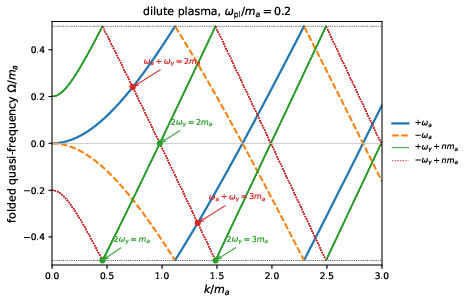
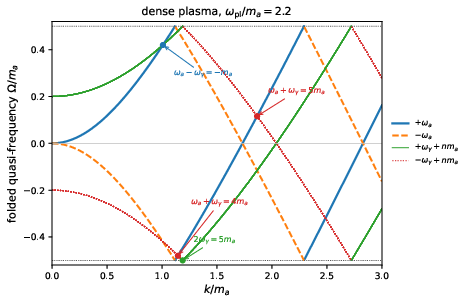
Figure 1: Dilute-plasma hierarchy.
Key to the analysis is the identification of the symplectic Krein signature (in temporal problems) or the spatial flux sign (in transfer problems) that each mode carries. At a folded crossing, if both colliding branches share the same signature, the local algebra is compact, giving rise to stable avoided crossings and bounded amplitude exchange. In contrast, for opposite-sign collisions, non-compact SU(1,1)-type algebra arises, associated with parametric instabilities in temporal problems or spatial stop bands (Bragg reflection) in transfer.
This classification allows unification of diverse resonance phenomena—ordinary axion–photon conversion, parametric photon instability (Mathieu channel), the Masaki–Aoki–Soda (MAS) sum-frequency resonance, driven forward conversion, and Bragg stop-band formation—within a single theoretical structure. The channel identification and physical interpretation depend on the chosen evolution variable (time or space), the conserved dynamical label (momentum or frequency), and boundary or initial conditions.
Temporal Floquet Analysis: Parametric Instabilities and Beating Modes
For homogeneous temporal (fixed-k) backgrounds, the Floquet sideband structure enables diagnosis of instability through the spectrum of temporal monodromy multipliers. When a positive-frequency axion and photon branch approach degeneracy, the result is a bounded avoided crossing, corresponding to stable beating (Rabi oscillation) between axion and photon modes.
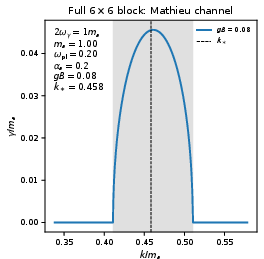
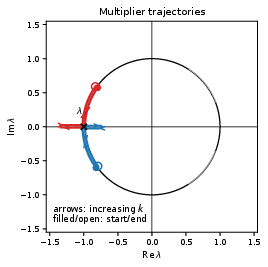
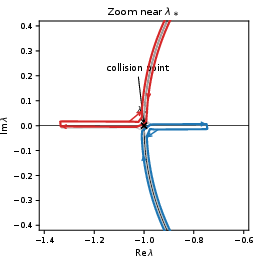
Figure 2: Growth rate versus momentum in the single-species Mathieu instability; the instability tongue is sharply localized near a folded crossing.
Conversely, positive-negative frequency (opposite-Krein-sign) collisions within the same species generate parametric instabilities, as classically described by the Mathieu equation. For cross-species positive-negative collisions, a sum-frequency resonance is realized, corresponding to the MAS channel, characterized by instability tongues in quasi-frequency space.
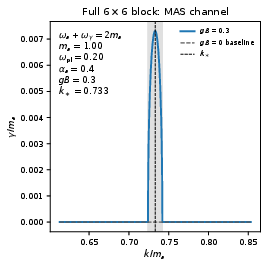
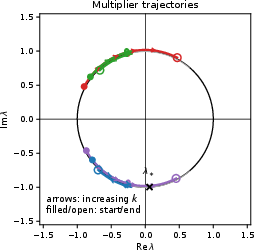
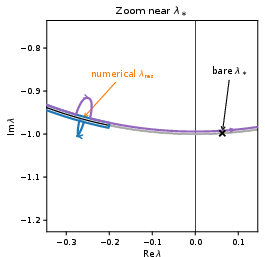
Figure 3: Growth rate versus momentum in the MAS channel; the emergence of an instability tongue and resonance splitting is visible.
These different instability domains are delineated by distinct detuning conditions within the sideband ladder framework: for instance, 2ωγ≈Nma for the Mathieu case, ωa+ωγ≈Nma for the MAS resonance, and ωa−ωγ≈Nma for positive-positive stable beating.
Spatial Transfer Matrix: Bounded Conversion and Bragg Stop-Bands
In the stationary spatial (fixed-ω) case, the periodic axion background is equivalently represented as a static spatial modulation, and the spatial transfer matrix formalism is invoked. Forward–forward (same-sign) crossings yield bounded spatial conversion (analogous to longitudinal oscillations in coupled waveguide systems), while forward–backward (opposite-sign) crossings instantiate Bragg reflection and stop-band formation, characterized by the emergence of real exponents (evanescent Bloch wave solutions) in the transfer spectrum and power reflection.
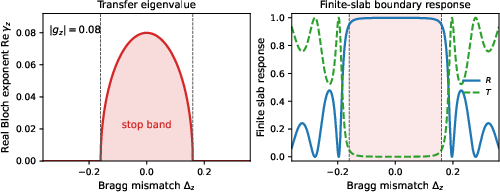
Figure 4: Real part of the Bloch exponent (left: growth rate in the stop-band region, right: reflection and transmission in a finite slab exhibiting distributed reflection in the stop-band interval).
The analytic structure of the two-mode envelope equations at crossings remains identical in both temporal and spatial contexts; the distinction arises from physical boundary data and the interpretation of the growth or attenuation.
Quantitative Scaling and Numerical Confirmation
The analytic construction is complemented by direct numerical integration of the monodromy and transfer matrices, confirming the predicted spectra, resonance locations, and the scaling of instability widths and phase shifts with coupling strength and sideband order. In particular, for the MAS resonance, the resonance-phase shift from the bare marker and the full width at half maximum (FWHM) of the instability tongue are shown to scale strictly as the second and third powers of the coupling, respectively, consistent with analytic expectations from endpoint coupling and self-energy corrections.
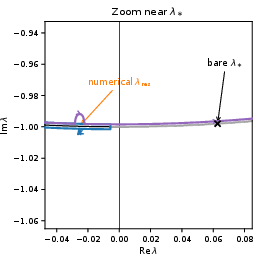
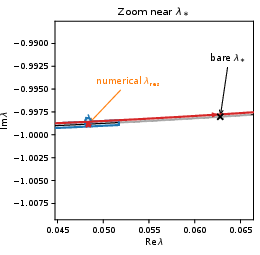
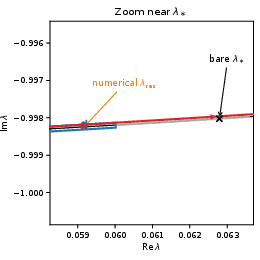
Figure 5: Zoomed numerical multiplier-plane panels as MAS channel coupling is weakly scaled, showing convergence to the bare marker.
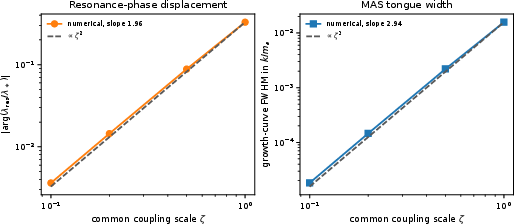
Figure 6: Log-log scaling plots for resonance phase displacement and FWHM of MAS instability—fit slopes confirm predicted scaling with coupling parameter.
Phenomenological and Theoretical Implications
A primary implication is the physically meaningful distinction between the true axion spatial wavenumber, Qreal=mava, and the effective ray-projected pump wavenumber, Qeff=ma/vg. This affects the interpretation and feasibility of resonance criteria—e.g., driven conversion and phase matching in static or ray-projected modulations differ parametrically, and high-order sideband contributions are non-negligible if the velocity spread is small.
The analysis places previously distinct phenomena—level-crossing conversion, driven resonance in inhomogeneous media, engineered Bragg/stop bands for enhanced conversion, parametric photon decay, and MAS instability—within a common sideband-unified framework. The theoretical apparatus is extendable: the symplectic approach, Floquet decomposition, and channel classification offer a template for analyzing periodic coupling structures in other field-theoretical contexts, including axion–fermion coupling, hidden-sector gauge fields, and more general modulated backgrounds.
Conclusion
The paper establishes a systematic, algebraic classification scheme for resonances, mode mixing, and instabilities in axion electrodynamics in periodic backgrounds. This scheme, rigorously grounded in the symplectic structure and sideband (Floquet–Bloch) decomposition, provides both predictive power and analytic clarity in distinguishing stable conversion from instability, both temporally and spatially. The methodology is numerically confirmed and is poised for immediate application to the design and interpretation of laboratory detection schemes, astrophysical conversion processes, and the analysis of dark matter interactions in complex propagation environments.