- The paper introduces a novel use of wavelet transforms and Hilbert-Huang analysis to isolate transient QPOs and quasi-regular modulations in the outburst.
- The paper identifies key spectral differences, noting that QPO-active intervals show up to ~17.5% fractional rms and a 1.1–1.4 factor increase in inner disk temperature.
- The paper links these timing and spectral variations to disk instability mechanisms, providing robust diagnostics for state transitions in black hole X-ray binaries.
NICER Timing and Spectral Analysis of the 2025 Outburst of 4U 1630−47
Observational Overview and Outburst Evolution
The study analyzes NICER observations covering the 2025 outburst of the Galactic black hole X-ray binary 4U~1630−47, a recurrent transient known for diverse spectral-timing phenomena and complex disk-wind behavior. The dataset provides dense temporal coverage from early April to early June 2025, enabling a detailed sampling of state transitions and the evolution of spectral and quasi-periodic variability.
The light curve exhibits a canonical rise to peak count rate, followed by gradual decline, with hardness ratio evolution tracing a standard "q"-like track in the hardness-intensity diagram (HID). Notably, the observations capture both the rising hard-to-intermediate transitions and the later softening phase, together with transient low-frequency QPOs (LFQPOs) and a weak, broad quasi-regular modulation (QRM) near outburst peak—a phenomenology distinct from the stronger 2023 "heartbeat" cycle.
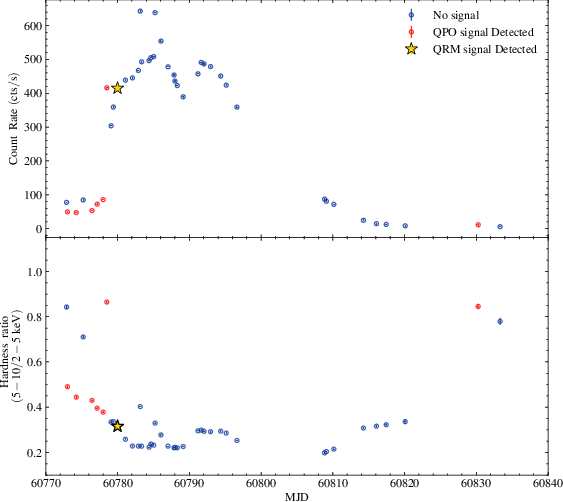
Figure 1: NICER light curve and corresponding hardness ratios for 4U 1630−47 in 2025, highlighting the temporal association of QPOs (red circles) and QRM (yellow stars).
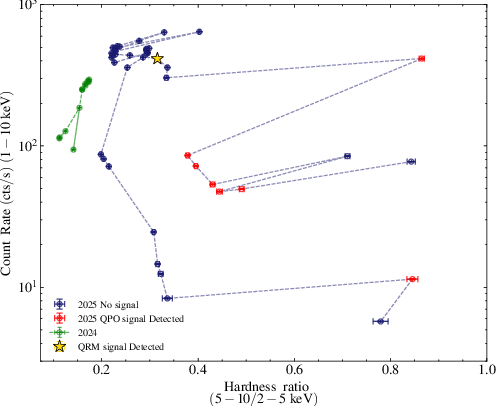
Figure 2: Hardness-intensity diagram of 4U~1630−47 showing 2025 coverage and comparison to 2024 data, contextualizing the full outburst evolution.
Time-Frequency Analysis of QPOs: Wavelet-Based Interval Separation
Beyond traditional Fourier PDS analysis, the work employs wavelet transforms to dissect the non-stationary, intermittent nature of type-C LFQPOs. The continuous wavelet transform, using a Morlet mother wavelet, detects transient power at characteristic QPO frequencies (ν∼0.2–$3.4$ Hz) during the outburst rise, with the centroid increasing monotonically as the source brightens and softens.
Critically, the wavelet approach enables the robust isolation of "with-QPO" versus "without-QPO" intervals within each NICER exposure. This separation hinges on statistically significant excursions of wavelet power above a red-noise background in local time-frequency maps.
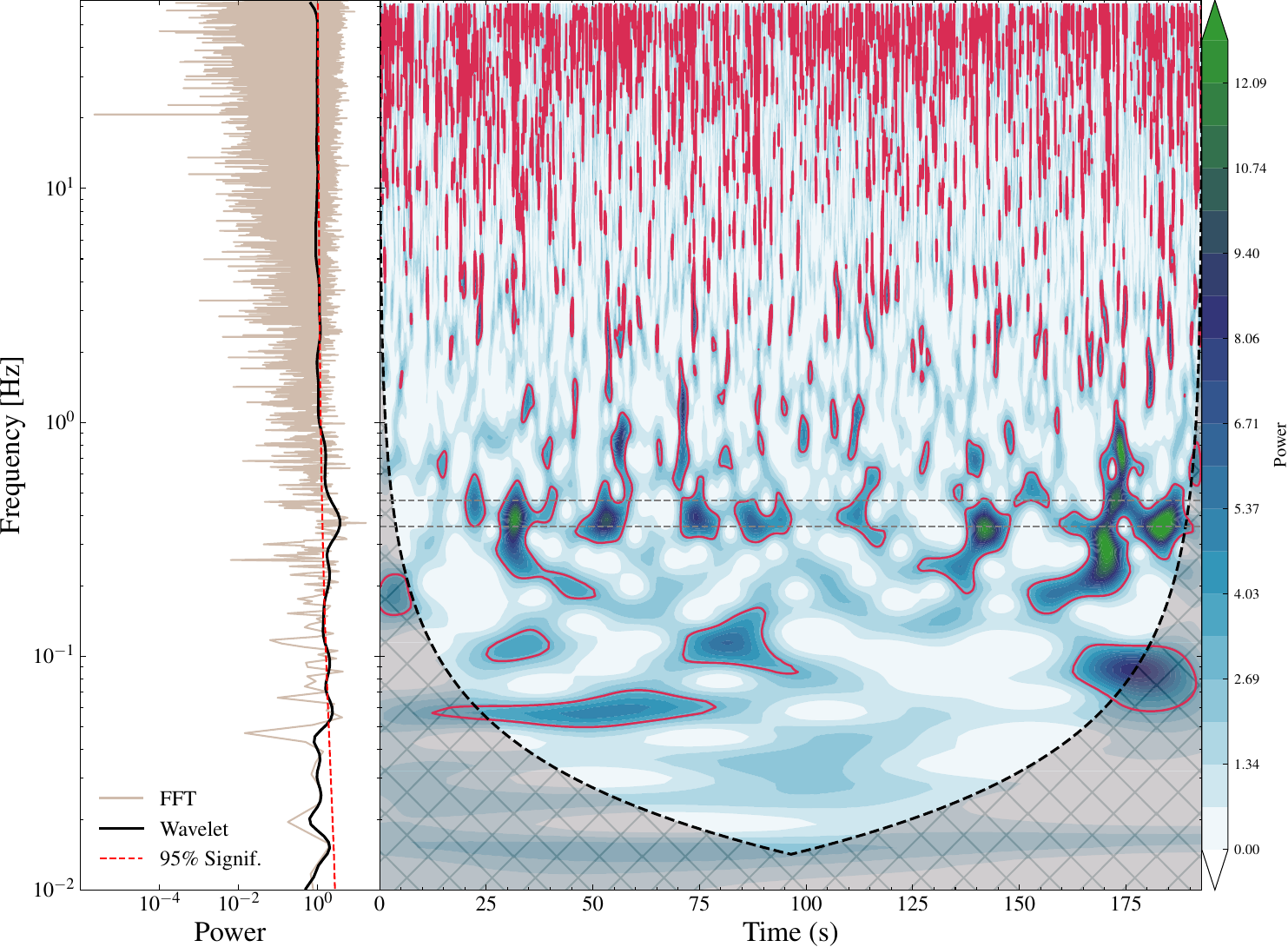
Figure 3: Wavelet power spectrum analysis for a representative QPO segment, highlighting the localization of significant oscillatory power and its alignment with classical PDS features.
Comparative PDS constructed from these intervals demonstrate that QPO features are spatially localized in time, with "with-QPO" intervals exhibiting sharp Lorentzian components at the QPO frequency and an integrated fractional rms amplitude up to ∼17.5%. "Without-QPO" intervals show no significant QPO feature, with the upper limit on rms amplitude well below that of the active segments.
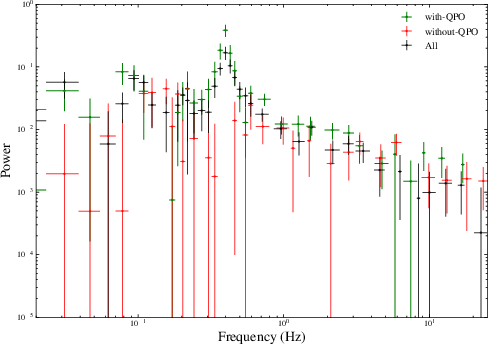
Figure 4: PDS comparison for all data, QPO-active, and QPO-inactive segments, verifying the efficacy of wavelet-based time selection in isolating transient QPO signatures at ∼0.41 Hz.
Spectral-Timing Coupling: State-Resolved Parametric Evolution
By extracting X-ray spectra from the wavelet-resolved QPO versus non-QPO intervals, the analysis probes how spectral parameters differentiate as a function of aperiodic and quasi-periodic timing states. The spectral model adopted, tbfeo × (thcomp ⊗ diskbb), incorporates variable interstellar absorption (with fixed −0, −1, −2), disk blackbody emission, and a thermal Comptonization component parametrized by photon index −3, electron temperature, and covering fraction.
Figure 5 shows the ratio of the best-fit parameters (disk temperature −4, normalization −5, photon index −6, covering fraction) in the QPO-resolved intervals relative to the time-averaged value.
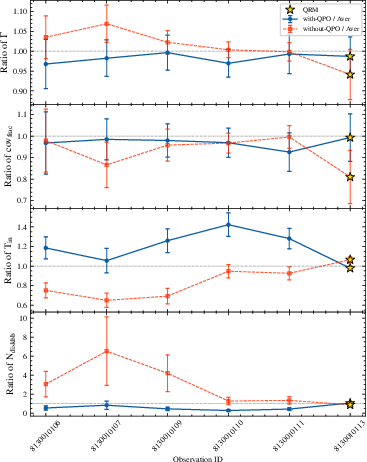
Figure 5: Evolution of wavelet-resolved best-fit parameters across observations, illustrating systematic differences between QPO-active, QPO-inactive, and time-averaged intervals.
Key numerical results:
- −7 is consistently higher (by a factor of −81.1–1.4) during QPO intervals than in non-QPO intervals.
- −9 is anticorrelated with −0, reaching its lowest values during strong QPO segments; the measured ratios deviate substantially from what would be expected purely from color-correction effects, indicating additional changes in apparent disk emission area/coupling.
- −1 and covering fraction are less variable and remain within their respective uncertainties between states.
The inversion of this spectral pattern in the QRM-dominated epoch (drop in −2, enhanced −3 during QRM) signals a clear phenomenological shift in accretion flow properties late in the outburst.
Quasi-Regular Modulation (QRM) and Phase-Resolved Spectral Evolution
At outburst peak, a weak QRM at −4 0.07 Hz appears, with −5 fractional rms. Its light curve remains less regular and of smaller amplitude compared to the pronounced −6-like heartbeat state in 2023 (−7 rms at −80.05 Hz).
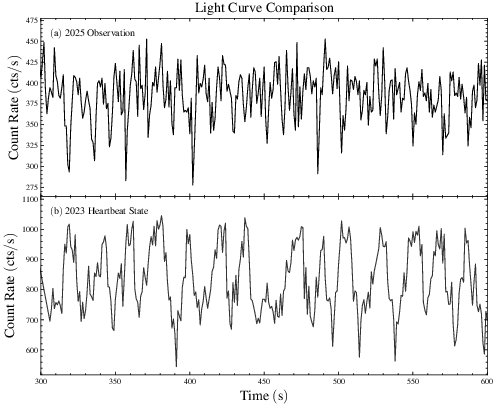
Figure 6: Direct comparison of 300-second light curve segments for QRM in 2025 (top) and the more regular, higher amplitude 2023 heartbeat state (bottom).
Applying the Hilbert-Huang transform (HHT)—specifically, complete ensemble empirical mode decomposition with adaptive noise (CEEMDAN) followed by a Hilbert spectral analysis—enables assignment of an instantaneous phase to each photon arrival and extraction of phase-resolved spectra. This method circumvents requirements for strict periodicity and is robust to amplitude/frequency modulation.
In both the 2023 heartbeat state and the 2025 QRM, phase-binned spectral fits reveal:
- −9 is strongly, positively correlated with count rate and pulse phase peak.
- −0 is systematically anticorrelated, reaching minima at pulse maxima.
- −1 and the Comptonization covering fraction show no statistically significant phase-dependent modulation.
Quantitatively, Pearson correlation coefficients between count rate and −2 are −3 (−4) in 2023 and −5 (−6) in 2025; for −7 vs. count rate, −8 (−9) and ν∼0.20 (ν∼0.21), respectively.
This disk-dominated, oscillatory behavior is consistent with a limit-cycle instability in the radiation-pressure dominated inner disk, confirming that heartbeat-like cycles and mHz QRM share a common physical origin, despite large differences in amplitude and regularity.
Implications and Theoretical Context
The findings strengthen the paradigm in which:
- Intermittent type-C LFQPOs during the outburst rise are associated with transient, hotter, and apparently truncated or partially obscured inner disk emission, with only mild changes in the Comptonizing corona;
- The presence, strength, and timing properties of QRM/heartbeat-like cycles are tightly linked to the degree of disk instability, but their detectability and amplitude can be modulated by the fractional contribution of stable disk/coronal emission. The detection of a weak, irregular QRM mode—not simply a low-frequency extension of type-C QPOs—highlights the diversity of accretion-driven limit cycles in BHXRBs;
- The use of advanced time-frequency and phase-resolving methodologies such as wavelet analysis and the HHT is essential for mapping rapid state changes and spectral evolution on sub-orbit timescales.
The inversion of the ν∼0.22–ν∼0.23 pattern at late times may signal a transition in the physical disk–corona coupling. Future developments may leverage the synergy between broadband X-ray coverage, polarization measurements, and time-resolved spectral decompositions to refine models of disk/corona geometry, test Lense-Thirring and precession origins for QPOs, and further constrain disk-instability cycles in highly variable accreting black holes.
Conclusion
This work demonstrates that coupling high-cadence, high-throughput observations with advanced time-frequency and phase-resolved techniques enables unprecedented dissection of the dynamic accretion environment in 4U 1630ν∼0.2447. The systematic association of QPO and QRM phenomena with disk parameter evolution, clarified by explicit interval selection and phase tagging, advances our empirical and theoretical understanding of non-stationary accretion physics. The methodology and results inform the next generation of spectral-timing diagnostics for black hole X-ray binaries and present a template for future studies of variability-driven spectral transformations in luminous accretors.