- The paper demonstrates that reverse annealing outperforms forward annealing by initiating from a classical candidate to overcome local minima challenges.
- It presents systematic experimental benchmarks across Max-Cut, Number Partitioning, and Sparse Clustering, highlighting the critical role of reverse distance and pause parameters.
- The study shows that hybrid FA–RA protocols substantially reduce time-to-solution and enhance scalability for complex QUBO instances compared to traditional methods.
Extending the Computational Reach of Quantum Annealing Using Reverse Annealing
Introduction
This paper investigates the efficacy of reverse annealing (RA) as a refinement mechanism for quantum annealing (QA)-based combinatorial optimization, providing a systematic experimental benchmark across Max-Cut, Number Partitioning, and sparse clustering problems. While forward annealing (FA) is the established approach in QA, its scalability is fundamentally limited by hardware noise, small spectral gaps, and embedding challenges on current quantum devices. Reverse annealing, which initializes the system from a candidate classical state and reintroduces quantum fluctuations for local refinement, is positioned as a promising strategy to overcome these limitations, particularly as problem complexity and hardware scale increase. The core contributions include a detailed empirical characterization of RA versus FA, a dissection of critical schedule parameters, and an evaluation of RA's performance scaling with problem size and intrinsic hardness.
Quantum Annealing and Reverse Annealing Dynamics
Forward annealing operates by initializing the system in a transverse-field Hamiltonian ground state (maximal quantum mixing) and adiabatically evolving toward the problem Hamiltonian. As the anneal proceeds, the system ideally remains in its instantaneous ground state if the evolution is slow relative to the minimum gap, but this becomes harder to guarantee as problem size and complexity increase. Reverse annealing departs from this protocol by starting from a classical candidate solution, temporarily increasing the transverse field to induce quantum transitions, and then annealing back toward the problem Hamiltonian. The reverse schedule introduces two main hyperparameters: reverse distance (how far the system re-enters the mixing regime) and the annealing pause (the duration spent near maximal mixing), which modulate the degree of exploration and the likelihood of escaping local minima.
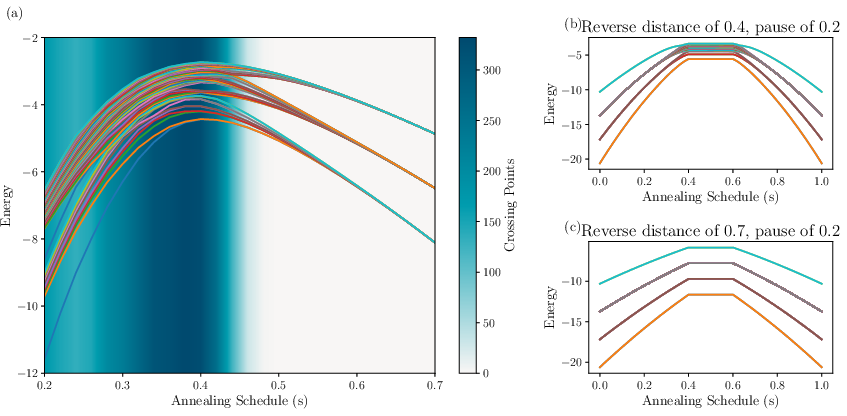
Figure 1: Energy spectra for forward and reverse annealing on a 12-qubit Max-Cut instance highlight the role of level crossings in RA-induced refinement.
The energy landscape, particularly the timing and density of avoided level crossings relative to freeze-out (i.e., when the system becomes effectively classical), determines the potential of reverse annealing to access new minima. As shown in Figure 1, successful refinement by RA requires sufficiently deep traversal into the anneal to reach energy crossings, but not so deep as to erase the memory of the starting configuration.
Benchmark Problem Classes and Complexity Quantification
The study systematically benchmarks QA performance across three QUBO-mapped problem classes:
- Max-Cut: Sparse Erdős–Rényi graphs, no auxiliary constraints, two-fold degenerate ground states, and high hardware compatibility.
- Number Partitioning: Fully connected models with one-hot encoding, strong constraint penalties, high degeneracy, and severe embedding overhead.
- Sparse Clustering: Structured to match hardware topologies with fixed node degrees, leveraging a dual objective (inter/intra-cluster distances) and efficient locality-based pruning.
Problem characteristics are quantified via normalized entropy, connectivity, QUBO density, and the random state energy gap (RSEG), which serves as an empirical proxy for problem "hardness." The analysis reveals a strong correlation of performance degradation (for both FA and RA) with increasing entropy and RSEG, regardless of problem size.
Experimental Methodology
Experiments are conducted on D-Wave Advantage hardware, with systematic variation of chain strengths, forward/reverse annealing times, reverse distances, and pause durations. Each configuration is extensively sampled (1000 runs), and results are aggregated over ensembles of randomly generated instances across a broad size regime.
Performance is quantified by normalized quality metrics specific to each problem class and time-to-epsilon (TTE): the expected time required to sample a solution reaching a pre-defined quality barrier with statistical confidence. An additional time-to-improvement (TTI) metric is used to directly compare improvements via RA versus prolonged FA runs.
Baseline results for FA reinforce the expected trends: higher problem size and complexity drive quality degradation, mitigated to a limited extent by longer annealing times. Optimal chain strengths decrease with Max-Cut sparsity but must be tuned higher for dense or heavily constrained problems (Number Partitioning, Clustering) to ensure coherent logical qubits. However, FA generally exhibits diminishing returns with increasing annealing times due to environmental decoherence and control errors.
Systematic parameter sweeps reveal the critical dependence of RA success on reverse distance. Maximal improvements are concentrated at intermediate reverse distances (typically 0.3–0.4), with long pauses or excessive reverse depth degrading performance by over-randomizing the state.
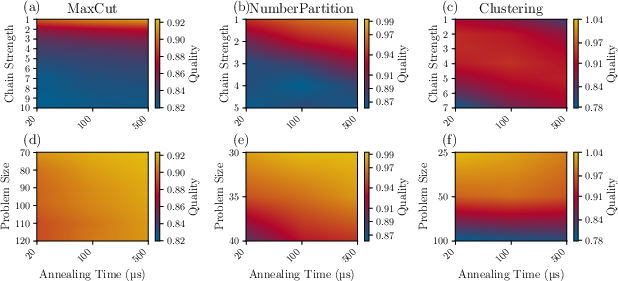
Figure 2: Average quality metrics across problem size, chain strength, and annealing time for all three benchmarks demonstrate FA baseline behavior.
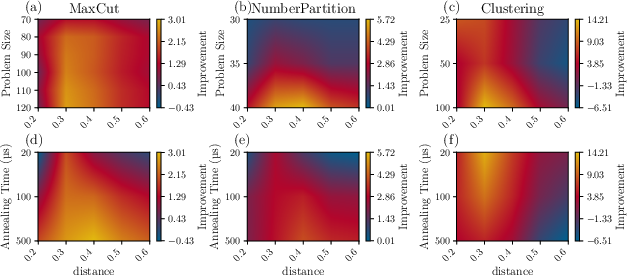
Figure 3: Percentage improvement over FA baseline as a function of reverse distance, annealing time, and problem size; negative values highlight the risk of excessive exploration in RA.
Notably, RA provides superior scaling of solution quality and efficiency compared to simple extension of FA durations. TTE and TTI analyses show that RA consistently reduces the time to high-quality solutions, especially for larger and more complex problems. This benefit is more pronounced in Number Partitioning and Clustering, where FA is systematically limited by embedding-induced errors and poor spectral gaps.
Exploration–Exploitation Trade-offs and Mechanistic Insights
A clear empirical trade-off emerges: as the degree of "exploration" (reverse distance plus appropriately weighted pause) increases, so does the Hamming distance between input and output states, until improvement collapses for excessive exploration. Effective RA occupies a regime of local refinement—small to moderate Hamming distances correlate with maximal gains, confirming RA's interpretation as a mechanism for escaping shallow local minima without wide randomization.
Regression analysis demonstrates that RSEG and mean chain length most strongly predict RA effectiveness, implicating both intrinsic problem structure and hardware constraints in setting practical limits.
Practical and Theoretical Implications
RA is most beneficial for large and intrinsically complex QUBO instances where FA underperforms, particularly due to narrow spectral gaps and error-prone embeddings. For small or structurally simple problems, FA already saturates hardware performance, leaving little room for RA to improve.
Key implications:
- Workflow Design: Hybrid FA–RA strategies should be the default for large-scale QA deployments, with parameters (especially reverse distance) tuned to target pre-freeze-out spectral crossings.
- Hardware Development: Improved qubit connectivity and reduced noise directly enhance RA's efficacy by stabilizing logical chain embeddings and reducing error rates.
- Algorithmic Advances: Machine-learned strategies for parameter selection and embedding optimization are likely to yield significant synergies with RA-based refinement.
- Limitations and Future Work: Embedding runtime, lack of head-to-head classical solver comparisons, and exclusive focus on synthetic instances delimit the present scope. Embedding and error-mitigation pipelines, as well as application-specific tuning of RA strategies, remain research priorities.
Conclusion
This study demonstrates that reverse annealing, when optimized for reverse distance and schedule parameters, systematically extends the computational reach of quantum annealing across multiple combinatorial problem domains. Maximal benefits arise in regimes dominated by high problem entropy, large RSEG, and embedding overhead—precisely where FA baselines deteriorate. RA provides both a qualitative leap in solution quality and a quantitative reduction in time-to-solution relative to naive extension of FA runs. As quantum annealing hardware matures, hybrid FA–RA protocols are likely to represent the standard paradigm for scalable quantum optimization, with their performance intimately linked to problem structure, embedding quality, and spectral properties of the annealing landscape.
This analysis addresses the central claims, highlights strong numerical improvements achieved by RA, and situates reverse annealing as a critical advancement for future quantum optimization workflows (2607.02146).