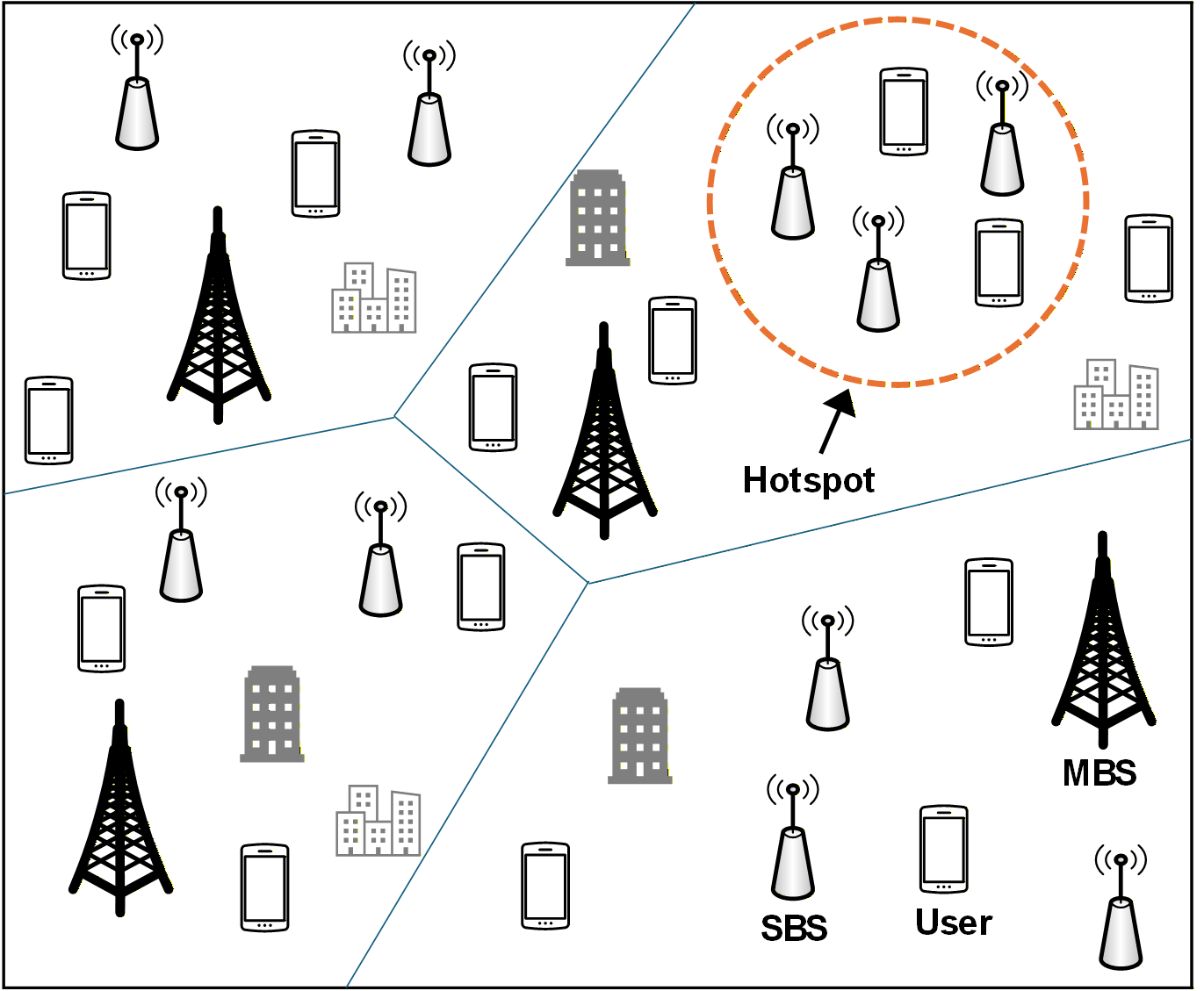
- The paper proposes a novel stochastic geometry framework that captures spatially clustered deployments in THz HetNets with tractable coverage probability expressions.
- Methodologically, it integrates LoS-based propagation, blockage modeling, and Thomas cluster processes to analyze user association and interference patterns.
- Validated by Monte Carlo simulations, the study offers actionable insights for optimizing small cell spread and mitigating intra-cluster interference in 6G networks.
Coverage Analysis in Terahertz Clustered HetNets: An Expert Perspective
Introduction and Motivation
Terahertz (THz) band communications, owing to their substantial spectral resources within the 0.1–10 THz region, are pivotal candidates for ultra-high data rate transmissions in 6G mobile systems. However, severe propagation limitations—including strong molecular absorption, high free-space attenuation, and restricted transmission power—render THz signals inherently suitable for short-range links. As a result, practical network architectures must tightly couple THz base stations (BSs) and users in physical proximity, generally around traffic hotspots, to harness THz's strengths and counter its inherent vulnerabilities.
This paper addresses this challenge by developing a comprehensive, tractable stochastic geometry framework for THz-based heterogeneous networks (HetNets), placing particular emphasis on spatially clustered deployments that reflect real-world user and SBS distributions.
System Model and Stochastic Geometry Framework
The considered HetNet consists of two tiers:
- Macro Base Stations (MBSs): Modeled as a homogeneous Poisson Point Process (PPP).
- Small Base Stations (SBSs): Modeled as a Poisson Cluster Process (PCP), specifically as a Thomas Cluster Process (TCP) to reflect spatial clustering around traffic hotspots.
- Users: Also modeled via a PCP, sharing cluster centers with SBSs.
Association policy is maximum received power, constrained to line-of-sight (LoS) links, as THz propagation is strongly LoS-dominated due to NLoS links incurring prohibitive attenuation.
Propagation conditions incorporate:
Distance and Association Statistics
The analytical tractability of the proposed model pivots on closed-form or semi-closed-form expressions for several spatial statistics:
- Distance Distributions: Derivations are presented for both the minimum distance to the nearest serving MBS (PPP) and the nearest serving SBS within a cluster (TCP), under LoS constraints.
- Association Probabilities: Precise probabilities for user association to either tier, parameterized by the serving distance thresholds from the maximum received power criterion.
SINR and Interference Modeling
The SINR for the reference user incorporates three fundamental aggregation processes, varying by association:
- If Served by MBS: Aggregate interference stems from other MBSs (excluding the serving MBS), intra-cluster SBSs, and inter-cluster SBSs.
- If Served by SBS: Interference arises from all MBSs, other intra-cluster SBSs, and inter-cluster SBSs.
The Laplace transform of the interference, crucial for SINR and coverage probability analyses, is developed for all cases, capturing the effect of directional antennas, random geometries, and varying LoS/NLoS conditions.
Coverage Probability
A general integral expression for downlink coverage probability is derived, integrating over the distribution of user-cluster locations and conditioning on network geometry, channel, and association policies. The final coverage probability necessarily marginalizes over serving distances, LoS probabilities, multi-path fading, and the stochastic spatial configuration of interferers.
Strong empirical claim: The derived coverage probability is validated by extensive Monte Carlo simulations, demonstrating close numerical agreement across relevant parameter ranges.
Numerical Insights and System Design Implications
The simulation section systematically evaluates the impact of model parameters on network coverage:
- THz PCP-HetNets vs. THz PPP-HetNets: Coverage is consistently superior in the PCP-based deployment. Clustered SBSs and users reduce average link distances, increasing the LoS fraction and thus dramatically improving achievable SINR, compared to uniformly distributed nodes.
- SBS Spatial Spread (σs): There exists an optimal spread whereby coverage is maximized; excessive clustering increases interference while excessive dispersion degrades access probability via long distances.
- User Spread (σu): Moderately dispersed user clusters balance minimal interference and reasonable access distances; too much dispersal reduces coverage.
- Cluster Size (Number of SBSs per Cluster, ns): Larger clusters initially boost coverage through densification, but returns saturate or even degrade as intra-cluster interference escalates.
- Blockage Density (λB): Dense building environments significantly erode coverage, verifying the critical role of environment-aware network planning in THz-band systems.
Implications and Future Directions
The findings highlight several pivotal practical and theoretical takeaways:
- Deployment Guidelines: For THz HetNets, spatial coupling of users and SBSs should be tailored to hotspot geometries, with moderate SBS spread optimally balancing interference and coverage.
- Stochastic Geometry Utility: PCP-based spatial models, rather than conventional PPP, are essential for accurate analysis of THz systems designed for hotspot coverage.
- Blockage-Aware Optimization: Future networks must integrate spatial environmental statistics—blockage maps, dynamic clustering, and user mobility—to dynamically adapt the deployment and operation of SBSs.
Potential extensions include incorporating user mobility, adaptive beamforming under real-time blockage information, and optimizing joint caching and load balancing in clustered environments.
Conclusion
This study advances the stochastic geometric analysis of THz HetNets by leveraging cluster processes to realistically capture hotspot-centric deployments. It provides closed-form expressions and validated frameworks for coverage prediction, yielding actionable deployment insights and underscoring the necessity of spatial clustering for optimal THz network operation. The rigorous quantitative analysis establishes a reference methodology for research in ultra-dense, high-frequency, and heterogeneously deployed 6G networks.
Reference: "Coverage Analysis in Terahertz Clustered HetNets" (2607.02125)