- The paper demonstrates that TbB4 exhibits mixed-parity spin splitting by resolving in-plane odd-parity and out-of-plane even-parity components through first-principles calculations and symmetry analysis.
- It employs tight-binding and k·p modeling to uncover symmetry-enforced constraints that yield distinct non-relativistic Edelstein and spin Hall responses.
- The study further shows that including spin-orbit coupling enables a Berry curvature dipole, indicating promising avenues for symmetry-driven spintronic applications.
Unconventional Mixed-Parity Magnetism in Rare-Earth Tetraborides
Introduction
This work establishes the rare-earth tetraboride family (RB4) as a model system for realizing and probing mixed-parity spin textures in compensated magnetic materials. Unlike conventional even- or odd-parity spin textures observed in altermagnets and odd-parity magnets, the study demonstrates that TbB4 exhibits a unique coexistence of even-parity and odd-parity spin splitting resolved in separate spin components. The analysis employs first-principles calculations, tight-binding and k⋅p modeling, and symmetry analysis, highlighting the symmetry-enforced constraints that produce this qualitatively new regime of magnetism. The paper further details the implications for non-relativistic spin-charge conversion phenomena, including the non-relativistic Edelstein effect, spin Hall response, and the emergence of a symmetry-allowed Berry curvature dipole under spin-orbit coupling (SOC).
Symmetry-Driven Magnetic Phenomena in RB4 Compounds
The investigation systematically contrasts the electronic and spin structures of GdB4, TmB4, and TbB4. GdB4, with a coplanar non-collinear AFM order, preserves 40 symmetry and exhibits no spin splitting or non-trivial spin-charge conversion, retaining only a nonzero non-relativistic spin Hall conductivity for the 41 channel due to symmetry constraints. 42, a collinear AFM along 43, realizes a 44-wave altermagnetic spin texture but, due to additional space group symmetries, all net spin-charge responses vanish.
By contrast, 45 hosts a non-coplanar ground state that is a direct superposition of the irreducible representations relevant to both 46 and 47, but the resulting spin texture exhibits component-resolved mixed-parity: in-plane components (48, 49) are odd-parity (TbB40- and TbB41-wave-like), while the out-of-plane component (TbB42) preserves even-parity (TbB43-wave) altermagnetic character.
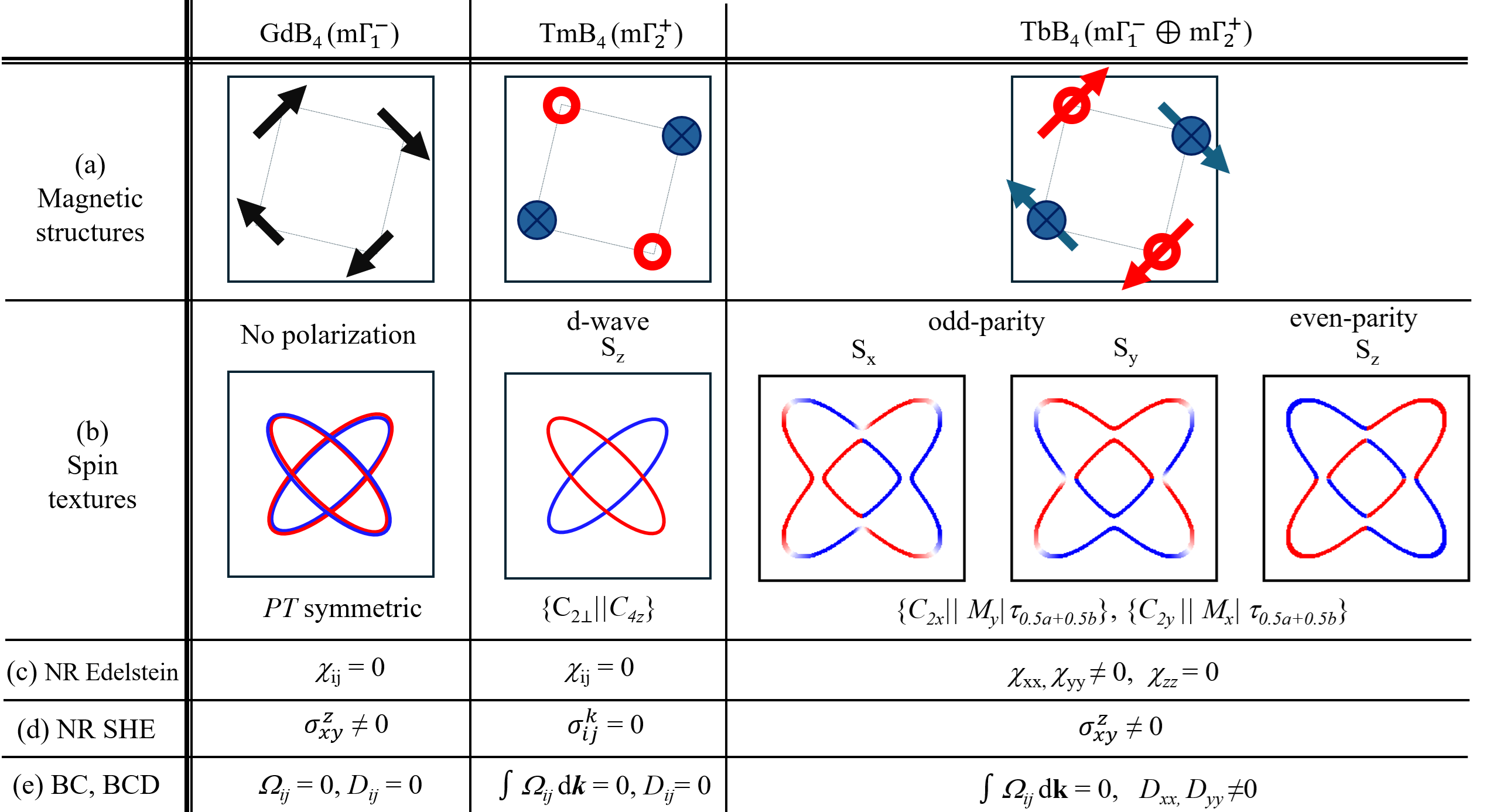
Figure 1: Comparative summary illustrating symmetry-enforced phenomena in TbB44, TbB45, and TbB46, including their magnetic structures and resulting transport properties.
Momentum-Space Spin Texture and Symmetry Constraints
First-principles calculations reveal that TbB47's band structure supports pronounced spin splitting with mixed-parity textures strictly dictated by its non-symmorphic spin-group symmetries. The spin-projected band analysis demonstrates that the TbB48 and TbB49 components satisfy odd-parity relations, whereas k⋅p0 remains even-parity. Effective k⋅p1 modeling, further supported by tight-binding calculations, elucidates the coexistence of k⋅p2-wave (linear-in-momentum) and k⋅p3-wave (cubic-in-momentum) features in the in-plane channels, directly arising from a staggered Berry phase generated by the ground state's scalar spin chirality rather than SOC. The k⋅p4 channel remains k⋅p5-wave dominated and even-parity.
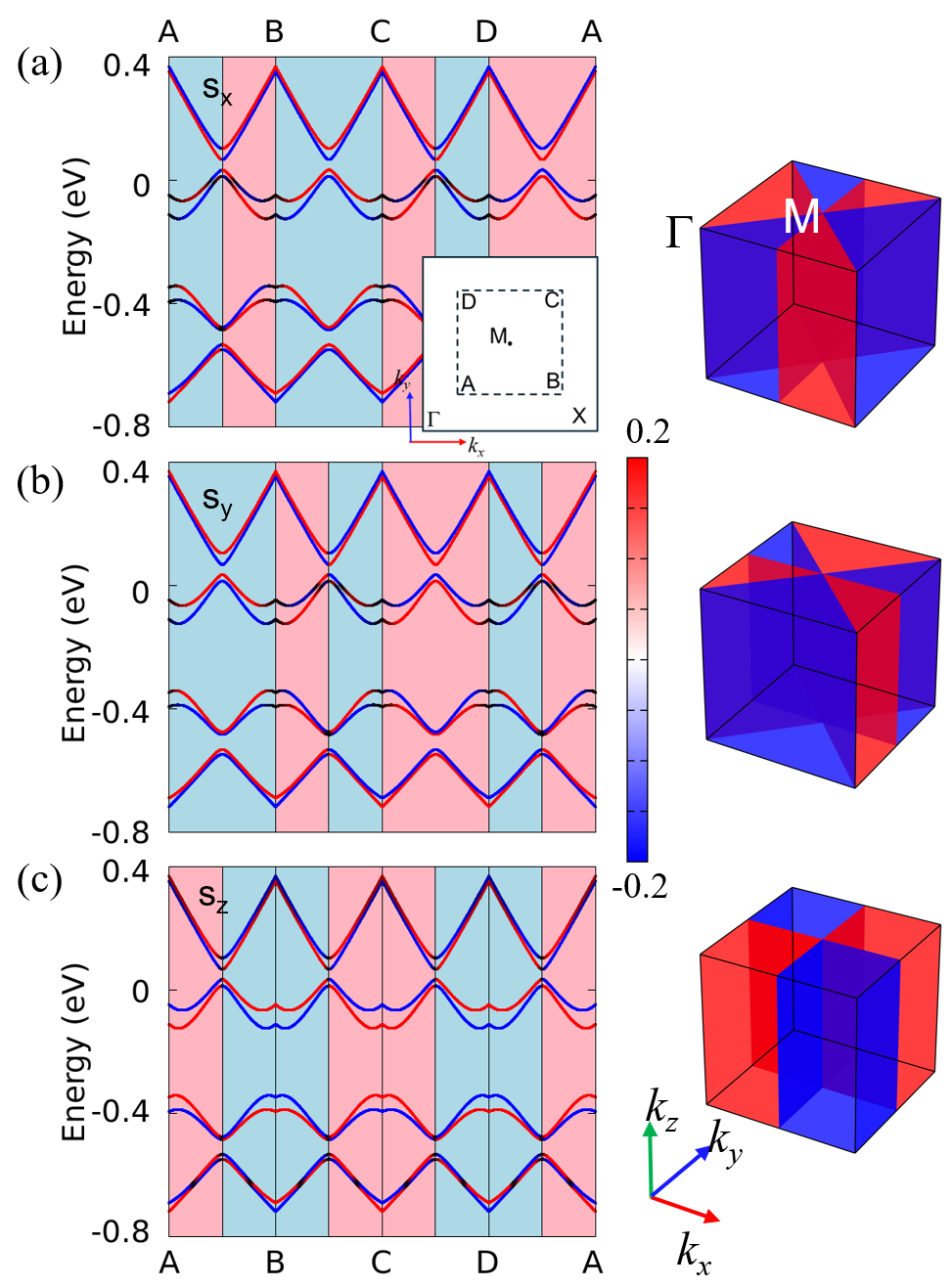
Figure 2: Component-wise spin splitting for k⋅p6 across the Brillouin zone, highlighting the coexistence of odd-parity (k⋅p7- and k⋅p8-wave-like) in-plane spin components and even-parity (k⋅p9-wave) out-of-plane component.
Symmetry analysis, incorporating generalized Seitz notation, demonstrates that the mixed-parity relations are rigorously enforced by operations such as R0 and R1. These yield, in band energies:
R2
where R3, explaining the component-resolved parity.
Transport Signatures: Edelstein and Spin Hall Effects
The odd-parity in-plane spin components in R4 generate a bulk non-relativistic Edelstein effect (NREE), characterized by tensor elements R5, which remain finite under all examined conditions, while all off-diagonal and R6 components are symmetry forbidden. Calculations decompose the Edelstein tensor into intra- and interband contributions, confirming the dictated symmetry relations.
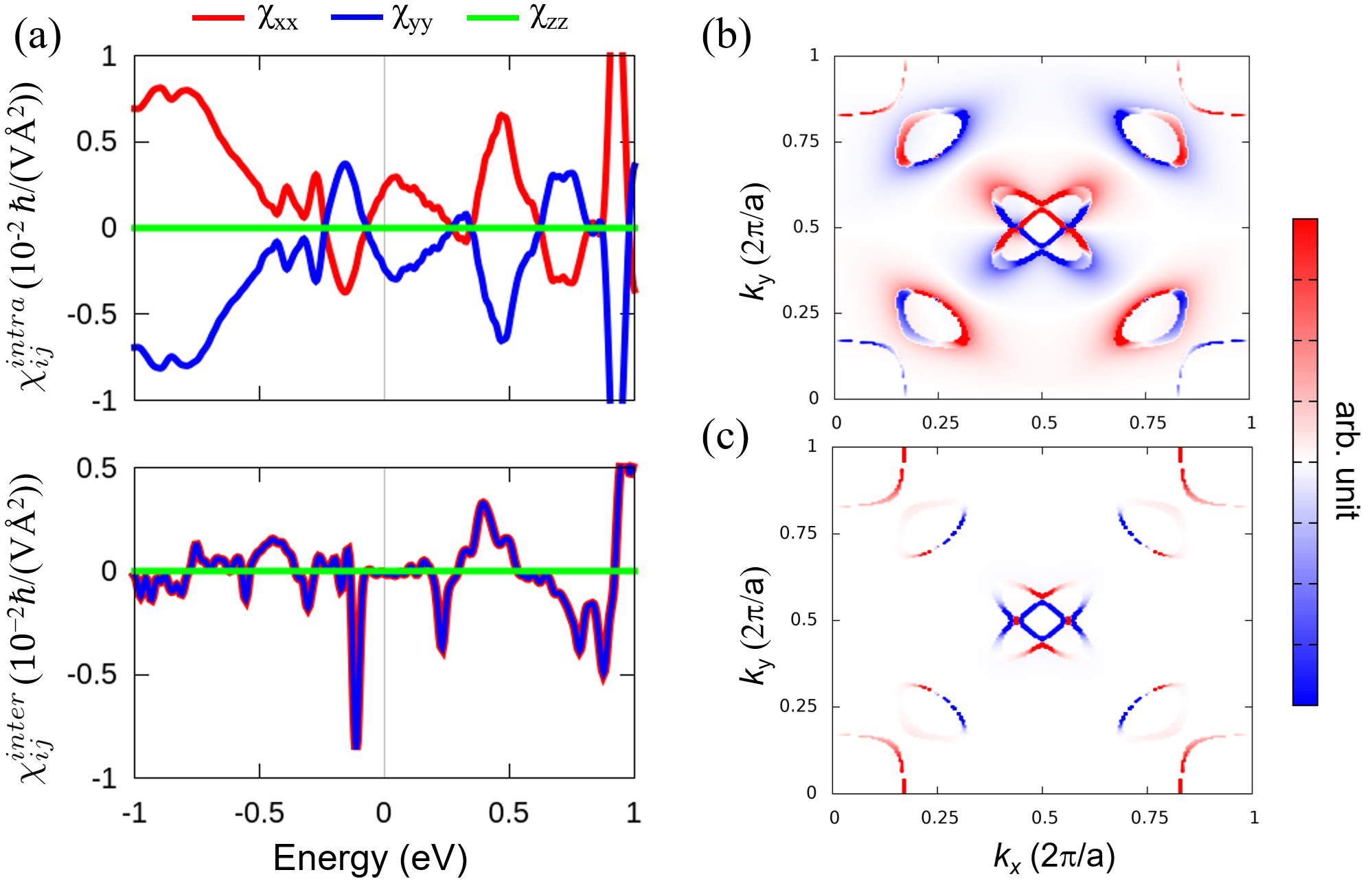
Figure 3: Calculated non-relativistic Edelstein response tensors and spin Berry curvature in R7, confirming symmetry-allowed diagonal elements and zero out-of-plane response.
The even-parity R8 channel yields a non-relativistic spin Hall conductivity, with only R9 symmetry-allowed. Although local spin Berry curvature exists for in-plane spin components, the Brillouin zone integration enforces cancellation, yielding a net macroscopic spin Hall effect solely for the 40 channel, consistent with symmetry predictions.
Spin-Orbit Coupling and Berry Curvature Dipole
Upon inclusion of SOC, which breaks certain spin-group symmetries, further exotic transport phenomena become symmetry-allowed. Notably, 41 realizes a bulk Berry curvature dipole (BCD), 42, while 43. This effect is entirely absent in 44 and 45, where symmetry (either 46 or 47) forbids macroscopic Berry curvature. The remaining magnetic rotations and 48 symmetry strictly dictate the allowed BCD components. The presence of a finite BCD in 49 demonstrates the system's capacity for nonlinear Hall-like responses, representing a further symmetry-engineered transport channel.
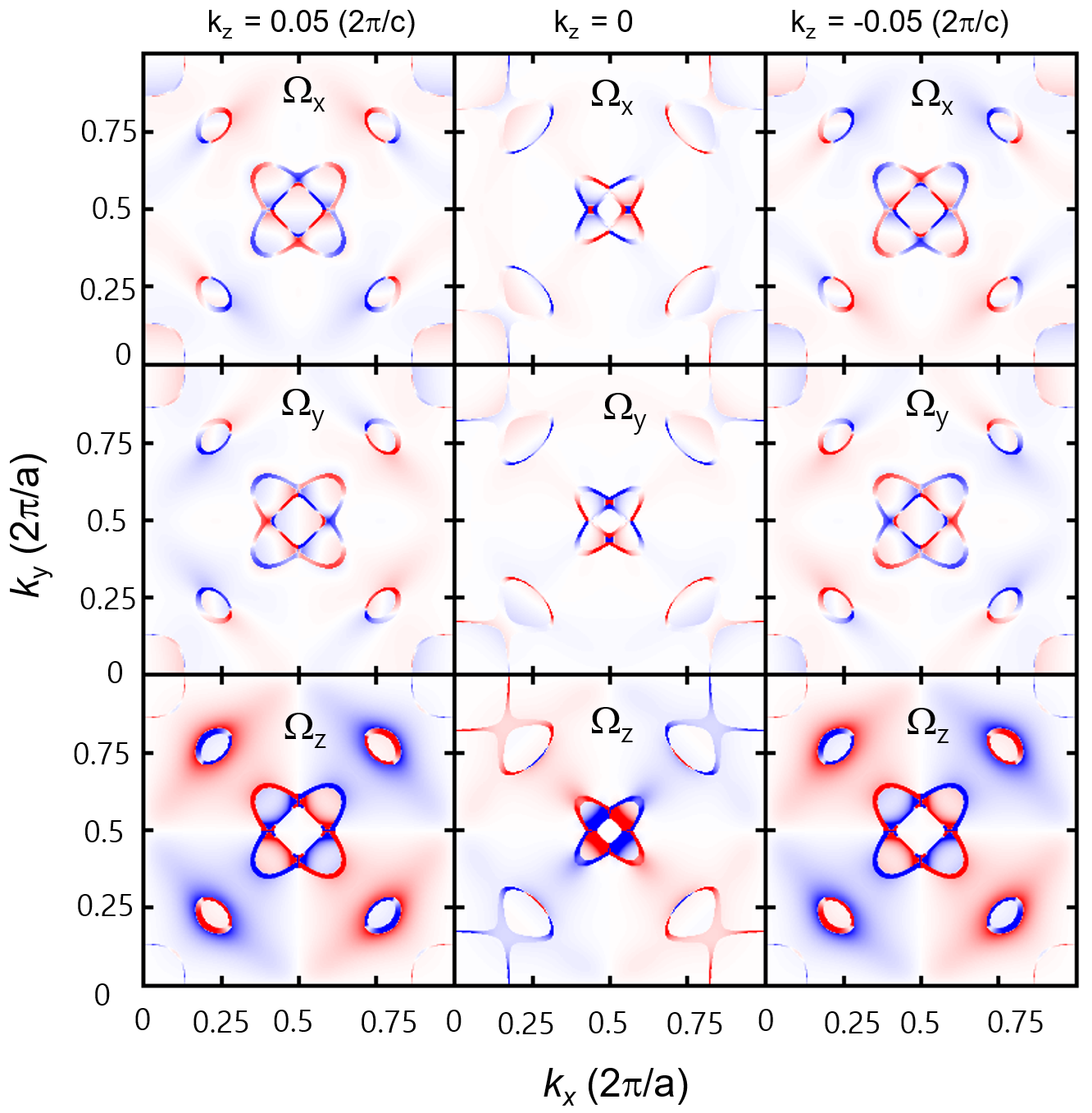
Figure 4: Calculated momentum-space Berry curvature distribution in GdB40 with SOC, demonstrating the non-cancelling behavior responsible for the symmetry-allowed Berry curvature dipole.
Implications and Prospects
These findings position GdB41 and, by extension, rare-earth tetraborides as key platforms for engineering spin textures and responses via symmetry manipulation. The demonstration that non-coplanar compensated magnetic structures can stabilize mixed-parity spin textures opens paths for designing materials with tunable spin-charge interconversion characteristics without reliance on SOC. Practically, GdB42BGdB43 families provide candidate materials for non-relativistic, symmetry-driven spintronics, including Edelstein and spin Hall devices, and nonlinear Hall effect-based architectures.
Theoretically, the symmetry-enforced separation of parity channels in different spin components, with underlying origins in scalar spin chirality and Berry-phase physics, offers new ground for exploration in quantum materials and the manipulation of emergent electronic phases. Extensions involving external tuning, interfacial engineering, or pressure could further expand the phase space of accessible mixed-parity phenomena.
Conclusion
This work provides a comprehensive demonstration that rare-earth tetraborides, and specifically GdB44, realize component-resolved mixed-parity spin splitting in a fully three-dimensional compensated magnet. This regime supports distinct, symmetry-enforced transport signatures—non-relativistic Edelstein and spin Hall effects, and, under SOC, a Berry curvature dipole—rooted in the material's non-coplanar magnetic ground state and non-symmorphic symmetry. Rare-earth tetraborides thus represent a promising class of compounds for advancing both fundamental understanding and application of symmetry-engineered spintronic phenomena.
(2607.02117)