- The paper demonstrates that chiral, plaid-like spin splitting occurs in MnTe2 via symmetry-protected magnetic interactions.
- It employs helicity-resolved Raman spectroscopy and DFT+U with linear spin-wave theory to resolve distinct magnon modes between 2.4 and 3.6 meV.
- The findings offer a diagnostic tool for altermagnets, paving the way for novel magnonic and spintronic applications.
Plaid-Like Spin Splitting and Chirality of Magnon Bands in Antiferromagnetic MnTe2
Introduction: Altermagnetism and Chiral Magnons
Altermagnets extend the conventional framework of magnetism beyond canonical ferromagnets and antiferromagnets. In altermagnets, collinear or non-collinear compensated spin arrangements coexist with symmetry-driven, momentum-dependent spin splittings that are not induced by relativistic spin–orbit coupling, but rather by crystalline symmetries that connect opposite spin sublattices via rotational or mirror operations. This results in a host of time-reversal symmetry-breaking phenomena, such as large anomalous Hall effects and Berry-curvature multipoles. Chiral magnon excitations with non-reciprocal ω(k)=ω(−k) dispersion are theoretically anticipated in such systems, yet their direct experimental identification outside a narrow class of materials has proven challenging.
This work targets MnTe2, a three-dimensional pyrite-type antiferromagnetic semiconductor, as a model platform for observing chiral magnon phenomena in a high-symmetry, non-coplanar magnet. The main results combine helicity- and angle-resolved Raman spectroscopy with density functional theory (DFT)+U computations and linear spin-wave theory to reveal signature “plaid-like” spin-splitting and magnon handedness in the momentum space of MnTe2.
Experimental Probes: Helicity-Resolved Raman Spectroscopy
MnTe2 crystallizes in the cubic pyrite structure, with four Mn sublattices adopting distinct ⟨111⟩ spin orientations below TN=87 K. The unique experiment design incorporates both circularly polarized (RL/LR) and rotation-resolved Raman scattering geometries to isolate the symmetry characteristics and handedness of magnetic excitations.
Representative low-temperature Raman spectra reveal two magnetic modes at 2.5 meV and 3.6 meV. A pronounced intensity imbalance between RL and LR channels is observed exclusively for the lower-energy (2.5 meV) mode on both Stokes and anti-Stokes sides, manifesting as a strong Raman circular dichroism (RCD). Uniquely, the sign of this RCD is reversed between Stokes and anti-Stokes spectra, a hallmark of handed (chiral) magnon excitations.
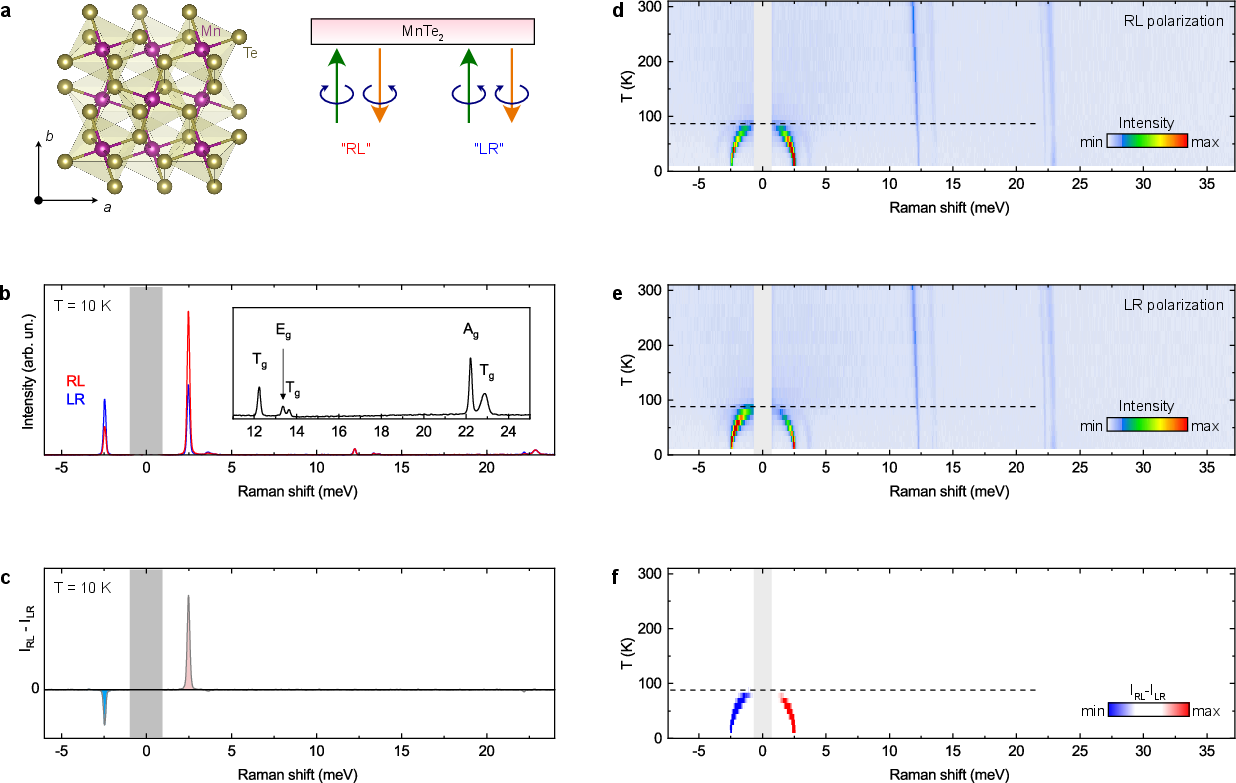
Figure 1: Temperature and polarization dependence of Raman-active phonons and magnons in MnTe2, illustrating the RL/LR intensity anomaly and reversed RCD for the low-energy magnon branch.
Temperature-dependent measurements demonstrate that the RCD appears only below TN, confirming a direct link to the magnetically ordered phase. In contrast, phononic and high-energy magnon excitations lack any such dichroic features.
Polarization- and rotation-resolved Raman scans further elucidate the symmetry of magnetic excitations. While phonon angular dependencies conform to expectations from their Raman tensors (isotropic or fourfold), the low-energy magnon branch displays a hybridization of fourfold and twofold symmetry in intensity, with a striking ω(k)=ω(−k)0 rotation between Stokes and anti-Stokes polarization patterns. These effects underscore the reduction in rotational symmetry induced by broken combined spatial–temporal symmetries and the underlying altermagnetic order parameter.
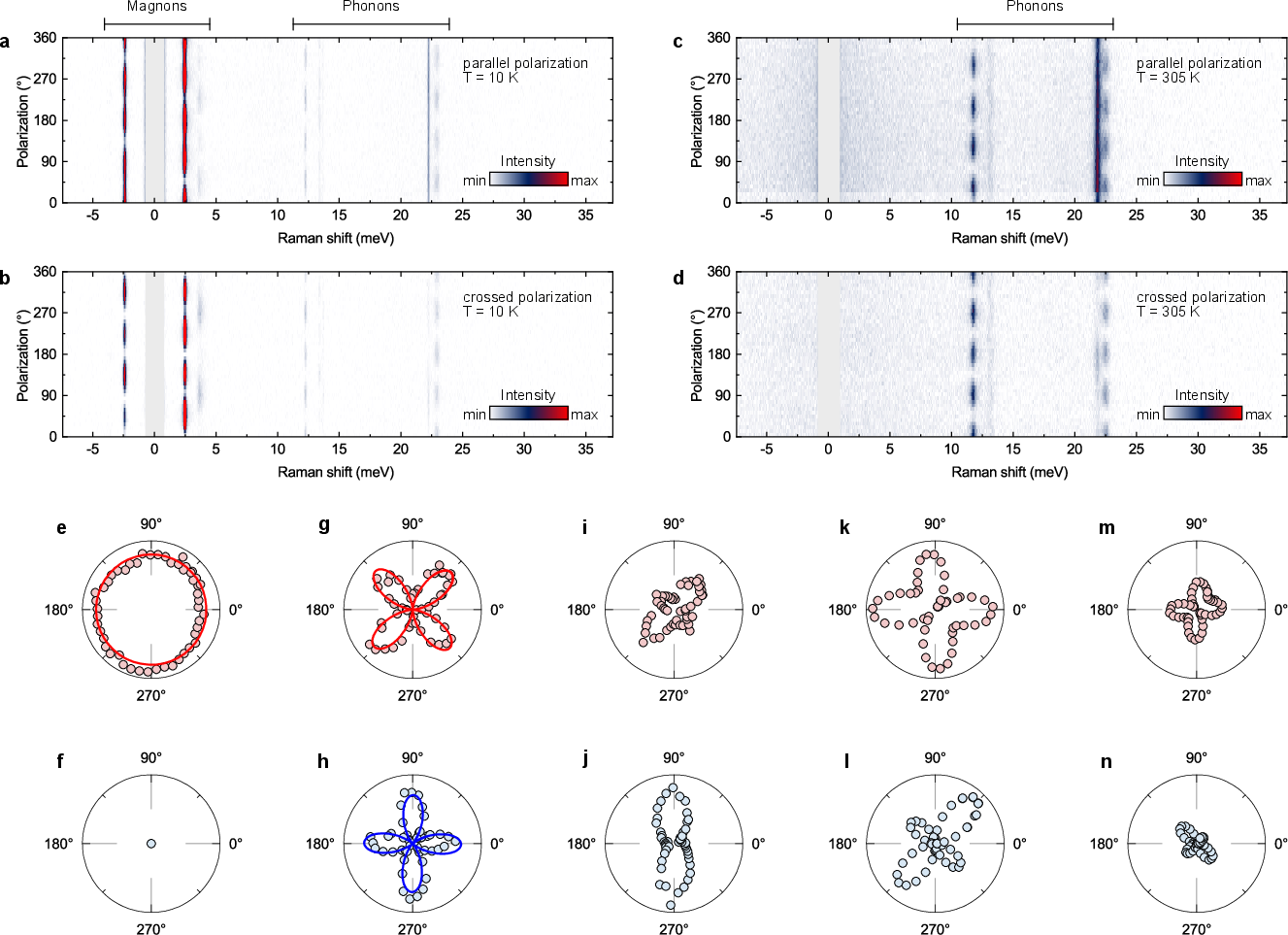
Figure 2: Polarization-resolved Raman maps and angle-dependent intensity profiles for both phononic and magnonic modes at low and high temperature; note the distinctly nontrivial angular response of the magnon branches.
First-Principles Insights: DFT+ω(k)=ω(−k)1 and Magnon Spin Textures
DFT+ω(k)=ω(−k)2 calculations, augmented with magnetic force linear response, are used to extract microscopic exchange interactions up to second-nearest neighbors. The resulting Hamiltonian includes dominant AFM ω(k)=ω(−k)3 meV and weaker FM ω(k)=ω(−k)4 meV couplings, and significant first-neighbor Dzyaloshinskii–Moriya (DM) interaction, stabilizing the noncollinear ground state.
These parameters feed into a Holstein-Primakoff-based linear spin-wave theory. The resulting magnon spectra yield four bands, with the three upper bands degenerate at ω(k)=ω(−k)5 (ω(k)=ω(−k)6 meV) and the lowest at ω(k)=ω(−k)7 meV—consistent with the observed Raman-active branches.
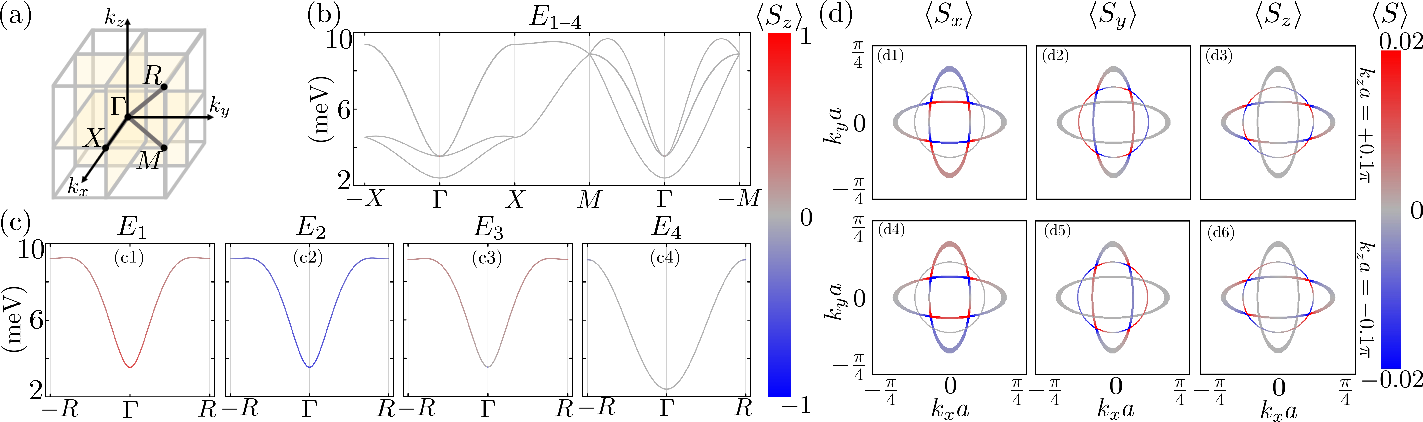
Figure 3: DFT-derived magnon band structure colored by ω(k)=ω(−k)8-component of magnon spin texture; momentum-resolved “plaid-like” spin splitting emerges from the underlying symmetries of MnTeω(k)=ω(−k)9.
A highly nontrivial plaid-like spin texture in momentum space is recovered for the magnon bands, reflecting the same symmetry operations that impart momentum-dependent spin splitting to the electronic bands in altermagnets. Notably, the 20-magnetization component changes sign under specific 21-vector inversions and obeys even-odd reflection properties forced by the composite symmetry group. This spin structure gives rise to the experimentally observed chiral dichroism and manifestly breaks the Kramers degeneracy characteristic of conventional antiferromagnets.
Implications and Future Directions
This work establishes MnTe22 as a prototypical three-dimensional altermagnet displaying chiral, symmetry-protected magnon excitations. The pronounced RCD detected in Raman spectroscopy provides a table-top diagnostic for reciprocal-space symmetry breaking in complex magnetic materials. This constitutes a powerful alternative to neutron scattering for classifying altermagnets, especially in systems with small samples or intricate magnetic structures.
The ramifications for magnonics and antiferromagnetic spintronics are substantive: the symmetry-enforced breaking of magnon degeneracy via crystalline operations (rather than SOC) enables tunable, non-reciprocal magnon propagation and chiral magnon currents—key elements for future logic devices or unconventional magnon-based circuit components. The observed plaid-like momentum-space splitting further connects the physics of chiral magnons with that of anomalous transport and topological Berry-phase effects in electronic altermagnets.
Future theoretical work could leverage this comprehensive experimental and ab initio framework to explore additional classes of non-coplanar altermagnets, generalize symmetry classifications, and potentially target compounds with larger spin splitting or tunable magnonic bandgaps. On the experimental front, table-top probes like the demonstrated Raman techniques could be applied across a wider array of complex altermagnets, bridging the gap between symmetry analysis, spectroscopy, and applications in advanced spintronic architectures.
Conclusion
The study definitively demonstrates the emergence of chiral, plaid-like split magnon bands in noncollinear antiferromagnetic MnTe23, rooted in the nontrivial interplay of magnetic sublattice structure and crystal symmetry. The combination of helicity-sensitive Raman spectroscopy and DFT+24-driven spin-wave theory establishes a direct link between symmetry-imposed spin textures and observable dichroic magnon signatures. These findings provide a robust platform for the engineering and classification of chiral magnonic phenomena and open new avenues in symmetry-driven antiferromagnetic spintronics.