- The paper introduces NLF, a unified framework that models congestion, min-delay, and max-flow problems as convex equilibria via a nonlinear Laplacian system.
- It employs an inexact damped chord-Newton algorithm with near-linear Laplacian solvers, ensuring robust and scalable performance across diverse network types.
- Empirical results demonstrate linear-time scaling on large graphs, with the method outperforming traditional solvers and extending to multicommodity flow problems.
NLF: A Resistor-Network Framework and Linear-Time Solver for Convex Network-Flow Equilibria
Unified Nonlinear Laplacian Flow Framework
This work introduces NLF (Nonlinear Laplacian Flow), a unifying framework and practical algorithmic suite for solving a broad class of convex equilibrium flow problems on networks. At the core lies the recognition that congestion routing, minimum-delay routing, and (soft) capacity-constrained maximum flow can all be formulated as stationary points of a convex, edge-separable energy whose first-order optimality conditions reduce to a nonlinear Laplacian system:
Bρ(B⊤ϕ)=αd
where B denotes the node-edge incidence matrix, ϕ are node potentials, αd is the (possibly scaled) demand vector, and ρ(⋅) is a monotone edge law encoding the physical or cost structure of the network. The specifics of ρ—whether unbounded (as in congestion), saturating (max-flow), or exhibiting hard nonlinearities (queueing models)—entirely determine the underlying problem class.
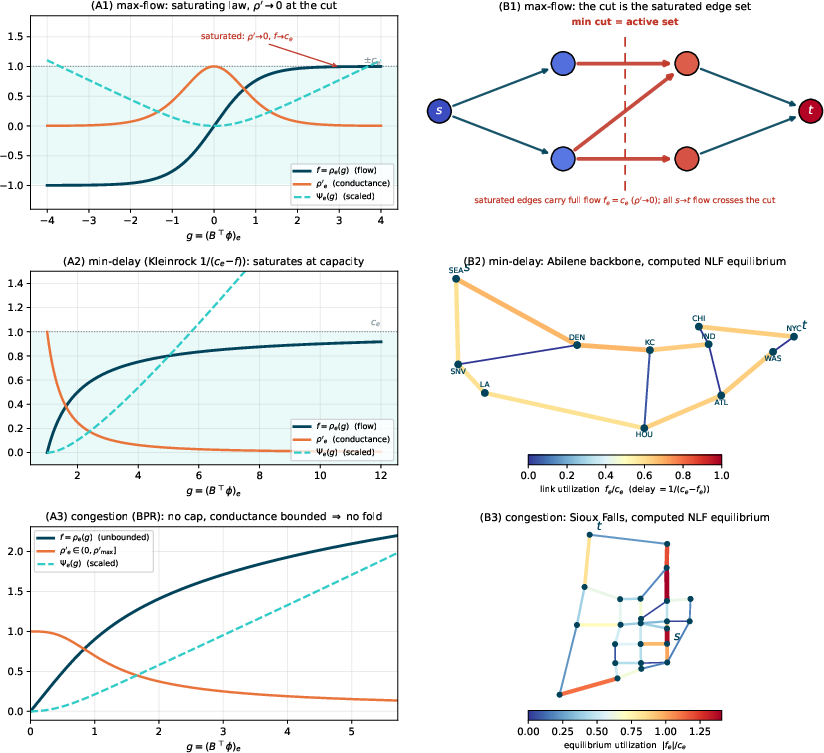
Figure 1: The three instances of the unified framework, illustrating (A) distinct edge laws, (B) induced conductance behavior, and (B1)-(B3) the structural properties and visualizations per application.
All unique features of the aforementioned network flow problems, such as feasibility limits or bifurcations, arise from the qualitative behavior of the chosen edge law. For instance, in congestion models (e.g., BPR), ρ is unbounded and no fold is present, while in max-flow or queueing, local saturation in ρ gives rise to a fold in the solution curve—a point of singularity in the Jacobian as the feasible flow limit is reached.
Algorithmic Approach: Chord-Newton Iteration With Near-Linear Solves
NLF employs an inexact damped chord-Newton algorithm, leveraging a frozen global linearization of the nonlinear Laplacian system as its main iterative step. Each Newton linearization results in a weighted Laplacian (graph Laplacian with edge weights determined by ρ′ at the current iterate), which is solved via a black-box near-linear Laplacian solver. Two such solvers are implemented and compared: randomized approximate Cholesky preconditioner and LAMG+, both allowing flexible tradeoffs between setup/reuse and solve accuracy.
Empirically, the entire nonlinear solve (including required continuation and arclength parametrization near folds) consumes only $2$–B0 linear Laplacian solves, making the effective complexity B1 in the number of edges for most practical purposes, despite the theoretical absence of a worst-case bound.
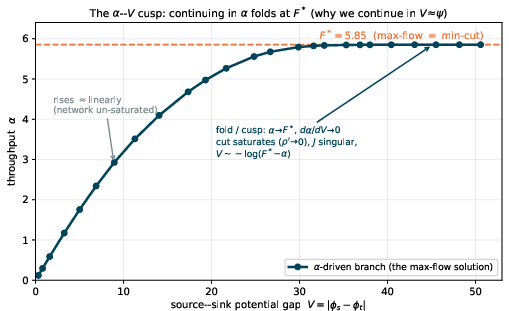
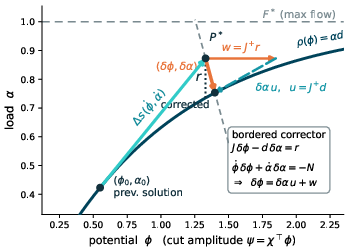
Figure 2: (a) Behavior of the source-sink gap and load parameter as the network approaches the flow fold (max-flow limit), and (b) geometric depiction of the pseudo-arclength continuation procedure, including predictor and correction steps in the space of potential and load.
The core design accommodates both no-fold (congestion, BPR) and fold (max-flow, minimum-delay) problem flavors: for the former, a direct frozen-setup iteration suffices; for the latter, pseudo-arclength continuation in a well-conditioned coordinate keeps the iterates traversing the solution curve, smoothly passing through the singularity.
Numerical Results: Traffic Congestion, Robustness, and Competitiveness
Empirical Linear-Time Scaling for Convex Congestion
NLF is rigorously benchmarked against state-of-the-art solvers on the undirected, single-commodity Beckmann relaxation instantiated for real metropolitan road networks (BPR cost). Across B2 SuiteSparse and TNTP graphs (up to B3 edges), NLF achieves convergence consistently, with median step counts independent of problem size and flat per-edge wall time. The median wall time per edge is approximately B4–B5s depending on scenario. NLF's performance remains robust across network typologies (planar, mesh, web, random), with wall time scaling empirically as B6.
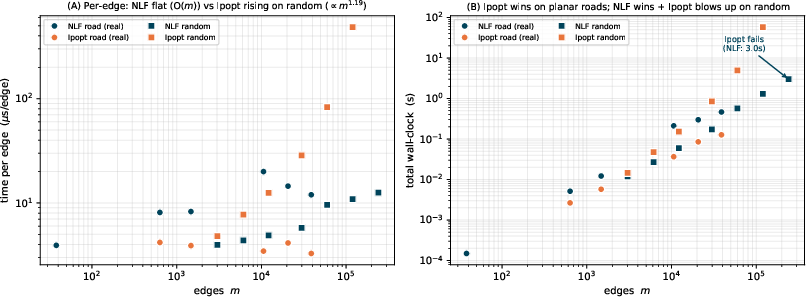
Figure 3: Congestion equilibrium solver scaling with NLF and Ipopt on both real (planar, circles) and synthetic poorly-separable (random, squares) road networks, illustrating near-linear scaling of NLF compared to superlinear fill-in for direct/IPM-based methods.
On well-separable graphs direct (sparse) factorization methods may be more efficient, but as the separator structure degrades (e.g., random graphs, denser synthetic benchmarks), NLF outpaces direct and IPM solvers by factors exceeding B7 at the largest tested scale. A robustness sweep also shows that, where both interior-point (Ipopt) and first-order (L-BFGS) methods struggle or fail (due to fill-in or ill-conditioning), NLF alone remains feasible, converging in 100% of tested instances within budget.
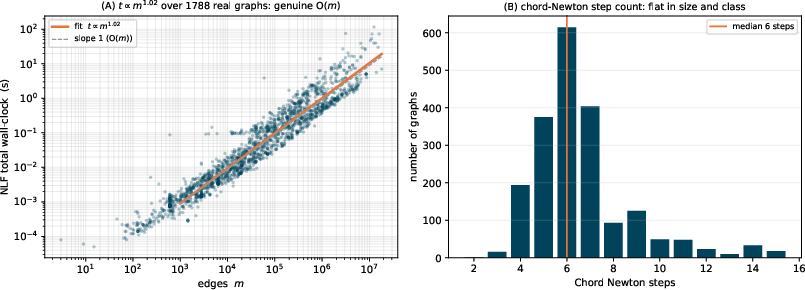
Figure 4: NLF scaling and convergence statistics over the full SuiteSparse corpus—total wall-clock time and Newton step distribution confirm empirical linearity and step-count stability across five decades of graph size.
Solver Modularity and Numerical Stability
Because the NLF framework is agnostic to the inner Laplacian solver, it can flexibly adopt the most performant available, even switching heuristically between Cholesky-based preconditioners and algebraic multigrid. Empirically, both approaches yield virtually identical equilibria; differences are predominantly in wall time dependent on the graph class. The modularity extends to continuation-aware bordered systems at folds, where the robustness of deflation (not the particular linear solver) ensures conditioning of the overall problem.
Solver Accuracy and Outer/Inner Tradeoffs
Empirical sweep over solution tolerances shows total computational cost scales logarithmically with target accuracy B8 as B9, supporting the heuristic that nonlinear problems solved via NLF cost only a small multiple of the associated linear problem solution at the same scale.
Maximum Flow as Smooth Nonlinear Laplacian
Maximum flow is realized by selecting a saturating edge law (ϕ0-type smooth approximation for box constraints), with the framework cleanly interpolating up to the min-cut. As ϕ1 approaches the true max-flow value ϕ2, the propagation 'folds' as the cut conductance vanishes, but—due to the bordered system in the pseudo-arclength continuation—NLF traverses the fold robustly without loss of conditioning.
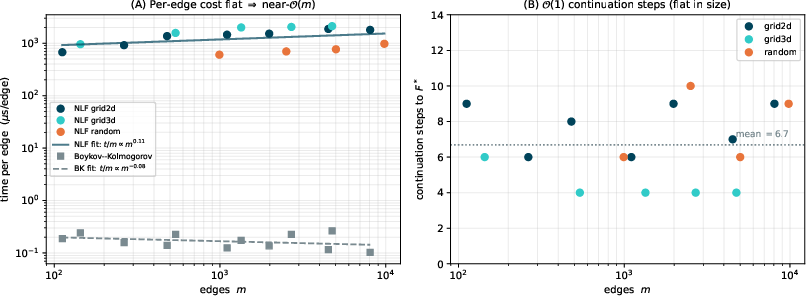
Figure 5: Max-flow scaling over various classes, with total wall clock exhibiting empirical linearity and average step counts remaining stable as scale increases.
NLF returns not only the value of max-flow but, crucially, the cut potentials (duals), the parametric flow curve, and the smooth interior flows—valuable in multi-objective settings where max-flow is an inner component.
Multicommodity Flow and Smooth Coupled Congestion
The framework extends directly to multicommodity flows, coupling ϕ3 commodities via a smooth edge law on the Euclidean norm of flows per edge. One key algorithmic innovation is the use of a single scalar Laplacian hierarchy for all ϕ4 commodities, amortizing the setup cost as ϕ5 work per Newton step. Empirical results on the full corpus demonstrate the method's robustness, with cost per step nearly linear in ϕ6 and independence of step count from problem size.
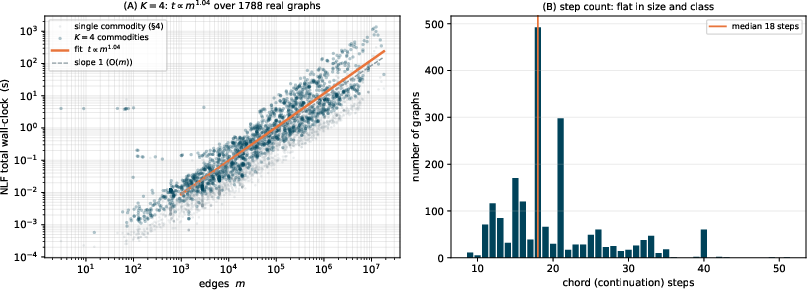
Figure 6: Multicommodity NLF scaling over suite corpus; total wall-time linear in edge count (ϕ7), and per-instance chord step count is flat and stable irrespective of ϕ8.
Theoretical and Practical Implications
Theoretical Integration
NLF generalizes an entire class of convex network flow problems, including Beckmann congestion, min-delay (ϕ9 queueing), and max-flow, into a single nonlinear Laplacian root-finding procedure. The use of inexact Newton methods with frozen high-accuracy inner solves is justified by the contraction properties of the nonlinear update, and the empirical separation of the inner/outer iteration cost is strongly validated.
Practical Significance
NLF's main practical advantage is linear (or nearly-linear) runtime in the number of edges, at all scales, and compatibility with current state-of-the-art graph Laplacian solvers. The algorithm’s robustness to network topology (planarity, separator structure, edge heterogeneity) and its extension to multicommodity and parametric variants make it suitable as a “workhorse” infrastructure for network optimization pipelines where the underlying physical or cost structure can be encoded in a monotone local edge law.
Future Developments
The paper suggests straightforward generalizations to directed graphs, volume-coupled (nonsmooth) multicommodity flows, optimal transport (Beckmann and Wasserstein), and bilevel network design. Extending the Laplacian-based structure-aware solvers to such domains promises efficiency and generality unmatched by existing combinatorial or naive convex optimization paradigms.
Further, by placing the nonlinearity entirely in the edge law, the framework paves the way for blending algorithmic advances in both fast Laplacian solving and nonlinear system continuation, with potential applications in data-driven or online network design contexts.
Conclusion
NLF provides a unifying algorithm and analytical structure for a wide class of convex network flow equilibria, with empirical linear time scaling, robustness across diverse network classes, modularity in its numerical core, and flexibility in accommodating edges laws and multiparameter extensions. The ability to compute not only flows but their duals and parametric sensitivities with minimal overhead positions the framework as an attractive tool for large-scale network optimization and design.