OntoLearner: A Modular Python Library for Ontology Learning with Large Language Models
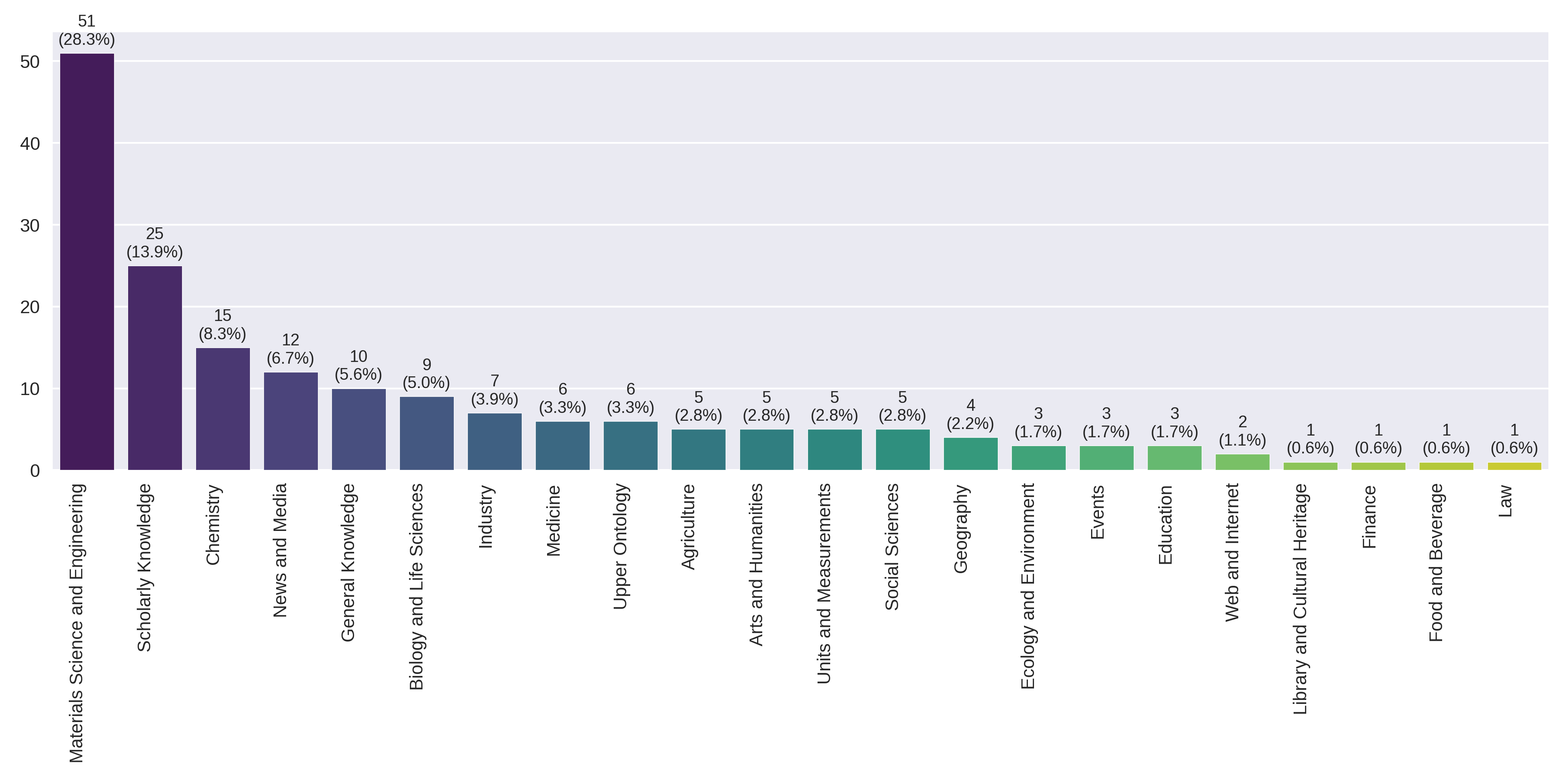
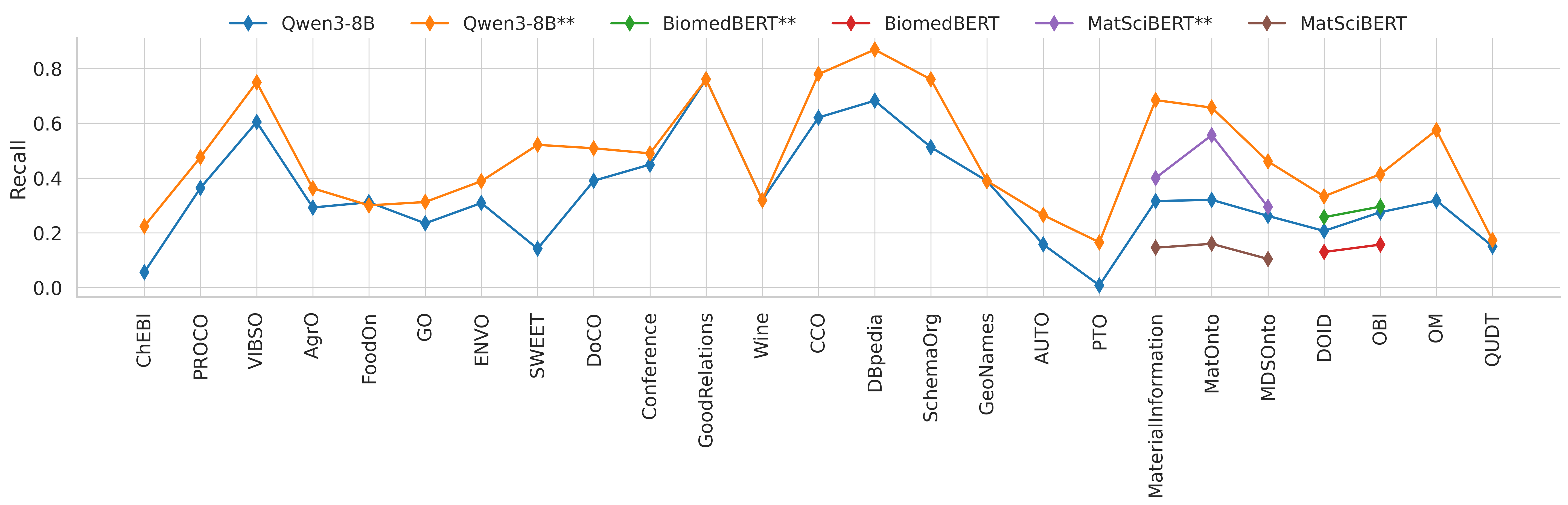
Abstract: Ontology learning (OL) aims to automatically construct structured knowledge models from text, yet progress remains fragmented across methods, domains, and evaluation practices. Despite decades of research, OL lacks a shared infrastructure for systematic evaluation and ontology access. This absence has hindered progress and fragmented research, leaving the central challenges of OL largely unaddressed. We introduce OntoLearner, a modular, cross-domain, and first-of-its-kind framework that unifies ontology access, LLM-driven learning pipelines, and standardized benchmarking. OntoLearner releases 180 machine-readable ontologies spanning 22 domains and provides pipeline-ready datasets with train/dev/test splits for three core OL tasks: term typing, taxonomy discovery, and non-taxonomic relation extraction. Using this infrastructure, we conduct a large-scale empirical study of OL, evaluating 22 retrieval models and 12 LLMs across domains and tasks. The results converge on a finding that reframes the central challenge of OL: failure modes scale with ontological complexity rather than model size or architectural sophistication. The primary bottleneck is not model capability, but a structural mismatch between how models encode knowledge and how ontologies organize it. These findings establish that effective OL is reachable through the cross-domain, multi-task benchmarking enabled by OntoLearner. OntoLearner is open-source (MIT license) at https://github.com/sciknoworg/OntoLearner/.
Paper Prompts
Sign up for free to create and run prompts on this paper using GPT-5.
Top Community Prompts
Explain it Like I'm 14
What is this paper about?
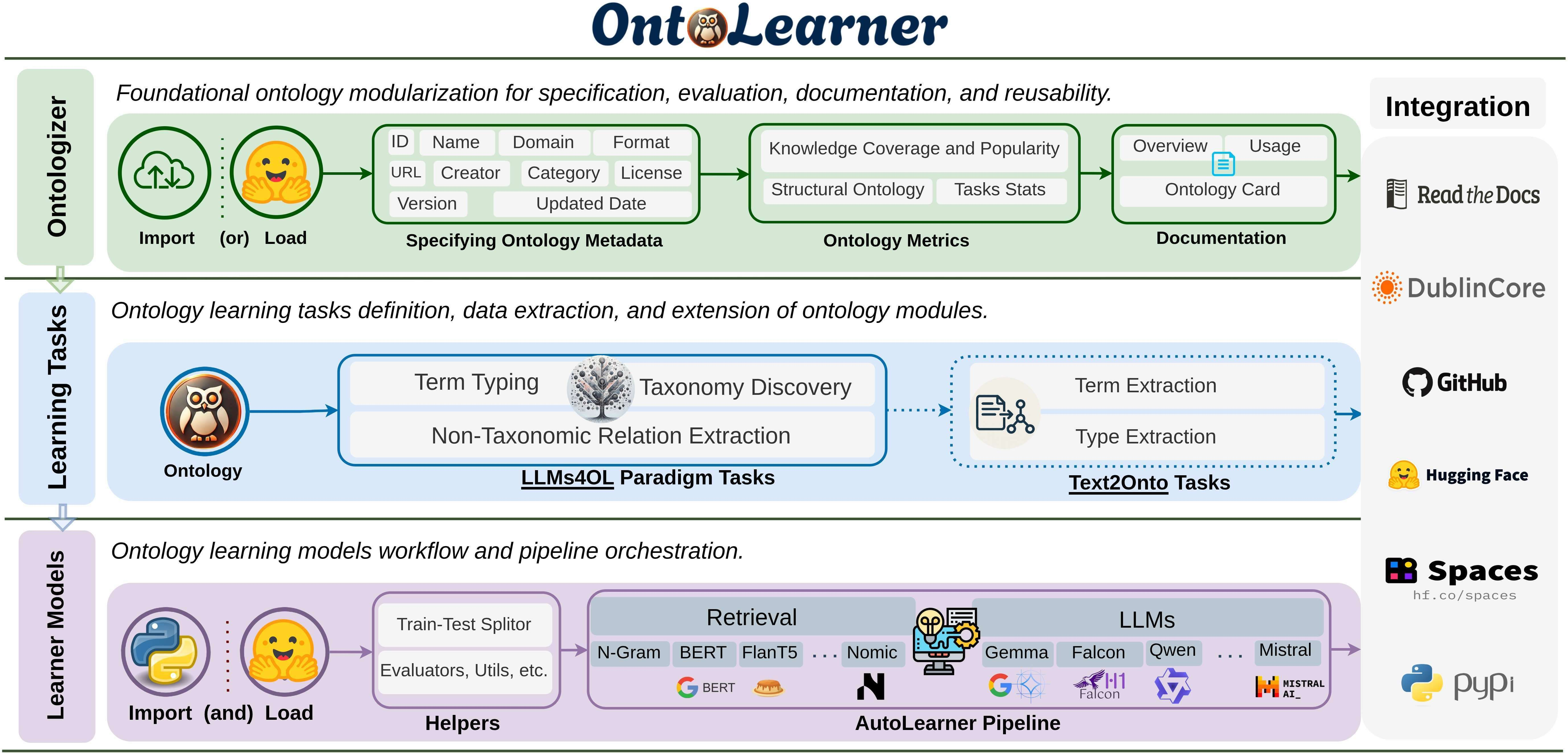
This paper introduces OntoLearner, a free, open-source Python library that helps computers build and improve “ontologies” using LLMs. An ontology is like a carefully organized map of knowledge: it lists important ideas (like “cell,” “disease,” or “planet”) and shows how they relate (for example, “a tiger is a kind of animal” or “the heart is part of the circulatory system”). OntoLearner brings together:
- easy access to many real ontologies,
- tools to train and test AI on key learning tasks, and
- fair, standard tests to compare different methods.
What questions did the researchers ask?
In simple terms, they asked:
- How can we give AI a clean, shared setup to learn ontologies across many fields (like medicine, geography, chemistry, and more)?
- Which parts of ontology learning are hardest for AI, and why?
- Do bigger or fancier AI models solve the problem, or is something else holding them back?
How did they do it?
The team built OntoLearner with three main parts and tested it on a large, diverse collection of ontologies.
First, they gathered and prepared data:
- They released 180 machine-readable ontologies from 22 different domains, ready for AI use.
- For each, they created “train/dev/test” splits—standard practice in AI to train models, tune them fairly, and test them honestly.
Then, they defined three core learning tasks that mirror how humans build ontologies:
- Term Typing: Decide what category a term belongs to (e.g., “cell death” is a type of “biological process”).
- Taxonomy Discovery: Figure out “is-a” links (e.g., “tiger is a kind of animal”).
- Non-Taxonomic Relation Extraction: Find other meaningful links (e.g., “heart is part of circulatory system”).
They built modular tools to plug in different AI components:
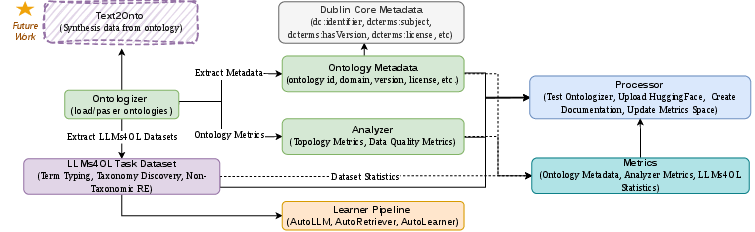
- AutoRetriever: search tools that find helpful snippets or entries.
- AutoLLM: LLMs that read and write text.
- AutoLearner: a controller that mixes and matches retrievers and LLMs, including retrieval-augmented generation (RAG).
They also added a helper called Text2Onto:
- It can generate “synthetic” text—natural-looking sentences created from ontology facts—so researchers can test AI methods even when real training text is hard to find.
Finally, they ran a big study:

- They evaluated 22 different retrieval models and 12 different LLMs across multiple domains and tasks to see what works best and where models fail.
Note: When they mention “ontology complexity,” think of how big, deep, and interconnected the ontology is—like the difference between a simple family tree and a huge, branching encyclopedia of life.
What did they find, and why is it important?
Main finding:
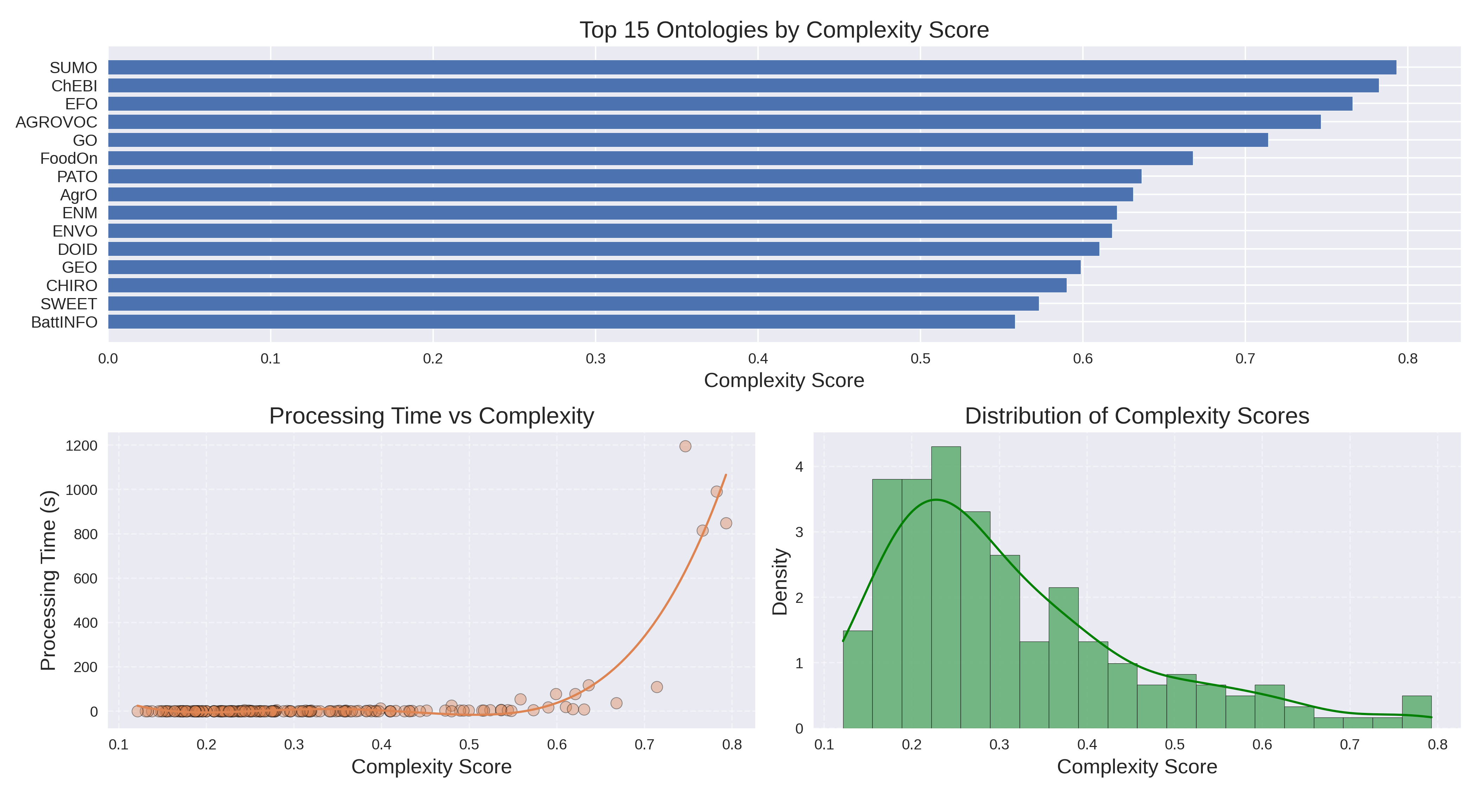
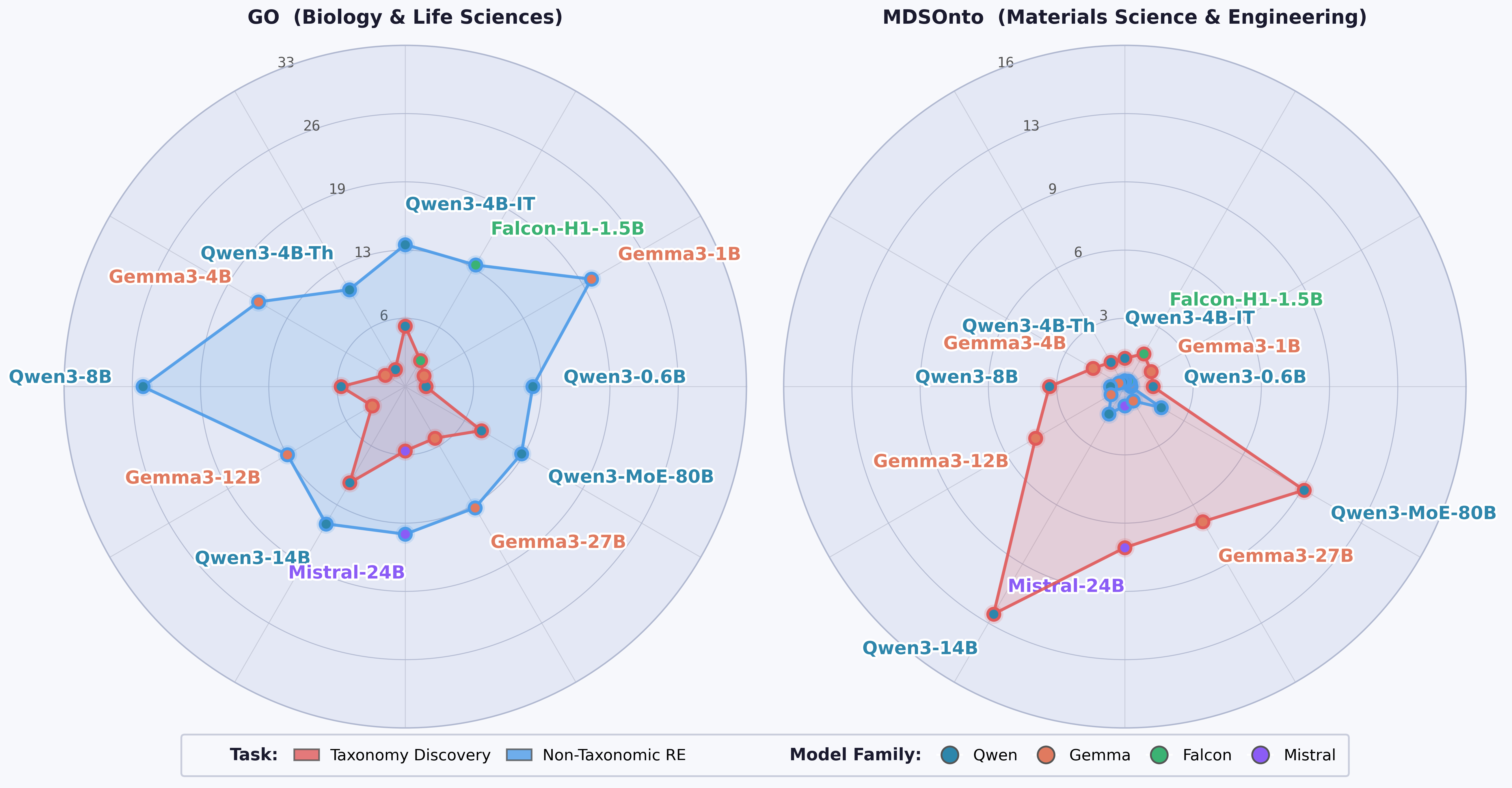
- The hardest part isn’t just building bigger or newer AI models. Instead, errors grow as the ontology gets more complex. In other words, as the “knowledge map” becomes more detailed and tangled, the models struggle more—no matter how large the model is.
Why this matters:
- It shows there’s a mismatch between how LLMs store knowledge (as patterns in text) and how ontologies organize knowledge (as precise, structured graphs). This means simply scaling model size isn’t enough. We need better ways to connect the model’s “text sense” to the ontology’s “structured map.”
Other key takeaways:
- OntoLearner’s standardized datasets and tests make it much easier to compare methods fairly across many fields.
- Combining tools—like using a retriever with an LLM in a RAG setup—helps, but structure-aware methods are still essential.
- Grounding AI in curated ontologies (not just free text) reduces mistakes and keeps results more consistent.
What is the impact of this work?
- A shared foundation for progress: OntoLearner gives researchers a common, cross-domain “playground” with clear tasks and fair evaluations. This helps the community build on each other’s results instead of starting from scratch.
- Better human–AI teamwork: The library is designed to assist, not replace, experts. It speeds up routine steps while keeping the structure and logic that make ontologies reliable.
- Smarter future models: The results suggest that the next big improvements in ontology learning will come from aligning AI with ontology structure—designing methods that “think” in terms of categories and relationships—not just from making models larger.
- Long-term accessibility: The project follows FAIR principles (Findable, Accessible, Interoperable, Reusable) and is openly available, so others can reuse and extend it.
In short, OntoLearner doesn’t just introduce a tool—it changes how we evaluate and improve AI for building structured knowledge. It shows that the real challenge isn’t raw language ability; it’s teaching AI to respect and use the careful structure of the knowledge maps we rely on.
Knowledge Gaps
Knowledge gaps, limitations, and open questions
The paper introduces a valuable modular library and benchmarking suite, but several aspects remain under-specified or out of scope. The following list consolidates concrete gaps, limitations, and open questions to guide future work:
- Missing task coverage beyond three core OL subtasks:
- No benchmarks for ontology alignment/mapping across ontologies, instance population, OWL axiom induction (e.g., disjointness, restrictions), class expression learning, logical constraint discovery, or competency-question grounding.
- Limited evaluation metrics:
- Current evaluation focuses on pair-/triple-level precision/recall/F1; lacks metrics for global structural quality (e.g., hierarchy coherence, tree/graph edit distance, ancestor similarity), logical consistency (reasoner-based validation), constraint satisfaction (domain/range, disjointness), and downstream utility measures.
- Logical validation is absent:
- No end-to-end pipeline to check OWL consistency of learned outputs (e.g., running a DL reasoner to detect unsatisfiable classes or axiom violations).
- Ontology alignment and vocabulary mapping not implemented:
- Table 1 flags alignment/mapping as “planned”; there is no API or benchmark to evaluate cross-ontology term alignment or synonym merging, despite overlapping content across repositories.
- Limited multimodal and multilingual scope:
- Benchmarks and pipelines appear English-centric and text-only; no support or evaluation for multilingual ontologies, cross-lingual term typing, or extraction from tables, PDFs, semi-structured data, or web schemas.
- Generalization and transfer not characterized:
- No experiments probing zero-shot/few-shot transfer to new ontologies, domains, or ontology versions; unclear robustness to ontology drift or evolving schemas.
- Ontology complexity as a bottleneck is asserted but not causally dissected:
- The “complexity over model size” thesis lacks ablations isolating which structural factors (depth, branching factor, relation diversity, axiom expressivity, polyhierarchies) drive failure; the proposed complexity scorer’s validity and sensitivity are not empirically validated against task performance.
- Synthetic corpus generation (Text2Onto) is preliminary and unvalidated:
- No quantitative evaluation of the realism, semantic fidelity, or downstream utility of CNL+LLM-paraphrased synthetic texts; risk of semantic drift or hallucinations is not measured.
- Lack of comparisons to real corpora or human-authored gold standards; no guidance on tuning LLM generation to reproduce domain registers or document structures.
- Leakage-aware splitting may not reflect real-world workflows:
- The term-level stratification and “no term overlap” constraint create a harder-yet-possibly-unrealistic setting for taxonomy/relations; no alternative protocols (e.g., incremental enrichment, time-based splits, ontology versioning splits) are provided or compared.
- Class imbalance and negative sampling strategies are under-specified:
- No standardized strategies for generating negatives in taxonomy or relation tasks; imbalance handling and calibration methods are not benchmarked or reported.
- Reproducibility for LLM-based experiments remains fragile:
- Non-determinism from LLM decoding, model updates, or provider differences is not systematically controlled; prompts, seeds, and decoding configurations needed for strict reproducibility are not fully specified or packaged.
- Missing support for model training and fine-tuning within the library:
- The framework orchestrates inference with LLMs and retrievers but does not provide adapters for fine-tuning (e.g., contrastive retriever training, instruction-tuning for OL tasks), hyperparameter search, or experiment tracking.
- Human-in-the-loop functionality is not yet supported:
- No GUI (F16), no active-learning loops, correction interfaces, or annotation tooling to integrate domain experts; no protocols to quantify human effort reduction or supervise LLM revisions at scale.
- Ensemble and multi-agent strategies are not implemented:
- F15 (multi-agent/ensemble) is marked as a current deficit; no built-in mechanisms for model stacking, adjudication, self-consistency, or debate to reduce drift and improve reliability.
- Task customization APIs are incomplete:
- F14 (customizing learning tasks) is not yet implemented; users cannot easily define new task schemas, label sets, or evaluation plugins within the framework.
- Optional extension isolation is incomplete:
- N9 is unfulfilled; no clear module isolation strategy for optional UI or advanced learners to protect the core from regression or heavy dependencies.
- Benchmark selection biases and coverage are not quantified:
- The 180 ontologies span 22 domains but potential skew toward biomedical and research-friendly sources is not measured; coverage of industrial ontologies, proprietary schemas, or non-OWL/OBO ecosystems is unclear.
- Licensing and redistribution risks are not discussed:
- While datasets are hosted on HuggingFace, the paper does not detail license heterogeneity, attribution requirements, or automated license checks that may constrain reuse or benchmarks.
- Scalability and resource profiling are not reported:
- Although N2/N3 claim support for large ontologies, there are no empirical runtime/memory benchmarks, throughput measurements, or complexity analyses across ontology sizes and tasks.
- Output-to-ontology integration is unspecified:
- No standardized export of learned results back into OWL/RDF with provenance, confidence, or justification; no compatibility testing with ontology editors (e.g., Protégé) or reasoners.
- Retrieval design choices are under-explored:
- The interplay between retriever granularity (term, definition, axiom), context windows, and RAG prompt design is not systematically ablated; negative effects like retrieval noise or query drift are not quantified.
- Error analysis is limited:
- No taxonomy of error types (e.g., hypernym errors vs. sibling confusions, relation-type misclassification vs. argument misbinding); no per-structure or per-relation diagnostic reporting to inform targeted improvements.
- Lack of community-validated requirements and use cases:
- Requirements were authored by developers without multi-stakeholder validation; user studies or external expert feedback on usability, priority features, and task definitions are missing.
- Bridging representational mismatch remains open:
- The paper identifies a structural mismatch between model-encoded knowledge and ontology organization but does not propose or evaluate mechanisms (e.g., constrained decoding, schema-aware adapters, graph-regularized objectives, neuro-symbolic loss functions) to close this gap.
- Robustness and safety not addressed:
- No tests for adversarial inputs (e.g., conflicting axioms), ambiguous terms, or noisy labels; no safeguards for hallucination containment, confidence calibration, or uncertainty estimation in OL predictions.
Practical Applications
Overview
Below are actionable, real-world applications that flow from OntoLearner’s findings, methods, and modular infrastructure. Items are grouped as Immediate Applications (deployable now) and Long-Term Applications (requiring further research, scaling, or development). Each bullet highlights sectors, concrete tools/workflows/products that could emerge, and feasibility assumptions or dependencies.
Immediate Applications
- Benchmarking and evaluation hub for ontology learning methods
- Sectors: software/AI research, academia, standards bodies
- Workflow/Product: Use OntoLearner’s 180 ontologies (22 domains) and task-ready train/dev/test splits for term typing, taxonomy discovery, and relation extraction to create reproducible leaderboards and internal evaluation dashboards comparing retrieval models and LLMs.
- Dependencies/Assumptions: Access to OntoLearner datasets on Hugging Face; LLM/Retrieval model access (local or API); compute for batch evaluation; adherence to dataset licenses.
- Complexity-aware model selection and project scoping
- Sectors: enterprise knowledge management, healthcare/biomed, finance, government
- Workflow/Product: Use ontology metrics and the emerging ontology complexity scoring to estimate difficulty and select lighter-weight pipelines for low-complexity ontologies, reserving human-in-the-loop and RAG workflows for complex ones.
- Dependencies/Assumptions: Ontology metrics available; internal policy for tiered QA; SMEs available for high-complexity review.
- Retrieval-augmented concept suggestion and hierarchy completion
- Sectors: healthcare/biomed (OBO, UMLS), engineering/materials, finance (product taxonomy), e‑commerce (catalogs)
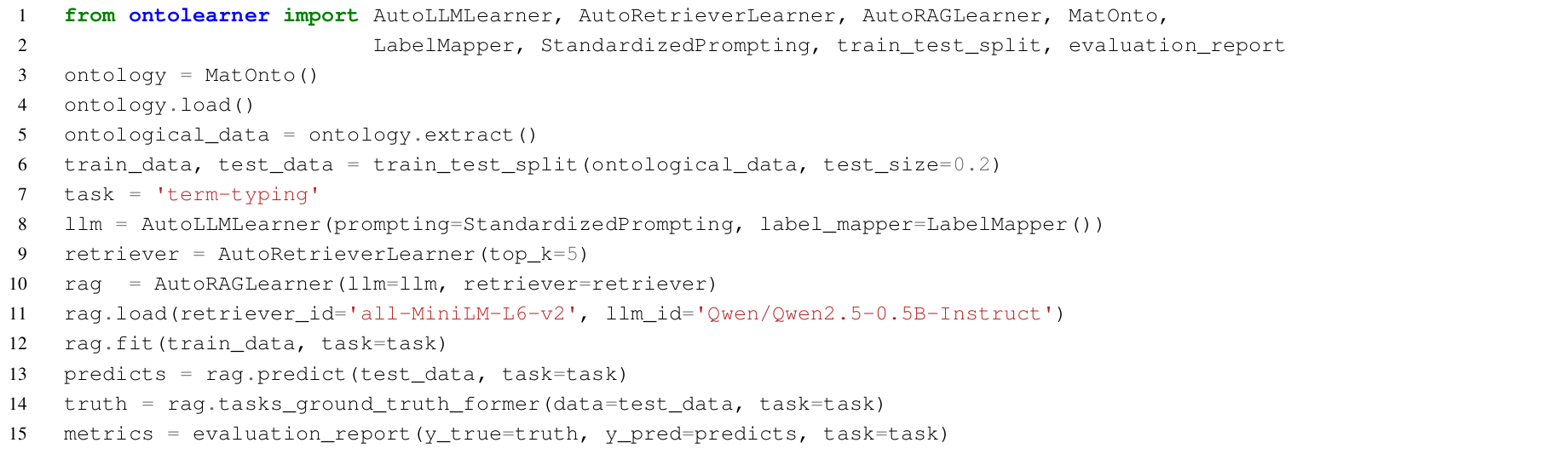
- Workflow/Product: Deploy AutoRetriever + AutoLLM (AutoRAGLearner) to suggest class placements, fill subclass links, and propose non-taxonomic relations grounded in curated vocabularies. Integrate LabelMapper to normalize LLM outputs and evaluation_report for quality tracking.
- Dependencies/Assumptions: Availability of seed ontologies; RAG-friendly text sources; SME validation; governance for ontology changes.
- Assisted term typing from internal corpora
- Sectors: healthcare (clinical notes, protocols), manufacturing (maintenance logs), finance (reports, filings)
- Workflow/Product: Use OntoLearner’s term typing task to classify new domain terms into existing types with leakage-aware splits for internal benchmarking and AutoLLM for deployment in annotation tools.
- Dependencies/Assumptions: Access to internal text; data privacy/compliance for sensitive content; SMEs to refine prompts and verify labels.
- Rapid prototyping of domain ontologies for new projects
- Sectors: software/AI, scientific publishing, government open data
- Workflow/Product: Bootstrap lightweight taxonomies by reusing included ontologies and running taxonomy discovery to extend or prune hierarchies. Compare versions over time with OntoLearner’s versioning and metrics.
- Dependencies/Assumptions: Project-specific corpus or seed terms; repository access; version control practices.
- Classroom and training labs for semantic web and neuro-symbolic AI
- Sectors: education, academic research
- Workflow/Product: Use standardized datasets and evaluation utilities (splits, metrics) in assignments on term typing, taxonomy induction, relation extraction, and RAG pipelines; demonstrate leakage-aware splits and reproducibility best practices.
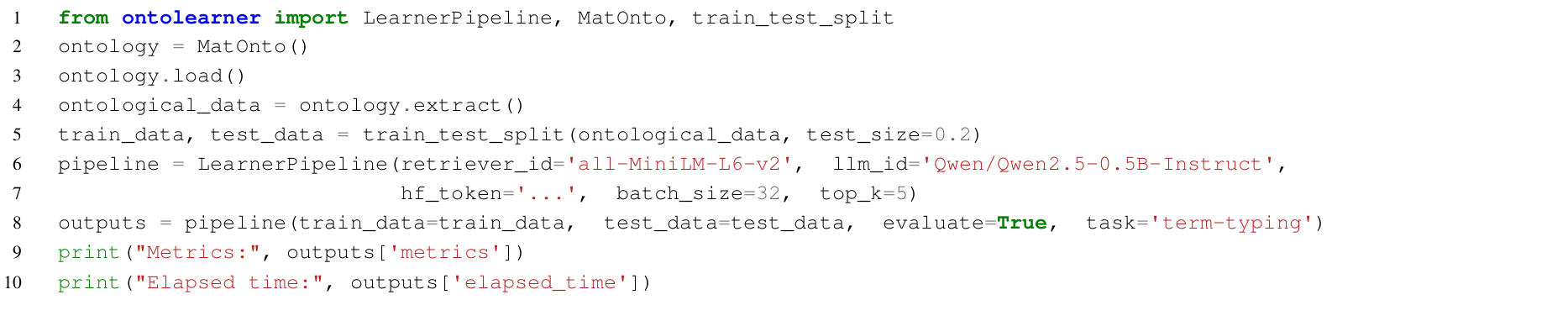
- Dependencies/Assumptions: Course compute resources; instructor familiarity with Python and LLMs; access to open or small local models (e.g., Qwen2.5-0.5B).
- Internal knowledge graph enrichment and consistency checks
- Sectors: pharma/biotech (drug–target, disease ontologies), energy (asset/maintenance ontologies), finance (instrument–risk relationships)
- Workflow/Product: Run non-taxonomic relation extraction over curated corpora to propose new edges; evaluate with evaluation_report; triage using complexity metrics to allocate human review.
- Dependencies/Assumptions: Curated corpora; KG ingestion tooling; SME review pipelines.
- Domain-specific RAG assistants grounded in ontologies
- Sectors: healthcare (clinical decision support disclaimers), materials/engineering (design assistants), publishing (metadata curation)
- Workflow/Product: Build task-specific prompts with AutoPrompt, combine ontological retrieval with LLMs for grounded answers (e.g., “Where does ‘cell death’ belong in this ontology?”), and log predictions for audit.
- Dependencies/Assumptions: Retrieval indices built over ontologies and definitions; prompt governance; monitoring for hallucinations.
- Synthetic corpus generation for internal extraction model training
- Sectors: software/AI, domains with scarce labeled data (e.g., niche engineering subfields)
- Workflow/Product: Use the Text2Onto synthetic data module to generate labeled texts aligned to existing ontologies; pre-train or fine-tune in-house extractors; validate against OntoLearner benchmarks.
- Dependencies/Assumptions: LLM access for paraphrasing; careful hyperparameter control to avoid over-regular text; legal review for generated data usage.
- Vendor/model evaluation for procurement and compliance
- Sectors: government, finance, healthcare
- Workflow/Product: Evaluate third-party LLMs/retrievers on standardized OL tasks and splits to support procurement decisions and model governance; report robustness vs ontology complexity.
- Dependencies/Assumptions: Data-sharing policies; model access under NDA or API; compliance frameworks.
- E‑commerce catalog and search improvement
- Sectors: retail/e‑commerce
- Workflow/Product: Apply term typing and taxonomy discovery to curate product hierarchies and improve facet search; run RAG for synonym/variant mapping within an existing controlled vocabulary.
- Dependencies/Assumptions: Product catalogs and descriptions; alignment/mapping features are planned (note: mapping module is not yet included).
- Reproducible MLOps integration for OL tasks
- Sectors: software/AI, enterprise IT
- Workflow/Product: Integrate OntoLearner as a PyPI package into CI/CD workflows for nightly evaluation of OL models, logging precision/recall/F1, with versioned datasets on Hugging Face.
- Dependencies/Assumptions: CI infrastructure; model registries; standard Python environments.
- FAIR-aligned ontology packaging and dissemination
- Sectors: scientific research, public-sector data portals
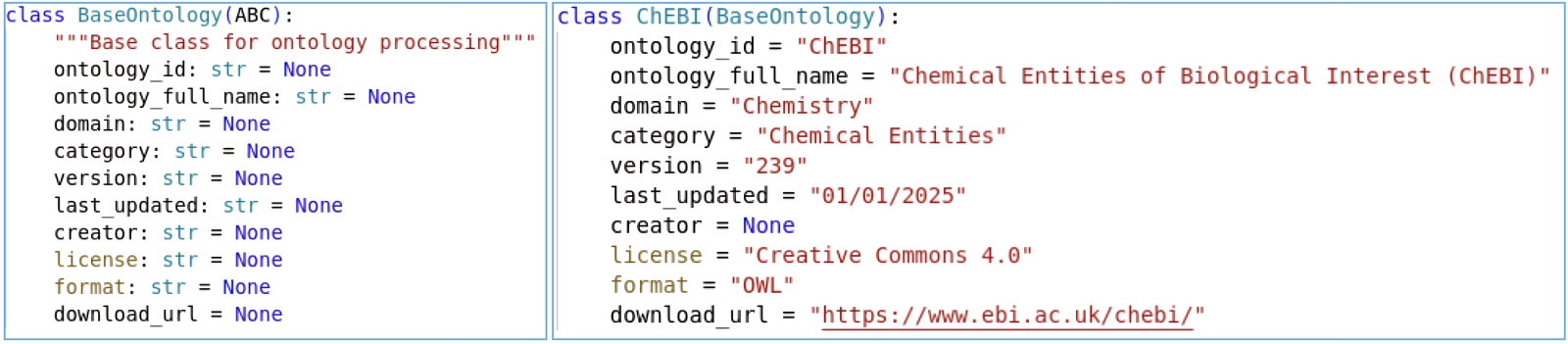
- Workflow/Product: Use OntoLearner’s metadata/versioning to publish pipeline-ready ontologies and benchmarks, improving discoverability and reuse; tie into FAIRsharing records.
- Dependencies/Assumptions: License clarity; metadata completeness; repository policies.
- Personal knowledge management and enterprise tagging aids
- Sectors: daily life, enterprise KM
- Workflow/Product: Use small local LLMs with AutoRetriever to auto-tag notes or documents to an existing taxonomy; quick categorization to support internal search.
- Dependencies/Assumptions: On-device models or private clusters; a seed taxonomy; acceptable latency.
Long-Term Applications
- Semi-automated ontology alignment and crosswalk generation
- Sectors: healthcare (terminology crosswalks), government open data, finance (taxonomy harmonization), education (curriculum mapping)
- Workflow/Product: Extend planned vocabulary alignment/mapping to reconcile overlapping ontologies (e.g., BioPortal/OBO terminologies) with LLM-assisted candidate mappings and confidence scores.
- Dependencies/Assumptions: New mapping module; robust evaluation sets; SME arbitration to resolve semantic conflicts.
- Multi-agent/ensemble OL strategies for complex domains
- Sectors: healthcare, law/regulation, defense/space
- Workflow/Product: Implement F15 (planned) to orchestrate ensembles (retrieval + multiple LLMs + symbolic pruners) that vote/critique and reduce semantic drift in high-complexity ontologies.
- Dependencies/Assumptions: Orchestration framework; cost controls for multi-agent runs; scalable human-in-the-loop processes.
- GUI-driven, collaborative ontology engineering assistants
- Sectors: industry KM, academia, standards consortia
- Workflow/Product: Build the planned GUI for interactive browsing, task execution, and diff/merge support; surface metrics, suggestions, and evaluation reports inline for non-technical curators.
- Dependencies/Assumptions: UI module development; integration with version control; user access control.
- End-to-end ontology generation from raw text at scale
- Sectors: publishing, pharma R&D, cybersecurity (threat ontologies), energy (asset/operations)
- Workflow/Product: Mature Text2Onto and combine with advanced SDG and open KGs to train pipelines that ingest large corpora and output coherent, axiomatized ontologies with automated pruning and consistency checks.
- Dependencies/Assumptions: High-quality corpora; reasoning checks (OWL/RDF); scalable storage; rigorous evaluation benchmarks.
- Complexity-adaptive neuro-symbolic pipelines
- Sectors: cross-domain
- Workflow/Product: Operationalize the paper’s core finding (failure modes scale with ontological complexity) into auto-tuning: pick model size, RAG depth, and rule-based pruning dynamically per ontology segment.
- Dependencies/Assumptions: Stable complexity scoring; monitoring/telemetry; validation policies.
- Domain-specific compliance and regulatory knowledge assistants
- Sectors: finance (Basel, MiFID), healthcare (HIPAA, MDR), energy (grid codes), environment (ESG)
- Workflow/Product: Build assistants that map emerging regulations to existing ontologies, highlight gaps, and propose updates; track evidence trails for audit.
- Dependencies/Assumptions: Access to up-to-date regulatory texts; provenance tracking; strong human governance.
- Robotics task and environment ontology builders
- Sectors: robotics, manufacturing
- Workflow/Product: Use taxonomy discovery and relation extraction to maintain task/environment ontologies that feed planners and simulators; integrate with scene graphs.
- Dependencies/Assumptions: Benchmarked corpora from logs/specs; interface to planning systems; real-time constraints.
- Cross-institution scientific knowledge fusion
- Sectors: life sciences, materials science, climate science
- Workflow/Product: Harmonize lab/consortium-specific ontologies and terminologies, enrich with non-taxonomic relations (e.g., method–material–outcome links), and maintain versioned, FAIR public releases.
- Dependencies/Assumptions: Cross-org agreements; data sharing; alignment/mapping tooling maturity.
- Automated curriculum and skill ontology management
- Sectors: education, HR/learning & development
- Workflow/Product: Extract skill hierarchies and relations from course catalogs, job postings, and syllabi; maintain consistent taxonomies for upskilling and personalized learning paths.
- Dependencies/Assumptions: Access to documents; mapping across institutions; validation cycles with educators/HR.
- Enterprise-wide metadata governance and lineage
- Sectors: large enterprises, public agencies
- Workflow/Product: Evolve metadata ontologies for data catalogs/lakes; track lineage and semantics via relation extraction; surface complexity-aware hotspots for steward review.
- Dependencies/Assumptions: Data catalog integration; security controls; steward bandwidth.
- Safety-critical ontology assurance
- Sectors: healthcare devices, aviation, autonomous systems
- Workflow/Product: Develop test suites where ontology complexity guides formal verification, consistency testing, and counterfactual generation to validate OL outputs before deployment.
- Dependencies/Assumptions: Formal methods integration; rigorous QA/validation frameworks; regulatory approvals.
- Commercial products: OL-as-a-service platforms
- Sectors: ISVs, enterprise software vendors
- Workflow/Product: Offer managed services that package OntoLearner pipelines (AutoRetriever/AutoLLM/AutoRAGLearner, Text2Onto) with dashboards, governance, and connectors to Protégé, KG stores, and MLOps.
- Dependencies/Assumptions: Product engineering; SLAs; integration with customer stacks.
Notes on Feasibility and Risk
- Human-in-the-loop curation remains essential, especially as ontology complexity increases; budgets should account for SME time.
- LLM behavior depends on model choice, prompting, and RAG quality; on-prem options (e.g., smaller open models) may be needed for privacy.
- Ontology and dataset licenses vary; verify terms for commercial use.
- Alignment/mapping and GUI features are planned but not yet available; workflows relying on them belong to the long-term horizon.
- Evaluation rigor benefits from OntoLearner’s leakage-aware splits; avoid naive splits that inflate performance estimates.
Glossary
- BioPortal: A comprehensive repository and portal for biomedical ontologies, offering hosting, search, visualization, and mapping tools. "BioPortal, developed by the National Center for Biomedical Ontology (NCBO), exemplifies the ontology development and repository platform (OD category)"
- Capacitated Minimum Spanning Tree Problem (CMST): A combinatorial optimization problem that partitions nodes into capacity-limited trees with minimal cost; here used to cluster ontology terms for corpus synthesis. "using an algorithm inspired by the Capacitated Minimum Spanning Tree Problem (CMST)"
- Controlled Natural Language (CNL): A restricted subset of natural language designed for unambiguous, machine-interpretible statements. "ontology axioms are verbalized using Controlled Natural Language (CNL)"
- DRILL: A neuro-symbolic algorithm for learning OWL class expressions over knowledge graphs. "It implements symbolic and neuro-symbolic algorithms (e.g., EvoLearner \cite{heindorf2022evolearner}, DRILL \cite{demir2023drill})"
- EvoLearner: An evolutionary algorithm for inducing OWL class expressions from knowledge graphs. "It implements symbolic and neuro-symbolic algorithms (e.g., EvoLearner \cite{heindorf2022evolearner}, DRILL \cite{demir2023drill})"
- FAIR principles: Guidelines to make data and resources Findable, Accessible, Interoperable, and Reusable. "aligned with FAIR principles"
- Hearst patterns: Lexico-syntactic patterns used to detect hyponym–hypernym (is-a) relations from text. "integrating linguistic pattern matching (e.g., Hearst patterns)"
- Knowledge coupling constraints: Constraints that jointly regulate learned facts and categories to limit errors like semantic drift in continuous learning systems. "under knowledge coupling constraints to reduce semantic drift"
- Linked Open Vocabularies (LOV): A curated registry of commonly used RDF vocabularies to support reuse and interoperability. "the Linked Open Vocabularies (LOV) project curates metadata"
- Metathesaurus: A large, integrated repository of biomedical concepts and synonyms within UMLS. "into a single Metathesaurus"
- Neuro-symbolic paradigms: Approaches that combine neural learning with symbolic knowledge and reasoning. "In emerging neuro-symbolic paradigms"
- Non-taxonomic relation extraction: Identifying semantic relationships between concepts other than is-a (e.g., part-of, causes). "non-taxonomic relation extraction"
- OBO Foundry: A community-driven initiative coordinating interoperable, non-overlapping biomedical ontologies. "The Open Biomedical Ontologies (OBO) Foundry takes a community-driven approach"
- Ontology learning (OL): The automated construction or enrichment of ontologies from data, typically text. "Ontology learning (OL) aims to automatically construct structured knowledge models from text,"
- Ontology Lookup Service (OLS): A centralized service and REST API for querying and accessing multiple ontologies. "The EMBL-EBI Ontology Lookup Service (OLS) offers a unified REST API"
- Orthogonality (in ontologies): A design principle ensuring ontologies avoid overlapping scope to minimize redundancy. "orthogonality to minimize redundancy"
- OWL axioms: Logical statements in the Web Ontology Language that define classes, properties, and constraints. "to elicit concepts, hierarchies, and OWL axioms"
- OWL class expressions: Formal expressions in OWL that describe sets of individuals using logical constructors. "learning OWL class expressions"
- Pointwise Mutual Information (PMI): A statistical association measure used to quantify term co-occurrence strength. "statistical association measures (PMI, TF-IDF)"
- Probabilistic taxonomy: A taxonomy where hierarchical relations are represented with associated probabilities. "to construct a 2.7-million-concept probabilistic taxonomy"
- Retrieval-augmented generation (RAG): A technique that augments generative models with retrieved evidence to improve factuality and grounding. "retrieval-augmented generation (RAG)"
- Schema-based extraction: Information extraction guided by a predefined schema of entities and relations. "schema-based extraction via the SPIRES method"
- Semantic drift: The gradual deviation of learned concepts or relations from their intended meanings over iterative updates. "semantic drift proved difficult to control"
- SPARQL: A query language for RDF and knowledge graphs used to retrieve and manipulate semantic data. "integration with SPARQL-based infrastructure"
- SPIRES method: A schema-driven prompting approach used by OntoGPT for structured extraction. "via the SPIRES method"
- Taxonomy discovery: The process of identifying hierarchical is-a relationships between concepts. "term typing, taxonomy discovery, and non-taxonomic relation extraction"
- Taxonomy induction: Automatically constructing a taxonomy from text or corpora, often using machine learning. "Taxonomy induction"
- Term typing: Assigning a lexical term to its appropriate ontology class/type. "term typing, taxonomy discovery, and non-taxonomic relation extraction"
- Unified Medical Language System (UMLS): An integrated resource that unifies multiple biomedical terminologies and standards. "the Unified Medical Language System (UMLS) integrates over 60 biomedical terminologies"
- Zero-shot prompting: Prompting an LLM to perform a task without any task-specific training examples. "recursive zero-shot prompting"
Collections
Sign up for free to add this paper to one or more collections.

