- The paper introduces the A-TMA framework that decouples state-aware memory failures across bank maintenance, retrieval, and QA conditioning to improve conflict query accuracy.
- The methodology employs explicit state tagging and relational links to differentiate current, historical, and transitional facts, achieving significant gains in benchmarks like LTP and LoCoMo.
- The approach facilitates precise debugging and robust performance improvements in long-term memory systems for LLM agents, setting the stage for future state-integrated architectures.
Decoupling State-Aware Memory Failures in Long-Term Agent Models: An Analysis of A-TMA
Introduction and Motivation
Long-term memory mechanisms are instrumental for LLM-based agents that aim to function as persistent, adaptive assistants. However, real-world user memories and environments change, introducing dynamic facts into agent memory banks. Classical memory architectures generally treat all memoranda as static and equally relevant, which is problematic when facts are mutable or superseded. This gives rise to a phenomenon termed "ghost memory," where obsolete, active, and transitional records coexist, leading to state-coordination errors during retrieval and question answering (QA).
Previous works—ranging from simple relevant-fact retrievers to temporally- and graph-augmented memory systems—do not adequately isolate or correct for these state-aware errors. Even with explicit timestamps or entity-relation graphs, there is often a failure to align the memory state at the levels of storage (bank), retrieval, and answer synthesis. This miscoordination means that correct answers may be artifacts of chance rather than correct state modeling, and failures cannot be attributed to the responsible pipeline stage.
A-TMA Framework: State-Aware Memory Overlay
The Adaptive Truth Maintenance Auditing (A-TMA) framework is proposed as a modular, host-agnostic overlay for memory systems. Its design explicitly decouples and addresses state alignment at three critical levels:
- Bank Maintenance: Preserves historical, current, and transitional facts using metadata and explicit relation/link constructs. Superseded and transitional records are kept in the memory bank, equipped with state/status and linked transitions (e.g., "supersedes", "evolves from") to make provenance and temporal changes explicit.
- State-Aligned Retrieval: Constructs evidence packets tailored to the state view required by the user query. This is achieved by profiling the query intent (using lightweight rule-based methods), expanding the candidate evidence pool via state-aware hops, and optionally re-ranking candidates with a bounded controller to prioritize state-congruent evidence.
- QA Conditioning: Serializes retrieved evidence with explicit labels reflecting each item's state role (e.g., current, historical, transition). The answer generator is constrained to answer in accordance with the query's requested state, making state violations measurable and actionable.
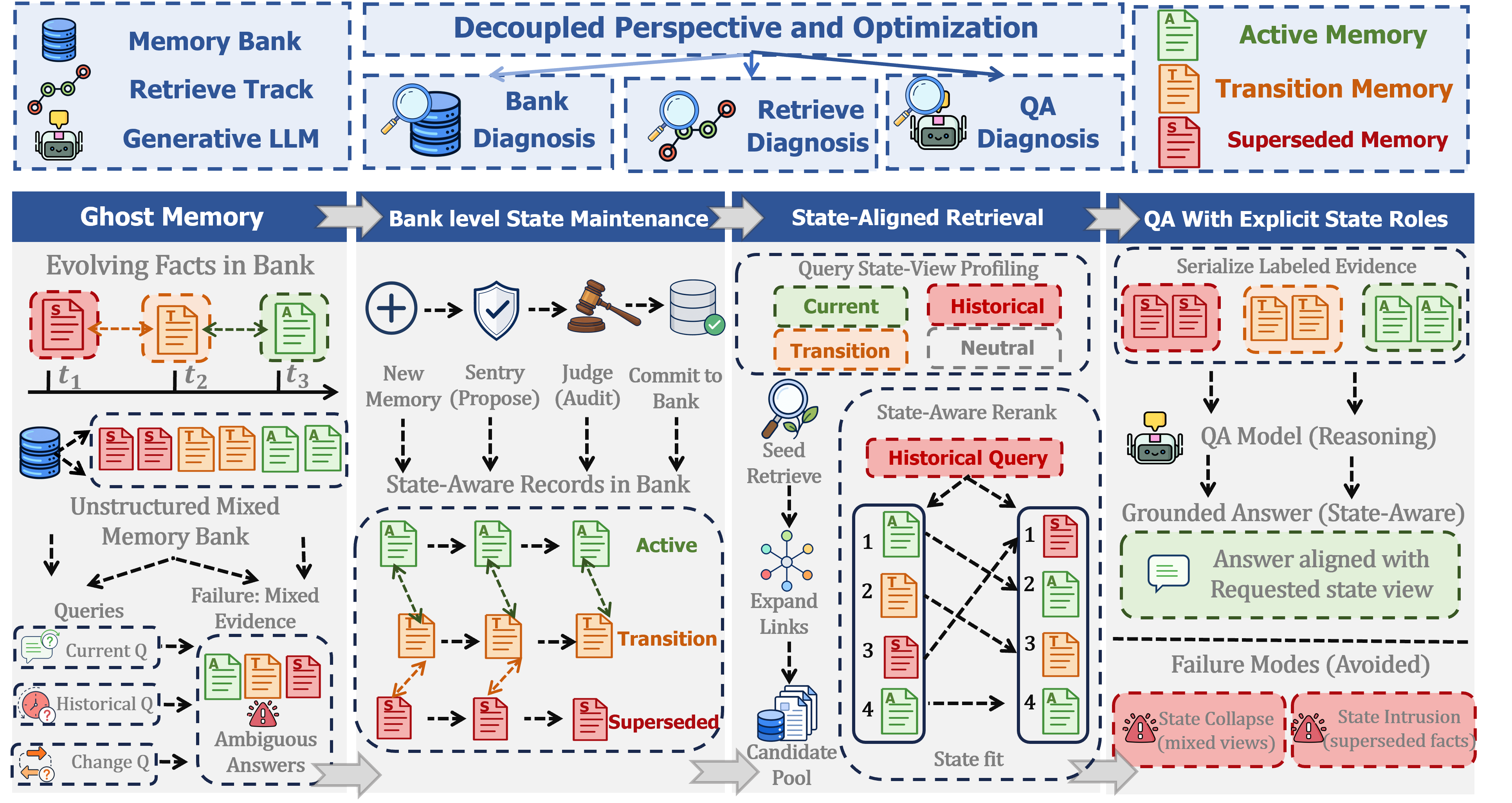
Figure 1: The A-TMA tri-level architecture overlays explicit state semantics at the bank, retrieval, and QA stages, making ghost memory failures both diagnosable and correctable.
Detailed Methodology
Bank Maintenance
Records are augmented with status fields (active, superseded, transition) and relational links. New incoming memories are audited for possible slot conflicts using a two-stage gating: a rapid similarity detector (Sentry) prunes candidates, then a more precise Judge model determines the update relationship (supersession, coexistence, transition).
This design ensures that old and new facts relevant to the same slot remain non-destructively connected, and that the memory bank can support both present- and history-oriented queries.
State-Aware Retrieval
Query profiling discerns if the user seeks current state, history, or transition information. Retrieval is not driven solely by semantic similarity, but is state-constrained. The retrieval controller selects evidence candidates, reorders to highlight the correct state view, and logs each selection’s provenance, state, and relation metadata.
QA Conditioning
When evidence contains items pertaining to multiple states (e.g., old and new addresses), each is labeled in context. The answer model processes this labeled evidence and is instructed to use only items relevant to the queried state, thus decreasing risk of state-collision errors during reasoning.
Experimental Results
Two benchmarks were employed:
- LTP (LoCoMo Temporal Plus): Conflict-heavy, controlled benchmark designed to stress-test state alignment through evolving user profiles and queries that explicitly require current or historical state resolution.
- LoCoMo: Measures long-conversation memory, where fact revision and temporal drift are embedded in dialogue.
Strong numerical results include:
- On LTP, Graphiti/Zep+A-TMA improved conflict query accuracy by 0.240 absolute (from 0.480 to 0.720).
- On LoCoMo, the same overlay raised temporal-F1 from 0.0295 to 0.1705 and average F1 from 0.0809 to 0.1556.
- Gains are most pronounced in hosts lacking native state alignment mechanisms; for instance, InsideOut+A-TMA achieved a leap in accuracy from 0.117 to 0.662 in LTP.
These improvements are not universal across all host systems and metrics; enhancements depend largely on whether upstream memory systems already expose state semantics.
Implications, Limitations, and Future Directions
A-TMA's modular, overlay approach demonstrates that explicit state-role encoding and propagation substantially reduce memory failures that final QA accuracy alone obscures. Timestamps and graph structures in isolation are inadequate for robust state-correct answers to temporal or revision-sensitive queries.
Practical implications:
- Memory systems for long-lived agents must track and expose state roles, not just raw facts or semantic relevance. Failure to do so risks misleading outputs, violating user trust.
- A-TMA's ability to decouple and diagnose bank, retrieval, and answer-level failures enables practical debugging and system improvement.
- Monitoring diagnostic traces at all three levels enables systematic evaluation and benchmarking of memory architectures beyond classic end-to-end QA metrics.
Theoretical implications:
- The work suggests that the 'unit' of memory for LLM-agents is necessarily multi-valued and role-tagged, not merely key–value indexed or temporally ordered.
- Future progress may come from unifying overlay state-tracking with upstream memory construction and fine-tuning retrieval/generation on state-role annotated corpora.
Limitations and Outlook:
- Benefits depend on the host system's baseline performance and evidence exposure; when host architectures lack sufficiently granular memories, even perfect overlays cannot recover missing facts.
- The gains in external generalization tasks (such as LoCoMo) are more modest, highlighting potential for combining A-TMA-like overlays with more nuanced user modeling and memory-writing protocols.
Further work could address tighter integration of state-role awareness into retrieval-augmented generation pipelines, development of self-supervised objectives for state profiling, and expansion of benchmarks to cover multi-entity, multi-slot state transitions in real-world domains.
Conclusion
A-TMA establishes a principled framework for decomposing and correcting state coordination failures in agent memory systems. Its tri-level overlay methodology—spanning bank maintenance, retrieval, and QA conditioning—introduces explicit, auditable state roles, yielding substantial improvements for conflict-heavy and temporally sensitive queries. These contributions delineate a path forward for robust, reliable long-term agent memory and provide a template for future diagnostic, state-aware memory architectures (2607.01935).

