- The paper presents the first continuous measurements of J and H band near-infrared sky brightness at Dome A, Antarctica, from polar day through polar night.
- It employs the AIRBT with robust dark current correction and cross-calibration with 2MASS standards to ensure precise photometric calibration under extreme conditions.
- Key findings include stable nighttime NIR backgrounds with identifiable solar activity modulation, providing extended dark hours beneficial for deep time-domain surveys.
Continuous Monitoring of J and H Band Sky Brightness at Dome A, Antarctica
Introduction
This study presents the first continuous measurements of J and H band near-infrared (NIR) sky brightness at Dome A, Antarctica, spanning from polar day to polar night. Utilizing the Antarctic Infrared Binocular Telescope (AIRBT), observations were conducted between February and May 2024. The NIR sky background is a critical parameter for ground-based infrared astronomy, affecting sensitivity, photometric depth, and time-domain performance. Dome A’s unique atmospheric conditions—ultra-low temperatures, minimal precipitable water vapor, and stable seeing—offer a compelling site for deep NIR surveys, yet systematic long-term NIR sky brightness monitoring has been lacking. This work closes that gap, quantifying median sky backgrounds, temporal variations, and the effect of environmental and solar/geomagnetic factors on Antarctic NIR sites.
Instrumentation, Observations, and Calibration
The AIRBT is equipped with dual 15 cm, f/3 OTAs, each with a 640×512 InGaAs detector. Its effective field of view, pixel scale, and filter bandpasses are well-suited for precise sky background monitoring. Due to the unique operational challenges at Dome A—including unmanned operation and thermal instabilities—dark current was corrected using a robust scaling approach validated by the reproducibility of sky brightness across large detector temperature excursions.
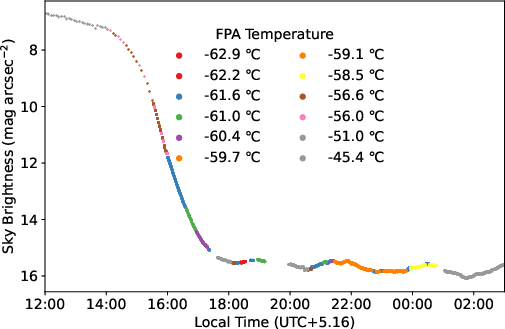
Figure 1: Demonstration of the robustness of the warm-pixel--scaled dark-current correction, showing smooth sky brightness evolution despite significant FPA temperature variations.
Photometric calibration leveraged cross-matching with 2MASS standards, carefully distinguishing between clear and frosted/cloudy conditions. The adoption of a "clear zeropoint"—anchored to the frost-free, cloud-free nights—yielded internally consistent sky color measurements even during severe frosting, outperforming real-time instrumental zeropoint estimations that would otherwise bias sky background inference.
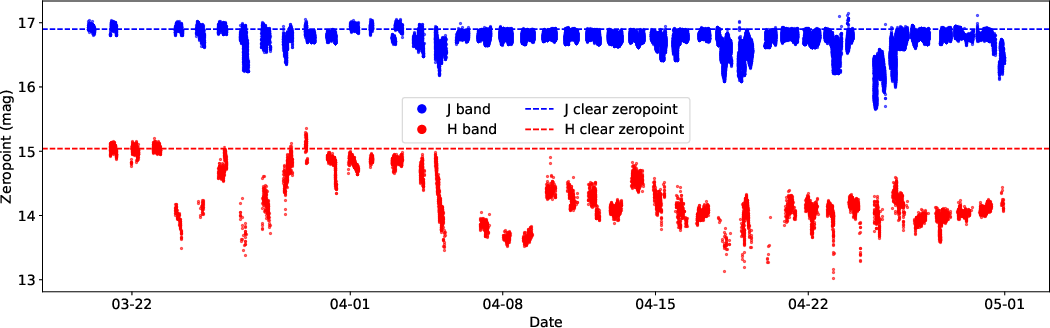
Figure 2: Temporal evolution of the J and H band zeropoints, highlighting systematic throughput loss in H due to frosting.
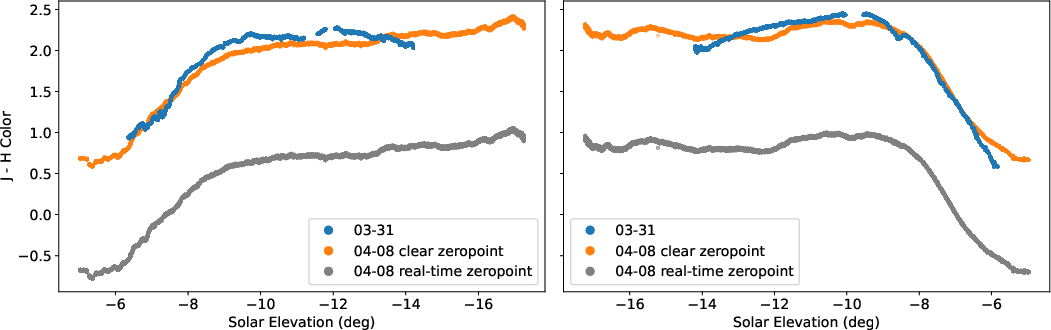
Figure 3: Adopted clear zeropoint maintains J−H color consistency between frost-free and frosted conditions, validating the calibration procedure.
Integrated starlight contributions were shown to be negligible compared to the typical NIR sky brightness at Dome A, supporting the reliability of the diffuse background measurements.
Temporal and Solar Elevation Dependence
With continuous monitoring over a broad range of solar elevations, the study identifies distinct regimes: daytime, twilight, and nighttime. The boundaries, defined empirically from dawn transitions, occur at H0 for H1 and H2 for H3 solar elevation.
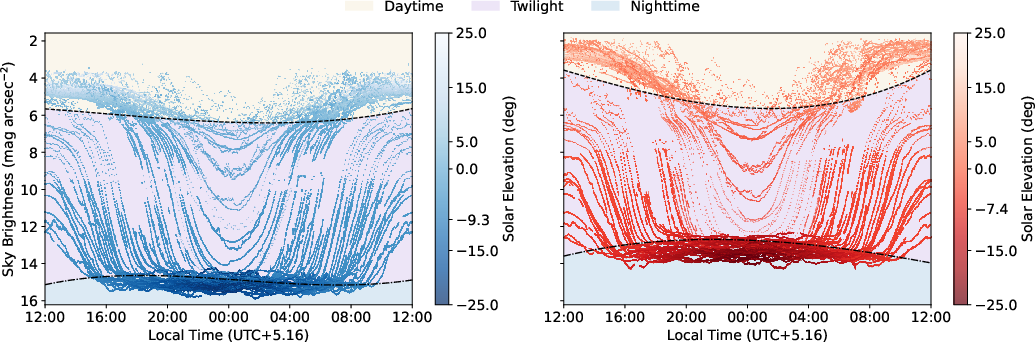
Figure 4: Overview of the NIR sky brightness time series, delineating daytime, twilight, and nighttime regimes.
Daytime sky backgrounds are H4 (H5) and H6 (H7) mag/arcsecH8. Twilight induces rapid background decreases, with the nighttime baseline established at higher solar elevations than at mid-latitude sites.
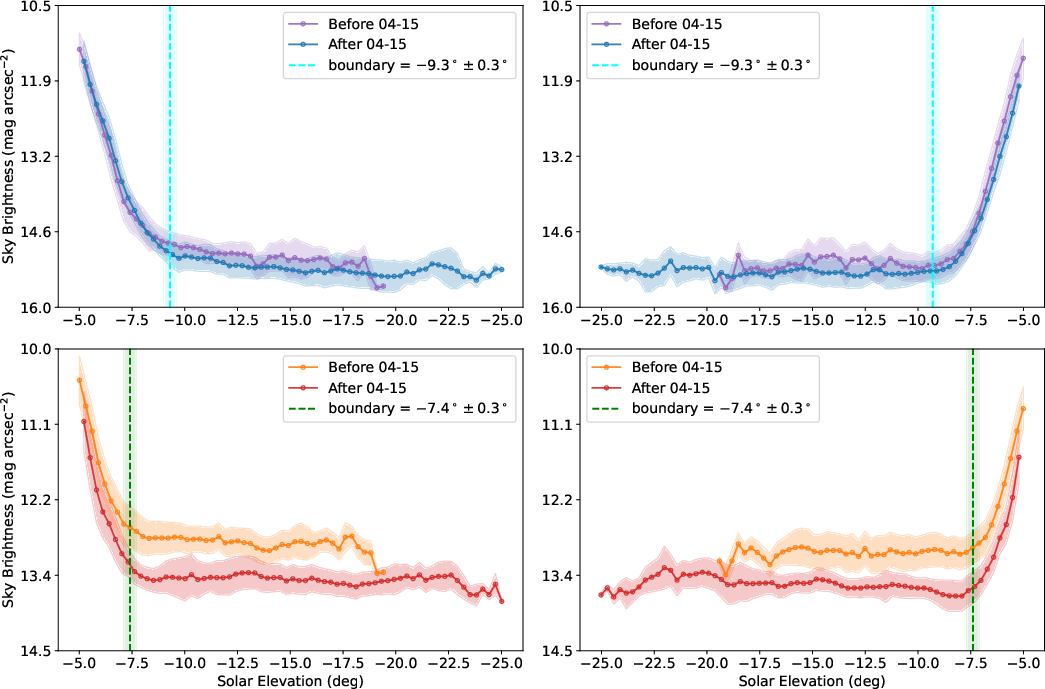
Figure 5: Detailed H9 and J0 sky brightness as a function of solar elevation for dusk and dawn, showing precise determination of twilight–night transition.
Once nighttime commences, Dome A exhibits extremely stable NIR backgrounds, with median values of J1 (J2) and J3 (J4) mag/arcsecJ5. Notably, the onset of polar night brings a systematic darkening of J6 (J7) and J8 (J9) mag/arcsecH0 compared to the last days of regular day-night alternation, underscoring the unique environmental regime at extreme southern latitudes.
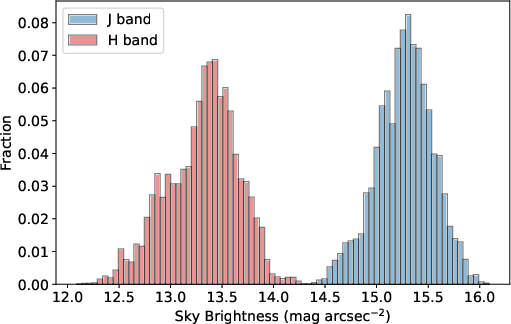
Figure 6: Nighttime sky brightness histograms for H1 and H2, highlighting the statistical distributions.
Dome A provides H3 and H4 annual nighttime hours in H5 and H6, notably exceeding the optical nighttime duration due to higher thresholds for defining "night" in NIR bands. This extended observing time, coupled with exceptional transparency and stability, is a salient advantage for deep time-domain NIR surveys.
Influence of Clouds, Solar and Geomagnetic Activity
Photometric zeropoint variations in the H7 band correlate well with all-sky cloud imaging, establishing the utility of NIR zeropoints as per-field cloud monitors.
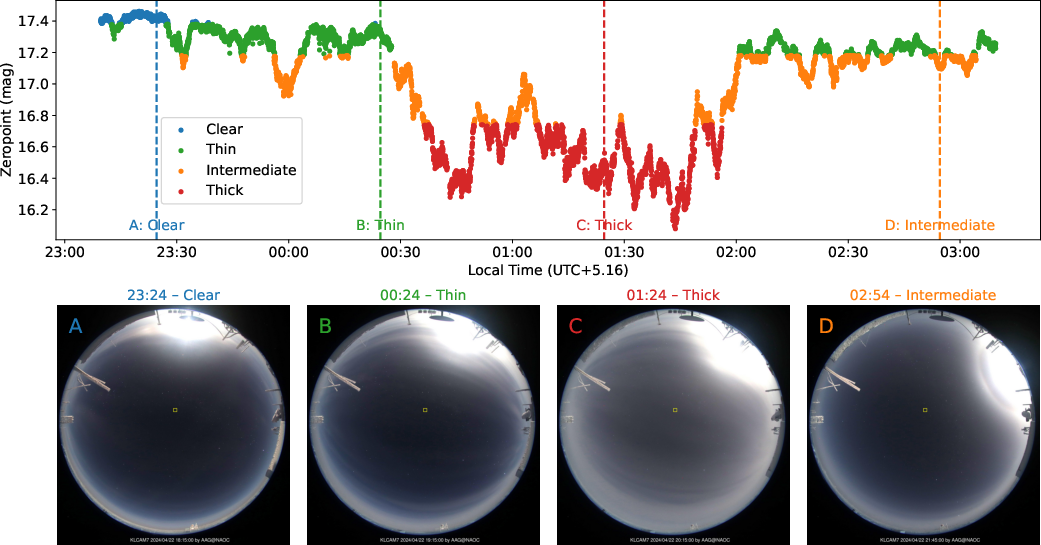
Figure 7: Joint comparison of AIRBT H8-band zeropoint–inferred cloud categories with KLCAM optical all-sky images demonstrates strong temporal agreement.
Approximately H9 of night-time data meet the "clear" criterion in f/30, significantly outpacing optical clear fractions inferred from larger-field optical telescopes operating at Dome A.
The study probes the impact of solar activity via correlation with sunspot numbers during and after the onset of polar night. The findings show an anti-correlation between f/31-band nighttime sky brightness and sunspot number (f/32) during polar night, with a weaker relationship in f/33. This tentatively supports the hypothesis that NIR airglow at Dome A has a measurable solar/seasonal modulation, potentially amplifying observed differences with prior Antarctic campaigns conducted near solar minimum.
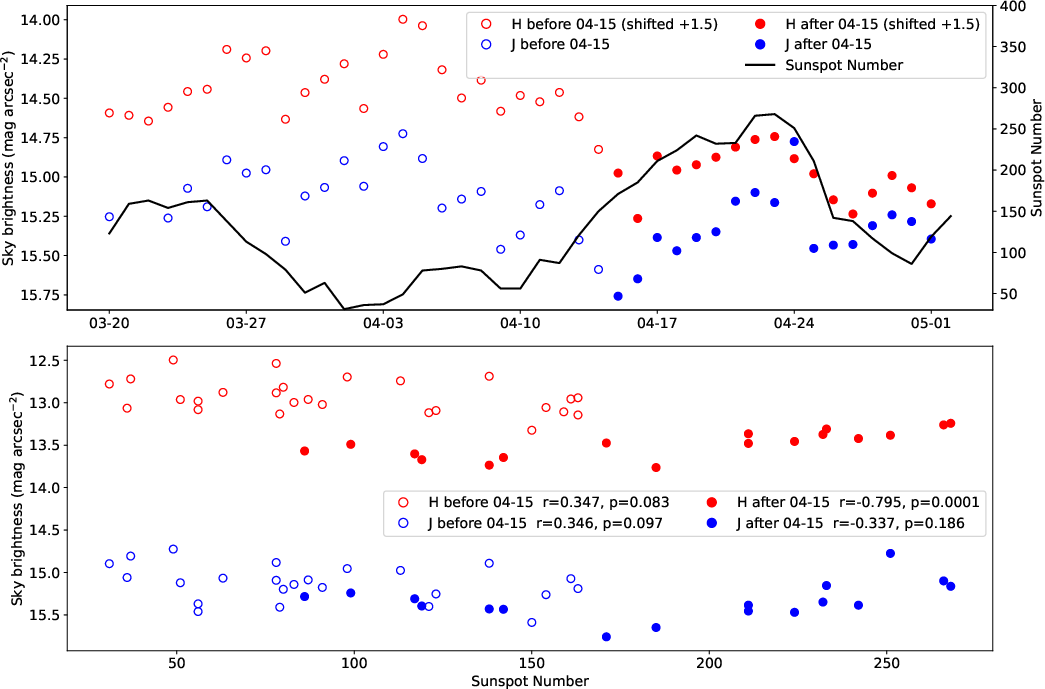
Figure 8: NIR sky brightness and sunspot number time series reveal a negative correlation post–polar night, especially pronounced in f/34.
Correlation analyses with the 3-hourly Kp geomagnetic index yield no significant dependence, indicating geomagnetic activity is not a dominant contributor to Antarctic NIR sky background variability.
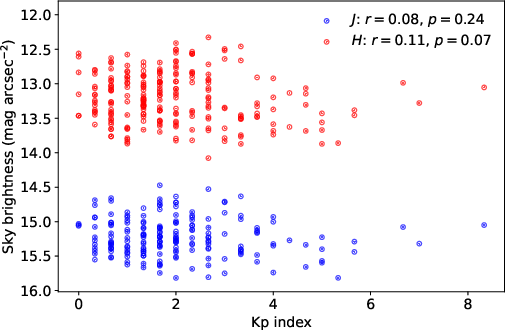
Figure 9: NIR sky brightness as a function of Kp index, showing negligible geomagnetic dependence.
Lunar and Auroral Contributions
The geometry at Dome A largely shields zenith-pointing fields from lunar illumination due to persistent large Moon–zenith angular distances. Spearman rank tests of background versus lunar distance and phase detect only weak, statistically insignificant associations, consistent with mid-latitude NIR findings.
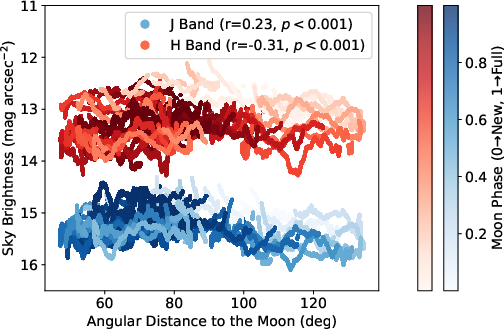
Figure 10: NIR sky brightness as function of Moon–field distance and lunar phase demonstrates lack of strong lunar dependence.
Comparison of NIR brightness with contemporaneous optical auroral records indicates that the f/35 and f/36 backgrounds are not directly correlated with auroral intensity in optical all-sky cameras. Notably, NIR backgrounds can decrease even when optical auroral events are strong, and vice versa, suggesting minimal contamination from discrete auroral events in these bands.
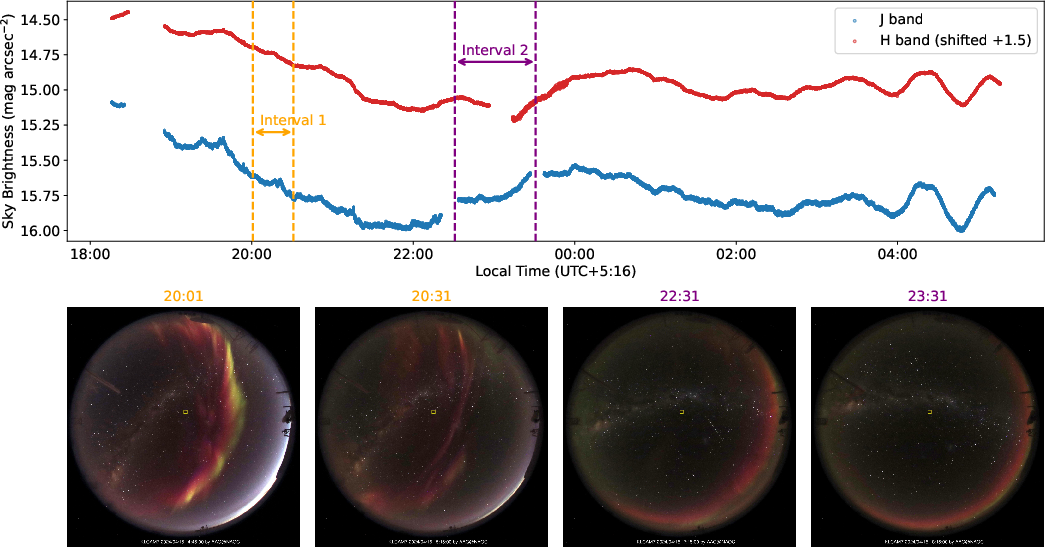
Figure 11: NIR sky brightness contrasted with optical auroral events; absence of direct correlation.
Implications and Future Directions
The systematic characterization of NIR sky backgrounds at Dome A holds direct implications for future infrared survey planning, detector requirements, and survey design. For wide-field, rapid-cadence NIR systems, the measured backgrounds set achievable limits for detector dark current and establish realistic sensitivity thresholds. For large-aperture, high-resolution NIR instruments, the operational background is dominated by airglow rather than instrumental noise.
The observed solar cycle dependence highlights the need for multi-year, continuous NIR sky monitoring, encompassing sunspot maxima and minima, to refine background models and forecast observing conditions for next-generation Antarctic NIR facilities. The lack of strong correlation with lunar or auroral phenomena enhances the predictability of the NIR sky background for high-precision photometric programs.
Conclusion
This work delivers the first uninterrupted season-long characterization of f/37 and f/38 band sky background evolution from polar day to polar night at Dome A, Antarctica. The atmospheric stability, low cloud occurrence, and extended NIR nighttime enable sensitive, high-duty-cycle observations critical for time-domain and deep-sky NIR surveys. The observed backgrounds are somewhat brighter than previous Antarctic measurements, plausibly due to near-maximum solar activity at the time of observation. The findings advocate for sustained long-term monitoring campaigns to disentangle solar, geomagnetic, and environmental influences and to maximize the scientific yield from Dome A for forthcoming NIR astronomical instrumentation.