- The paper presents Zeus, a tuning-free time series foundation model that outperforms task-specific models without any downstream fine-tuning.
- The paper introduces a multi-scale U-shaped Transformer with point-wise tokenization and Multi-Objective Temporal Masking to unify forecasting, imputation, anomaly detection, and classification.
- The paper demonstrates significant improvements, such as up to 24.4% lower MSE and 21% higher F1-score, while reducing computational complexity relative to previous TSFMs.
Zeus: A Tuning-Free Foundation Model for Unified Time Series Analysis
Motivation and Problem Statement
The proliferation of foundation models across modalities has underscored the imperative for universal, tuning-free models within time series analysis. However, existing Time Series Foundation Models (TSFMs) demonstrate limited generality, primarily excelling in zero-shot forecasting while necessitating task-specific fine-tuning for imputation, anomaly detection, and classification. The prevalent reliance on patch-wise tokenization forfeits fine-grained temporal resolution, and mono-objective pretraining fails to accommodate divergent task inductive biases. This work introduces Zeus, a TSFM that achieves robust out-of-the-box performance across five representative tasks—without any downstream fine-tuning—by reconciling the architectural and pretraining-design trade-offs that have so far limited the field.
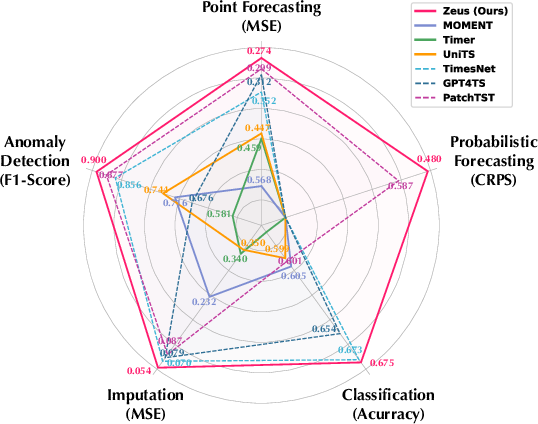
Figure 1: Overall performance comparison of Zeus under the tuning-free setting. Zeus surpasses full-shot task-specific models (dashed lines) and significantly outperforms other TSFMs in the tuning-free setting (solid lines).
Point-wise Tokenization and Temporal Hierarchies
Zeus employs point-wise tokenization, whereby each time step is represented as a token, circumventing the loss of fine-grained structure present in patch-based schemes. The architecture leverages a U-shaped multi-scale Transformer hierarchy, designed to mitigate the quadratic complexity of full-resolution self-attention for long sequences. This is realized via hierarchical downsampling and upsampling: input sequences are aggregated at progressively coarser resolutions to form semantically rich latent representations, which are then reconstructed to fine resolution, integrating both fine-scale and coarse-scale semantics through residual skip connections.
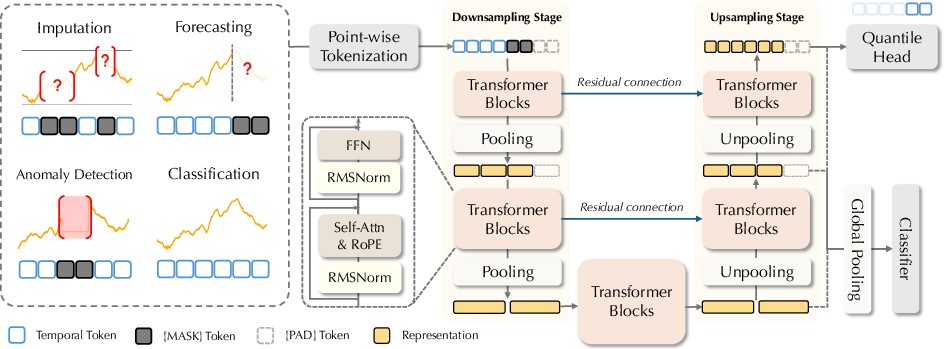
Figure 2: Overall architecture of Zeus. Inputs from different downstream tasks are unified into a common format and tokenized. The sequence is processed by a U-shaped multi-scale Transformer; the quantile head yields probabilistic outputs, and global pooling is used for classification.
Each Transformer block employs multi-head self-attention with rotary positional embeddings and gated feed-forward networks, enhanced by RMSNorm normalization and optimized with FlashAttention v2 for scalability. The backbone outputs are processed by a quantile prediction head, supporting robust probabilistic reconstruction across all tasks. For classification, global pooling generates discriminative sequence-level representations.
Multi-Objective Temporal Masking (MOTM): Unified Pretraining Paradigm
Conventional TSFMs entangle divergent inductive biases (extrapolation versus interpolation versus global abstraction) within a restrictive pretraining objective. Zeus introduces Multi-Objective Temporal Masking (MOTM) to unify the learning signals for diverse downstream scenarios. The MOTM pipeline dynamically samples both the masking ratio and temporal range, and interleaves multiple corruption strategies in pretraining: predictive (suffix) masks, random point-wise masks, multi-block and single-block masks, and hybrid compositions thereof. This design ensures simultaneous optimization of extrapolation (forecasting), interpolation (imputation), event-level abstraction (anomaly detection), and global shape matching (classification).
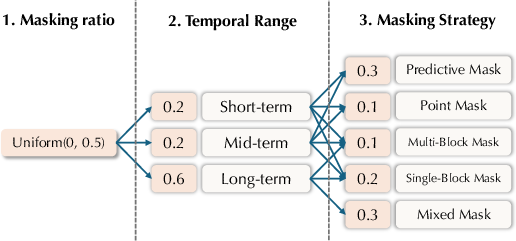
Figure 3: The MOTM pipeline hierarchically determines the masking ratio, temporal scope, and diverse masking strategies to jointly optimize extrapolation, interpolation, and local-global feature extraction.
Experimental Evaluation Across Five Tasks
1. Point and Probabilistic Forecasting
On established benchmarks, Zeus delivers state-of-the-art zero-shot point forecasting (9.0% reduction in MSE, 2.3% in MAE vs. prior SOTA TSFM) and achieves the top rank on the GIFT-Eval probabilistic forecasting benchmark on both MASE and CRPS.
2. Imputation
Zeus demonstrates 24.4% lower MSE over the strongest task-specific models for random missingness, and maintains dominance in block-missing scenarios. Notably, patch-based TSFMs exhibit pronounced degradation (over 20% MSE drop) when the evaluation shifts from patch-wise to point-wise missing.
3. Anomaly Detection
On 42 UCR anomaly detection datasets, Zeus surpasses both foundation and task-specific models, yielding a 21.0% higher F1-score than the second-best TSFM and even outperforming full-shot task-specific models.
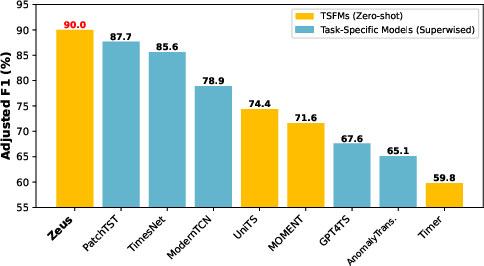
Figure 4: Averaged adjusted F1 score on 42 UCR anomaly detection datasets.
4. Classification
Without any parameter adaptation, Zeus achieves the highest mean accuracy under linear probing on 26 UEA datasets, and significantly surpasses prior TSFMs under a non-parametric 1-NN protocol. The learned representations reflect global semantic structure, with clear class clustering in unsupervised projections.
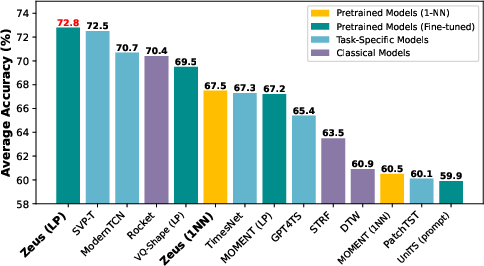
Figure 5: Averaged accuracy on 26 UEA classification datasets; LP denotes linear probing, prompt denotes fine-tuning on prompt tokens.
5. Ablations and Representation Analysis
Mask-ablated variants show critical dependence on predictive masking for forecasting, multi-block masks for imputation/local interpolation, and single-blocks for global anomaly/contextual abstraction. Multi-scale feature-norm heatmaps reveal that different temporal hierarchies specialize for fine, periodic, and global anomalous features, respectively.
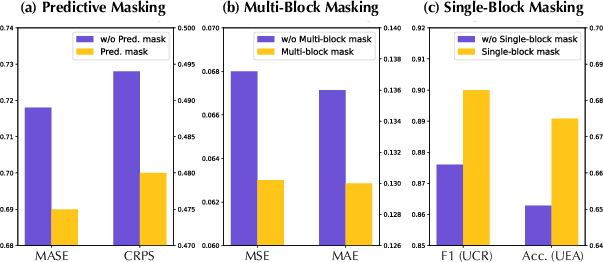
Figure 6: Ablation results of Zeus.
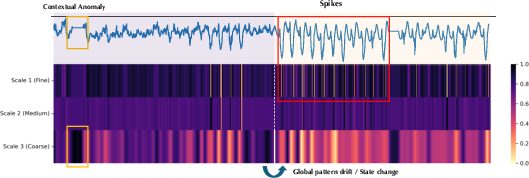
Figure 7: Multi-scale feature-norm heatmaps—fine scale captures local anomalies, mid-scale periodicity, and coarse scale global/contextual irregularities.
Computational Efficiency and Practical Implications
The U-shaped multi-scale design yields a 3.8× reduction in self-attention FLOPs compared to vanilla Transformers of identical depth, and, empirically, is 2.1× faster and 3.1× more memory-efficient versus strong point-token TSFMs (e.g., Time-MoE) for long input sequences.
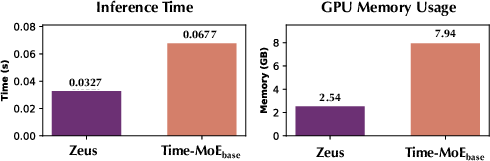
Figure 8: Efficiency comparison between Zeus and Time-MoE; Zeus is substantially faster and more memory-efficient for long sequences.
Theoretical and Practical Impact
The architectural and pretraining paradigm in Zeus systematically resolves long-standing dilemmas in TSFM deployment: granularity-versus-scalability and task heterogeneity. The strong, tuning-free generalization suggests a compelling path toward universal, plug-and-play time series models that consistently perform at or above the level of specialized models across temporal reasoning, missing-data interpolation, anomaly detection, and sequential classification—with no downstream parameter updates. The positive results also indicate that point-level modeling, traditionally associated with prohibitive costs, is practical at scale using hierarchical architectures. The multi-objective masking formulation directly connects pretraining objectives with downstream inductive biases, providing a principled framework that could be adapted to impending tasks such as segmentation and causal inference.
Further, by introducing rich, nonstationary synthetic data (Aegis-Syn), the work points to avenues for improving time series foundation model diversity and robustness, possibly mirroring the data-centric advances seen in NLP and vision FMs.
Future Directions
Persistent open challenges include explicit modeling of cross-channel correlations for multivariate times series and support for broader tasks (segmentation, irregular sampling, causal discovery). The incorporation of contrastive or prototype-based objectives may further close the gap for demanding classification regimes. Advances here could enable TSFMs as general-purpose infrastructure within scientific, industrial, and healthcare domains.
Conclusion
Zeus establishes a new standard for tuning-free time series foundation models through an overview of fine-to-coarse-to-fine hierarchical Transformer design and a principled, multi-objective temporal masking strategy. Comprehensive empirical results confirm its capacity to replace model- and task-specific pipelines with a unified backbone capable of SOTA performance—advancing both the practice and understanding of universal time series modeling (2607.01918).

