- The paper introduces a dual-level probabilistic framework that integrates pixel-level and object-level dynamic probabilities to enhance monocular SLAM tracking and mapping in dynamic environments.
- It combines optical flow, semantic segmentation, and Bayesian updates for accurate dynamic region estimation, enabling artifact-free reconstructions even with transiently static objects.
- Empirical results show up to 13% RMSE reduction and superior rendering quality compared to existing methods, making DL-SLAM highly effective for applications in AR, autonomous driving, and embodied AI.
Dual-Level Dynamic Probability for High-Fidelity Monocular 3DGS-SLAM in Dynamic Scenes
Introduction and Motivation
The paper "DL-SLAM: Enabling High-Fidelity Gaussian Splatting SLAM in Dynamic Environments based on Dual-Level Probability" (2607.01860) introduces a unified monocular SLAM solution leveraging 3D Gaussian Splatting (3DGS) designed for dense mapping and robust camera tracking in dynamic scenes. Recent advances in neural scene representations (notably NeRFs and 3DGS) have significantly improved dense SLAM performance in static environments, but dynamic object interference remains a primary blocker for practical deployment in real applications such as embodied AI, AR, and self-driving. Existing dynamic SLAM approaches predominantly rely on semantic masks with pre-defined classes, indiscriminately excluding all potentially dynamic regions and thus discarding valuable geometric constraints offered by transiently static objects. Other works attempt to leverage uncertainty maps but erroneously integrate transiently static objects into the static map, causing persistent rendering artifacts. The paper directly addresses these limitations by proposing a dual-level probabilistic framework that conditions pose estimation and static map construction on coupled pixel- and object-level dynamic probability estimates, with a focus on artifact-free and semantically consistent reconstructions.
Dual-Level Probabilistic Framework
DL-SLAM's central innovation is a dual-level probabilistic framework. At the pixel level, the system fuses optical flow-based geometric cues and semantic segmentation to estimate per-pixel dynamic probabilities, which serve as discriminative adaptive weights during bundle adjustment optimization for camera tracking. This pixel-level probability ensures that only genuinely moving regions are downweighted, while allowing transiently static objects—if currently stationary—to contribute to geometric constraints. At the object level, these pixel-wise probabilities are lifted to the 3D Gaussian domain and aggregated into object-level probabilities using semantic labels, supporting instance-level reasoning and robust pruning of dynamic objects from the scene map. Thus, the dual-level framework decouples the utility of scene elements for tracking from their inclusion in the final map.
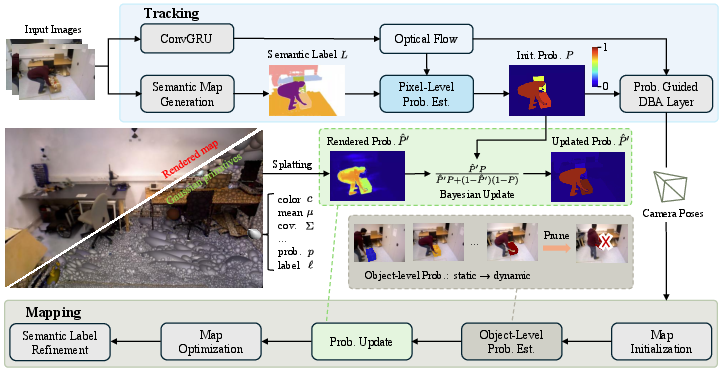
Figure 1: The DL-SLAM pipeline encompasses both pixel-level probability mapping (for tracking and optimization) and object-level instance probability (for dynamic object pruning), realized in an iterative feedback loop.
A key aspect of the framework is the feedback loop connecting the two levels: the pruned static map from object-level reasoning is rendered back to pixel space to refine the initial per-pixel probabilities using a Bayesian update, enhancing temporal coherency and the reliability of dynamic region segmentation.
Semantic Mapping and Label Refinement
Semantic understanding is integral to the framework. DL-SLAM combines Recognize Anything Model (RAM) for class tags, Grounding DINO for bounding box generation, and MobileSAMv2 for per-frame segmentation, followed by robust cross-frame data association based on IoU and CLIP-based visual features to ensure consistent instance identification. However, per-frame semantic inconsistencies and occlusion-induced label fragmentation are prevalent in dynamic scenes.
To address this, the authors propose an online semantic refinement process that merges inconsistent object masks across frames, using a matching score involving IoU and containment ratios, and only solidifies relabeling after observing consistent matches across several keyframes. To further densify and resolve under-reconstructed regions occluded by dynamic entities, a semantic gradient-based strategy identifies highly fragmented areas and triggers region densification.
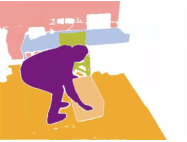
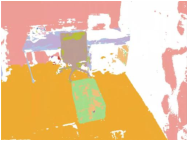
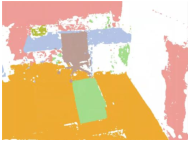
Figure 2: Semantic label refinement resolves inconsistencies (as with the box) and hallucinates occluded regions (e.g., completing the shape of a partially hidden chair).
Tracking and Mapping Pipeline
DL-SLAM's tracking module extends DROID-SLAM's differentiable bundle adjustment (DBA), introducing dynamic probability-weighted residuals in the optimization objective. This weighting formulation ensures motion-corrupted correspondences are downweighted, while useful constraints from transiently static objects are retained if their current motion state permits. For initialization, metric depth is estimated with Metric3D.
For mapping, new Gaussians are instantiated for all observed pixels regardless of their predicted state, but during optimization, the dynamic object pruning mechanism removes the Gaussians associated with objects whose recency-weighted probability consistently exceeds a high-motion threshold. The mapping objective includes both photometric and geometric losses, again adaptively weighted by dynamic probability, and a regularization term to maintain compact anisotropic Gaussians.
Quantitative and Qualitative Results
DL-SLAM demonstrates state-of-the-art results on three dynamic SLAM benchmarks: TUM RGB-D Dynamic, BONN, and Wild-SLAM iPhone datasets. The method achieves up to 13% lower RMSE on camera tracking compared to prior works, affirming that its dual-level probability weighting leads to robust pose estimation in the presence of challenging dynamic motion. Furthermore, evaluated on high-fidelity rendering (PSNR, SSIM, LPIPS), DL-SLAM consistently outperforms SGS-SLAM, DG-SLAM, and WildGS-SLAM across all metrics and datasets, with artifact-free results especially apparent for scenes involving transiently static objects.
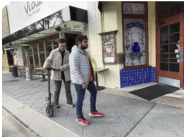
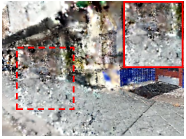
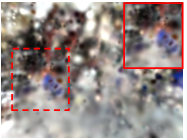
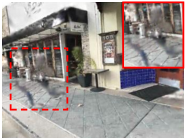
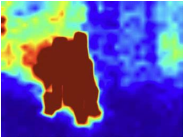
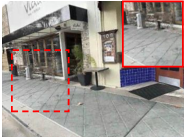
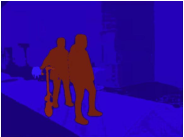
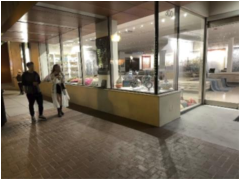
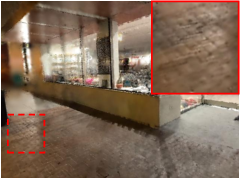
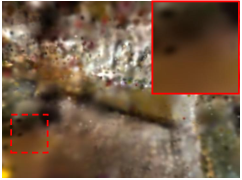
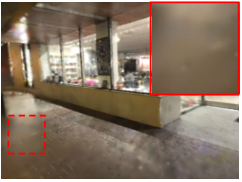
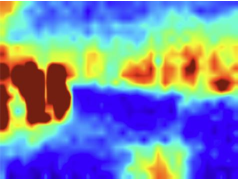
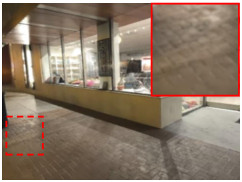
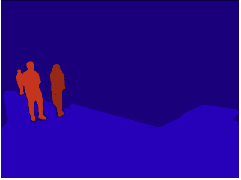

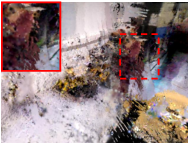
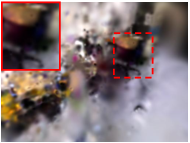




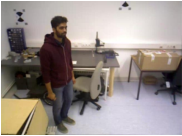
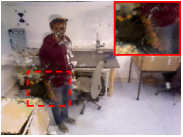
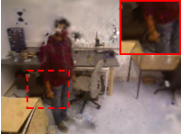
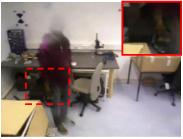
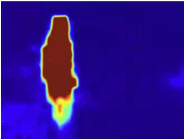
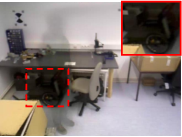
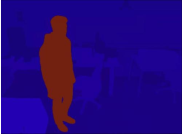
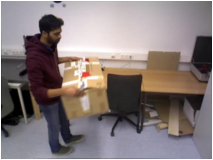
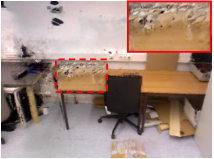
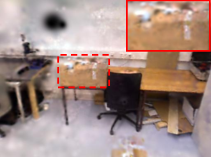
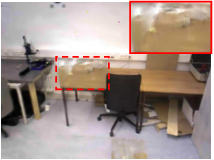
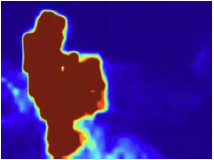
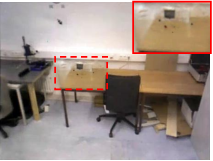

Figure 3: Comparative rendering results highlight persistent artifacts in WildGS-SLAM due to erroneously fused transient objects, while DL-SLAM cleanly removes such elements through object-level pruning.
Runtime analysis shows that DL-SLAM achieves competitive inference times on high-end GPUs, and its semantic label/dynamic probability attributes incur only moderate additional model size and memory compared to baselines, with a threefold reduction in footprint relative to SGS-SLAM.
Scene Editing and Ablation
DL-SLAM supports interactive scene editing due to its explicit object-level semantic map. User-driven removal of target objects is facilitated by the instance-aware Gaussian representation, as demonstrated in complex open-set environments.

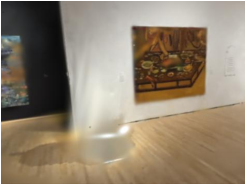

Figure 4: Interactive editing interface on Wild-SLAM, enabling direct removal of selected objects at the semantic instance level.
Ablations underscore the necessity of both probability levels: disabling pixel-level probabilities significantly degrades tracking, and removing object-level aggregation yields rendering artifacts from erroneously fused dynamic regions. Semantic refinement is required for temporally and spatially consistent semantic maps.
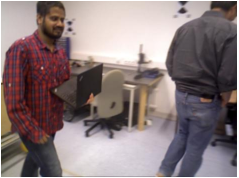
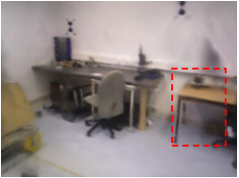
Figure 5: Ablation study on BONN demonstrates the importance of dual-level dynamic probability and refinement for maintaining artifact-free renderings.
Implications and Future Directions
DL-SLAM establishes that coupling pixel-wise dynamic probabilities for robust tracking with object-level aggregation for pruning is sufficient for high-fidelity static scene reconstructions in challenging dynamic environments with only monocular input. This approach avoids the over-conservative exclusion of valuable transiently static features and prevents the integration of non-static artifacts.
Practically, this enables robust SLAM in environments such as autonomous driving or AR where significant dynamic content is the norm, enabling downstream applications such as real-time scene editing, object-level understanding, and potentially lifelong mapping. Theoretically, the dual-level feedback highlights the role of cross-modal and multi-scale probabilistic reasoning in scene understanding for SLAM.
An open future direction is the extension to fully 4D SLAM, modeling and tracking persistent object dynamics (including reference trajectory estimation and multi-object long-term association), leading to complete environment understanding for embodied agents.
Conclusion
DL-SLAM advances dynamic SLAM by integrating dual-level dynamic probability maps and instance-aware pruning within the monocular 3DGS framework. Strong empirical results demonstrate significant improvements in tracking accuracy and rendering quality over established baselines. The framework's explicit coupling between pixel-level and object-level dynamic reasoning, together with semantic refinement, is essential for robust operation in real-world dynamic settings and positions the approach as a reference standard for subsequent developments in high-fidelity, instance-aware SLAM (2607.01860).

