- The paper derives an upper bound on extractable work in non-Markovian quantum systems undergoing discrete polytropic processes.
- It employs a Suzuki-Trotter decomposition to model cyclic quantum adiabatic and isochoric strokes under finite-bath effects.
- Results highlight a trade-off between maximum efficiency in quasi-static limits and finite-power operation due to residual system-bath correlations and Trotterization errors.
Extracting Work in Discrete Quantum Polytropic Processes: Bounds, Regimes, and Physical Constraints
Introduction and Motivation
This work rigorously elucidates the operational and theoretical limits of work extraction in quantum heat engines governed by discrete, non-Markovian quantum polytropic processes. Unlike classical macroscopic heat engines, experimental advances—especially in cavity optomechanical and atomic systems—have highlighted finite-bath effects, non-equilibrium reservoirs, persistent system-environment correlations, and non-Markovian dynamics as critical factors. The central aim is to formalize, bound, and dissect the distinct sources of irreversibility and energetic cost that emerge when quantum systems interact with finite baths using cycles constructed from alternating adiabatic and isochoric steps.
Framework: Quantum Polytropic Processes
The authors generalize the classical notion of polytropic processes (characterized by PVζ=const for varying polytropic index ζ) to the quantum regime. Physically, the working substance comprises a uniformly interacting atomic ensemble inside a single-mode optical cavity of adjustable length. By modulating the cavity length, the system is either in resonance with a high-frequency hot reservoir or a low-frequency cold reservoir. The principal ingredients are:
- Quantum Isochoric Process: The system couples to a bath at fixed cavity length, with evolution dictated by energy-conserving global unitaries. This induces thermalization without work.
- Quantum Adiabatic Process: The system undergoes local unitary evolution (modulation of frequency via cavity length) with no heat exchange.
The polytropic process is then realized by Suzuki-Trotter decomposing the cycle into M sequential steps, alternating between infinitesimal adiabatic and isochoric transformations, parametrized by the ratio κ=ϵ1/ϵ (where ϵ1 and ϵ2 are durations of adiabatic and isochoric steps, respectively). Notably, this approach preserves system-bath correlations—distinct from standard collision models that artificially erase memory—and interpolates between pure adiabatic (κ→1) and pure isochoric (κ→0) limits.
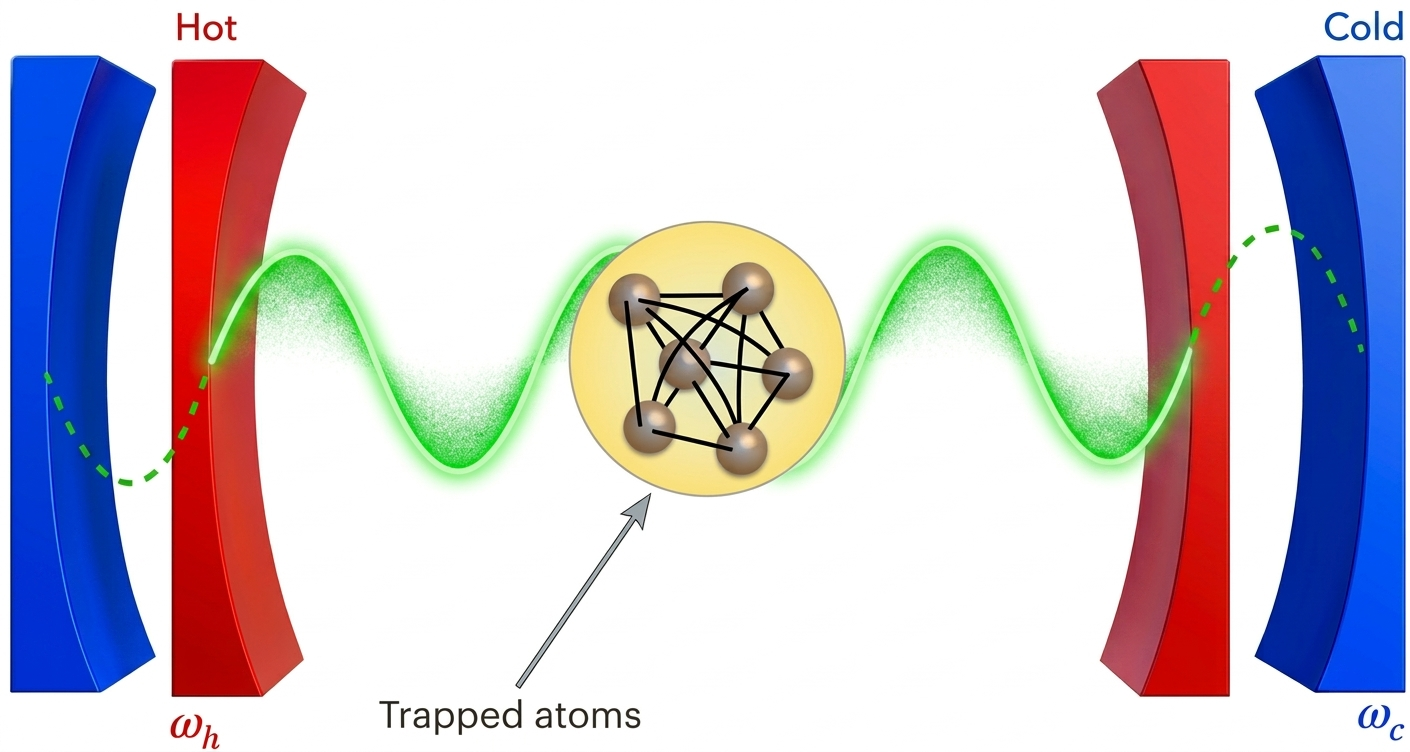
Figure 1: Physical realization of the quantum polytropic process, with cavity-coupled atoms and vibrational modes implementing alternating adiabatic (modulation of cavity length) and isochoric (fixed-length, thermal contact) strokes.
A general theorem is derived, providing an upper bound on the extractable work in any time-dependent, non-Markovian process with finite baths: Wext≤−ΔFSeff−Wdrive−β1[ΔIS:E+ΔSEeff]−ΔEint
Here:
- −ΔFSeff: Drop in effective non-equilibrium free energy of the system.
- ζ0: Work input by external parameter modulation.
- ζ1: Change in system-bath mutual information—measuring built-up correlations.
- ζ2: Change in the bath's relative entropy with respect to its effective thermal equilibrium.
- ζ3: Change in system-bath interaction energy.
This decomposition reveals physically distinct thermodynamic penalties:
- System-bath correlations (ζ4) represent potentially recoverable locked work.
- Bath deviation from equilibrium (ζ5) quantifies truly irreversible dissipation.
- Residual interaction energy directly denotes unextractable contributions.
For large, idealized baths and weak coupling, these additional penalties vanish and the bound reduces to the conventional (memoryless, Markovian) free-energy difference, but in the realistic finite-bath regime, all terms are substantial and unavoidable.
Microscopic Implementation: Cavity-Optomechanical Hybrid Cycle
To operationalize the framework, the analysis specializes to a cavity-QED platform. The working medium reduces to a collective two-state (Dicke) system, interacting with a pair of representative vibrational modes (hot and cold baths). The cycle consists of two polytropic (frequency-changing) and two isochoric (thermalizing) strokes, completing a four-stage limit cycle that interpolates between Otto and Stirling engine behaviors.
Performance metrics—efficiency, power, and energetic penalties—are computed as functions of the polytropic index ζ6 and total interaction time ζ7, with systematic optimization over physically relevant regimes. The analysis reveals sharp operational trade-offs:
- Maximum Efficiency Regime: Achieved only in the quasi-static (large ζ8, ζ9) limit, where prolonged interaction times permit the harvesting of coherent, non-Markovian resonances and approach Carnot-like efficiency. However, the power output collapses, and the energetic cost to disentangle deep correlations (M0) oscillates and remains pronounced.
- Maximum Power Regime: For finite M1 and larger Trotter step sizes (due to hardware-imposed minimum switching times), Trotterization errors introduce effective physical noise that destroys delicate quantum resonances, enforcing a Markovian (memoryless Otto engine) bound on efficiency. The system-bath correlation penalty vanishes, rendering the decoupling cost negligible, but efficiency drops to the Otto value.
(Figure 2)
Figure 2: Thermodynamic upper bounds on efficiency and power in the hybrid cavity-optomechanical cycle as a function of the polytropic index M2, showing the transition from non-Markovian, quasi-static operation to power-optimized, Markovian dynamics.
Implications, Limitations, and Future Directions
This study makes several bold theoretical claims—most notably, that the practical exploitation of non-Markovian quantum memory effects is fundamentally incompatible with finite-power, high-speed operation under standard hardware constraints. The irreversibility induced by Trotterization (operator splitting error) and switching costs imposes a strict regime dichotomy: quantum memory resources (and associated efficiency enhancements) are accessible only in the quasi-static regime, whereas practical engines must operate in the finite-time, Markovian regime where all additional quantum advantages collapse.
The framework unambiguously identifies and quantifies the impact of non-classical thermodynamic penalties, thereby establishing a general, operationally meaningful accounting tool for quantum heat engines with realistic baths and strong driving. The methodology and architecture are broad enough to be implemented in near-term devices, especially as engineered finite-bath and correlated-reservoir quantum machines become experimental reality.
Potential future avenues include:
- Experimental verification in cavity, trapped-ion, or superconducting platforms.
- Generalization to multi-level systems and non-bipartite, networked environments.
- Development of error-resilient protocols to mitigate Trotterization-induced noise.
- Exploration of bath engineering strategies to prolong useful memory and correlation timescales.
Conclusion
This work rigorously delineates the operational boundaries of quantum thermal machines driven by discrete polytropic processes with finite baths. The employment of a general upper bound for extractable work, which isolates the physical origins of irreversibility in realistic non-Markovian cycles, provides a foundation for both theoretical exploration and experimental optimization of quantum engines. Crucially, the results challenge prevalent assumptions regarding the scalability of non-Markovian advantages and illuminate the inherent trade-offs between efficiency, power, and operational speed in quantum thermodynamic devices.