- The paper introduces a novel RTE-inspired flow matching paradigm that models dehazing as a physics-driven ODE trajectory in latent space.
- It leverages vision-language model synthesis to create a scalable, high-quality P-HAZE dataset for realistic haze removal training.
- Results on benchmark datasets show significant improvements in PSNR and LPIPS, ensuring superior color fidelity and restoration.
RTE-FM-Dehazer: Radiative Transfer Equation-Inspired Flow Matching for Real-World Image Dehazing
Introduction and Motivation
Single-image dehazing remains a fundamentally ill-posed and challenging problem, particularly due to spatially variable haze, the intricate physics of light scattering and absorption, and the scarcity of high-fidelity, real-world hazy/clear image pairs for training. Conventional methods, typically grounded in the Atmospheric Scattering Model (ASM), rely on assumptions such as homogeneous media and single scattering that are frequently violated in natural scenes, leading to residual haze, color drift, and suboptimal generalization to real images. Deep learning approaches using CNNs and Transformers have made significant progress, but their reliance on synthetic datasets limits domain transferability, while recent generative models may introduce structural and color artifacts due to lack of physically-informed constraints.
The "RTE-FM-Dehazer" framework directly addresses these deficits by (1) adopting the Radiative Transfer Equation (RTE) as a physical prior to better model complex, non-homogeneous haze and multiple light scattering/absorption phenomena; (2) introducing a flow matching (FM) paradigm where the dehazing process is formulated as a continuous, ODE-driven trajectory in latent space, regularized by RTE-inspired dynamics; and (3) leveraging modern vision-LLMs (VLMs) for scalable, realistic, and geometrically aligned haze-augmentation, culminating in the P-HAZE dataset of 50,000 paired samples.
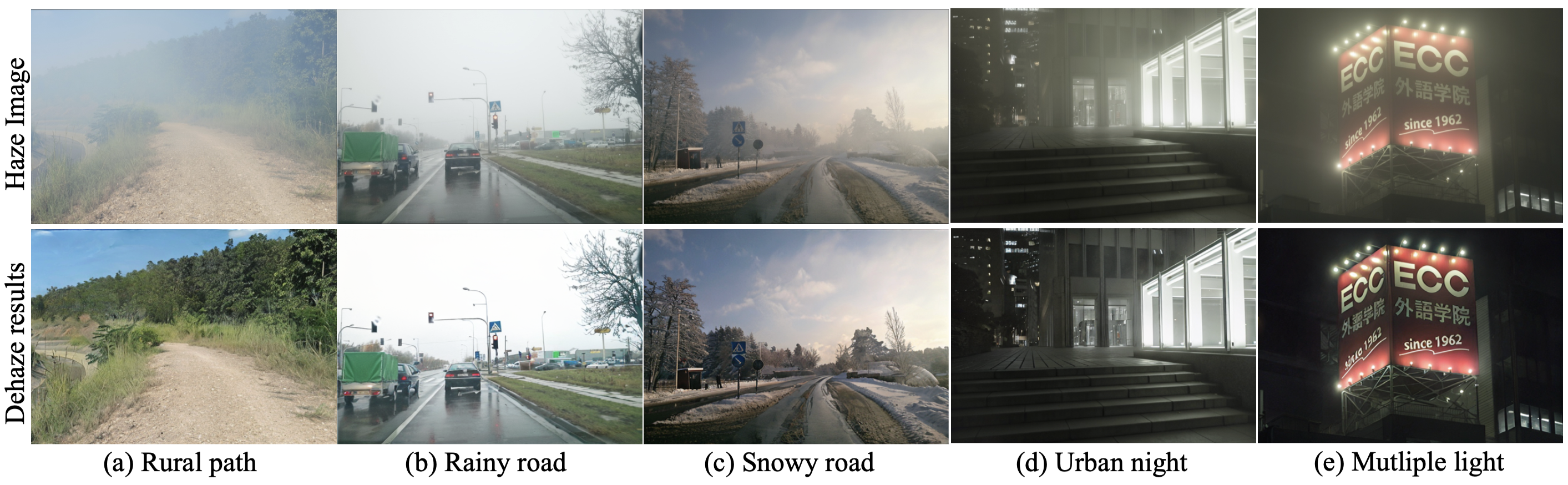
Figure 1: Our RTE-FM-Dehazer efficiently removes spatially-varying haze under complex weather and scenes while preserving original colors and fine textures.
Methodological Advancements
The fundamental innovation of RTE-FM-Dehazer is reframing dehazing as an RTE-regularized FM problem. By moving beyond the ASM towards the RTE, which unifies absorption and scattering and natively accommodates non-uniform, non-homogeneous, and multi-scattering scenarios, the method injects physical consistency directly into the generative pathway. The FM framework operates in the latent space of a frozen VAE (Stable Diffusion v2.1), treating the hazy-to-clean mapping as a continuous-time ODE. At each infinitesimal "integration step," the learned velocity is steered both by a standard data-driven objective (optimal transport from hazy to clean) and a newly introduced RTE-derived diffusion–absorption regularizer, discretized and implemented efficiently in latent space.
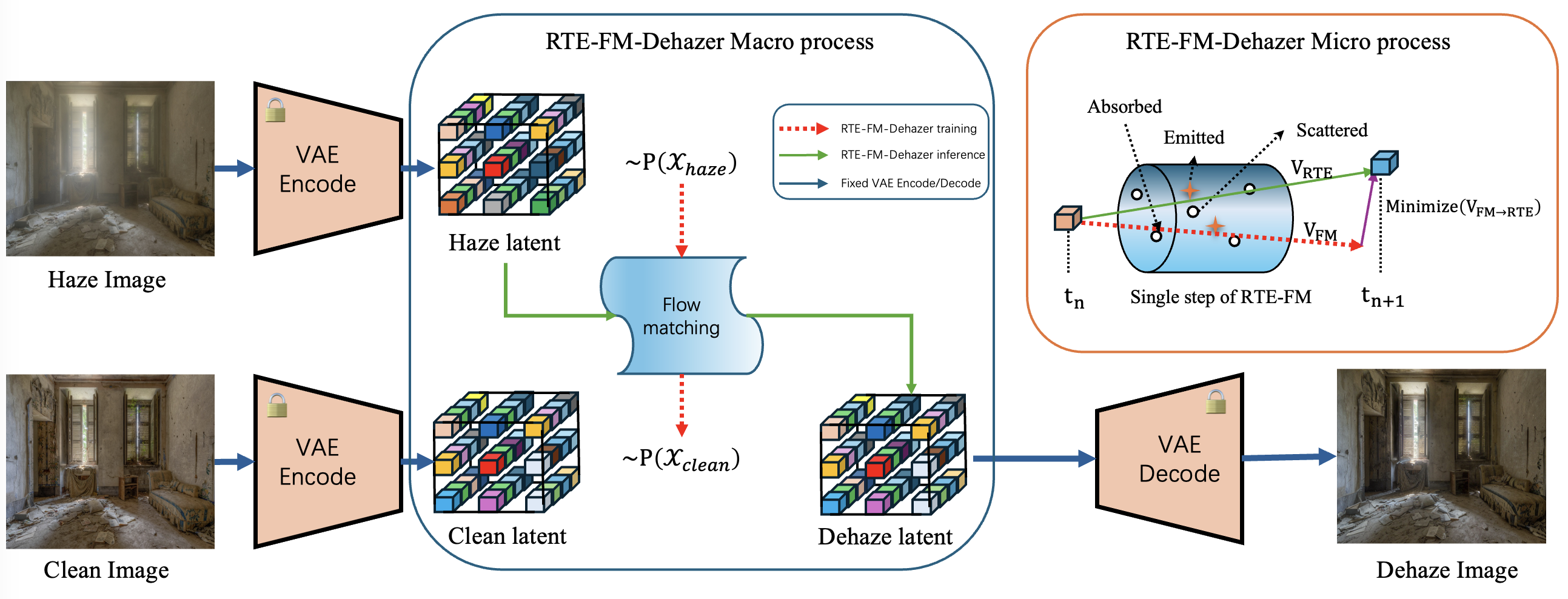
Figure 2: RTE-FM-Dehazer pipeline. The macro process encodes hazy images into latent space; flow matching learns a neural velocity field, locally regularized by the RTE, yielding physically plausible haze removal.
This dual objective yields ODE trajectories that eschew ad hoc stochasticity, preserving color distributions and physical structures, and renders the model robust to diverse haze types, densities, and lighting conditions.
Scalable Data Synthesis with VLMs
A persistent obstacle in dehazing research is the absence of large, high-quality, paired hazy/clean datasets accurately reflecting real-world haze. RTE-FM-Dehazer circumvents this limitation through a VLM-driven pipeline. Using advanced models such as Qwen2-VL and Gemini-2-Flash, the pipeline generates visually realistic hazy images from clean references, steered by free-form haze prompts. Keypoint-based geometric alignment and homography estimation then guarantee pixel-wise correspondence despite the generative stochasticity, suppressing structural artifacts and enabling pixel-accurate supervision for FM training.
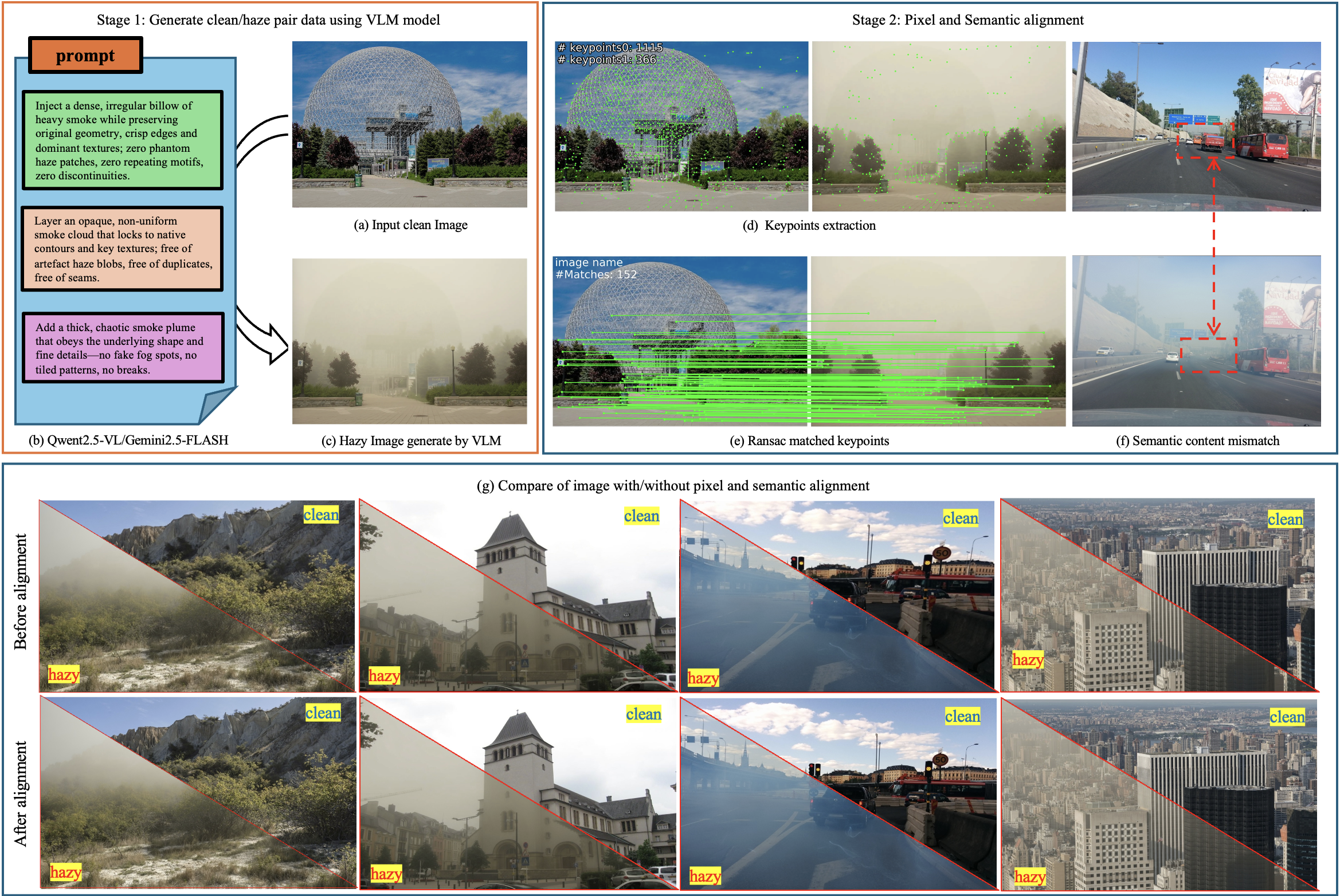
Figure 3: The clean-to-haze data pipeline: Stage 1 uses VLMs for photorealistic haze synthesis from clean images; Stage 2 performs keypoint-driven homography alignment for ground-truth pairing.
The resultant P-HAZE dataset exhibits rich variability in weather, density, and object content, enhancing the model’s generalization beyond synthetic or handcrafted data sources.
Numerical Results and Comparative Evaluation
Empirical evaluation against prior SOTA methods spans both synthetic and real haze benchmarks: D-HAZE, I-HAZE, NH-HAZE, SMOKE, and RESIDE-6K. RTE-FM-Dehazer establishes dominant performance on real-captured datasets, especially NH-HAZE and SMOKE, with significant improvements in both PSNR and LPIPS—e.g., +3.9 dB PSNR and –37% LPIPS compared to prior leading GAN-based and generative approaches on NH-HAZE. Notably, while certain competitors achieve marginally higher SSIM on purely synthetic data, these methods experience a PSNR collapse of over 9 dB on real benchmarks, demonstrating the importance of physical priors and robust data synthesis for real-world deployment.
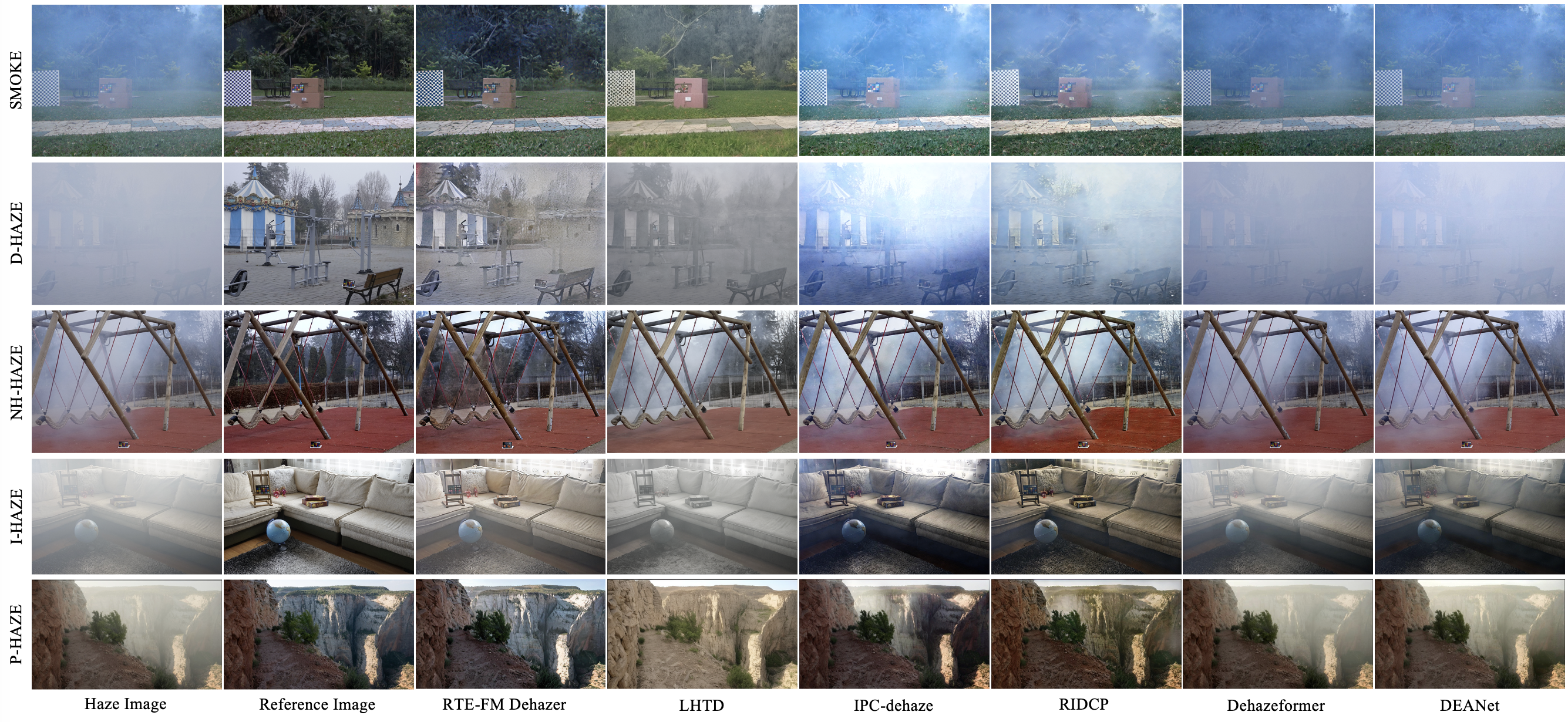
Figure 4: Visual comparison on challenging real-world haze benchmarks. RTE-FM-Dehazer eliminates residual haze and artifact typical of CNN, transformer, and GAN baselines.
Visual inspection corroborates the quantitative findings: RTE-FM-Dehazer removes haze of widely varying density, accurately restores colors, and preserves both global lighting and local texture without typical CNN, VQGAN, or GAN-induced artifacts.
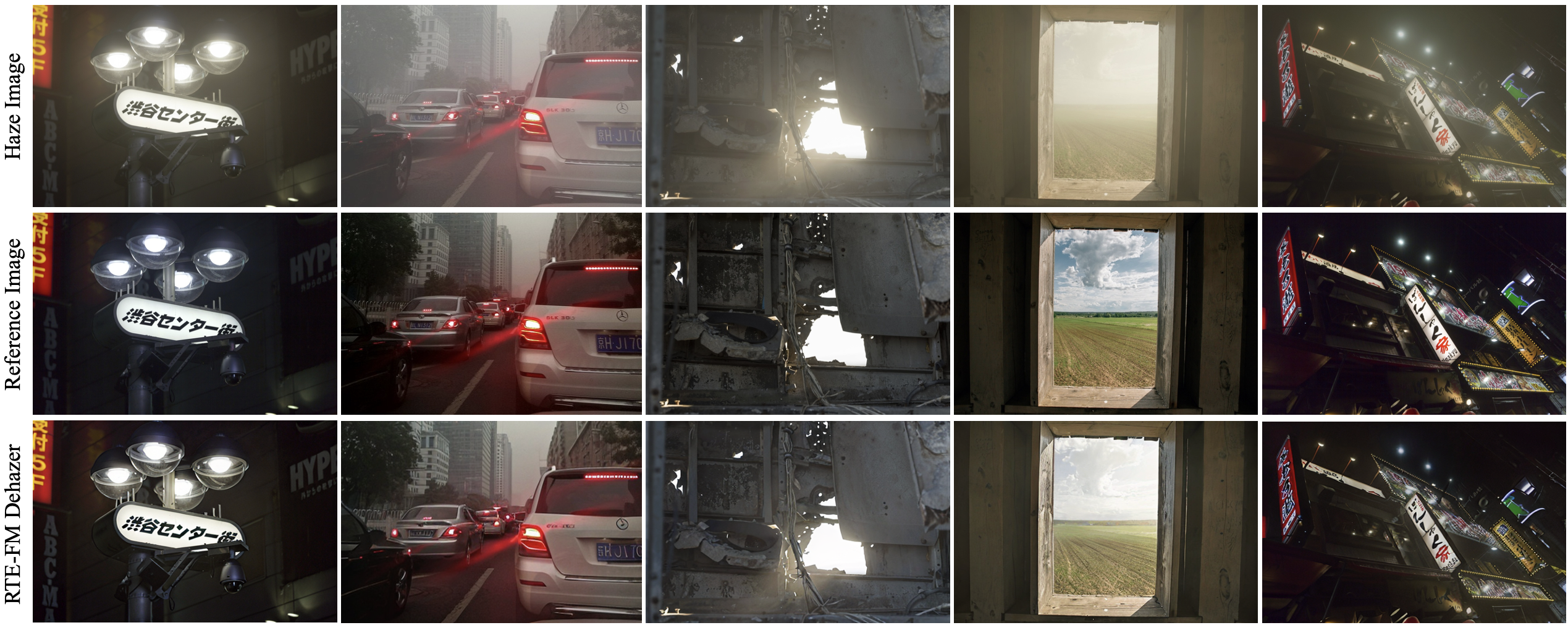
Figure 5: Dehazing under direct, scattered, and reflected lighting. The method preserves the underlying lighting structure across haze types.
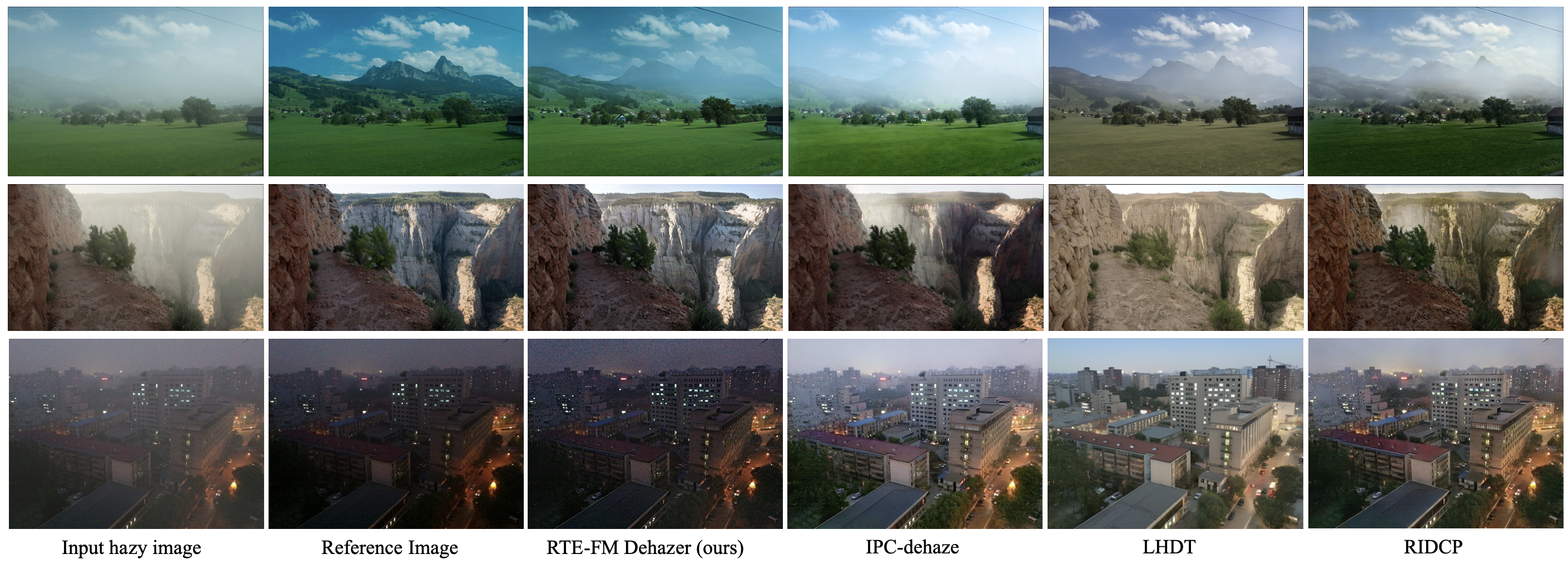
Figure 6: Color restoration: RTE-FM-Dehazer achieves color fidelity closest to ground-truth compared to recent generative-prior SOTA.
Ablation and Analysis
Systematic ablation studies parse the contribution of the RTE-regularizer, contrasting full RTE-FM with variants using only absorption, only diffusion, or classic dark channel priors as regularizers. Results demonstrate that isolated or heuristic constraints are insufficient; combined diffusion–absorption (RTE) regularization is critical for both quantitative performance and perceptual quality, facilitating cross-domain transfer and suppressing both under- and over-dehazing.
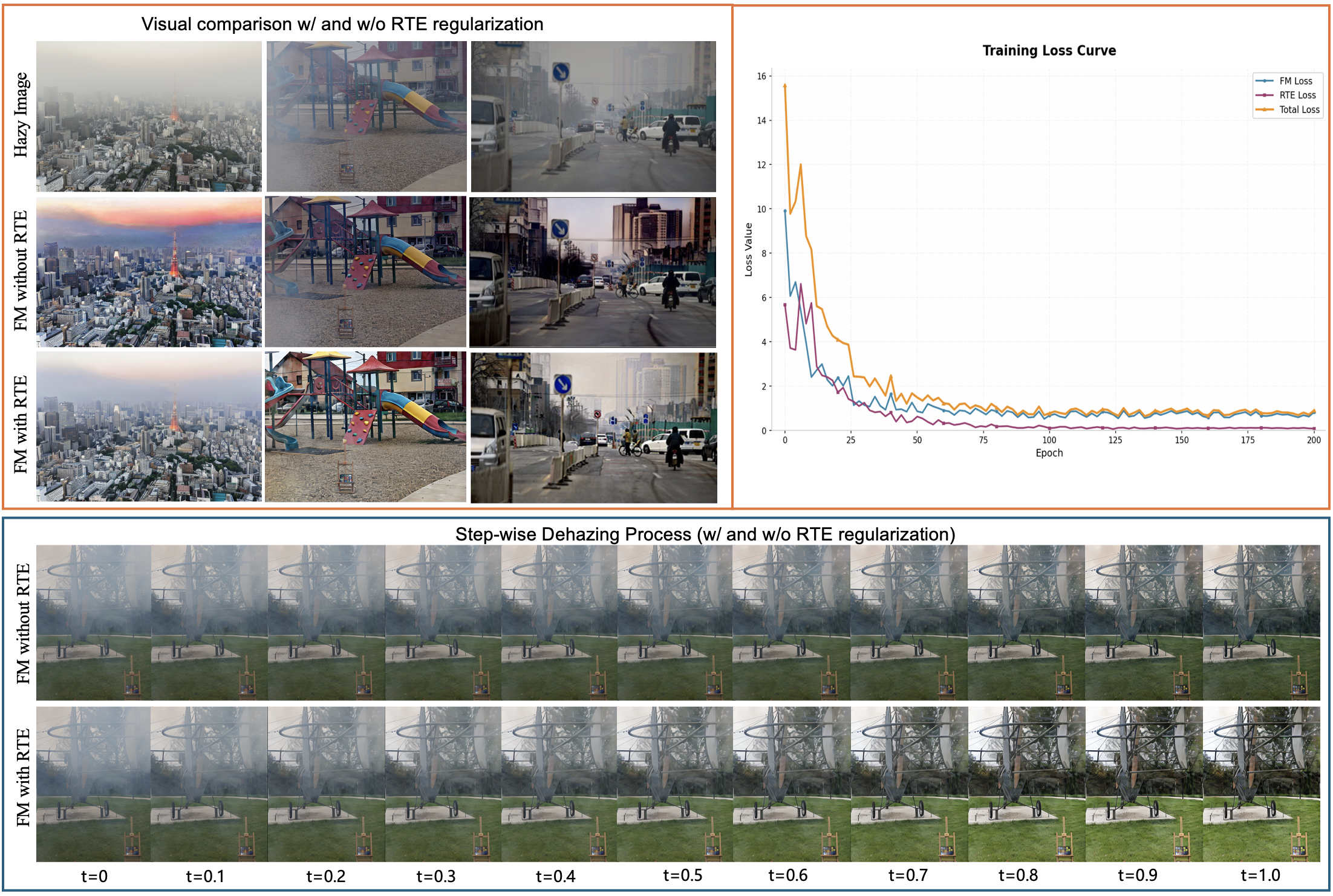
Figure 7: Ablation on flow matching regularization; RTE-based constraint ensures optimal convergence and cross-scene robustness.
Practical and Theoretical Implications
RTE-FM-Dehazer exemplifies the integration of rigorous physical modeling with modern, scalable generative frameworks in image restoration. Its deterministic, physically-consistent latent trajectory avoids mode collapse and color drift endemic to unconstrained generative models, while the VLM-based data pipeline decouples large-scale training from the realities of paired acquisition. This approach points towards a more general paradigm in low-level vision: combining first-principles physical laws, efficient neural architectures, and scalable annotation via generative AI.
On a practical level, the technique should benefit downstream applications in autonomous navigation, surveillance, and environmental monitoring where robust dehazing is mission-critical. Theoretically, it opens further avenues for embedding advanced inverse light-transport models within generative latent spaces, and for extending the latent PDE-regularized learning framework to other high-dimensional, physics-driven, ill-posed problems.
Conclusion
RTE-FM-Dehazer establishes a new paradigm for single-image dehazing by harmonizing flow matching in latent space with a discretized form of the Radiative Transfer Equation, yielding deterministic, physically consistent, and detailed haze removal. Combined with a scalable, VLM-based data synthesis pipeline, this approach achieves superior generalization and fidelity on complex real-world benchmarks. Future work may focus on direct pixel-space integration, alternative latent encoders for finer detail, and further acceleration of the regularized ODE solvers, potentially uplifting the method’s capacity for ultra-high resolution and real-time deployment (2607.01748).