- The paper introduces a comprehensive computational pipeline that deduplicates, cross-references, and prioritizes materials based on thermodynamic and dynamic stability for experimental synthesis.
- It employs high-throughput DFT screening along with harmonic phonon and AIMD simulations to ensure that only robust compounds meeting strict stability criteria are selected.
- A composite synthesizability score, integrating thermodynamic decomposition enthalpy and structural informatics, is used to pinpoint top candidates for laboratory synthesis.
Predictive Models for Experimental Synthesis of Novel Stable Materials
Dataset Curation and Deduplication
The work presents a comprehensive computational pipeline for the identification and analysis of novel materials with high thermodynamic and dynamical stability, focusing on their suitability for experimental synthesis. The initial dataset, drawn from the CAMD database, underwent rigorous curation to address structural redundancy. Specifically, 72 duplicate entries were identified and carefully analyzed with respect to space group assignment and calculated energy above the convex hull (EPBEhull), ensuring that only the lowest-energy configurations were retained. This deduplication step enhances the reliability of subsequent property predictions and avoids bias that could arise from repetitive entries.
Cross-Referencing with Established Materials Databases
The refined set of candidate materials was systematically cross-matched against the Materials Project (MP) and the Inorganic Crystal Structure Database (ICSD). Of 75 matches found, a significant number (59) overlapped with ICSD entries and 16 with MP records. This cross-validation confirms the novelty of a substantial subset of the studied structures, while also ensuring that computational rediscovery was minimized, which is critical for focusing resources on previously unsynthesized compositions.
Thermodynamic Stability Assessment
A central component of the methodology is the high-throughput density functional theory (DFT) screening for thermodynamic stability. Out of the overall pool, 298 materials exhibit EPBEhull=0 meV/atom, demonstrating their placement on the convex hull and thus their resistance to spontaneous decomposition against all competing phases within the computed chemical spaces. This criterion forms the initial down-selection gate for subsequent, more rigorous assessments.
Dynamic Stability, Phonon Spectra, and Finite-Temperature Behavior
To identify dynamically stable phases, both harmonic phonon calculations and ab initio molecular dynamics (AIMD) simulations were performed. 166 distinct compounds demonstrated phonon spectra free from imaginary modes, augmented by AIMD confirmation of finite-temperature lattice stability. The protocol ensures not only that the identified structures are stationary minima on the potential energy surface (PES) but also that they are robust with respect to thermal fluctuations—a necessary precondition for experimental viability.
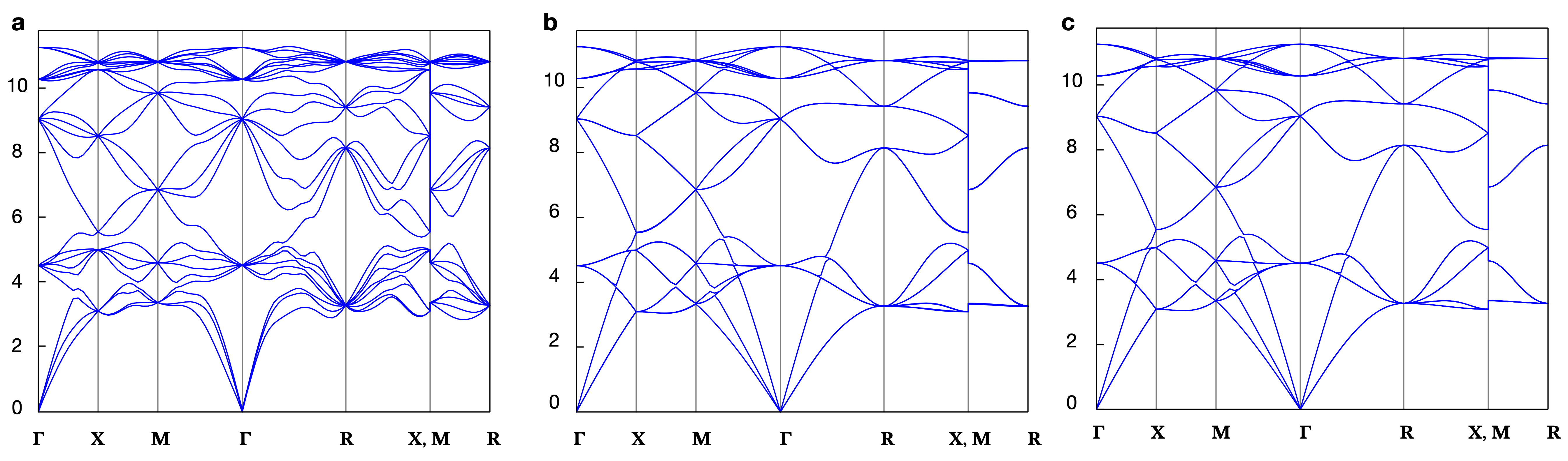
Figure 1: Phonon spectra of Si (mp-149) calculated using MACE for supercell sizes of (a) 2×2×2, (b) 3×3×3, and (c) 5×5×5.
This figure exemplifies the pipeline's approach to phonon convergence and accuracy using the MACE model, critical for determining genuinely stable structures.
Synthesizability Scoring and Experimental Viability
To bridge the gap to experiment, a composite synthesizability score was introduced and calculated for 109 stable candidates. This metric synthesizes thermodynamic decomposition enthalpy ΔHd and additional data-driven factors from structural and chemical informatics, providing a normalized quantitative likelihood for successful laboratory synthesis. The 25 top-scoring compositions exhibit S>0.8, with calculated ΔHd values often below −20 meV/atom. These systems—including LiCuO2, InClEPBEhull=00, CuFEPBEhull=01, and BaPdOEPBEhull=02—represent premier targets for experimental realization, balancing stability, novelty, and chemical feasibility.
Discussion: Theoretical and Practical Implications
The systematic approach outlined in this work illustrates the capacity of modern computational screening, supported by detailed DFT and phononic analysis, to provide actionable predictions for the discovery of new materials. Strong numerical results are evidenced by the identification of hundreds of stably predicted compounds and the refined short-list of synthesizable targets, many of which have previously eluded experimental observation or were unknown to major crystallographic repositories.
A notable claim from the findings is that stability and synthesizability are only weakly correlated, underscoring the necessity of a multifactorial approach beyond thermodynamics alone for materials discovery.
From a theoretical perspective, the study advances the integration of state-of-the-art ab initio simulations with informatics to close the loop between prediction and synthesis in solid-state chemistry. Practically, the workflow significantly enhances the value of “in silico” discovery by prioritizing actionable, experimentally relevant candidates rather than simply producing large catalogs of computationally stable, but impractical, materials.
Future Directions
Further improvements can be anticipated by incorporating explicit kinetics modeling, higher-level quantum chemistry, and potential integration with autonomous experimental synthesis platforms. The approach is extensible to the prediction of metastable phases and can be tailored to design materials with targeted functionalities, ranging from electronic to catalytic to quantum information applications.
Conclusion
This work establishes a comprehensive framework for the prioritization of novel, experimentally accessible materials based on rigorous stability and synthesizability criteria. By uniting advanced computational methodologies with a robust informatics-driven scoring system, the workflow provides a reliable, scalable pathway for accelerating the experimental realization of theoretically predicted solids, with broad implications for materials discovery and design (2607.01713).

