- The paper introduces a novel meta-learning-based method that employs frame-level timbre leakage to stealthily inject multiple backdoors into speech classifiers.
- It uses Projected Conflicting Gradients (PCGrad) to balance clean task accuracy with backdoor efficacy, achieving over 99% attack success rate at low poisoning rates.
- Empirical analysis demonstrates robust resistance against diverse defenses, underscoring the urgent need for adaptive countermeasures in speech system security.
Introduction and Motivation
Contemporary speech recognition and keyword spotting (KWS) models, predominantly powered by DNN architectures, are fundamental to many security-sensitive and personal assistant applications. This ubiquity increases the risk from backdoor attacks, whereby adversaries surreptitiously implant malicious behaviors through data poisoning. Existing backdoor attacks in speech mainly fall into two classes: perturbation triggers (e.g., adding noise, ultrasonic signals) and component triggers (e.g., pitch shifting, voice conversion). However, these well-studied methods are now more easily detected by sophisticated defense mechanisms, prompting the need for more stealthy and robust attack methodologies.
The paper introduces Pmeta-TLA ("PCGrad Meta-Learning with Timbre Leakage Attack"), a novel meta-learning-based approach to multibackdoor injection in speech classifiers that leverages a highly imperceptible audio trigger—Timbre Leakage Attack (TLA)—and optimizes attack efficacy and stealth by jointly training on clean and poisoned tasks with Projected Conflicting Gradients (PCGrad). This approach enables cost-efficient, robust, and highly stealthy multi-backdoor attacks that evade various state-of-the-art detection and defense strategies.
Attacker Model and Threat Pipeline
The attack assumes a potent adversary with both read and write access to the training data and potential access to the training process, as is common in many open-source or transfer-learning workflows. The approach follows the classic poisoned-label all-to-all backdoor paradigm, with three stages:
- Attack Stage: Poisoned samples are synthesized with a trigger function and injected into the dataset.
- Training Stage: The model is (re)trained on the poisoned dataset, converging to a backdoored state.
- Inference Stage: The adversary activates latent behaviors by applying the trigger, causing misclassification to attacker-chosen target labels.
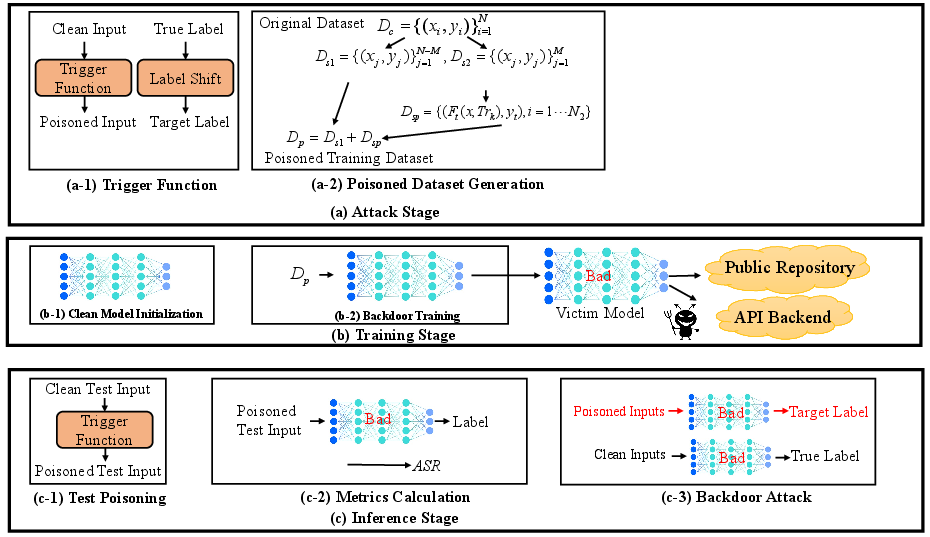
Figure 1: The backdoor attack pipeline, illustrating attack, training, and inference stages with injected triggers and induced model compromise.
Timbre Leakage Attack (TLA): Frame-level Trigger Design
The TLA trigger constructs poisoned samples that are both highly stealthy and robust to defense. Unlike previous work such as VSVC, which performs utterance-level full voice conversion to achieve targeted timbre mapping, TLA achieves stealth by only converting the timbre in selected frames (segments) of the utterance. The trigger synthesis is performed via the following pipeline:
- Extract deep semantic vectors from the utterance using a pretrained self-supervised learning (SSL) speech model.
- Cluster these vectors (with k-means) to segment the utterance into replaceable units.
- For the target timbre, compute average vectors from a reference set and substitute the closest matching clusters in the clean utterance.
- Use a pretrained vocoder to reconstruct the audio with the injected timbre leak.
This process results in frame-level timbre leakage that is imperceptible to both human listeners and most automated quality or speaker verification models.
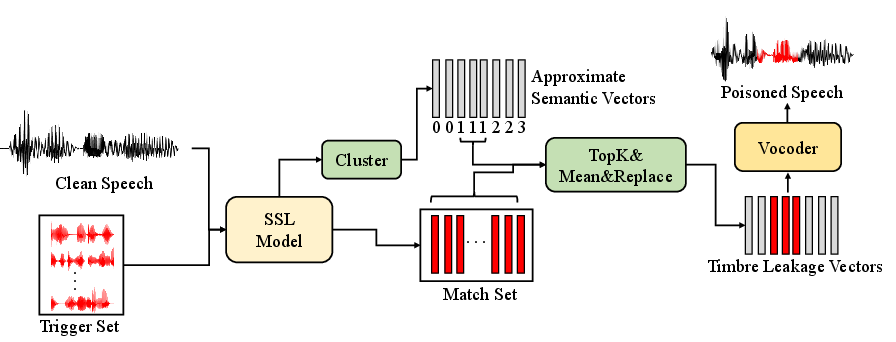
Figure 2: The TLA trigger function, showing selective, cluster-based replacement of deep semantic vectors from a trigger set and subsequent audio reconstruction.
The multi-backdoor paradigm aims at all-to-all attacks, implanting distinct triggers for multiple label targets. The key challenge is robustly and efficiently embedding multiple backdoors without substantial accuracy trade-off for clean tasks. The solution is a meta-learning framework that alternates between clean and poisoned task batches, employing PCGrad for gradient projection.
PCGrad Mechanism
PCGrad computes task-specific gradients for clean and poisoned tasks. If a backdoor task gradient conflicts with the clean task (negative dot product), the conflicting component is removed via orthogonal projection, thus maintaining high clean-task accuracy while still effectively optimizing for backdoor efficacy.
Training Workflow
The approach constructs a meta-dataset comprising clean and multiple poisoned tasks, partitioned into support and query sets per task. The meta-learner manages alternating clean/multitask updates, only utilizing the PCGrad conflict resolution in multitask steps, and ensures that the poisoning proportion aligns with the designated rate to preserve stealth.
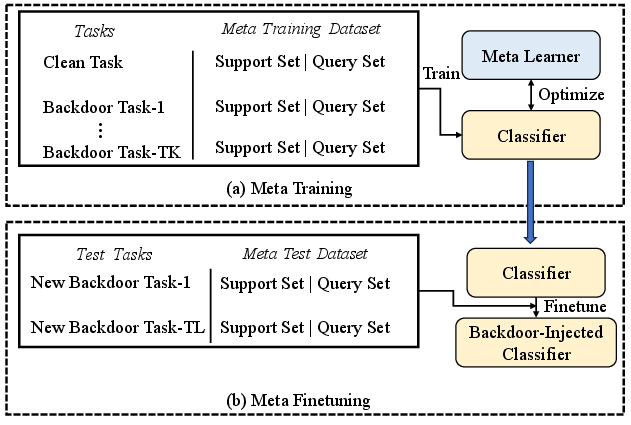
Figure 3: Dual-phase meta-learning, showing meta-training to "learn-to-inject-backdoor" and fast out-of-domain backdoor injection in fine-tuning.
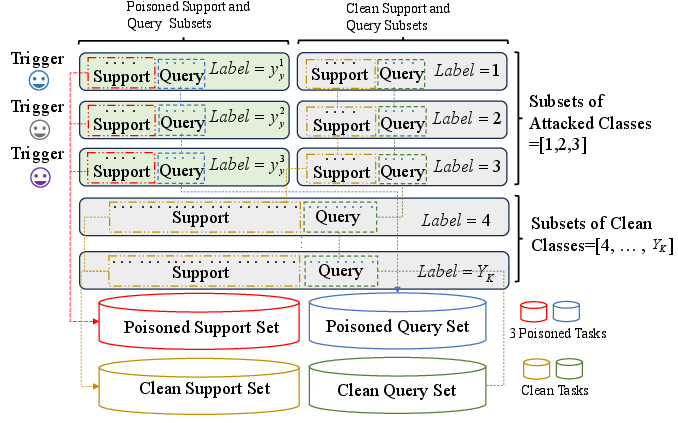
Figure 4: Backdoor meta-dataset partitioning for all-to-all attack—demonstrating support/query sets for both clean and poisoned tasks.
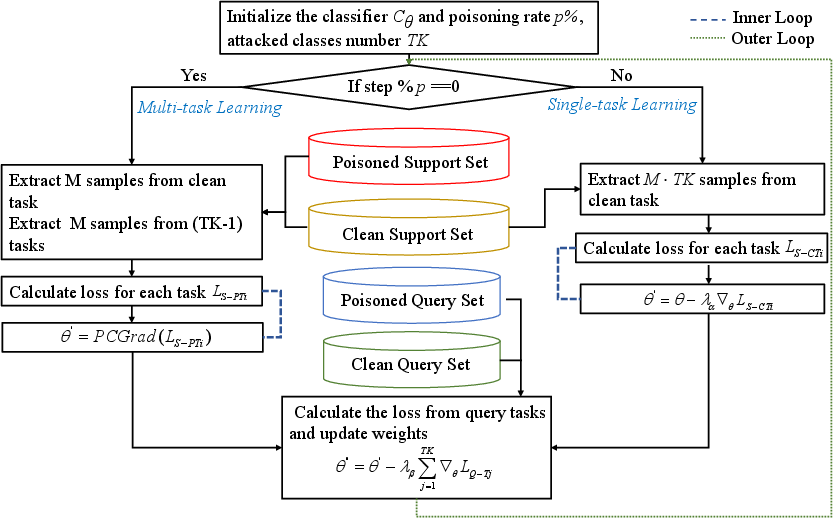
Figure 5: Meta-learner architecture coordinating classifier initialization, batch task selection, and PCGrad-driven parameter updates.
Empirical Analysis: Efficacy and Robustness
Benchmarking with KWS Models
The attack is evaluated on Google Speech Commands V2 (KWS) using top architectures (ERes2Net, KWS-ViT, EAT-S, CAM++). Pmeta-TLA is benchmarked against PIBA, DABA, PBSM, Ultrasonic triggers, and VSVC baselines.
Key Claims and Strong Results:
- Higher ASR at Lower Poisoning Rates: Pmeta-TLA achieves ASR >99% in multi-backdoor settings with substantially reduced poisoning numbers compared to baselines.
- Efficient Meta-Learning Adaptation: Models trained with Pmeta-TLA quickly adapt to new backdoor triggers in meta-fine-tuning, supporting rapid "one-shot" backdoor injection.

Figure 6: ASR vs. poisoning number for various attack methods—Pmeta-TLA achieves top ASR while requiring fewer poisoned samples across KWS models.
Ablation and Stealth Analysis
Empirical studies show that the position of the timbre leakage (beginning, middle, end of utterance) yields no statistically significant difference in attack efficacy (p=0.9824), implying robustness to temporal variation in trigger placement.
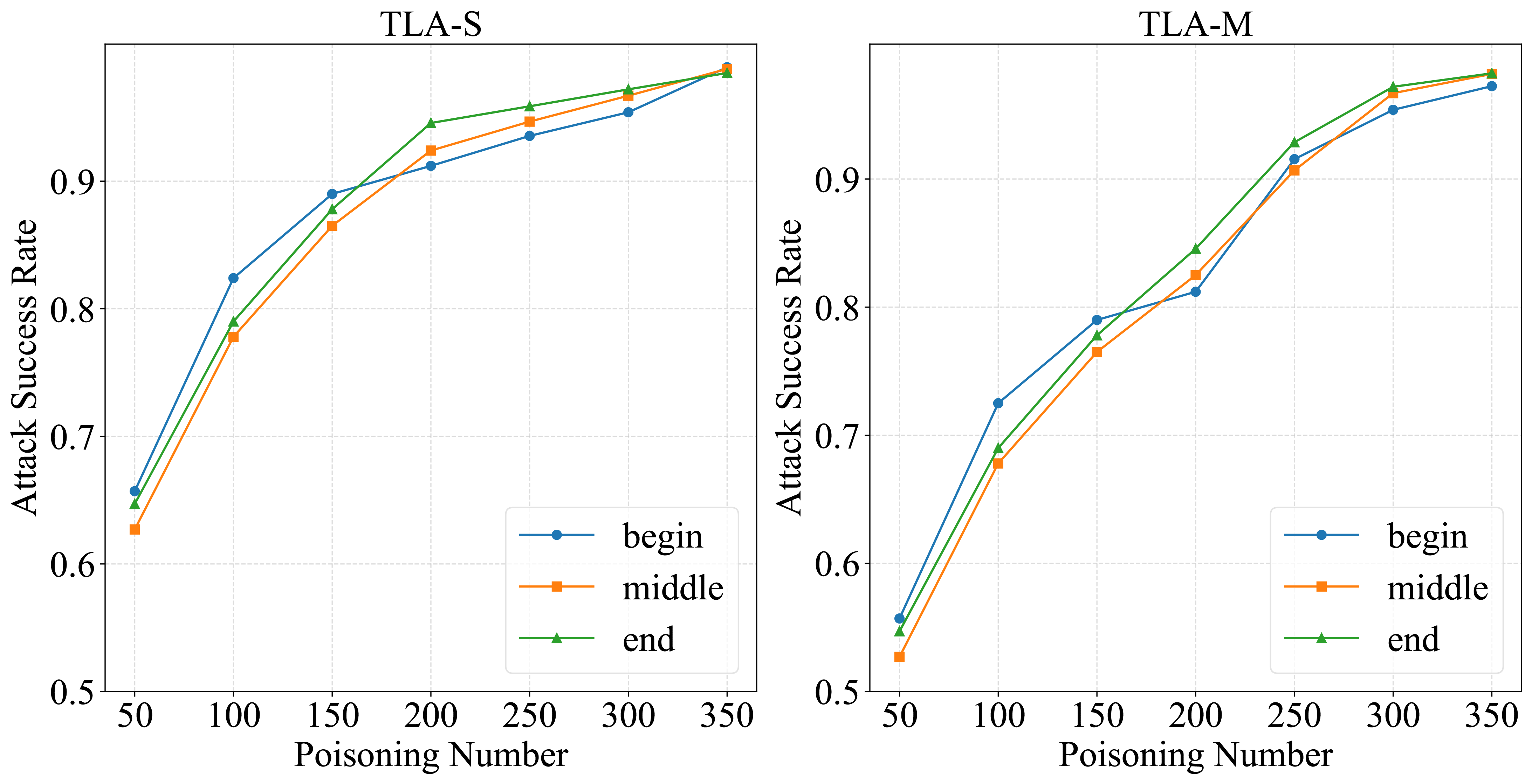
Figure 7: ASR as a function of poisoning number and trigger injection position—demonstrating invariance to leakage location.
Combining meta-learning with PCGrad enables further reductions in poisoning requirements and boosts ASR, as detailed in comparative protocol ablations.
Defense Resistance
Pmeta-TLA is subjected to five major defenses:
- Fine-tuning: Only mitigates the attack partially; Pmeta-TLA ASR remains >45% even after extensive tuning.
- Model pruning: Reduces ASR but correlates with a heavy drop in clean accuracy—defense is not selective.
- STRIP: No clear entropy separation between clean/poisoned samples; defense fails.
- Spectral signatures: Only minimal anomaly score shift; separation is not reliable.
- Trigger filtering (frequency/noise suppressors): ASR is nearly unchanged.
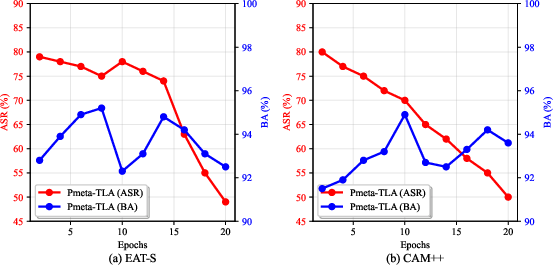
Figure 8: Pmeta-TLA’s ASR under fine-tuning—demonstrates significant retention of backdoor efficacy.
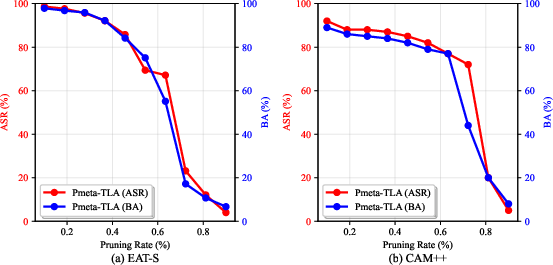
Figure 9: Pmeta-TLA’s ASR and clean accuracy under various levels of model pruning.
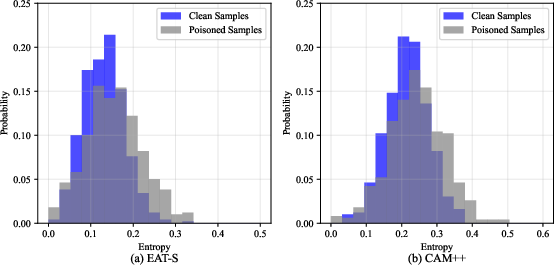
Figure 10: STRIP entropy distribution for clean and poisoned samples—indistinguishable distributions defeat STRIP.
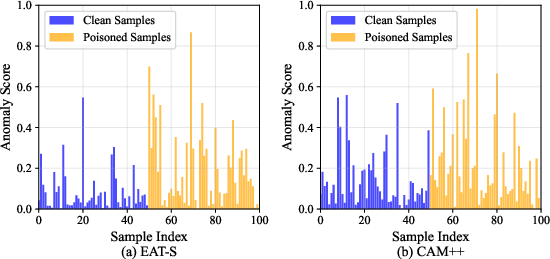
Figure 11: Spectral signature anomaly scores—little separation between clean and poisoned samples with Pmeta-TLA.
Implications and Directions for Future Research
Pmeta-TLA exposes a critical vulnerability in DNN-based speech classification pipelines: highly localized and semantically entangled triggers at the frame level evade conventional and advanced detection strategies. Its meta-learning backbone and PCGrad-based conflict resolution demonstrate that backdoor attacks can scale to multi-trigger/all-to-all scenarios while remaining undetectable to both humans and models, and enable rapid extension to novel triggers post-deployment.
This implies a need for:
- Redesigning defense analytics toward semantic and context-level triggers and integrating feature-level anomaly detection that goes beyond simple statistical measures or fixed trigger patterns.
- Reexamining trust boundaries in transfer-learning and model-sharing workflows for speech systems.
- Developing meta-learning-aware defense mechanisms that can detect generalized backdoor behaviors rather than instance- or domain-specific abnormities.
Continued research must focus on both adaptive attack strategies, such as meta-learning-augmented, context-aware triggers, and generalizable, robust defenses that do not rely on brittle pattern-matching or fixed statistical separation.
Conclusion
Pmeta-TLA presents a technically rigorous, meta-learning-driven methodology for multi-backdoor injection in speech classifiers. By leveraging imperceptible, frame-level timbre leakage and robust multi-task gradient management, it enables potent, stealthy all-to-all attacks resistant to a spectrum of established defenses. The results underscore the inadequacy of current speech backdoor defenses and the heightened urgency for theoretically grounded, holistic countermeasures in future DNN-based speech systems.