- The paper demonstrates that a rigorous Bayesian analysis reveals Galactic chemical evolution explains the Sun’s chemical makeup in about 62% of solar twins.
- The paper employs high-precision line-by-line differential spectral synthesis with σ≈0.015 dex accuracy to extract elemental abundances.
- The paper concludes that signs of planetary engulfment are rare (2–9%), highlighting the need for precise GCE corrections in chemical tagging studies.
The Sun's Chemical Peculiarity: Disentangling GCE and Planetary Engulfment in Solar Twins
Introduction
The chemical composition of the Sun, compared to its solar twins, has been a longstanding subject of debate with implications for stellar astrophysics, planetary system formation, and Galactic chemical evolution (GCE). This study undertakes a comprehensive Bayesian re-analysis of 79 high-fidelity solar twins, focusing on whether the Sun's purported chemical peculiarity is primarily a consequence of GCE or signatures of planetary engulfment. Leveraging the Korg spectral synthesis code and a Bayesian framework, the authors extract high-precision (σ ≈ 0.015 dex) abundances for 18 elements, systematically distinguish GCE effects from signatures of exoplanetary ingestion, and assess the statistical evidence for chemical anomalies in individual stars (2607.01699).
Data, Methodology, and Validation
The sample comprises 79 solar twins (non-α-enhanced, within 100 pc, matching solar Teff, log g, and [Fe/H]), observed with HARPS and MIKE at high resolution and S/N. Stellar parameters and elemental abundances are rederived using line-by-line differential analysis with Korg and MARCS model atmospheres, validated against previous results from MOOG and ATLAS9 [spina_2018, bedell_2018]. This results in exceptional internal consistency: residuals between this work and prior studies are below the combined uncertainties.
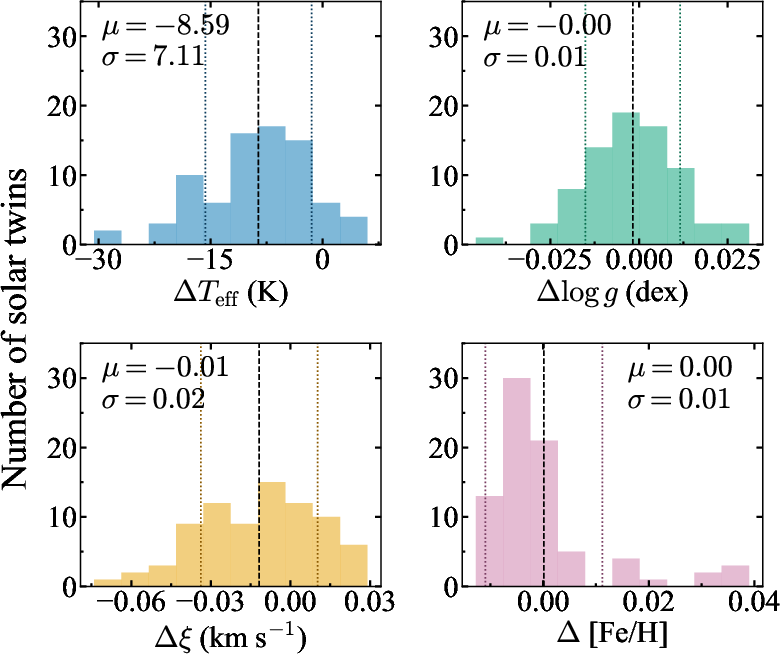
Figure 1: Distribution of differences in stellar parameters between this work and [spina_2018], demonstrating high accuracy and negligible bias from the use of modern spectral tools.
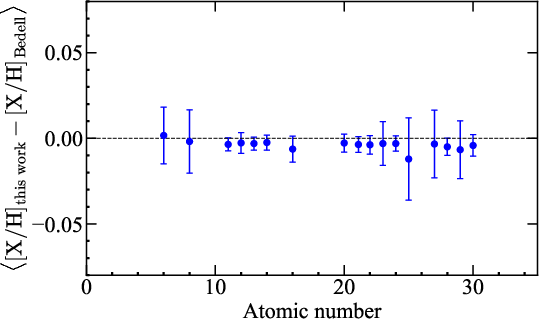
Figure 2: Mean differences in differential [X/H] between this work and [bedell_2018], confirming negligible systematic offsets at the sub-0.01 dex level for most elements.
Correcting for GCE is performed both via externally calibrated and in-sample age–abundance relations. NLTE corrections for O are included. The analysis prioritizes [X/Fe] over [X/H] to minimize the impact of atomic diffusion on abundance patterns.
Bayesian Framework for Scenario Discrimination
The core methodology involves fitting several physically motivated models to the abundance patterns of individual stars:
- Null-offset model: Compositional identity to the Sun with random scatter
- Flat model: Overall abundance offset plus scatter
- GCE model: Linear age–abundance relations per element (from [bedell_2018])
- Planetary engulfment models: Additions of bulk Earth or CM chondrite material to the convective zone with predictions parameterized by engulfed mass
Model comparison employs the Bayesian evidence log-ratio (ΔlnZ), calibrated using mock datasets to evaluate statistical robustness.
Results: Dominance of GCE
The Bayesian evidence indicates GCE is the statistically preferred explanation for chemical patterns in 62.3 ± 5.8% of the solar twin sample. The majority of abundance patterns are indistinguishable from those produced by GCE, with only a minority requiring additional astrophysical processing.
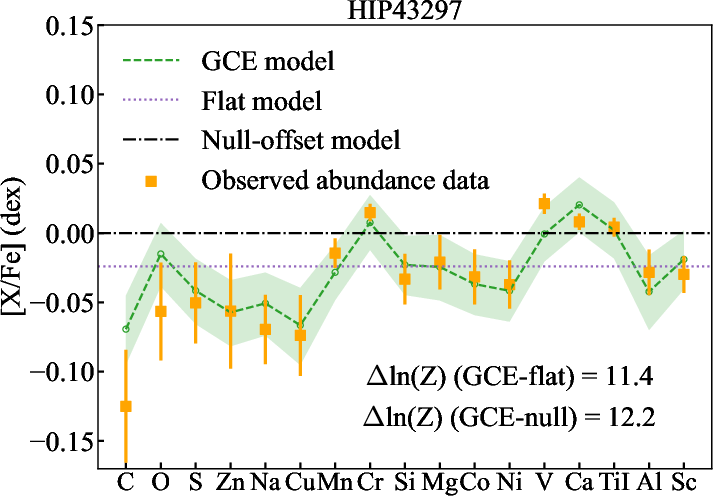
Figure 3: GCE-uncorrected [X/Fe] for a representative solar twin, fit by null-offset, flat, and GCE models, demonstrating the superiority of GCE in matching the observed pattern.
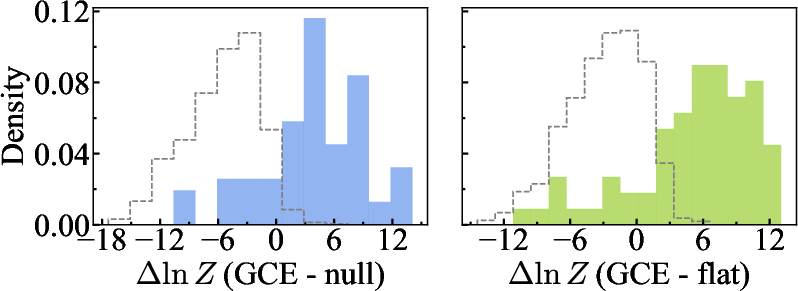
Figure 4: Distribution of evidence differences ΔlnZ between GCE and baseline models; solid lines indicate real data, dashed grey the noise expectation—strong deviation confirms the GCE hypothesis.
Contrary to earlier work that emphasized condensation temperature (Tcond) trends and suggested the Sun was refractory-poor, this Bayesian approach demonstrates most solar twins can be entirely explained by their birth times and the local GCE context.
Incidence and Characterization of Planetary Engulfment
After removing GCE effects, a small subset of solar twins (2–6 out of 69) exhibits statistically significant evidence for planetary engulfment, with inferred accreted masses of several Earths' worth of material.
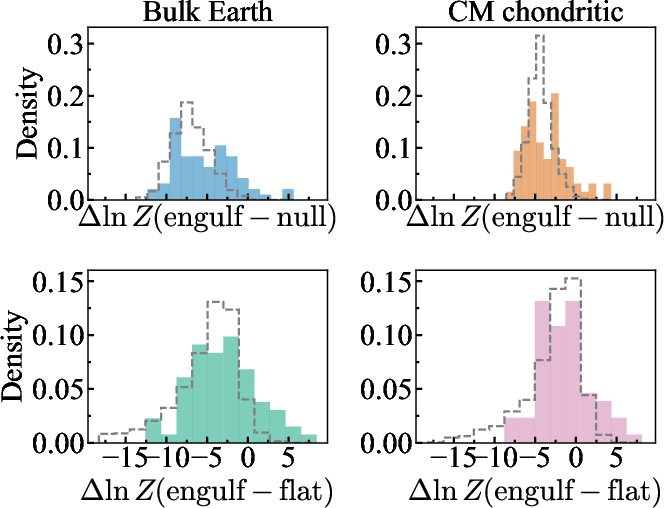
Figure 5: Evidence ratio distributions for engulfment models vs. baseline (null/flat) after GCE correction; only a handful of stars significantly deviate from baseline.
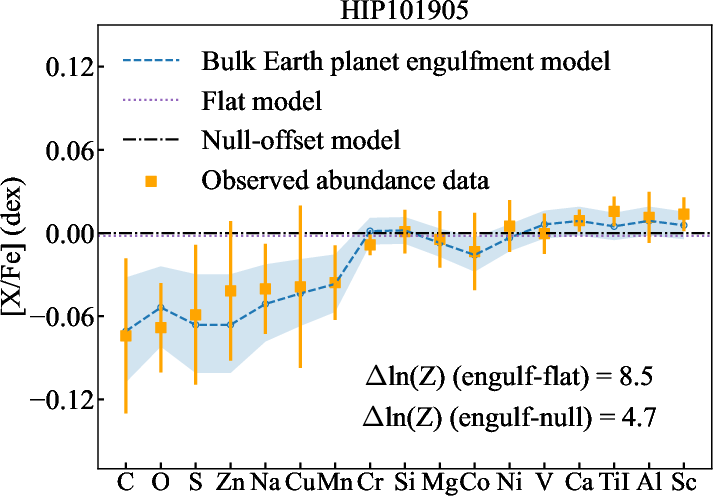
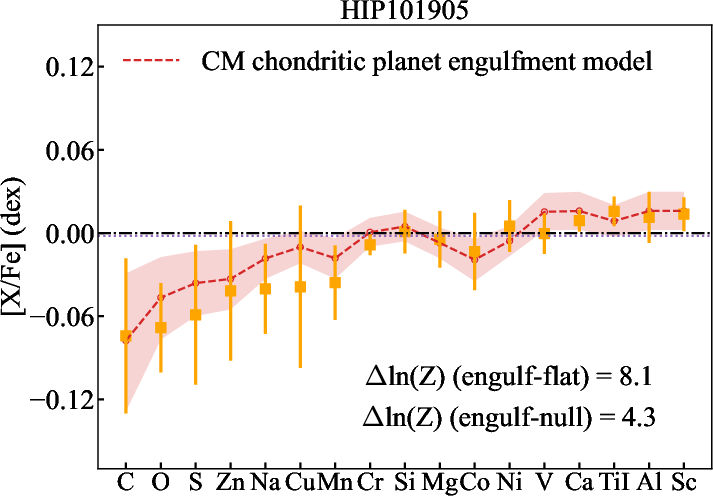
Figure 6: GCE-corrected abundances of HIP 101905, with Bayesian fits for flat, null, bulk-Earth, and CM chondritic engulfment models; the engulfment scenario is strongly favored with inferred MBE∼5M⊕ or MCM∼7.5M⊕.
Identified candidates span a range of ages, but most are consistent with the expectation that early main-sequence stars, with shallow convective envelopes, retain the strongest chemical imprint from engulfment [sevilla_2022]. The estimated occurrence rate (3–9%) aligns with binary twin studies [spina_2021, liu_2024], supporting shared dynamical instability rates in Sun-like stars regardless of multiplicity.
Stellar Activity, Systematics, and Model Limitations
Analysis of magnetic activity indices suggests no confounding activity trend with abundance anomalies or planetary engulfment evidence within this sample.
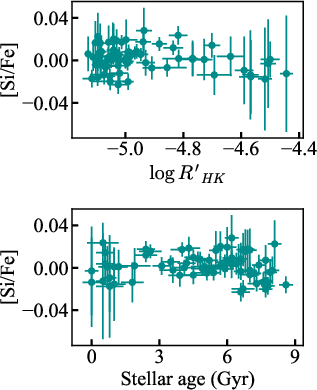
Figure 7: [Si/Fe] as a function of magnetic activity (logRHK′) shows no significant correlation, representative of other elements.
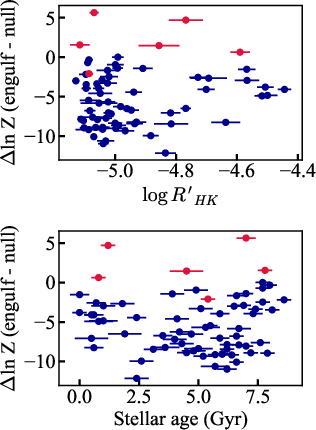
Figure 8: Bayesian evidence for engulfment models versus logRHK′ or age; engulfment candidates are not correlated with activity, and most are sufficiently old to avoid substantial spot-related biases.
The analysis assumes a constant convective zone mass fraction typical of solar analogs and considers only two canonical engulfment chemistries. Systematic uncertainties from GCE correction choice and stellar structure variations remain, although sensitivity analyses show candidate identification is robust for the strongest cases.
Theoretical and Practical Implications
This study delivers several strong conclusions:
- Once GCE is rigorously controlled for, the Sun is not chemically anomalous relative to most solar twins.
- The incidence of detectable planetary engulfment signatures in field solar twins is $2$–g0, consistent with rates from other populations and theoretical expectations.
- Most previous claims of the Sun's chemical peculiarity arise from insufficient GCE treatment or overinterpretation of condensation temperature trends, which are themselves model-dependent.
- Implications for stellar chemical tagging are profound: robust chemical tagging for planet formation histories demands controlling for GCE at the g10.01 dex level.
Theoretically, these results support models in which most Sun-like stars are naturally explained by their natal chemistry and Galactic context, with only a minority marked by dramatic early system instability or late-stage ingestion events. Planetary engulfment remains detectable but rare for solar twins, reinforcing models which predict low rates of such events for calm systems analogous to the Solar System.
Looking Ahead
Future progress will require:
- Deeper integration of detailed GCE modeling with 3D hydrodynamical stellar atmospheres and diffusion processes
- Bayesian approaches extending to larger, more diverse samples, including stars with a broader spread in age, metallicity, and birth radius
- Case-by-case evolution modeling of engulfment candidates to constrain engulfment epochs, mixing timescales, and link to planetary system architectures
- Exploitation of new high-fidelity abundance data from next-generation surveys and asteroseismic calibration of stellar ages
Conclusion
Bayesian hierarchical modeling of large solar twin samples now demonstrates that the Sun's compositional pattern is unexceptional when GCE is properly accounted for, and that planetary engulfment signals are robustly detectable in a small subset of Sun-like stars. These findings critically inform the interpretation of chemical signatures in exoplanet host stars and sharpen the requirements for high-precision chemical tagging in Galactic archaeology and exoplanetary science.
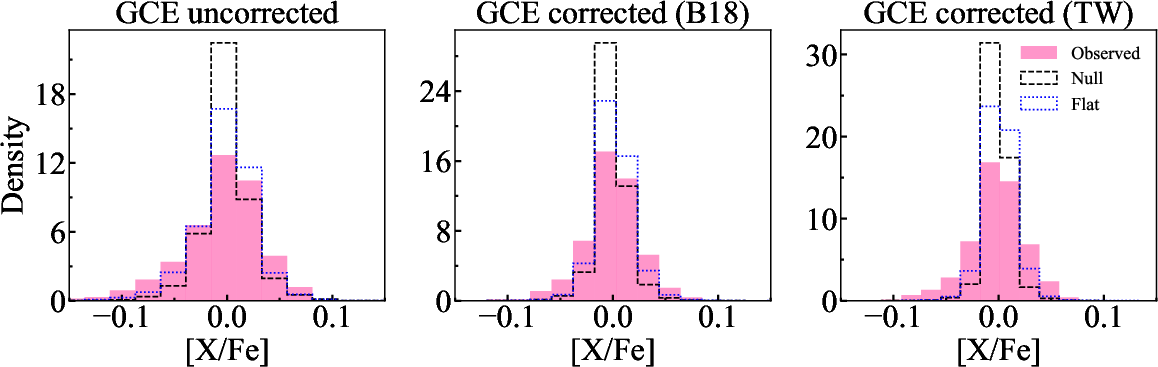
Figure 9: Comparison of observed [X/Fe] with mock noise samples from baseline models, highlighting the clear excess in real abundance anomalies only for the handful of engulfment candidates.