Linking effective Ratner equidistribution to the semicircle law for skew-shift matrices
Published 2 Jul 2026 in math.DS | (2607.01655v1)
Abstract: We consider large Hermitian matrices whose entries are defined by evaluating the exponential function along orbits of the skew-shift (\frac{j(j-1)}{2}ω+ jy + x \mod 1) for irrational (ω). We establish a rigorous connection between the effective Ratner equidistribution theorem for unipotent orbits in (\SL(3,\R)/\SL(3,\Z)) and the global semicircle law for such deterministic matrices. For frequency sequences satisfying a Diophantine condition, we prove that the empirical spectral distribution of these matrices converges to the Wigner semicircle law with optimal polynomial rate (O(N{-1})); for rectangular matrices the corresponding Marchenko--Pastur law is obtained. The proof uses a multi-parameter effective mixing property derived from the effective Ratner equidistribution theorem, combined with a graph-theoretic expansion of the moments. Our results evidence the quasirandom nature of the skew-shift dynamics observed in other contexts by Bourgain, Goldstein and Schlag, and Rudnick, Sarnak and Zaharescu, and provide a dynamical systems proof of the semicircle law with an improved convergence rate.
The paper establishes a rigorous link between effective Ratner equidistribution and the semicircle law with an absolute polynomial convergence rate independent of Diophantine conditions.
It employs skew-shift dynamics and combinatorial graph expansion to construct deterministic Hermitian matrices and control spectral moment errors.
The study decouples convergence rates from arithmetic properties, offering new insights into spectral universality in quasirandom systems.
Linking Effective Ratner Equidistribution to the Semicircle Law for Skew-Shift Matrices
Introduction and Context
This paper investigates the spectral properties of large deterministic Hermitian matrices whose entries are constructed by specific dynamical rules—namely, exponential phases evaluated along orbits of the skew-shift transformation on the torus. The central objective is to rigorously connect effective equidistribution results from homogeneous dynamics (specifically, effective Ratner theorems for unipotent orbits in SL(3,R)/SL(3,Z)) to the universality phenomena in spectral statistics observed in random matrix theory, namely the Wigner semicircle law and the Marchenko–Pastur law for rectangular ensembles.
The work builds upon connections between quantum ergodicity, deterministic models exhibiting quasirandom behavior, and spectral universality phenomena. Previous advances have shown that certain deterministic matrices with entries governed by "quasirandom" frequency sequences achieve the semicircle law, but with convergence rates dependent on Diophantine properties of the frequencies. This paper overcomes these limitations by leveraging the recent breakthrough of L. Yang in effective homogeneous dynamics, resulting in an absolute polynomial convergence rate, independent of the Diophantine exponent.
Matrix Model and Skew-Shift Dynamics
The authors study matrices of the form
Xi,j=N1e(2j(j−1)ωi+jyi+xi),
with e(z)=e2πiz, frequencies ωi, deterministic shifts xi, and uniformly random shifts yi. Hermitian matrices are constructed via
H=(0XX∗0),
and the spectral moments are considered through traces of powers of H.
The frequency sequence of primary interest is ωi=iα mod 1, with α Diophantine of exponent Xi,j=N1e(2j(j−1)ωi+jyi+xi),0. The "skew-shift" transformation, Xi,j=N1e(2j(j−1)ωi+jyi+xi),1, is a natural source of deterministic yet quasirandom dynamics, with a long-standing conjecture that the eigenvalues of such matrices obey universal statistics akin to random matrices.
The quadratic phase in the skew-shift drastically improves the decay properties of exponential sums, offering the possibility for deterministic universal behavior under appropriate frequency conditions. Notably, the model can be interpreted as a gauge-transformed 1D Schrödinger operator with off-diagonal disorder due to the skew-shift, after diagonal terms are absorbed into complex off-diagonal phases.
Graph Expansion, Kirchhoff Law, and Moment Calculations
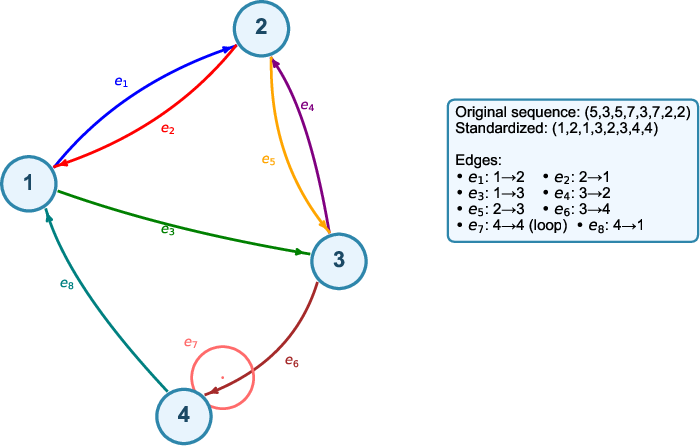
The analysis begins by expanding the spectral moments Xi,j=N1e(2j(j−1)ωi+jyi+xi),2 in terms of combinatorial graphs (“exploration graphs”), with vertices associated to rows and edges to the propagation of indices. A crucial technical aspect is the Kirchhoff current law, which arises naturally from averaging the auxiliary random variables Xi,j=N1e(2j(j−1)ωi+jyi+xi),3 and enforces currents (edge indices) to sum to zero at vertices. The class of graphs surviving in the large Xi,j=N1e(2j(j−1)ωi+jyi+xi),4 limit are the “fully reducible” (planar, non-crossing) ones, whose count yields Catalan numbers, corresponding to the moments of the semicircle law.
Subleading (“non-fully reducible”) graphs contribute only at subleading order, their evaluation reduced to exponential sums whose analysis is the crux of establishing the global semicircle law.
Figure 1: Example of an exploration graph on Xi,j=N1e(2j(j−1)ωi+jyi+xi),5 edges and Xi,j=N1e(2j(j−1)ωi+jyi+xi),6 vertices, crucial for organizing moment expansions.
Homogeneous Dynamics and Effective Ratner Equidistribution
Key to the methodological advance is the employment of effective Ratner equidistribution results for unipotent flows in Xi,j=N1e(2j(j−1)ωi+jyi+xi),7. The authors use recent work showing that unipotent orbits of Diophantine initial conditions equidistribute at exponential rates independent of the exponent, provided Xi,j=N1e(2j(j−1)ωi+jyi+xi),8. They establish, through smooth test functions Xi,j=N1e(2j(j−1)ωi+jyi+xi),9 constructed from group coordinates, that the matrix entries can be realized as evaluations of e(z)=e2πiz0 along such unipotent orbits.
A multi-parameter effective mixing property is established via induction, enabling the control of integrals over admissible current assignments in the graph expansion. The effective equidistribution theorem underpins the polynomial control of deviations from the semicircle law for arbitrary Diophantine frequencies (within the e(z)=e2πiz1 constraint), because it provides an absolute exponential convergence, unaffected by the "approximability" of e(z)=e2πiz2.
Main Results: Semicircle Law with Absolute Polynomial Rate
The strong claim of the paper is that for frequency sequences e(z)=e2πiz3 with e(z)=e2πiz4 Diophantine (e(z)=e2πiz5), the empirical spectral distribution of e(z)=e2πiz6 converges to the Wigner semicircle law (for the square case) and the Marchenko–Pastur law (for rectangular case), with polynomial convergence rate e(z)=e2πiz7 where e(z)=e2πiz8 is absolute and independent of e(z)=e2πiz9’s Diophantine exponent:
ωi0
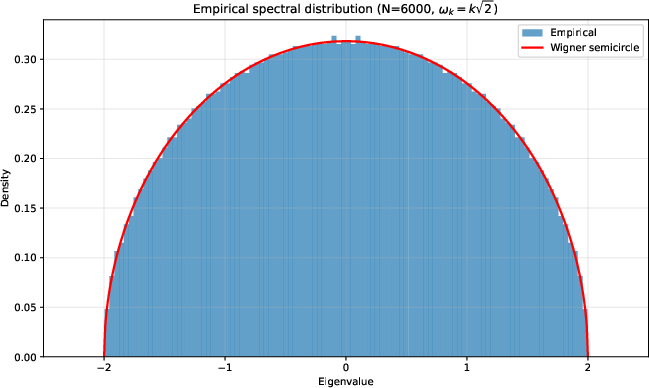
where ωi1 is the ωi2-th Catalan number. This result demonstrates that dynamical models with sufficient quasirandomness, quantified via modern homogeneous dynamics, manifest random-matrix spectral universality with nearly optimal rates.
Figure 2: Empirical spectral distribution of a ωi3 skew-shift matrix compared to the Wigner semicircle density—numerically underscoring the connection claimed by the paper.
Exponential Sums, Dynamical Reduction, and Proof Strategy
A central remaining challenge is to estimate exponential sums of the form
ωi4
which arise from the leading subleading graphs (melons). Through change of variables and linearization, these are shown to be controlled by Birkhoff averages along straight line orbits in the torus—a setup precisely where the aforementioned effective equidistribution applies.
Through careful exploitation of group representations, partition of unity via smooth functions, and Poisson summation, the authors reduce the problem to quantifying equidistribution of polynomial sequences, which the effective Ratner theorem robustly handles.
Consequently, for the relevant class of frequency sequences, all error terms in moment calculations—those from discretization, subleading graphs, and effective equidistribution—are shown to be polynomially small, with an exponent dictated only by global parameters and not by the arithmetic properties of ωi5.
Implications, Limitations, and Future Directions
The authors' approach emphatically demonstrates that deterministic structures, underpinned by sufficiently mixing dynamical systems, can realize the same spectral universality as genuinely random matrices. The key technical leap is the decoupling of the convergence rate from the Diophantine properties of the underlying frequency (for exponents up to ωi6), achieved via sharp equidistribution rates in non-compact homogeneous spaces.
One notable limitation is the reliance on averaging over the random variables ωi7 to enforce the Kirchhoff current law; the fully deterministic case (ωi8) remains open, despite compelling numerical evidence. Extending effective mixing statements to handle the joint distribution of these variables (multi-parameter mixing) is identified as a necessary step for a complete deterministic proof.
Anticipated future developments include: (1) relaxing the bound on the Diophantine exponent ωi9 within the effective Ratner framework; (2) deriving explicit, possibly optimal, convergence exponents; (3) addressing joint mixing and tackling the fully deterministic regime; and (4) applying these insights to other spectral universality problems in mathematical physics and ergodic theory.
Conclusion
This work rigorously establishes, for a class of skew-shift–generated deterministic matrices with Diophantine frequencies, that the spectral empirical distribution converges to the Wigner semicircle or Marchenko–Pastur law at an absolute polynomial rate, independent of frequency approximability. By uniting advances in modern homogeneous dynamics with the combinatorial structure of spectral moments, the paper provides both a powerful methodological template and a significant technical advance in understanding deterministic origins of random-matrix universality.