- The paper's main contribution is a hybrid ITE-TR-FALQON protocol that efficiently prepares TFD states via non-unitary dynamics and time-rescaling.
- It demonstrates that integrating imaginary-time evolution with feedback overcomes unitary traps, achieving near-unity fidelity with reduced circuit depth.
- The study has important implications for quantum simulation of many-body systems and holographic duality in AdS/CFT correspondence.
Feedback-Based Quantum Algorithms for Thermofield Double State Preparation in Coupled SYK Models
Introduction
The preparation of correlated thermal states, such as the Thermofield Double (TFD) state, is a critical task in quantum simulation and quantum gravity research. TFD states capture the entanglement structure central to the AdS/CFT correspondence and are a resource for protocols including quantum teleportation and quantum error correction. This paper systematically examines feedback-based quantum algorithms (FALQON and its variants) for ground state preparation in the Maldacena-Qi model, which describes two coupled Sachdev-Ye-Kitaev (SYK) systems with a holographic dual in AdS2 gravity. The work identifies kinetic limitations of unitary feedback protocols and proposes a hybrid algorithm that integrates imaginary-time evolution with time-rescaled feedback, enabling high-fidelity preparation of highly entangled TFD states from trivial product initializations (2607.01653).
Algorithms: FALQON and Its Variants
FALQON Paradigm
FALQON (Feedback-based Algorithm for Quantum OptimizatioN) eliminates classical optimization by adopting a closed-loop parameter update rule inspired by Lyapunov quantum control. Evolution occurs via Trotterized circuits alternating between the problem Hamiltonian (Hp) and a driver (Hd), with each layer’s control parameter set from quantum measurements. The algorithm is strictly unitary and deterministic.
TR-FALQON and Kinetic Acceleration
The Time-Rescaled Feedback Quantum Algorithm (TR-FALQON) accelerates convergence by applying a dynamic time-rescaling to modulate evolution speed, effectively enhancing gradients early in the evolution. This adjustment can substantially reduce the required circuit depth in favorable problems.
ITE-FALQON and Non-Unitary Dynamics
ITE-FALQON introduces imaginary-time evolution (ITE) steps, which are mathematically non-unitary and act as dissipative filters, exponentially suppressing excited state components. The ITE step is realized stochastically in simulation or, on real hardware, would require ancilla-driven unitary embeddings and post-selection.
Hybrid ITE-TR-FALQON Protocol
The hybrid ITE-TR-FALQON protocol combines both time-rescaling and imaginary-time evolution, leveraging their complementary advantages: non-unitarity for escaping symmetry-protected subspaces and time-rescaling for kinetic efficiency. The protocol is systematically depicted below.
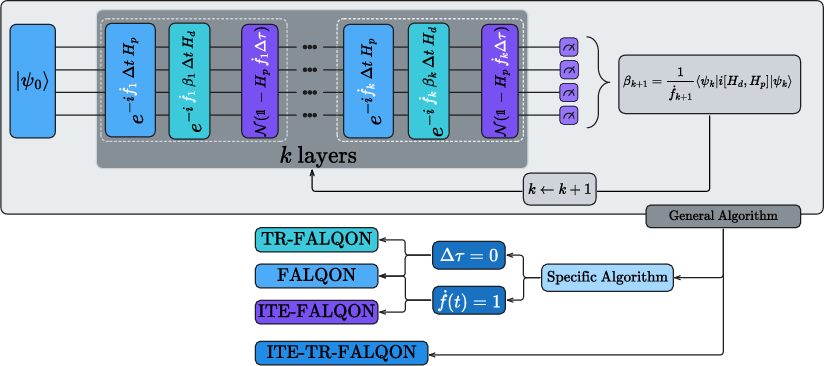
Figure 1: Unified schematic of feedback quantum algorithms, showing sequential application of unitary and non-unitary steps. Specializations illustrate the transition between FALQON, TR-FALQON, ITE-FALQON, and their hybridization.
Model System: The Maldacena-Qi Coupled SYK Model
The target for state preparation is the ground state of the Maldacena-Qi Hamiltonian, consisting of two (L, R) copies of the q=4 SYK model with a bilinear Majorana-Majorana coupling of strength μ. For small μ, the ground state is a TFD state at effective inverse temperature β(μ). Preparing this state from a trivial product in Jordan-Wigner-encoded qubits is a natural benchmark for quantum simulation algorithms.
Numerical Results
Energy Convergence
Simulations with N=8 Majorana fermions per SYK copy assess energy convergence and algorithmic robustness to coupling strength Hp0. Unitary-only protocols (FALQON, TR-FALQON) exhibit rapid early descent for energy but fail to approach the true ground state, indicating trapping in low-entanglement subspaces. The addition of ITE steps dramatically improves convergence, with the hybrid protocol (ITE-TR-FALQON) achieving monotonic approach to the exact ground energy with circuit depths an order of magnitude smaller than pure ITE-FALQON.
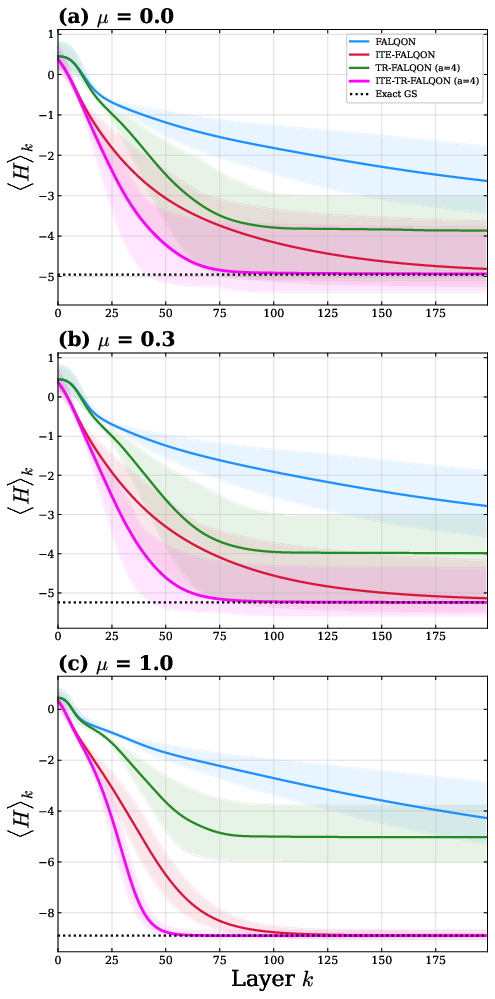
Figure 2: Convergence of Hp1 for Hp2 Majoranas per SYK copy as a function of circuit depth Hp3 under different values of Hp4. The hybrid ITE-TR-FALQON outperforms both unitary and single-mechanism protocols and reaches the ground state energy efficiently.
Fidelity to Ground State
Fidelity with respect to the exact ground state quantifies the quality of state preparation. Unitary methods plateau at low fidelities even after Hp5 layers. In contrast, ITE-TR-FALQON displays a sharp fidelity transition to near-unity (Hp6), even at strong coupling, and does so with significantly reduced circuit depth.
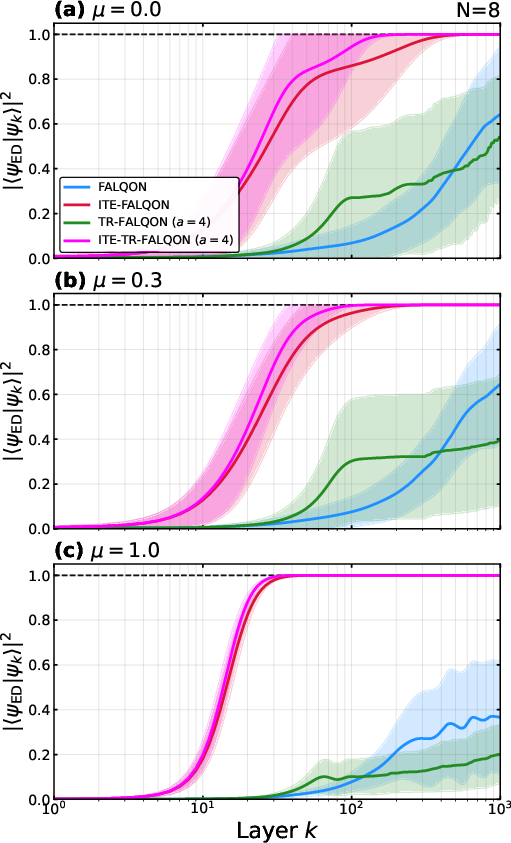
Figure 3: Fidelity Hp7 over circuit layers up to Hp8 highlights the inability of unitary protocols to reach the ground state, while hybrid methods achieve near-unity fidelity rapidly.
Entanglement Structure
Entanglement statistics probe the correspondence with the TFD state. The hybrid protocol achieves not only correct von Neumann entropy but also the entire family of R\'enyi entropies, recapitulating the full thermal statistics of the reduced density matrix eigenvalues. Unitary methods, while sometimes energetically close, qualitatively fail in reproducing the fine entanglement spectrum, particularly at higher R\'enyi orders, reflecting their inability to escape restricted subspaces originating from the product state initialization.
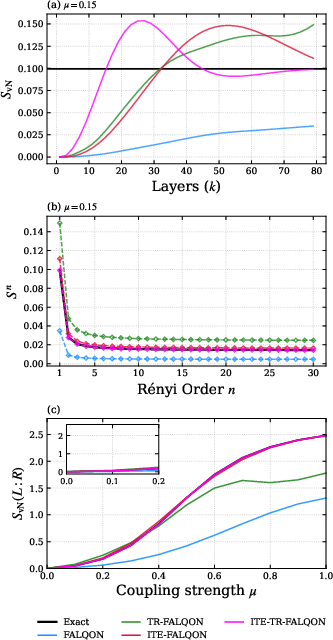
Figure 4: (a) Convergence of von Neumann entropy Hp9, (b) full spectrum of R\'enyi entropies Hd0, and (c) dependence of steady-state von Neumann entropy on coupling Hd1, all verifying that the hybrid algorithm correctly reproduces the TFD entanglement properties across the physically relevant regime.
Theoretical and Practical Implications
The results highlight critical claims:
- Non-unitary dynamics are strictly necessary for breaking symmetry-protected traps that preclude access to highly entangled ground states in models like the coupled SYK. Unitary-only feedback algorithms stagnate under such kinetic barriers.
- Time-rescaling provides significant acceleration in algorithm convergence when coupled with non-unitary filtering, reducing circuit resources.
- The protocol achieves fidelity and entanglement spectra indistinguishable from exact TFD states for physically relevant coupling strengths, making it suitable for holographic quantum simulation and probing traversable wormhole physics.
On hardware, implementing non-unitary ITE steps is non-trivial because physical gate operations are strictly unitary; practical realization will require efficient compilation strategies, possibly via block-encoding and post-selection. The cumulative probability decay in sequential non-unitary steps is a notable bottleneck, and alternative strategies such as variational QITE may be necessary for scalable execution.
Future Directions
The findings suggest several priorities for further research:
- Circuit-level realization of ITE steps: Development of efficient block-encoding, post-selection, or error-mitigated approximations for non-unitary operations in NISQ devices.
- Extension to other strongly correlated models: Application of hybrid protocols to broader classes of many-body systems, especially those relevant for quantum gravity, condensed matter, or quantum chaos.
- Investigation of optimization landscapes and expressivity: Analytical characterization of traps and symmetries in Hamiltonian landscapes that limit strictly unitary feedback protocols’ reach.
Conclusion
The integration of non-unitary imaginary-time evolution with deterministic, feedback-driven quantum control is demonstrated to be essential for faithful, efficient preparation of highly entangled TFD ground states in coupled SYK models. The hybrid ITE-TR-FALQON protocol remediates critical kinetic limitations that afflict unitary-only feedback algorithms, achieving excellent fidelity and correct entanglement scaling properties even from uncorrelated initial states. While concrete quantum hardware implementation remains algorithmically non-trivial due to the non-unitary step, this work substantiates the necessity of controlled dissipation for scalable quantum simulation of many-body thermodynamics and gravity duality scenarios (2607.01653).

