- The paper proposes a unified framework that factors the quantum density matrix as FF†, ensuring positivity and trace constraints by design.
- It systematically incorporates structured models like low-rank, tensor networks, and neural networks to overcome the exponential scaling in QST.
- The study demonstrates that a novel step-size-free power method achieves faster convergence and lower reconstruction errors compared to traditional gradient descent.
Unified Structured Factorization for Quantum State Tomography
Introduction
The paper "Structured Factorization Approaches for Quantum State Tomography" (2607.01608) introduces a unifying framework for quantum state tomography (QST) that rigorously incorporates both physical validity and structural priors in the estimated quantum states. QST is fundamentally challenged by exponential scaling, requiring O(d2n) parameters and sample complexity for n qudits without structural assumptions. The manuscript addresses these scaling barriers by embedding a wide range of tractable structure—such as low-rank, tensor network, and neural-network-based models—directly into a factorization of the quantum density matrix that guarantees positivity and trace constraints by construction.
Under the paradigm introduced in this work, the density matrix is parameterized as FF†, where F is restricted to a structured family. This design unifies the Cholesky decomposition, low-rank models, matrix product operator (MPO) structures, and neural density operators (NDOs) under a single mathematically and physically valid umbrella.
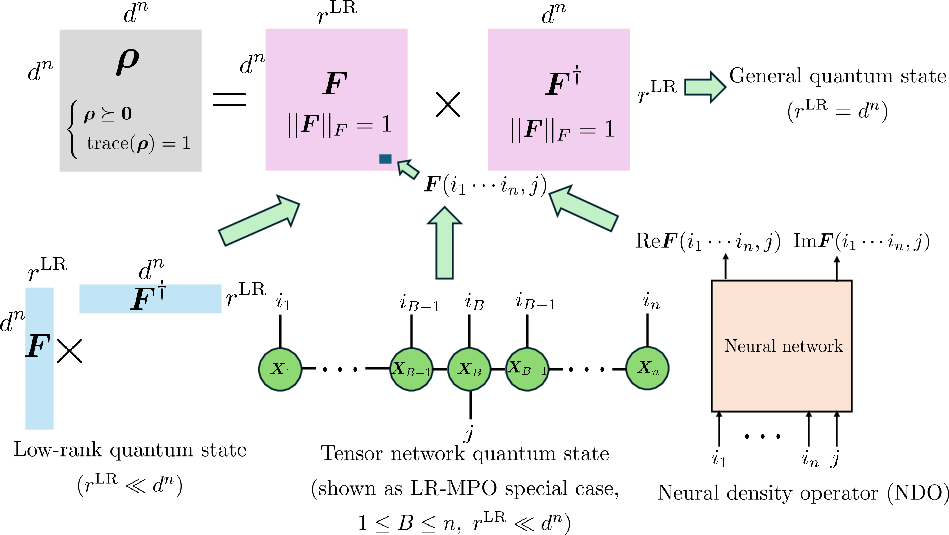
Figure 1: Summary of different physically compatible structured density matrix factorizations, illustrating expressive trade-offs and nested structural constraints.
Structured Factorization Framework
The core approach generalizes the Burer–Monteiro factorization to the quantum setting: all parametrizations express the density matrix as FF† with ∥F∥F=1 and F constrained to represent different structured models. The following classes are systematically encapsulated:
- Full-rank/Cholesky: Recovers all positive semidefinite states; Cholesky imposes a lower-triangular factor.
- Low-rank: F∈Cdn×r, r≪dn, captures approximate/pure quantum states.
- MPS/LR-MPO: Tensor network structure is imposed on the factor, permitting polynomial-parameter representations for physically local quantum systems.
- Neural Density Operators: F is realized as the output of an expressive neural network, such as a multilayer perceptron (MLP) or transformer.
This design ensures density matrix positivity and unit trace, eliminating the need for expensive projections or ad hoc constraints during optimization. The factor dimension (rank) is used directly as a tunable model parameter, supporting strong theoretical and algorithmic properties across state families and measurement protocols.
Sample Complexity and Theoretical Guarantees
The authors provide a unified statistical analysis for the sample complexity of least-squares estimation (LSE) within their framework. The principal result establishes that reconstruction error (in Frobenius norm, and by extension trace norm/fidelity) scales proportionally to the intrinsic degrees of freedom of the model class, as given by the logarithm of a covering number for the set of candidate quantum states. For example, for low-rank states, n0 samples suffice; for an MPO of fixed bond dimension, this becomes polynomial in system size.
These rates are tight up to constants for Haar-random and unitary n1-design measurements, matching known lower and upper bounds. The analysis formally captures the interplay among physical constraint satisfaction, structured parametrization, and statistical efficiency, extending beyond tensor networks to neural-network-based parameterizations—though explicit neural sample complexity is not provided, reflecting open questions in neural quantum state theory.
Algorithms: Projected Gradient Descent and Power Methods
Two algorithmic approaches are treated in depth:
- Projected Gradient Descent (PGD): Operates in the factor space, with projection steps efficiently implemented for low-rank, Cholesky, or TT/TT-SVD (for tensor networks). This framework supports both LSE and maximum-likelihood (MLE) objectives.
- Power Method (PM) for MLE: A novel insight is that the geometry induced by the MLE objective and n2 factorization admits a parameter-free, step-size-free iterative scheme. The update corresponds to projecting the negative MLE gradient onto the constraint set, naturally yielding the iterative normalizations familiar in quantum state estimation. This recovers standard methods (such as the iterative likelihood maximization of Cover and Lvovsky) in the appropriate limits and generalizes them to arbitrary structural constraints.
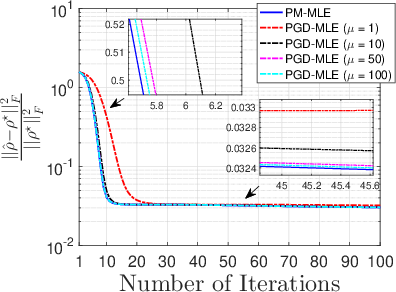
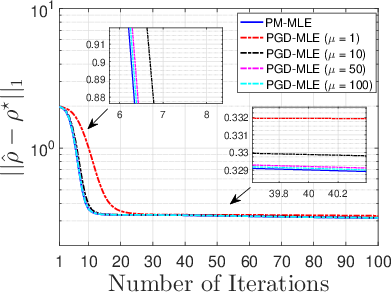
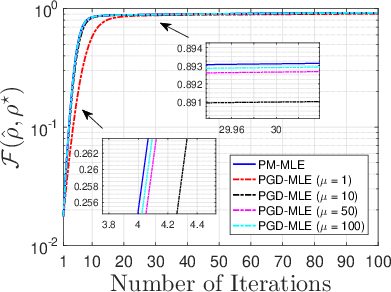
Figure 2: Convergence comparison of PGD-MLE and PM-MLE for low-rank tomography, illustrating faster convergence and improved final error for the PM variant.
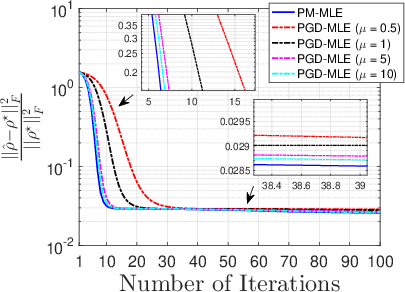
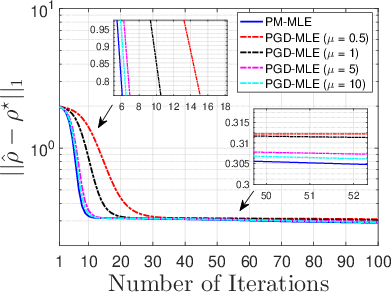
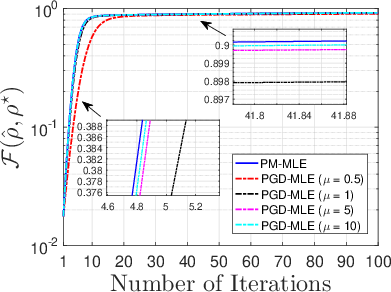
Figure 3: Convergence comparison of PGD-MLE and PM-MLE for low-rank MPO tomography, demonstrating step-size-free, faster, and more robust convergence for PM.
Empirically, the PM exhibits consistently faster and more robust convergence than step-size-tuned PGD across structured classes.
Numerical Results and Empirical Findings
Comprehensive experiments validate the superior statistical and computational properties of the proposed framework on large-scale QST tasks involving Haar-random measurements:
- MLE versus LSE: MLE consistently yields lower reconstruction error and higher fidelity across low-rank, MPO, and neural models, especially at moderate sample sizes.
- Structured Factorization: Explicit incorporation of tensor network constraints (LR-MPO vs. LR) significantly improves robustness and accuracy as system size grows, with error scaling linearly in n3 for MPOs.
- NDOs (MLP and Transformer): Neural architectures can achieve competitive performance, particularly on pure/structured states, but require careful selection of model dimension and depth for stability at scale. Transformers outperform MLPs as system size and state complexity increase, especially with moderate attention block sizes and a small number of heads.
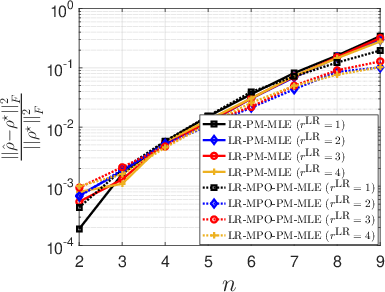
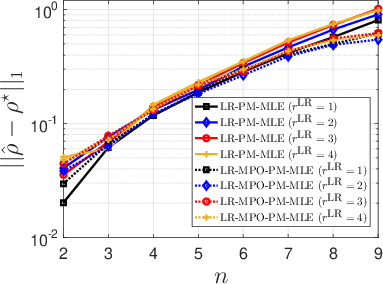
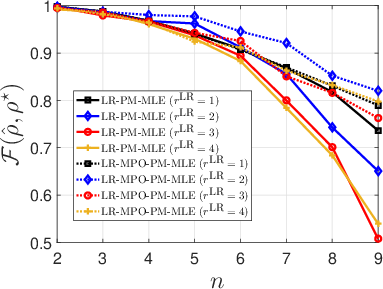
Figure 4: Error and fidelity scaling of PM-based low-rank versus MPO tomography with increasing system size n4 and rank parameter n5, highlighting superior scaling for MPO-based reconstruction.
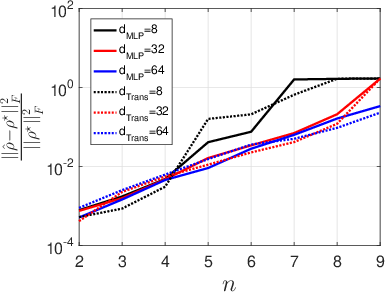
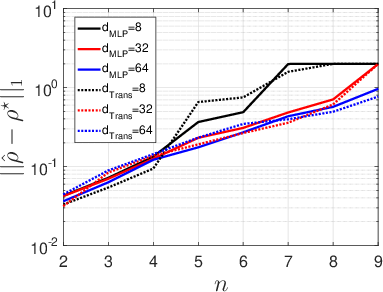
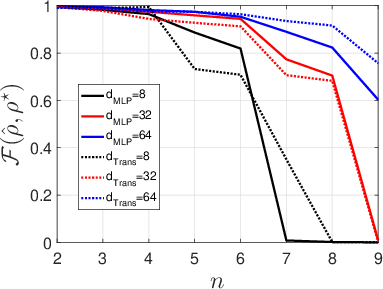
Figure 5: Impact of MLP and transformer width/model dimension on performance for thermal state QST as the number of qubits increases.
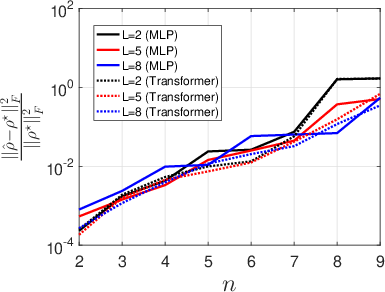
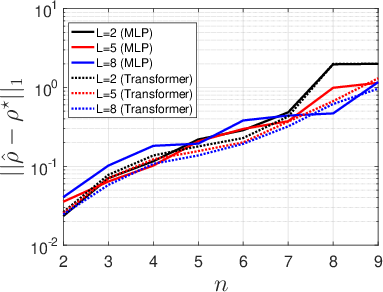
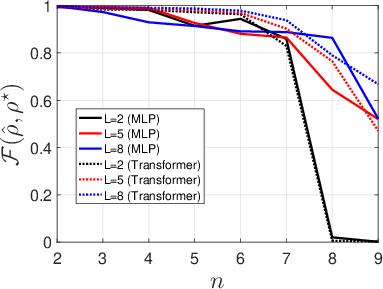
Figure 6: Effect of network depth on performance for both MLP and transformer NDOs under increasing system size for thermal state QST.
Other key empirical insights include:
- The step-size-free PM algorithm is scalable and hyperparameter-insensitive.
- The NDO approach’s performance is only competitive when sufficient model capacity is provided, with ReLU/LeakyReLU activations preferred in the MLP case.
- Cholesky and Burer–Monteiro (BM) models achieve comparable accuracy for full-rank cases, but BM provides a path to efficient low-rank models and parameter reduction.
Implications for Quantum Tomography and Future Directions
This unified framework streamlines the rigorous integration of structural priors into physically valid QST models, simplifying both the theory and practice of large-scale quantum state characterization. The direct parametrization of positivity, rank, and structure supports sample- and parameter-efficient QST, and enables practical and theoretical advances in tomography with tensor networks and neural quantum states.
The PM approach for MLE is significant: it represents an algorithmic innovation that can accelerate reliable reconstruction across structured models, from pure-state to highly mixed scenarios. The systematic empirical comparison between structured models and deep learning–based approaches clarifies the current advantages and limitations of neural quantum states, revealing areas for architectural and theoretical improvement (e.g., principled covering number bounds for NDOs).
Open challenges include extending sample complexity guarantees to deep neural representations, optimization improvements for very large quantum systems, and the exploration of hybrid models combining tensor network and neural architectures. The structured factorization paradigm can potentially inform the design of classical machine learning architectures for quantum data, as well as reinforce connections between matrix factorization methods in other high-dimensional estimation contexts.
Conclusion
The structured factorization approach to QST introduced in this work advances both the theoretical understanding and practical implementation of scalable, physically valid quantum state estimation. The framework’s flexibility, rigorous constraint satisfaction, and compatibility with both classical and neural architectures position it as a powerful tool for future developments in quantum tomography, quantum device characterization, and quantum machine learning.