- The paper introduces a proactive approach that dynamically adjusts TMR based on workload criticality and real-time fault risk.
- It employs a bi-level Markov Decision Process to optimize a composite cost function balancing latency, energy, and reliability.
- Experimental results show a 45.9% throughput improvement and a 30.3% energy reduction compared to conventional static and reactive methods.
ProWAFT: Proactive Workload-Aware Fault Tolerance for FPGA-Based CNN Accelerators
Motivation for ProWAFT
SRAM-based FPGAs have become essential for latency- and energy-constrained CNN inference at the edge, but transient hardware faults, such as SEUs, threaten system reliability. Traditional strategies, including static triple modular redundancy (TMR) and reactive recovery, have significant drawbacks—static TMR incurs high resource and energy overhead, while reactive approaches introduce recovery latency, potentially violating real-time constraints. These approaches further suffer from ignoring the spatiotemporal heterogeneity of both workload criticality (layer-type, propagation susceptibility) and fault risk (partition- and time-dependent SEU rates). As depicted in Figure 1, static or reactive solutions are inefficient at optimizing for dynamic reliability requirements, motivating the need for a proactive, fine-grained strategy that adapts redundancy according to workload characteristics and real-time fault risk, explicitly accounting for partial reconfiguration (PR) overhead.
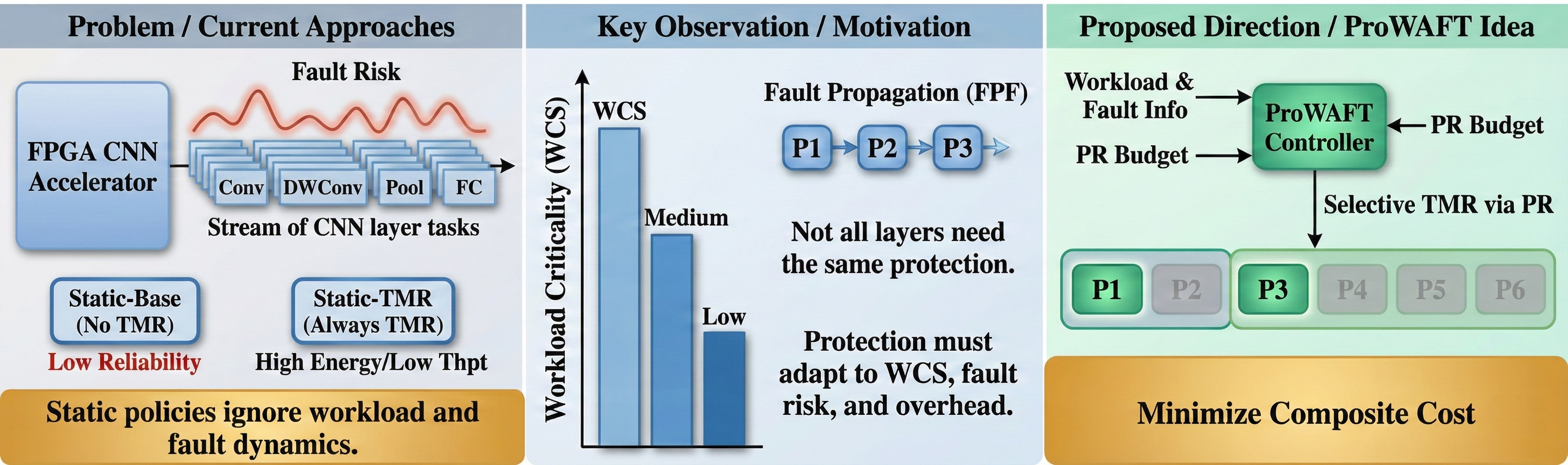
Figure 1: ProWAFT proactively adapts redundancy by integrating workload criticality, instantaneous fault risk, and reconfiguration overhead, outperforming static and reactive approaches in composite cost.
ProWAFT Architecture and Decision Framework
ProWAFT is a runtime framework designed to judiciously deploy TMR via PR in FPGA-based CNN accelerators on a per-partition, per-task basis. The architecture processes streams of telemetry—including workload features and partition-level health metrics—through four stages: Workload Criticality Scoring (WCS), Fault-Aware Performance and Reliability Risk Modeling, Composite Cost Evaluation (considering latency, energy, and reliability risk, plus PR overhead), and a bi-level Markov Decision Process (MDP) policy for configuration selection (see Figure 2).
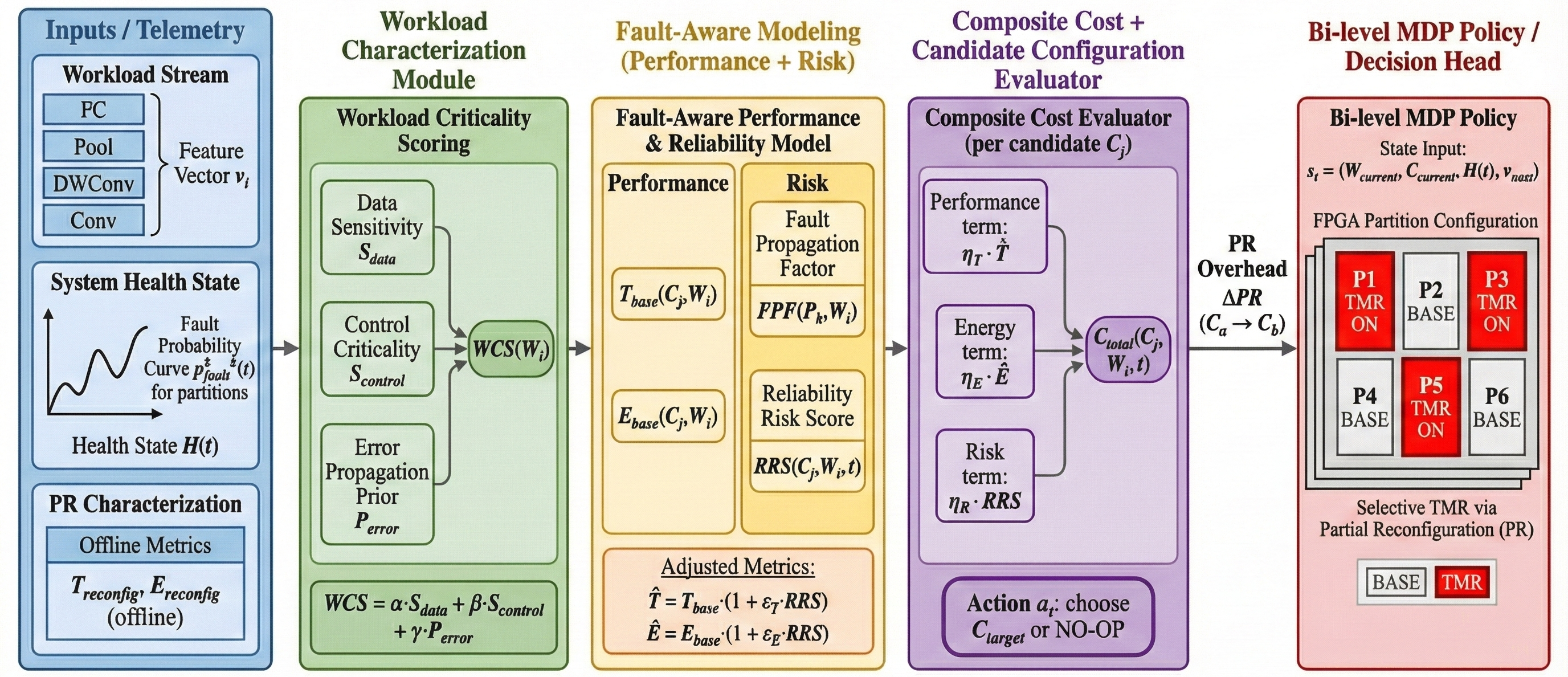
Figure 2: The ProWAFT pipeline sequentially processes telemetry to derive optimized partition protection policies using WCS, risk modeling, cost evaluation, and bi-level MDP policies.
Workload Criticality Scoring
Each CNN workload segment receives a WCS, which is a convex combination of:
- Data sensitivity (Sdata): Approximated by activation entropy via offline profiling.
- Control criticality (Scontrol): Indicator for conditional/critical-path workloads.
- Error propagation likelihood (Perror): Estimated by single-bit fault injection and regression modeling.
This enables the controller to prioritize protection for layers with the greatest vulnerability to faults.
ProWAFT integrates:
- Fault-free performance and energy modeling for candidate partition configurations using operator-level DSP utilization and power models.
- A propagation-aware Reliability Risk Score (RRS) that compounds partition-level fault likelihood, workload criticality, partition utilization, and observed output severity.
- Explicit time/energy overheads for partial reconfiguration (offline characterized for transitions between configuration sets).
The overall composite cost is a weighted sum of normalized latency, energy, and RRS; the policy selects the action minimizing this cost plus PR overhead, subject to budget constraints.
Experimental Methodology
System and Workload
Experiments are executed on a Xilinx Zynq UltraScale+ ZCU104 platform, partitioned into six reconfigurable regions. The accelerator library includes baseline and TMR-hardened modules for Conv, Pool, and BN/Activation layers. Evaluation is conducted on a synthesized 500-task trace derived from ResNet-18, MobileNetV2, and EfficientNet-Lite, with a sinusoidally modulated per-partition SEU fault injection model (fault probabilities in [0.001,0.01]).
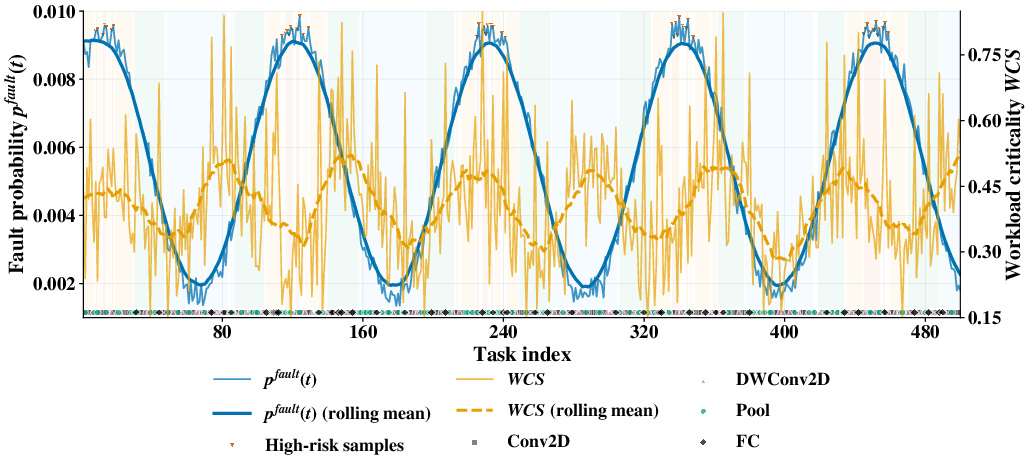
Figure 3: 500-task workload trace and partition fault risk temporal profiles, demonstrating heterogeneity in both criticality and transient error probability.
Baselines and Metrics
ProWAFT is compared against Static-Base (always baseline), Static-TMR (full TMR), and Reactive-Reconfig (TMR upon post-fault detection). Primary metrics are composite cost, normalized throughput (relative to 1.0 Static-Base), total system energy, task success rate, and PR overhead.
Quantitative Results
ProWAFT achieves superior Pareto efficiency: compared to Static-TMR, normalized throughput improves from 0.61 to 0.89 (∆+45.9%), energy consumption is reduced by 30.3%, and task success rate remains high at 98.8%. Notably, the composite cost Ctotal is minimized (0.54 vs. 0.81), representing a substantial improvement in operational quality-of-service. Compared to the Reactive baseline, ProWAFT delivers significant throughput and energy gains and reduces the composite cost by 30.8%.
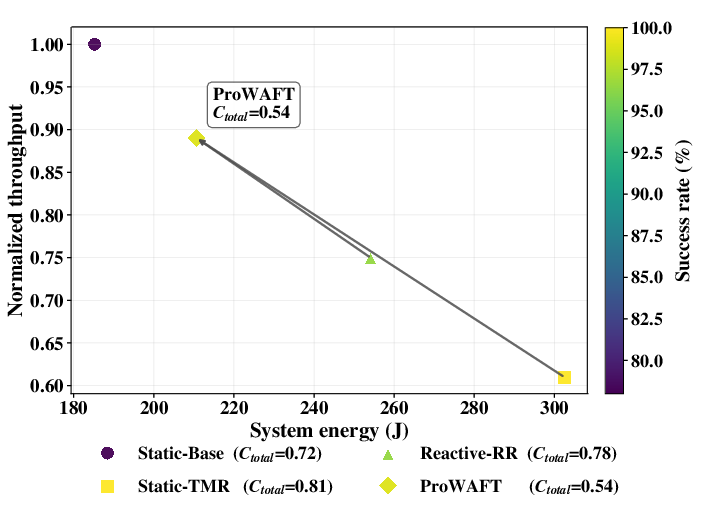
Figure 4: ProWAFT situates at a more favorable energy–throughput–reliability trade-off point compared to static and reactive baselines.
Adaptivity and Temporal Behavior
ProWAFT dynamically modulates TMR coverage, increasing redundancy during periods of heightened fault risk or elevated workload criticality, as shown in Figure 5. Decision latency is low (sub-millisecond), and proactive PR events are scheduled ahead of predicted error bursts, contrasting sharply with the lagging behavior of reactive schemes. In high criticality or high-risk regimes, TMR coverage can exceed 95%, but drops below 15% during benign operation.
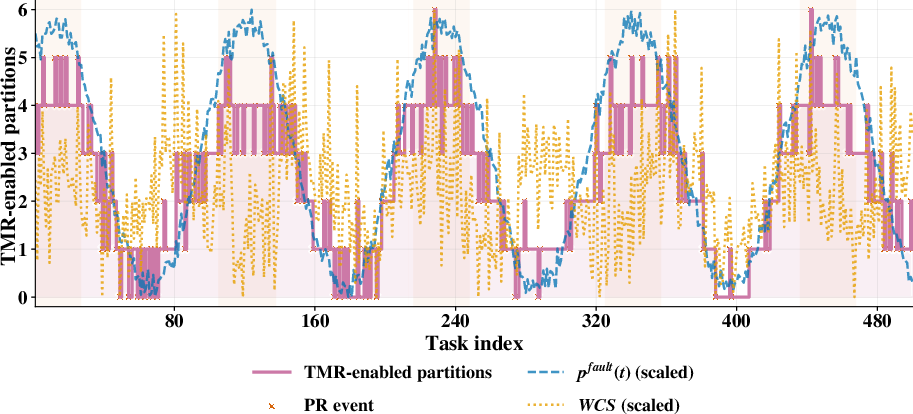
Figure 5: Timeline showing proactive adaptation in number of TMR-enabled partitions under varying risk and workload, with PR events ahead of potential anomalies, unlike the delayed response in reactive approaches.
Overhead and Ablation
Online decision overhead is negligible (approximately 0.5 ms), and the total proactive overhead (decision plus PR) is significantly lower than the latency induced by reactive recovery. Ablation studies confirm that each major component—WCS, propagation modeling, and bi-level policy—contributes substantially; removing any degrades Ctotal by 13–22% or more.
Robustness and Sensitivity
ProWAFT demonstrates robust operation under moderate modeling or parameter estimation errors. Adjusting composite objective weights moves the operating point as expected, facilitating user customization for energy-centric, performance-centric, or reliability-centric deployments.
Theoretical and Practical Implications
The explicit coupling of workload-driven criticality and real-time system health metrics within an actionable cost-minimization policy formalizes a new instance of runtime reconfigurable reliability management. The demonstrated benefit of integrating dynamic criticality and propagation-aware risk modeling underscores the limitations of statically programmed or naively reactive architectures. Importantly, ProWAFT’s architecture generalizes to broader post-von-Neumann reconfigurable AI accelerators, for any context in which reliability, energy, and latency are simultaneously constrained and heterogeneous.
ProWAFT anticipates a future in which adaptive, telemetry-driven protection becomes essential for robust deployment of edge AI in adversarial or uncertain environments (e.g., space, industrial settings, safety-critical robotics). The work further motivates development of more autonomous in-field self-calibration (beyond offline profiling) and integration of physical fault sensors.
Conclusion
ProWAFT provides a principled, low-overhead runtime solution for adaptive reliability management in FPGA-based CNN accelerators, yielding a superior composite trade-off compared to static or reactive fault-tolerance schemes. By leveraging telemetry and formal cost modeling, ProWAFT achieves substantial improvements across energy, throughput, and task success under dynamic operational scenarios. Future research should focus on more realistic physical fault testing, self-adaptive calibration pipelines, and extending to larger-scale and more heterogeneous accelerator deployments.