- The paper introduces a multi-rate NMPC framework that optimizes center of mass trajectories and discrete foothold placements for wall-supported locomotion.
- It employs a layered control architecture combining fast environment reaction force adjustments with high-frequency quadratic programming for whole-body tracking.
- Simulations demonstrate a 2.9x higher survival rate under disturbances, showing superior constraint satisfaction and adaptability in complex terrains.
Multi-Rate Nonlinear Model Predictive Control for Wall-Supported Bipedal Locomotion of Quadrupedal Robots
Introduction and Motivation
Wall-supported bipedal locomotion in quadrupedal robots addresses significant operational challenges in constrained settings, such as narrow corridors, cluttered industrial spaces, and disaster environments. Standard quadrupedal gaits are unsuitable in these environments due to spatial limitations and the need for elevated manipulation capabilities. By leveraging environmental contacts, specifically vertical surfaces, quadruped robots can achieve upright, wall-supported postures, facilitating tasks that require reach and stability beyond what is possible with classical four-legged locomotion. However, this hybrid locomotion mode poses unique control and planning problems: it combines multi-rate hybrid dynamics, nontrivial coupling between contacts and motion, and real-time actuation under tight kinematic and dynamic constraints.
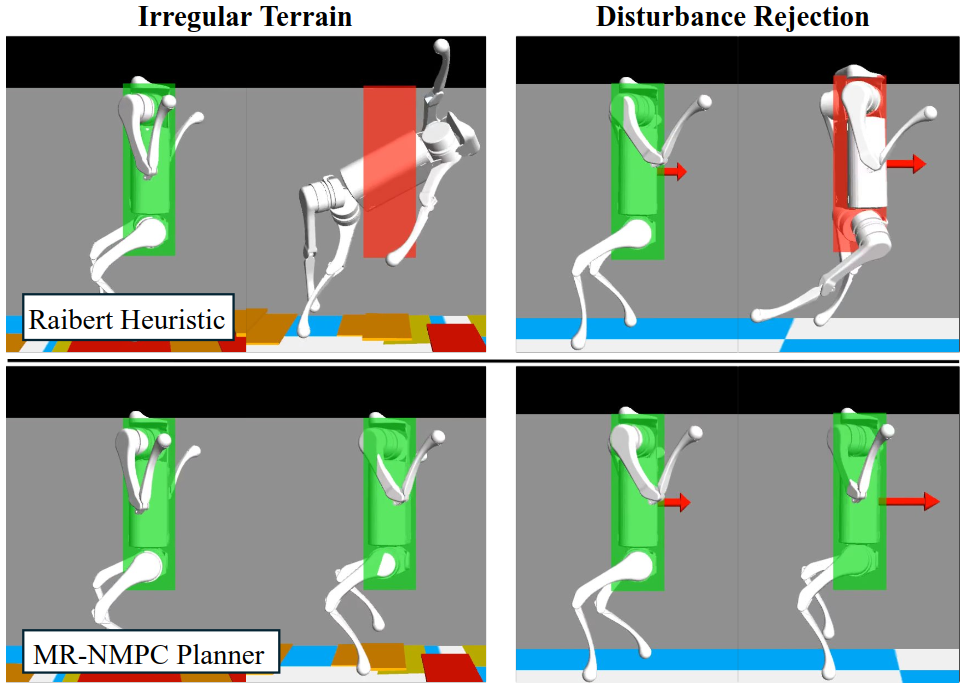
Figure 1: Snapshots demonstrating wall-supported locomotion using the proposed MR-NMPC controller and the Raibert heuristic as a baseline. The green box denotes the prescribed safety envelope, while the red box indicates a violation of the safety envelope during the wall-supported locomotion.
Layered Control Architecture
The proposed solution employs a two-level control hierarchy. At the high level, a Multi-Rate Nonlinear Model Predictive Controller (MR-NMPC) simultaneously optimizes the center of mass (CoM) trajectories, torso orientation, environment reaction forces (ERFs), and discrete contact-point (footstep) placements using a single rigid-body (SRB) template. Fast inputs (ERFs) can be adjusted at each time step, while slow inputs (foothold updates) are handled at defined discrete events, typically gait transitions. The low-level controller, a Whole-Body Controller (WBC), executes these references at high frequency (1 kHz) using a quadratic programming (QP) formulation of the full robot dynamics. This hierarchical split manages computational complexity while providing the reactivity and robustness required by hybrid contact-rich locomotion.
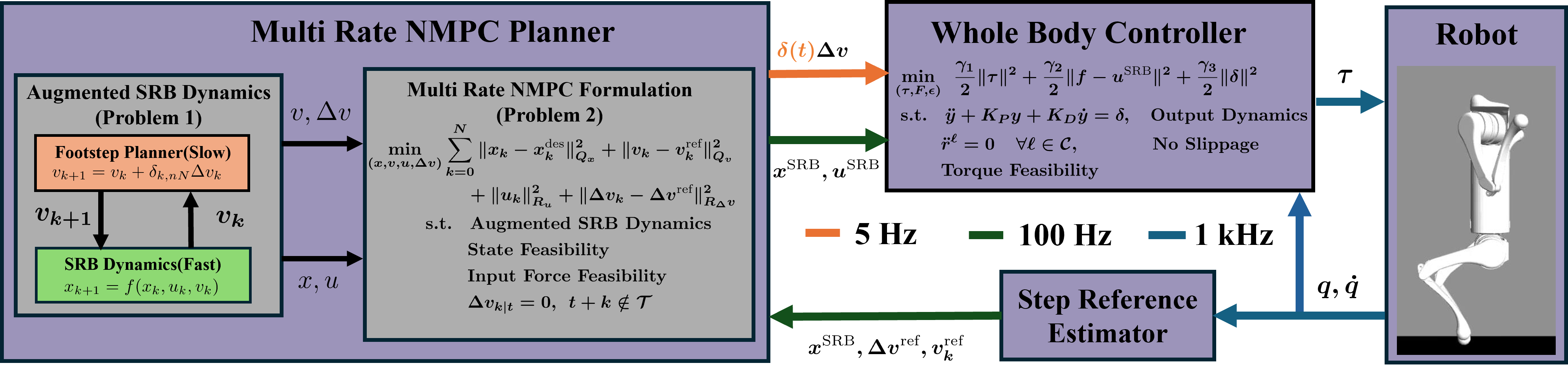
Figure 2: Proposed layered control architecture: The high-level MR-NMPC optimizes reduced-order trajectories and footstep placements, while the low-level WBC tracks these optimal values using full-order nonlinear dynamics and high-frequency sensor feedback.
The MR-NMPC is constructed around a multi-rate discrete-time system integrating both fast and slow control loops. The dynamics are based on the SRB abstraction with states comprising CoM position, orientation, and limb end-effector locations. ERFs—incorporating both ground and wall contacts—are fast control variables. Foot placements are slow variables, updated at phase transitions per an explicit gait schedule comprising four-contact, three-contact, and two-contact phases.
A central structural innovation is the explicit inclusion of limb end-effector trajectories as state variables. The MR-NMPC problem is formulated as a constrained optimal control problem with a stage cost combining tracking errors for both the SRB state and the contact location sequence. A binary gating mechanism enforces the slow/fast input schedule, operationalized through an indicator function on contact switching events.
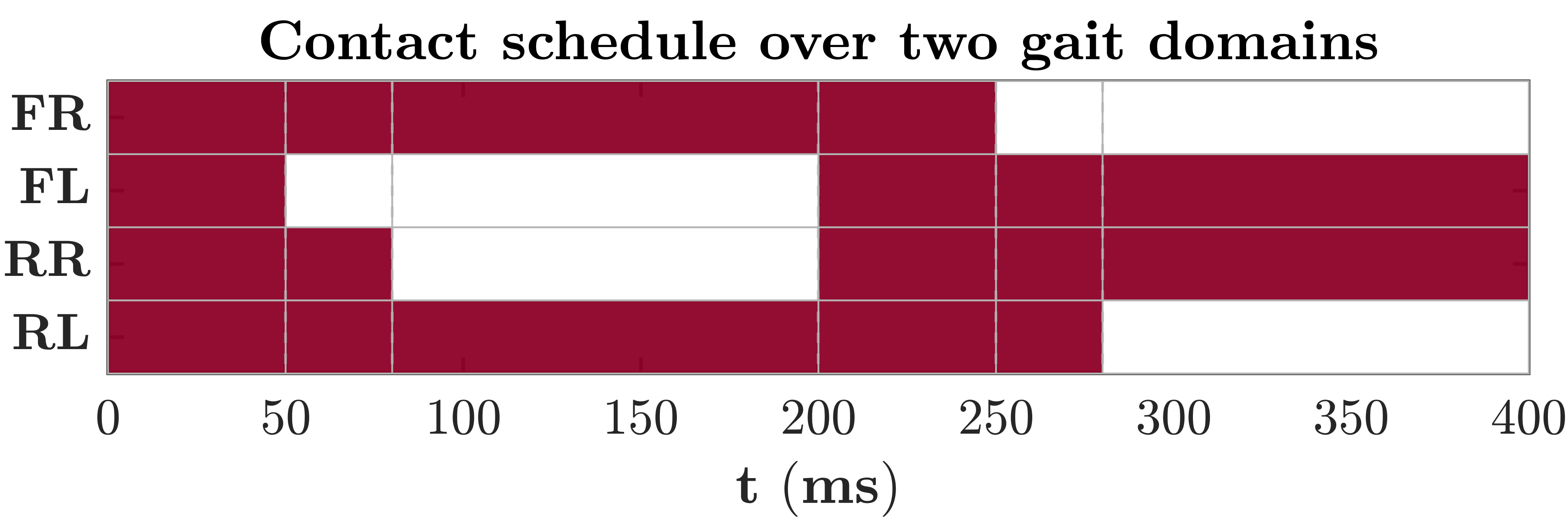
Figure 3: Gait contact schedule over a 400 ms interval across two gait domains. Dark maroon regions denote the stance phase, while white regions indicate the swing phase.
Nonlinear Whole-Body Tracking
The low-level controller translates the optimal SRB-regulated trajectories into full-order joint torques while satisfying physical constraints (e.g., joint torque limits, friction cones, no-slip conditions for stance feet). Virtual constraints are defined to enforce tracking of the desired CoM motion, body orientation, and swing leg trajectories, thus mapping reduced-order planned motion into the full robot configuration space. The resulting QP problem is convex and solved at high frequency for real-time performance.
Simulation Evaluation and Empirical Results
Simulation validation employs the Unitree A1 quadruped in complex environments modeled with the RaiSim physics engine. The reference scenario is a 45 cm corridor lined with randomly stacked wooden blocks, imposing challenging terrain and requiring precise navigation and disturbance rejection.
Flat Terrain Benchmark
Under nominal conditions, MR-NMPC and the Raibert velocity-based heuristic both successfully maintained upright wall-supported locomotion with accurate velocity and orientation tracking. This establishes baseline controller equivalence in benign settings.
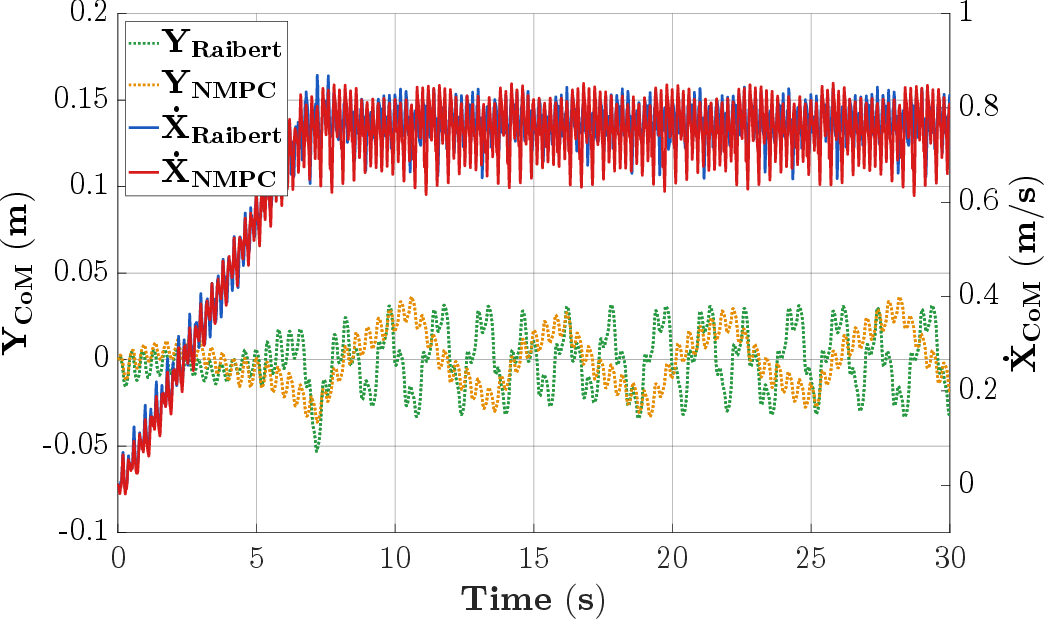
Figure 4: A comparison of the CoM velocity and base orientation tracking for the Raibert heuristic (blue) and the proposed MR-NMPC (red) in a flat-terrain condition where the desired forward velocity is 0.8 m/s.
Disturbed and Rough Terrain
On rough terrain and under external disturbances (e.g., a 50 N sinusoidal push), the MR-NMPC framework achieves superior disturbance rejection, adaptive foothold selection, and constraint satisfaction. The MR-NMPC proactively varies front/rear foot placements, expanding/contracting the support polygon to optimize stability margins—a capability absent in symmetric heuristics, which resort to longer, unsafe steps under disturbance, frequently breaching joint/kinematic constraints.
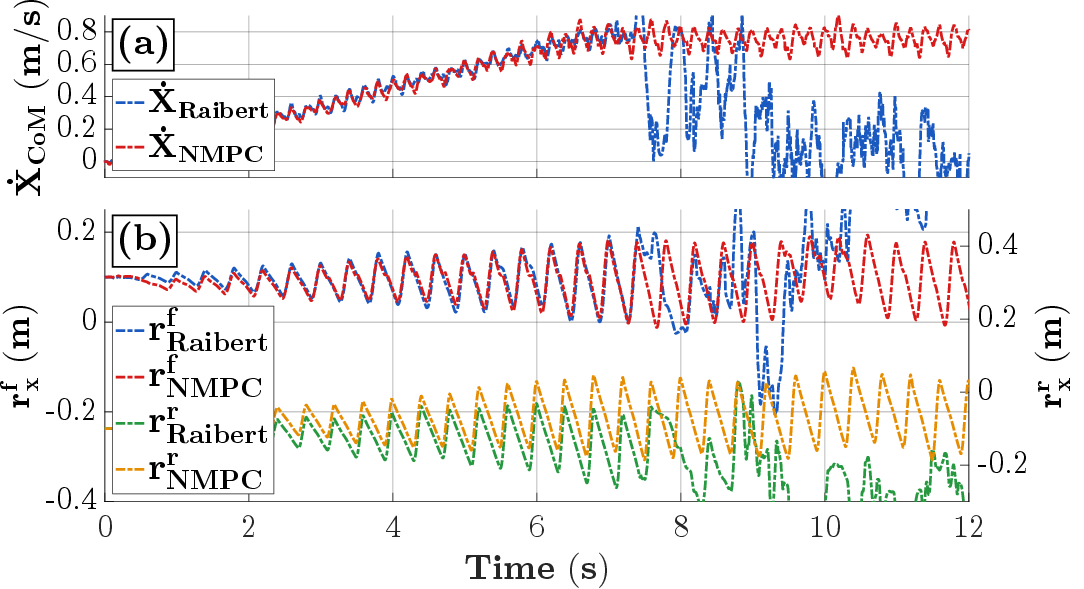
Figure 5: Plots of the (a) CoM velocity with the Raibert heuristic (blue) and with MR-NMPC (red), where 0.8 m/s is the desired velocity (b) front and rear foot position evolution with respect to the CoM position with the Raibert heuristic (blue) and with MR-NMPC (red).
Statistical Analysis of Success Rates
Simulation results over 250 randomized rough-terrain trials demonstrated a 2.9x improvement in survival probability for MR-NMPC versus the Raibert heuristic at high speeds, defined as the ability to traverse the entire corridor without violating safety, height, or kinematic constraints. The success rate for the heuristic degrades sharply with increased velocity, while MR-NMPC maintains robust performance.
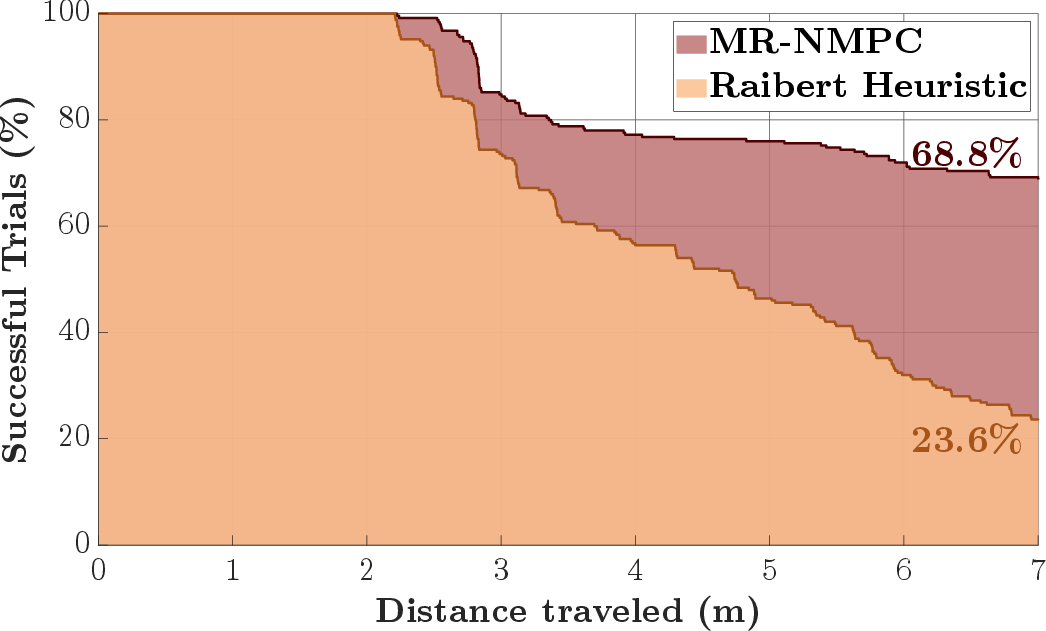
Figure 6: Comparison of proposed MR-NMPC planner against Raibert heuristic over 250 randomly generated rough terrains.
Disturbance Recovery
The MR-NMPC demonstrates constraint-aware disturbance recovery, using small, asymmetric steps to maintain safety, while the heuristic saturates at kinematic limits and induces falls.
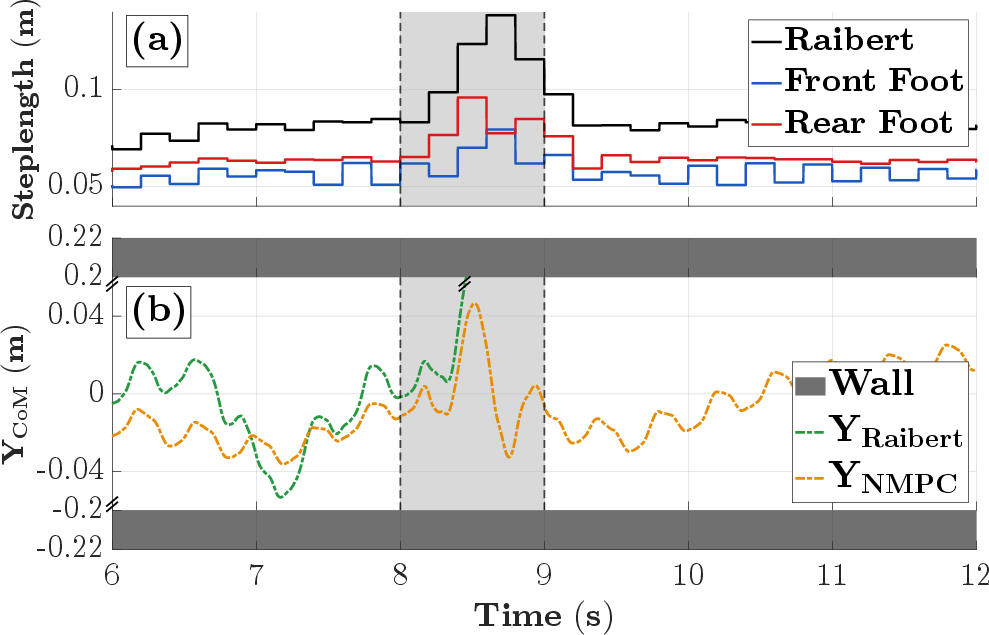
Figure 7: %Lateral recovery under a 50N sinusoidal push, comparing step length and CoM trajectory between MR-NMPC and the Raibert baseline.
Implications and Future Directions
Theoretical and Practical Impact
The integration of multi-rate NMPC with explicit contact-location optimization in the context of wall-assisted bipedal quadrupedal locomotion addresses critical limitations in both model-free RL-based and traditional MPC approaches—specifically, their inability to jointly optimize over discrete adhesion sequences and continuous states under real-time constraints. The demonstration of constraint satisfaction, superior disturbance rejection, and adaptability under hybrid, contact-rich conditions is highly relevant for autonomous operations in unstructured environments.
Path Forward
Fundamental challenges remain for reliable operation on physical hardware: state estimation accuracy—especially for forward velocity during sustained upright gaits—remains a major bottleneck; improvements via observer/Kalman filtering and sensor fusion are necessary. Further directions include expanding wall contact robustness via larger foot pads, perception-aware planning to resolve terrain and wall geometry uncertainties, and closing the sim-to-real gap through hardware-in-the-loop evaluation.
Conclusion
The paper presents a comprehensive multi-rate NMPC framework for wall-supported bipedal locomotion of quadrupedal robots, validated via extensive simulation on rough terrain and under significant disturbances. The layered control architecture—combining trajectory and contact optimization at the high level and constraint-enforcing QP tracking at the low level—demonstrates robust, real-time feasibility and significant advantages over classical heuristics in terms of safety, agility, and adaptability, notably achieving a 2.9x higher survival rate in complex terrains. These findings have direct implications for deploying legged robots in real-world, constrained, and dynamic environments, motivating further work in robust estimation, perception integration, and real-hardware validation.
Reference:
Multi-Rate Nonlinear Model Predictive Control for Wall-Supported Bipedal Locomotion of Quadrupedal Robots (2607.01574)

