- The paper’s main contribution is the development of a multiplex collaborative persona graph to robustly personalize LLM outputs via facet-aware peer aggregation.
- It employs a dual-branch inference combining non-parametric neighbor retrieval with parametric graph message passing, leading to superior benchmark performance.
- Empirical evaluations show significant improvements in metrics like ROUGE and BLEU, effectively mitigating facet-level cold-start and coverage biases.
Collaborative Persona Graphs for Robust LLM Personalization: An Expert Analysis of CoPersona
Motivation and Problem Setting
LLM personalization faces acute challenges arising from the inherent sparsity and bias present in real-world user histories. Most users contribute limited interactions, and the available data disproportionately cover only a subset of behavioral facets (e.g., topics, tone, preferences), leading to facet-level cold-start conditions. When downstream tasks depend on user attributes that are weakly or never observed, standard retrieval or embedding-based personalization methods break down, either reverting to generic LLM outputs or hallucinating unrepresentative persona attributes. The empirical findings underscore the ubiquity of this challenge: for instance, in the Books and Movies domains, over 97% of users lack strong support for at least one facet, highlighting severe coverage bias.
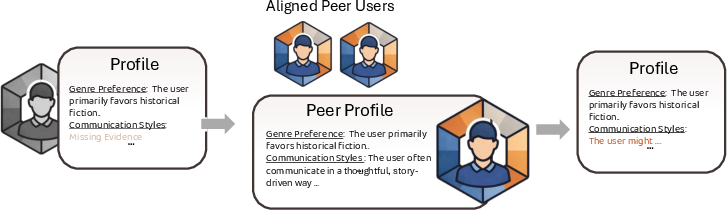
Figure 1: Facet coverage bias is addressed via collaborative completion, augmenting user profiles with facet evidence inferred from behaviorally aligned peers.
From Facet-Agnostic Borrowing to Facet-Aligned Collaboration
Conventional collaborative personalization approaches either exploit global user similarity or shallow neighbor document retrieval. These methods can be highly confounded due to facet mixing: users may appear similar under dominant observed facets while being dissimilar under under-supported ones. Unstructured aggregation, therefore, introduces noise and undermines interpretability, controllability, and auditing of personalization strategies.
CoPersona addresses this limitation with a structured, facet-aware pipeline grounded in a multiplex collaborative persona graph. This construction enables precise borrowing of complementary signals from behaviorally similar peers, organized along well-defined, data-driven facets.
Methodology
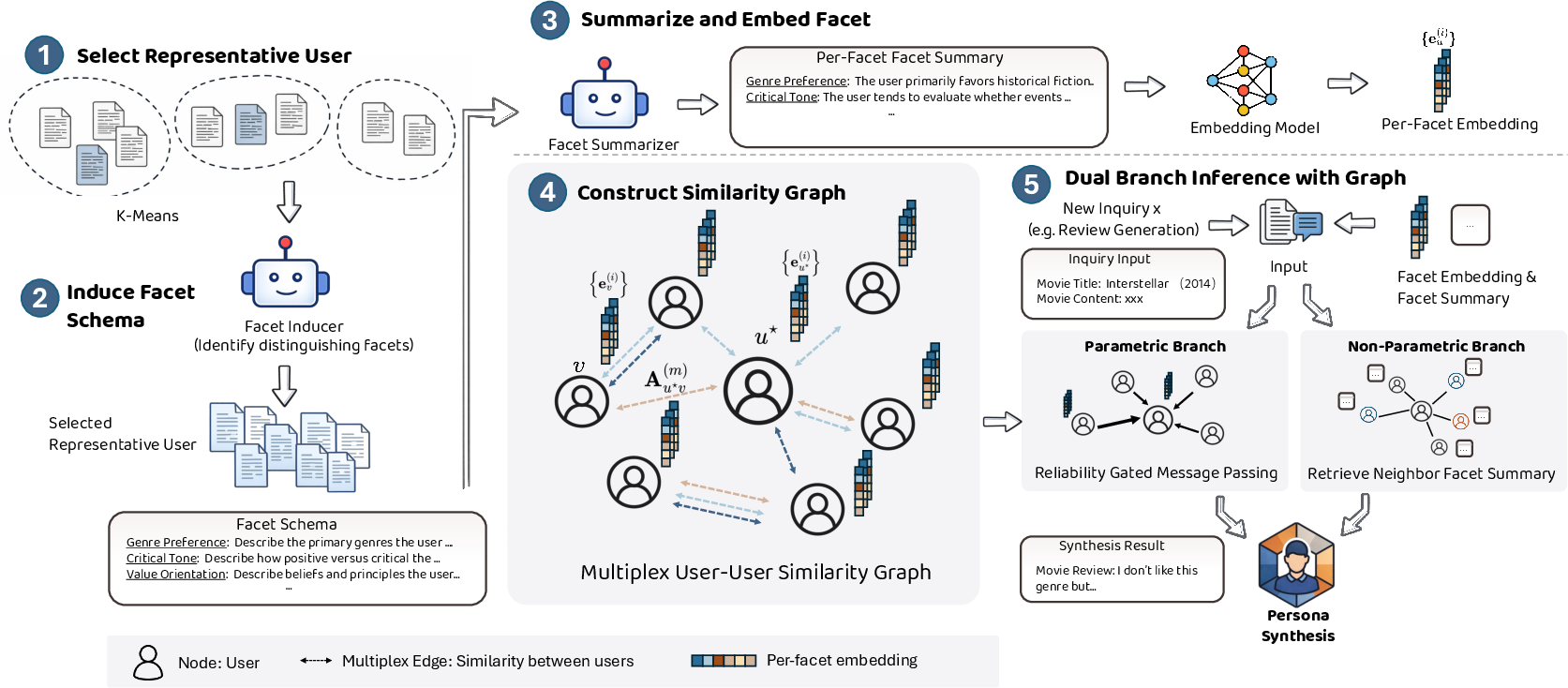
Figure 2: CoPersona system overview, illustrating facet induction, multiplex persona graph construction, and dual-branch (retrieval + parametric) inference.
Facet Schema Induction and Embedding
Rather than relying on handcrafted or static persona schemas, CoPersona induces a domain-adaptive, human-interpretable facet schema directly from user population data. User histories are clustered in a dense embedding space, and clusters are summarized for an LLM to induce orthogonal, salient facets (e.g., engagement level, genre preference, tone). Each user is then summarized per-facet, and facet-level evidence is embedded for similarity computations.
Multiplex Collaborative Persona Graph
The core data structure is a multiplex user--user graph, with each facet inducing a distinct edge layer. User pairs are connected on a facet if their facet embeddings are sufficiently similar (cosine similarity, reliability-gated), and edges are sparsified to retain only the strongest alignments. The reliability of facet summaries is explicitly tracked, enabling trust-weighted neighbor aggregation and robust handling of weakly supported or noisy facets.
Dual-Branch Inference: Retrieval and Graph Message Passing
Personalization at inference time combines:
- Non-parametric facet-aligned neighbor retrieval: For each facet, the top-K most aligned peers are retrieved; their facet summaries and evidence are linearized and injected as human-interpretable context to the LLM.
- Parametric, reliability-gated latent graph inference: Neighbor facet embeddings are aggregated via a message-passing scheme, with the influence weighted by evidence reliability. The final user representation is obtained via cross-facet self-attention and projected into soft prompt tokens that condition the LLM.
This dual-branch architecture provides both high-fidelity, explicit facet evidence and a denoised, compressed latent personalization signal, maintaining robustness under severe coverage bias.
Empirical Evaluation
Benchmark and Evaluation Protocol
CoPersona is evaluated on Amazon Reviews 2023 across Books, Movies, CDs/Vinyl, Video Games, Musical Instruments, and Sports/Outdoors—a diverse suite designed to test both core and cold-start regimes. Baselines span non-personalized generation, retrieval-augmented generation (RAG), profile-augmented generation (PAG), difference-based profiles (DPL), and dense embedding-based personalization (DEP). Metrics include ROUGE (R-1, R-L), METEOR, BLEU, BERTScore, and LLM-as-Judge assessment (Qwen2.5-72B).
Overall Quality and User Alignment
CoPersona consistently achieves the highest scores across all metrics and domains. On Books (7B scale), it yields +3.3 ROUGE-1, +3.4 METEOR, +3.1 BLEU over the best prior baseline (DEP), demonstrating strong lexical and semantic alignment with gold targets. The gains are robust to increased sparsity, with Video Games and Sports/Outdoors showing sizable improvements in BLEU—indicative of better phrase-level and stylistic matching.
Human-Likeness and Authenticity
LLM-as-Judge evaluation on the Books dataset demonstrates that CoPersona-generated reviews have the highest authenticity and practical-detail scores, directly outperforming DEP by +1.24 in practical details. This reflects enhanced realism and naturalness, signifying that collaborative facet completion more accurately reconstructs user-level voice beyond mere n-gram overlap.
Component Ablations
Ablations reveal the complementary significance of both system branches:
- Removing the non-parametric (retrieval) branch degrades BLEU by -2.17, while removing the parametric (graph) branch decreases BLEU by -4.13 and ROUGE more substantially, confirming the necessity of latent collaborative smoothing.
- Substitute retrievers (dense or recency-based) have only mild effects, validating the method’s insensitivity to self-history retrieval specifics; most gains originate from structured peer borrowing.
Sensitivity and Hyperparameters
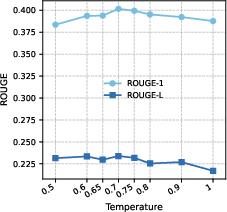
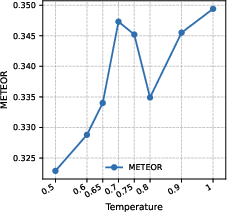
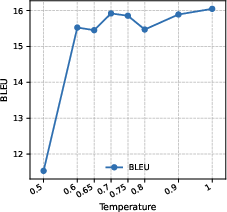
Figure 3: Decoding temperature exhibits minor influence on performance, attesting to system robustness across 0.5–1.0.
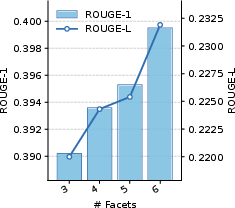
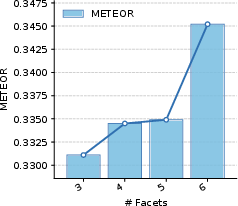
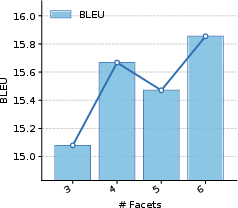
Figure 4: Increasing the number of induced facets incrementally improves performance, with diminishing returns past moderate facet counts.
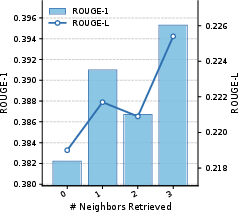
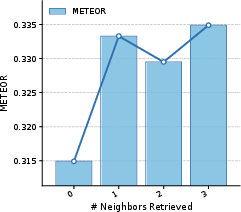
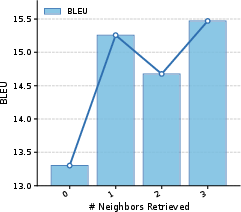
Figure 5: Expanding the retrieved neighbor budget per facet boosts outcome, saturating as the top relevant peers are incorporated.
CoPersona remains robust to decoding temperature, facet schema granularity, and neighbor budget, reflecting stable inductive biases and practical deployability.
Theoretical and Practical Implications
CoPersona’s facet-aware collaboration moves beyond traditional LLM personalization paradigms by enabling interpretable, auditable, and robust imputation of user attributes in high-coverage-bias and cold-start regimes. The explicit facet decomposition and reliability-gated graph architecture further mitigate the negative transfer risks ubiquitous in global similarity approaches. The induced facets reflect domain semantics, aligning the learned representations with real user intention distributions.
Practically, the system is efficient at inference, supporting offline computation of persona graphs and soft prompts. Cached representations minimize runtime overhead and facilitate deployment in both resource-limited and high-throughput environments.
Theoretically, CoPersona relates to structured collaborative filtering but extends its expressiveness through end-to-end learnable, evidence-aware message passing over multiplex structures, directly targeting generative alignment, not just retrieval or recommendation tasks.
Future Directions
This framework opens multiple avenues:
- Adaptation to dynamic or evolving facet schemas under changing population behaviors or task domains.
- Integration with user-side controls for auditing and overriding facet transfers, supporting privacy and transparency.
- Richer message-passing protocols combining structural, temporal, and higher-order behavioral attributes.
- Extension to vertical tasks including dialogue agents, task-oriented assistants, and personalized re-ranking.
Conclusion
CoPersona sets a new paradigm for robust, facet-aware LLM personalization in the face of sparsity and coverage bias. By leveraging a structured collaborative persona graph with dual-branch inference, it reliably augments user profiles, achieves superior empirical results across strong benchmarks, and produces outputs that are quantitatively and qualitatively more aligned with authentic human persona attributes. The system’s adaptability and rigor suggest substantial impact for the coming generation of personalized AI applications.
(2607.01485)