- The paper derives exact and asymptotic formulas for the expected collection time in two multi-draw coupon collector models using advanced analytic methods.
- The paper shows that both retention rules yield a leading-order reduction in collection time by a factor of d and universally converge to a Gumbel distribution.
- The paper applies the models to DNA data storage, providing explicit trade-offs and practical formulas for optimizing sequencing coverage.
Two Multi-Draw Coupon Collector Models with Different Retention Rules
This work investigates two multi-draw extensions of the classical Coupon Collector's Problem (CCP), introducing two retention mechanisms under which a collector receives d distinct coupons per draw from a uniform set of N types. Problem I utilizes a collection mechanism where all previously unseen coupons in a d-tuple are retained upon each draw. Problem II requires the collector to select the least-collected coupon among those drawn in each round. Both mechanisms generalize the traditional (d=1) CCP and find direct practical application in combinatorial motif-based DNA data storage.
Main Results: Mean and Asymptotic Expansions
For both models, the expected time (number of draws) to collect a full set of N coupon types is derived exactly and asymptotically, utilizing advanced tools such as Nørlund–Rice integral representations and Euler–Maclaurin expansions.
Problem I: "Keep All New" Rule
The exact mean completion time is given by an alternating binomial sum (Theorem 1), and its asymptotic expansion as N→∞ is
E[TN,d]=dNlogN+dγN−2dd−1logN+(21−2dd−1γ)+O(NlogN)
showing a reduction by a factor of d in the leading term compared to the classic collector (d=1). The full expansion includes all orders in N−1, with closed-form recursion for coefficients (Theorem~\ref{thm:fullI} in the paper).
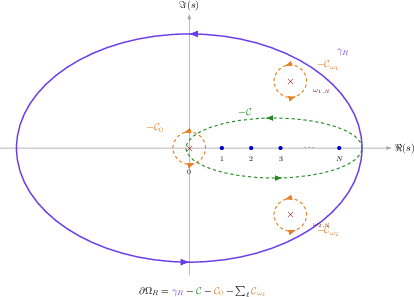
Figure 1: The region N0 used in the complex-analytic residue calculations for Nørlund–Rice integrals.
Problem II: "Keep Least-Collected" Rule
For this model, the expected completion time is:
N1
and its asymptotic expansion is
N2
with N3 strictly increasing in N4 and representing the per-unit-N5 penalty incurred by this retention strategy. Its closed form is given as N6, where N7 is the digamma function.
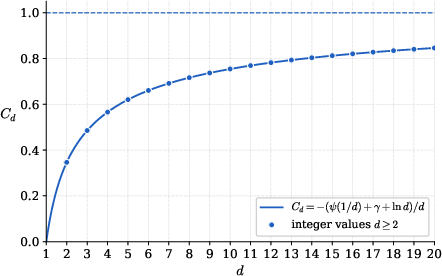
Figure 2: Graph of N8 as N9 increases; d0 approaches d1 logarithmically slowly with d2.
Both models exhibit identical leading and logarithmic behavior, differing only in the d3 term via constant d4.
Limiting Distribution and Fluctuations
The normalized completion times, under both models, are shown to converge to a standard Gumbel law:
d5
where d6 denotes the standard Gumbel random variable. The normalization reflects the modified scale imposed by the d7-draw protocol.
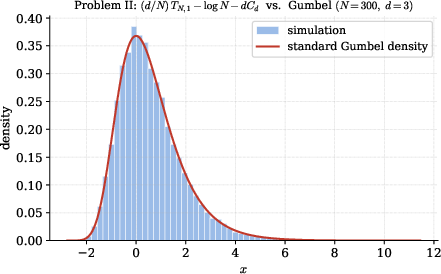
Figure 3: Empirical distribution of the normalized completion time d8 for Problem II, confirming convergence to the Gumbel law.
The rate of convergence in the Kolmogorov distance is explicitly quantified as d9.
Variance Analysis
The variances for both retention rules satisfy
(d=1)0
revealing that the leading-order fluctuation scale is invariant under the choice of retention rule; differences only arise at the (d=1)1 and lower-order terms.
Application to Motif-Based DNA Data Storage
Problem I precisely models sequencing-coverage for combinatorial motif-based DNA data storage systems, where reading one symbol reveals (d=1)2 motifs at once, and the decoding requires all constituent motifs to be observed at least once.
The main implications are:
- The leading-order expected read count per symbol shrinks proportionally to (d=1)3 with increasing combinatorial alphabet size.
- Normalized completion time fluctuations follow an extreme-value law (Gumbel), supporting probabilistic guarantees for coverage-targeted system design.
Practical system parameters such as coverage depth, required to ensure a desired recovery probability, can be computed using the provided asymptotic expansions.
Theoretical and Practical Implications
Theoretical Advances
- The analysis demonstrates the robustness of the Gumbel limit under significant sampling modifications, with the normalization adapting to the rule.
- The full asymptotic expansions (including all subleading terms) for nontrivial, highly structured alternating sums are established using analytic and probabilistic techniques.
- Explicit asymptotic correspondences between mean, variance, and limiting laws of both models are provided.
Practical Impact
- Enables rapid, high-accuracy computation of mean and variance for large (d=1)4, supporting parameter optimization for synthetic DNA storage or analogous multi-draw collection processes.
- Quantifies the trade-off between aggressive retention strategies and collection speedup, guiding system architecture in biotechnology and communications.
Speculation on Future Developments
Open directions highlighted by the authors include:
- Extending results to non-uniform coupon type distributions, which would remove the binomial structure enabling the current analytic approach.
- Study of multi-set (multi-coverage) versions with (d=1)5-fold target coverage for each coupon.
- Investigation of coding or scheduling layers manipulating coverage balance under multi-draw regimes, which may blend probabilistic extremal analysis with combinatorial coding theory.
Further cross-disciplinary applications are anticipated, especially in scalable data storage technologies, randomized search, and ecological/biological sampling where analogous collection and coverage processes arise.
Conclusion
This paper rigorously characterizes the completion time behavior in two generalized multi-draw coupon collector models under differing retention protocols. Key findings include universal leading-order speedup by (d=1)6 in expected collection time, retention-rule-sensitive (d=1)7 corrections, invariant leading-order variances, and universal convergence to the Gumbel law. The analysis provides both the exact formulas and practical asymptotics necessary for application in real-world systems, particularly in the combinatorial DNA data storage domain. The framework and analytic techniques established here lay a foundation for further advances in the generalized coupon collector theory and its applied interfaces.