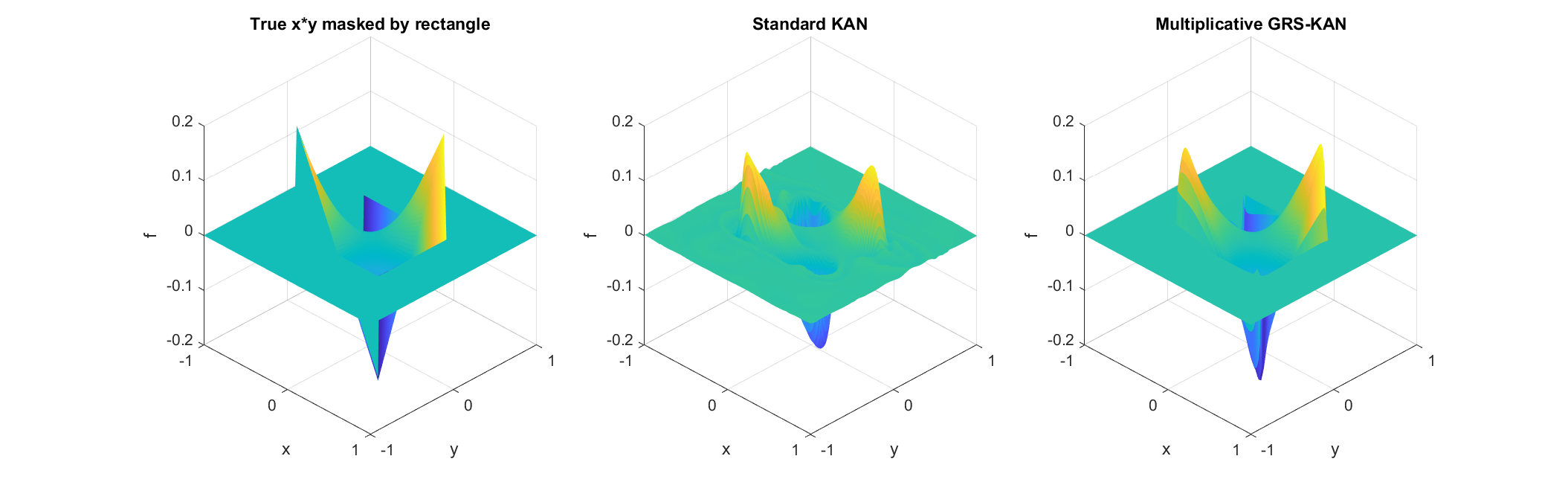
- The paper introduces a novel GRS-KAN architecture that fuses smooth KAN branches with explicit R-function geometry to model discontinuities.
- It demonstrates significant RMSE reductions (up to 67% in additive and 58% in multiplicative tasks) over standard methods.
- Its agnostic variant dynamically learns to combine smooth and geometry-aware components, enhancing interpretability and robustness.
Geometry-Aware R-Structured Kolmogorov–Arnold Networks: Theory and Empirical Assessment
Introduction and Motivation
The paper "Geometry-Aware R-Structured Kolmogorov-Arnold Networks" (2607.01449) introduces the GRS-KAN architecture, a hybridization of Kolmogorov–Arnold Networks (KANs) with Rvachev's R-functions. The principal research question is how to inject explicit geometric and logical constraints into a neural function approximator, thus enabling the transparent modeling of feasible regions, discontinuities, or boundaries in multivariate regression problems, without sacrificing the differentiability crucial for gradient-based optimization.
This approach sits at the methodological intersection of the recent wave of KAN variants (which focus on learnable univariate functions for compositional, interpretable, and highly accurate regression) and the analytical geometry encoded via R-functions, which allow differentiable logical operations (AND, OR, NOT) to be constructed directly on geometric primitives.
Theoretical Framework and Methodology
GRS-KAN models are built around two orthogonal modeling components:
- KAN Branches: These learn the smooth, continuous component of the target function. Edge-based univariate functions parameterized as splines and SiLU bases are trained by backpropagation, exposing compositional sparsity and interpretability.
- R-Function Geometry Branches: Known geometric or logical information (such as support indicators, feasible regions, or discontinuities) are encoded analytically via differentiable R-functions, which operate as explicit gating or modulation mechanisms within the neural architecture.
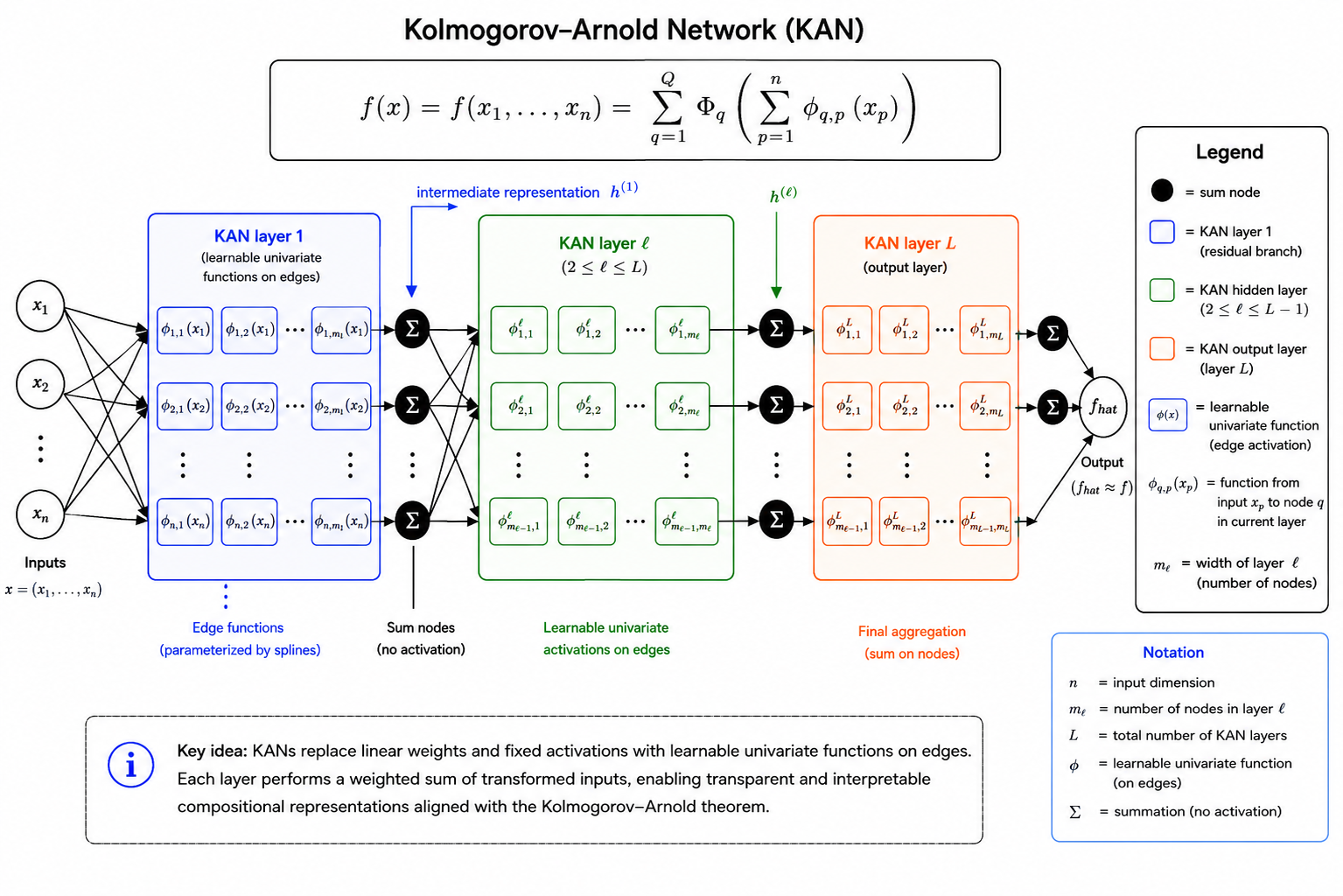
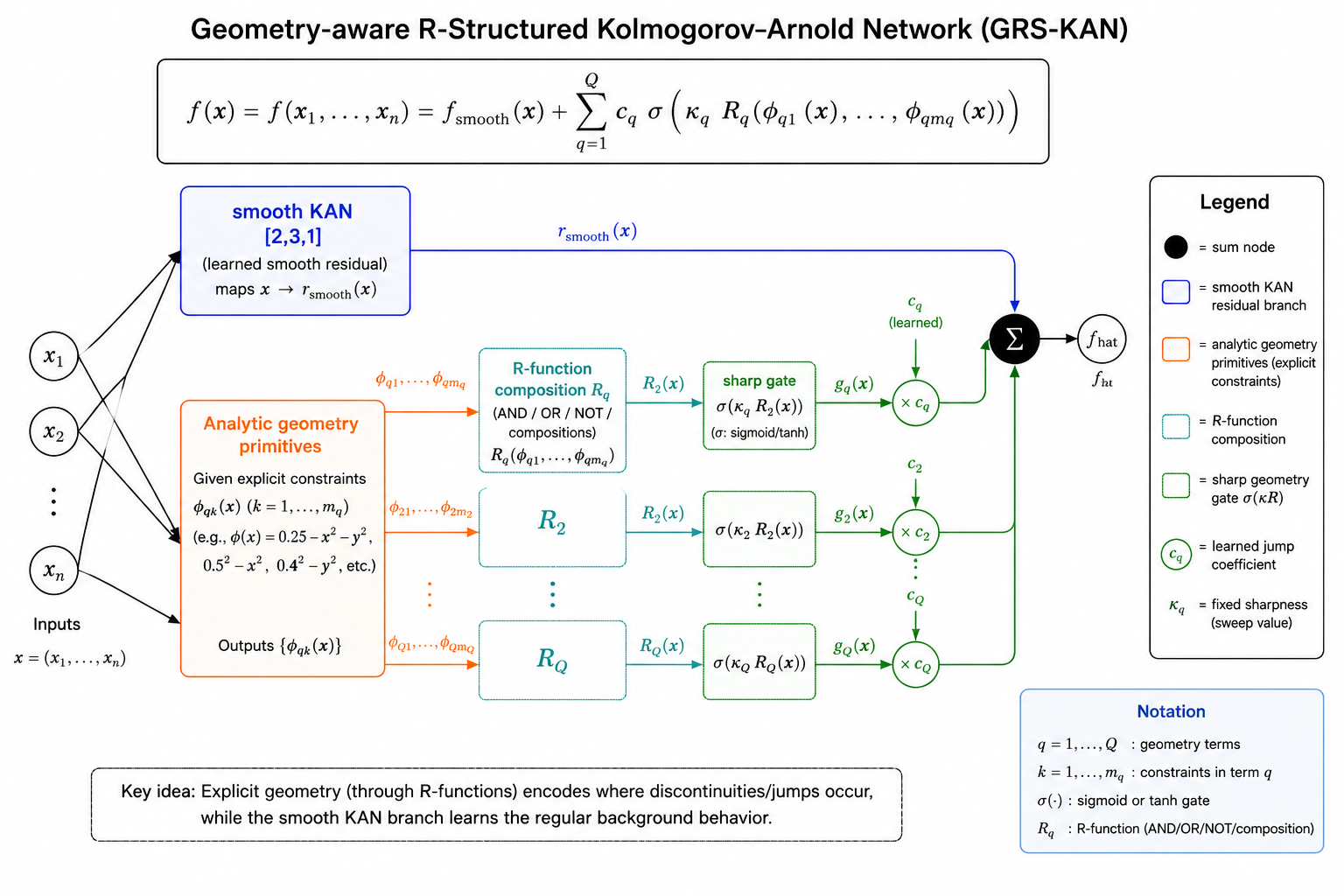
Figure 1: Standard KAN architecture.
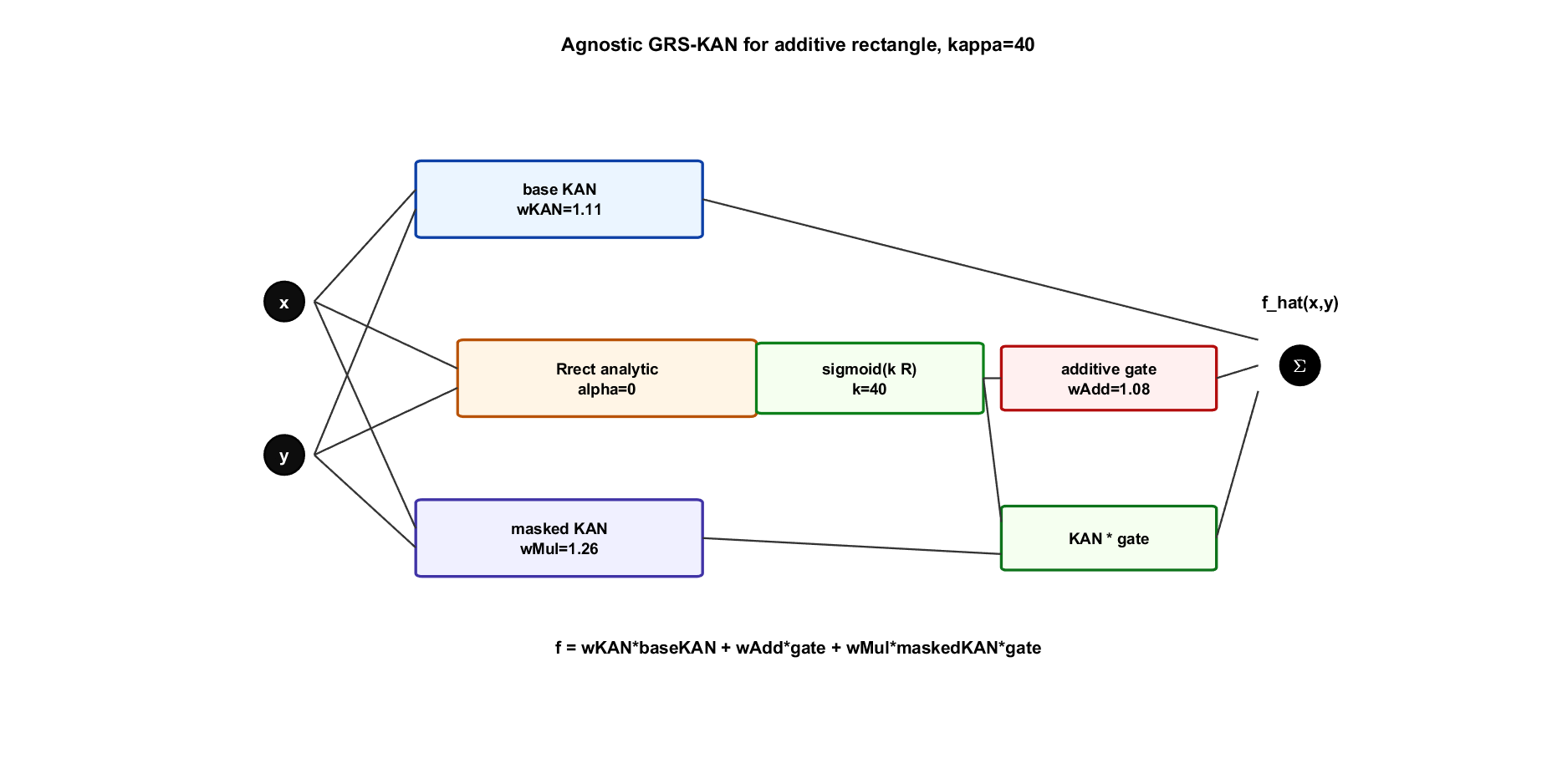
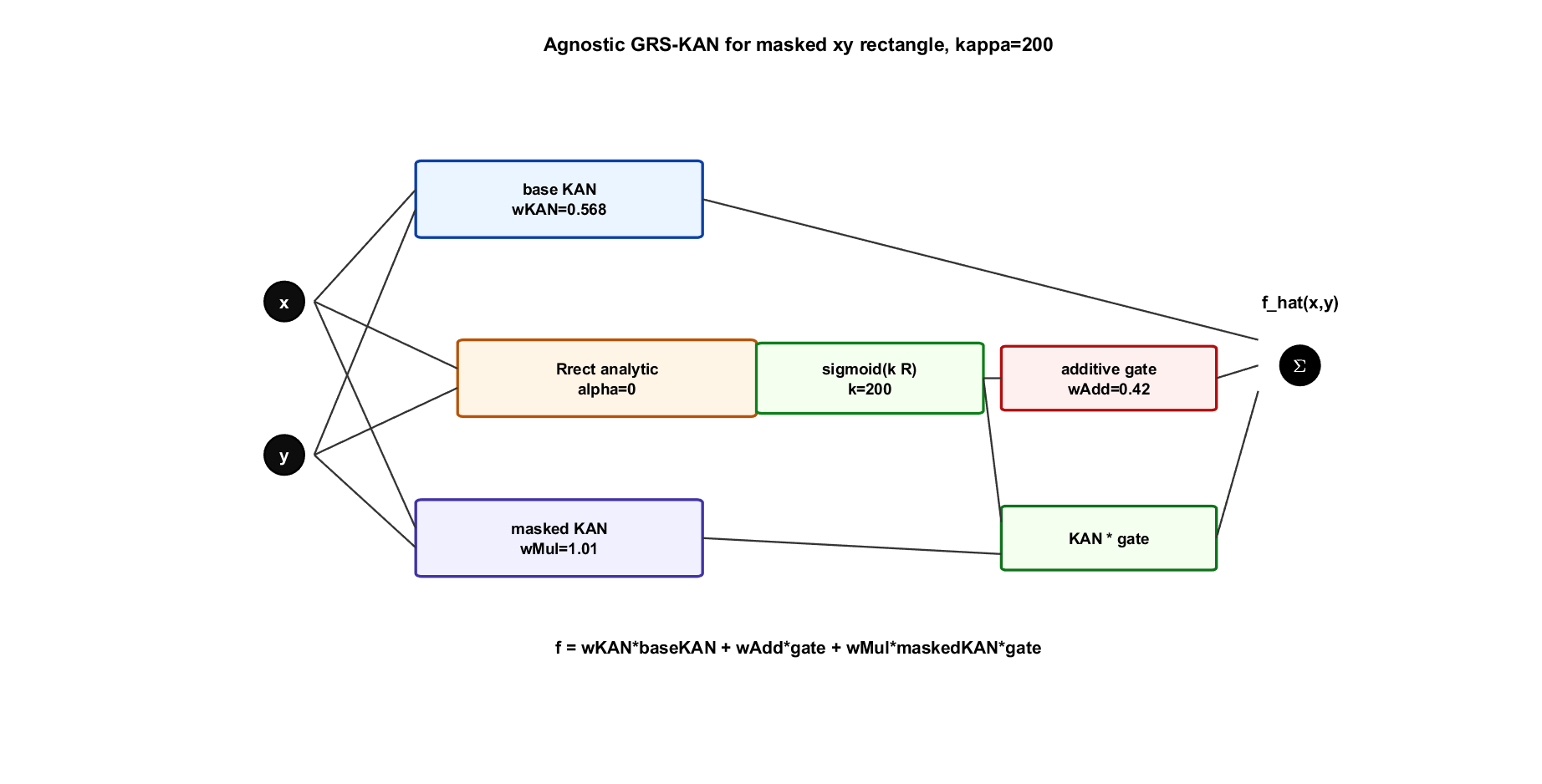
Figure 2: Additive discontinuity problem. All three branches remain active, indicating that the optimal approximation combines smooth, additive, and multiplicative components.
R-Function Analytical Formulation: R-functions R(ϕ1,…,ϕm) allow arbitrary Boolean combinations of implicit regions, using operations like R-conjunctions (for intersections), R-disjunctions (for unions), and R-negations (for complements). For instance, a rectangular region can be encoded as the R-conjunction of two strip functions, and then smoothed into a differentiable indicator via a sharp sigmoid.
GRS-KAN Architectural Variants
Three principal variants are developed:
- Targeted Additive GRS-KAN: Models targets as f(x)=fsmooth(x)+cI(x∈D), where an explicit geometric indicator supplies an additive discontinuity or jump of learned amplitude c inside region D. The indicator I is replaced by a sigmoid-gated R-function for differentiability.
- Targeted Multiplicative GRS-KAN: Captures functional behavior of the form f(x)=fsmooth(x)⋅I(x∈D), appropriate where the solution is supported strictly on a region D (e.g., masking, domain restrictions).
- Agnostic GRS-KAN: A meta-architecture with learnable weights over the KAN, additive, and multiplicative geometry branches. The model automatically discovers whether geometry-aware corrections are beneficial; non-contributing branches are suppressed during training.
Empirical Results
Baseline KAN Experiments
- For smooth targets, such as f(x,y)=exp(sin(πx)+y2), KANs efficiently recover the global nonlinear structure, with automatic pruning exposing minimal compositional forms and parameter counts on par with or superior to standard dense MLP baselines.
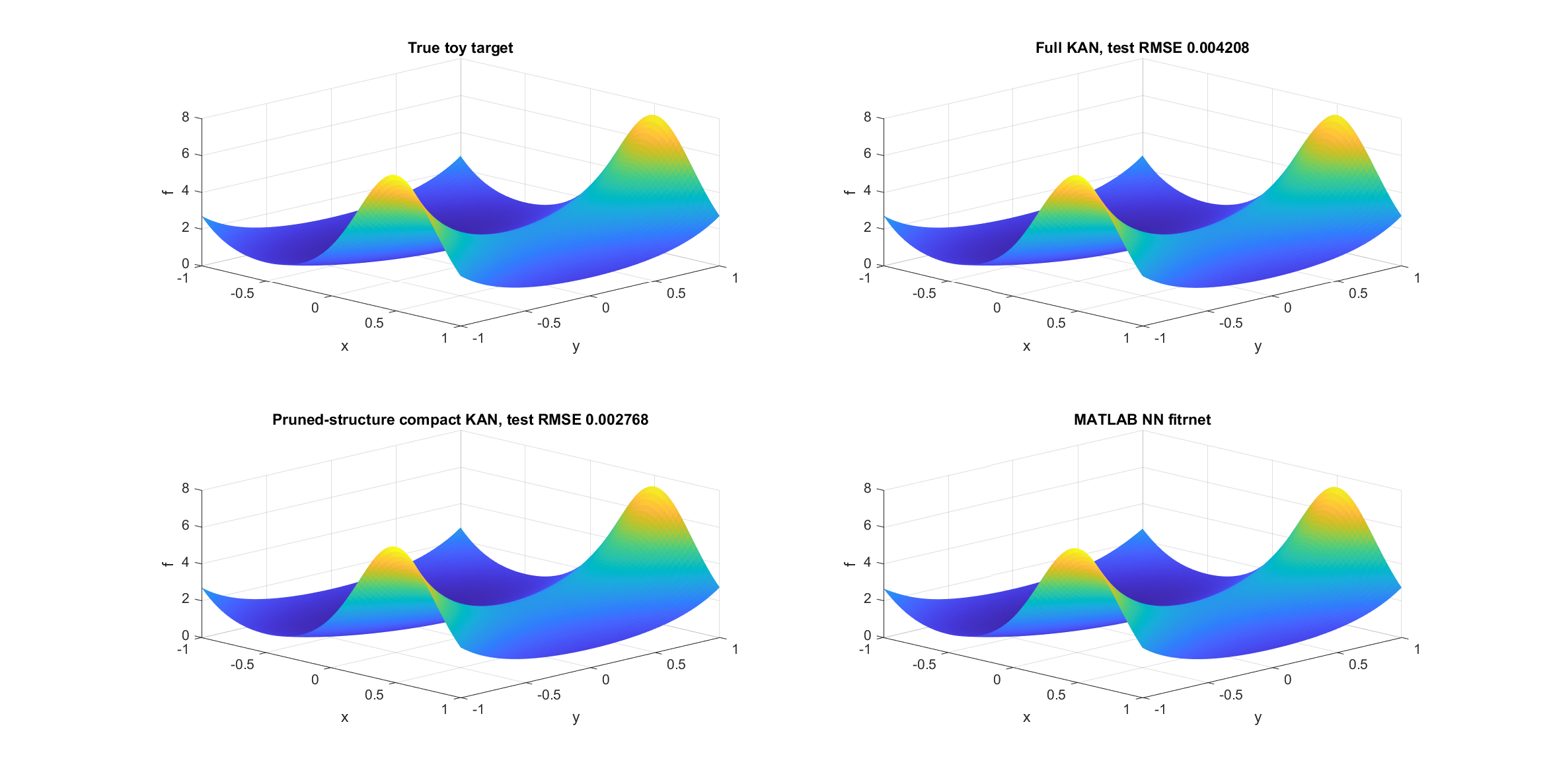
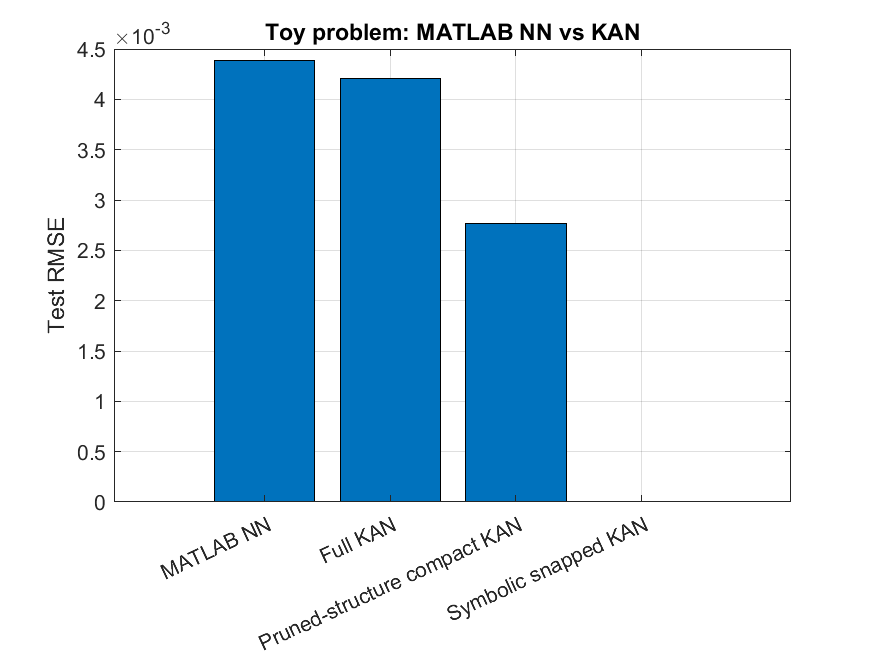
Figure 3: True target, full KAN, compact KAN, and MATLAB NN surfaces.
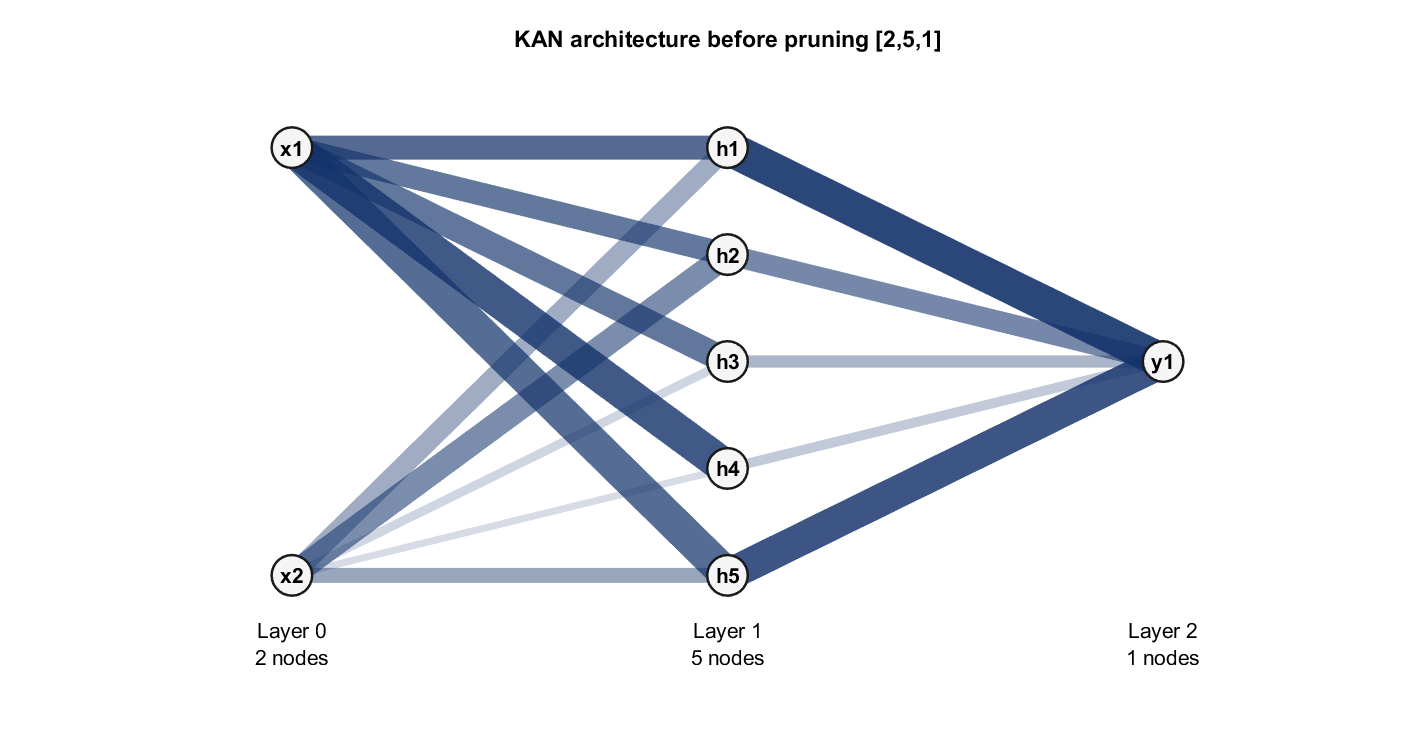
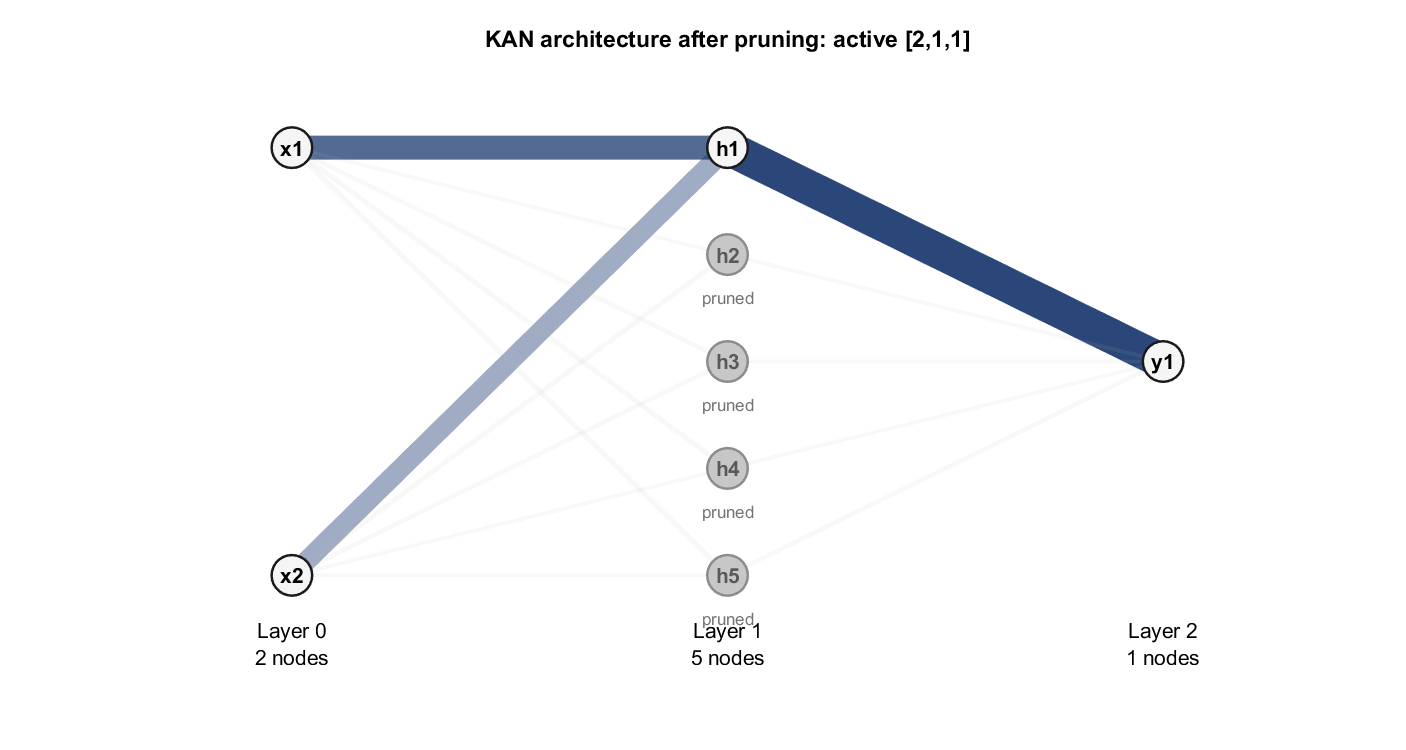
Figure 4: Full [2,5,1] KAN before pruning.
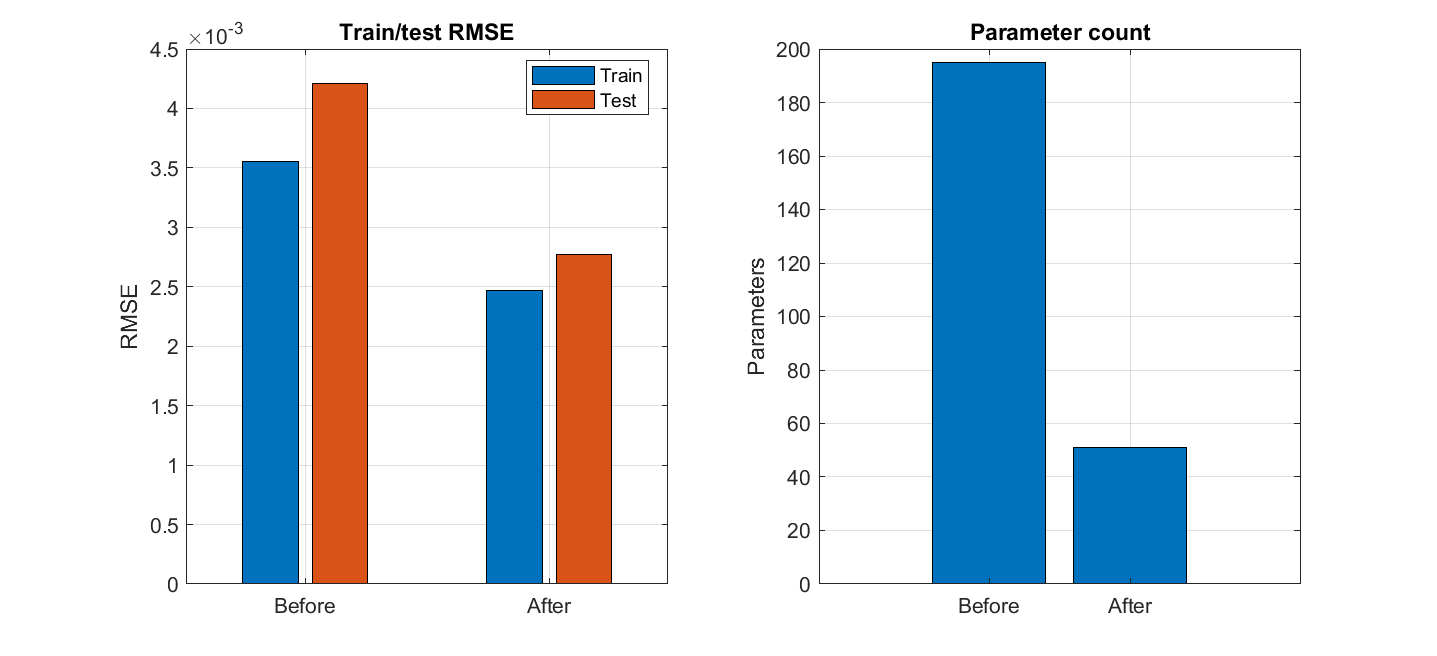
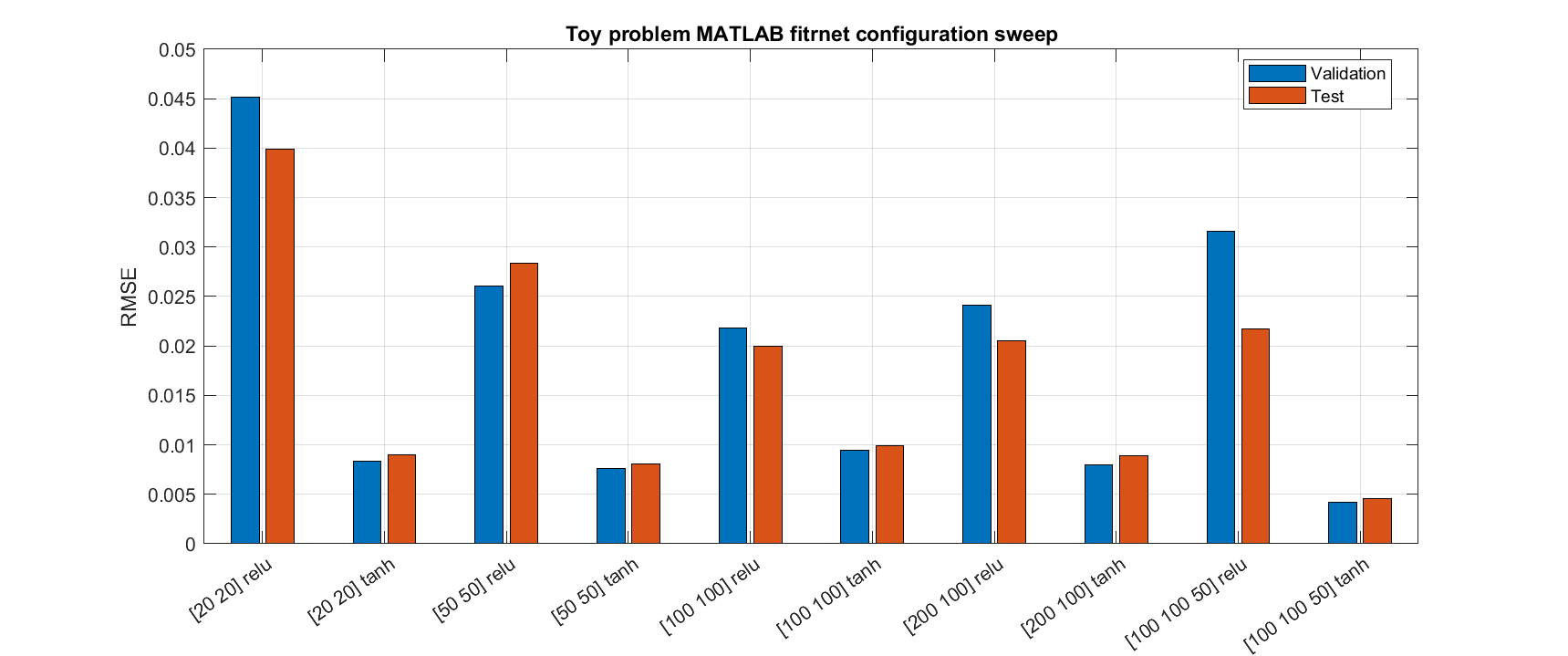
Figure 5: Before/after RMSE and parameter count after pruning.
Geometry-Aware Architectures
Additive Discontinuity Benchmark
A sharp jump within a rectangular region is modeled. Standard KANs and dense NNs produce smeared approximations to the discontinuity, struggling to localize sharpness due to the limitation of smooth basis function composition. With the GRS-KAN, the jump boundary is exactly aligned via the analytic R-function, improving both the global and boundary-localized RMSE.
- Quantitative Gain: The targeted additive GRS-KAN with optimized gate sharpness (κ) achieves up to 67% lower test RMSE and 61% lower boundary-band RMSE compared to standard KANs.
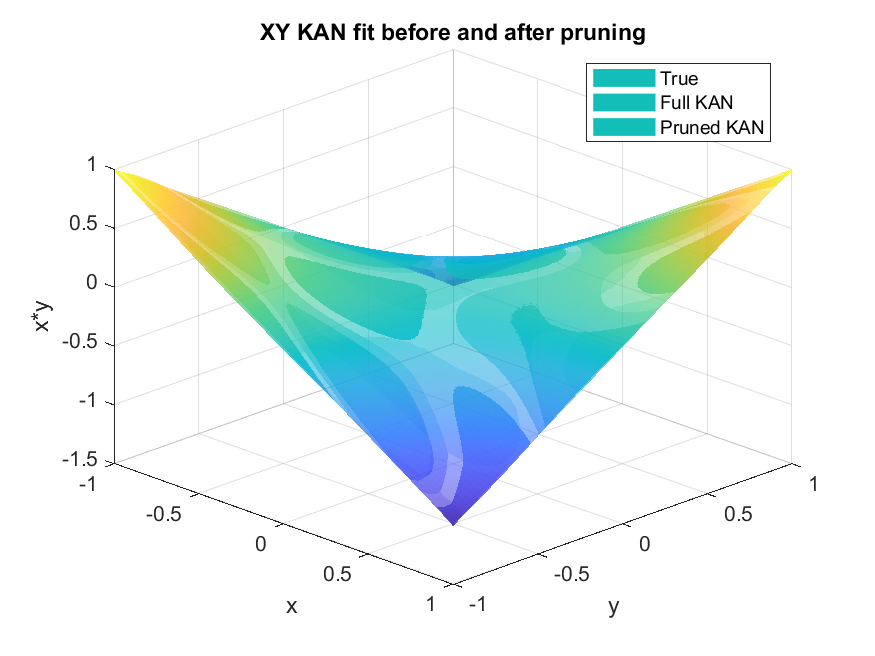
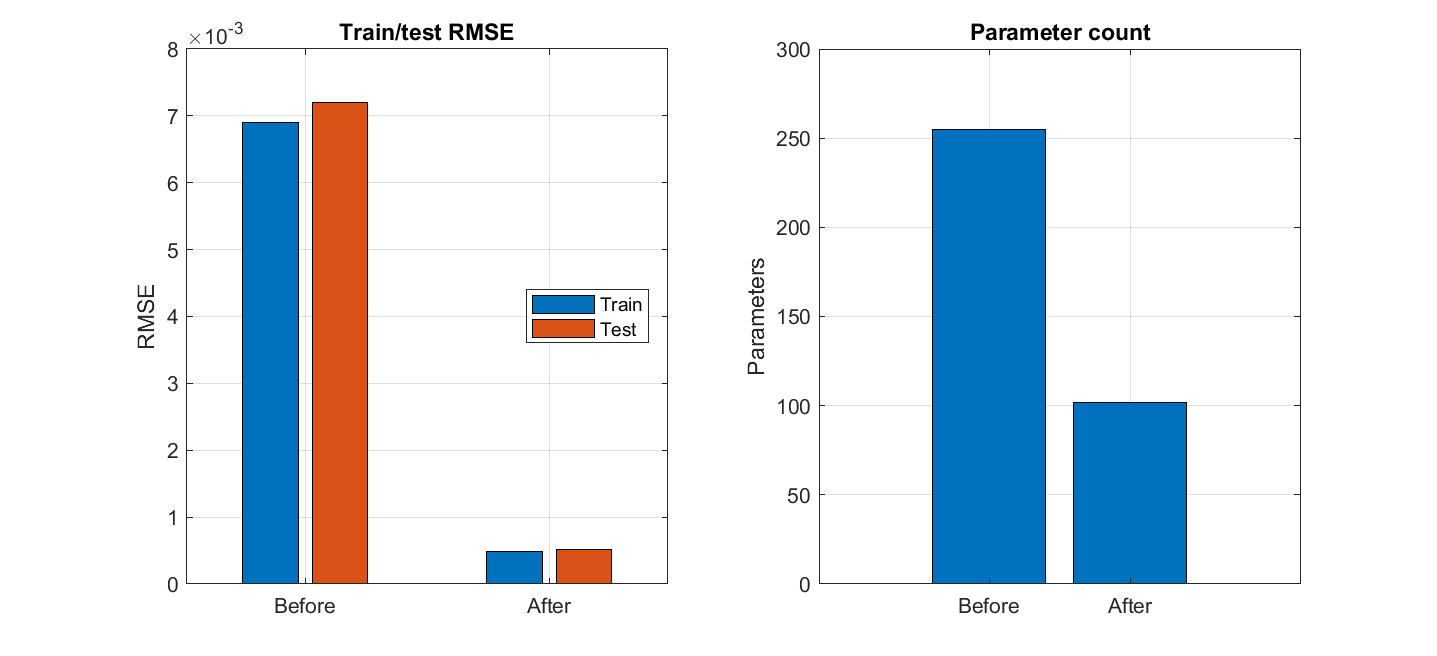
Figure 6: Surface fit for full and pruned KAN.
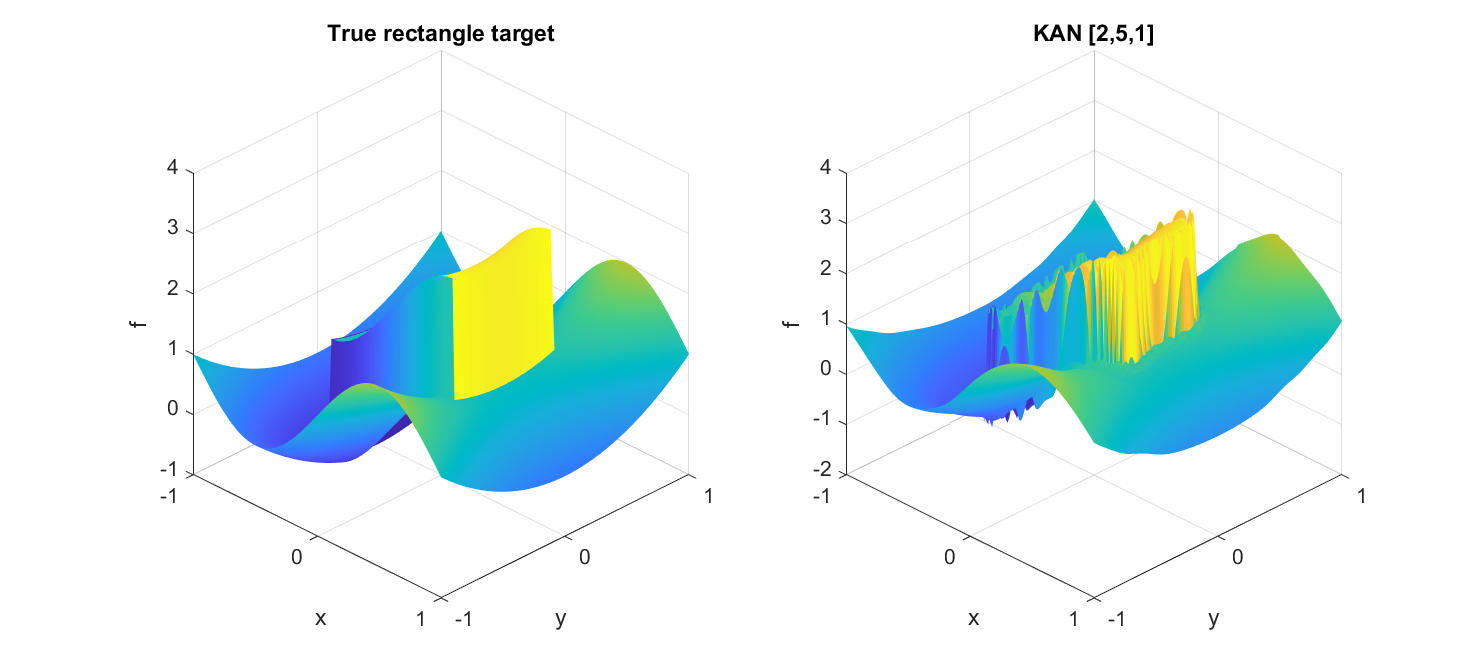
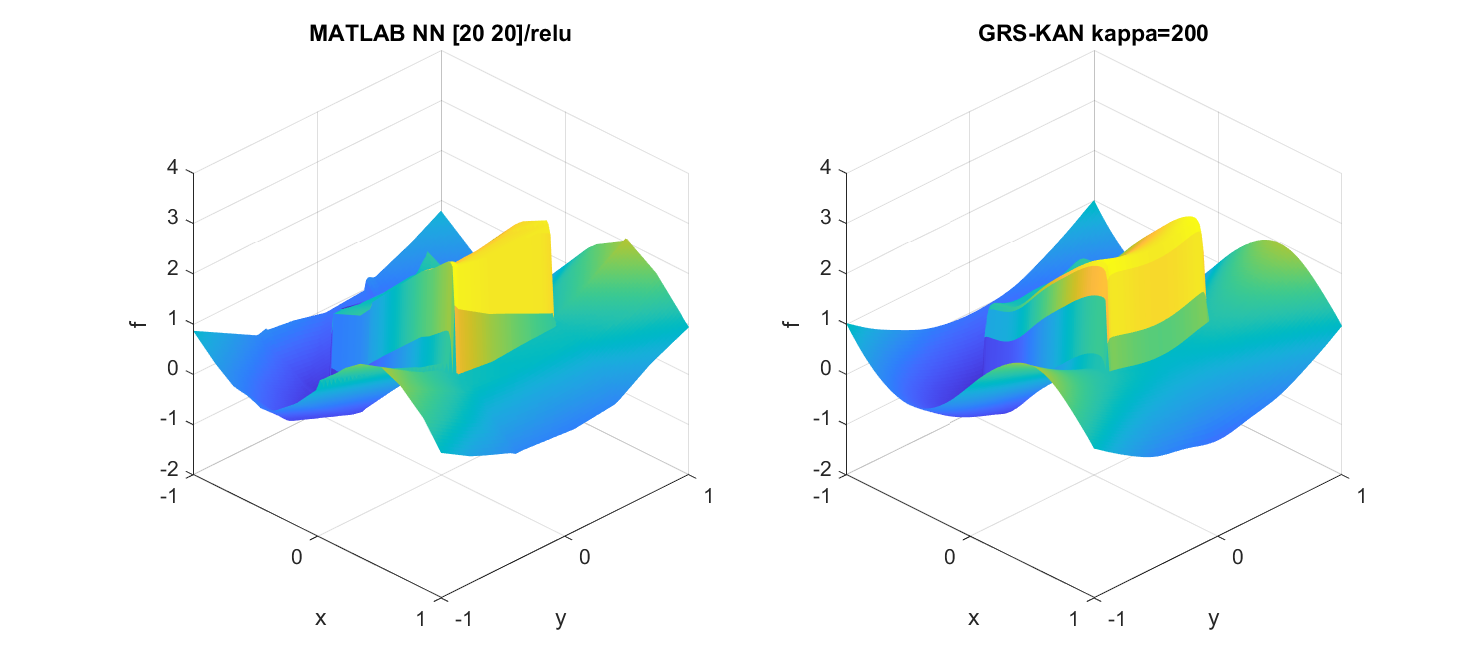
Figure 7: True target (left) and standard KAN [2,5,1] prediction (right).
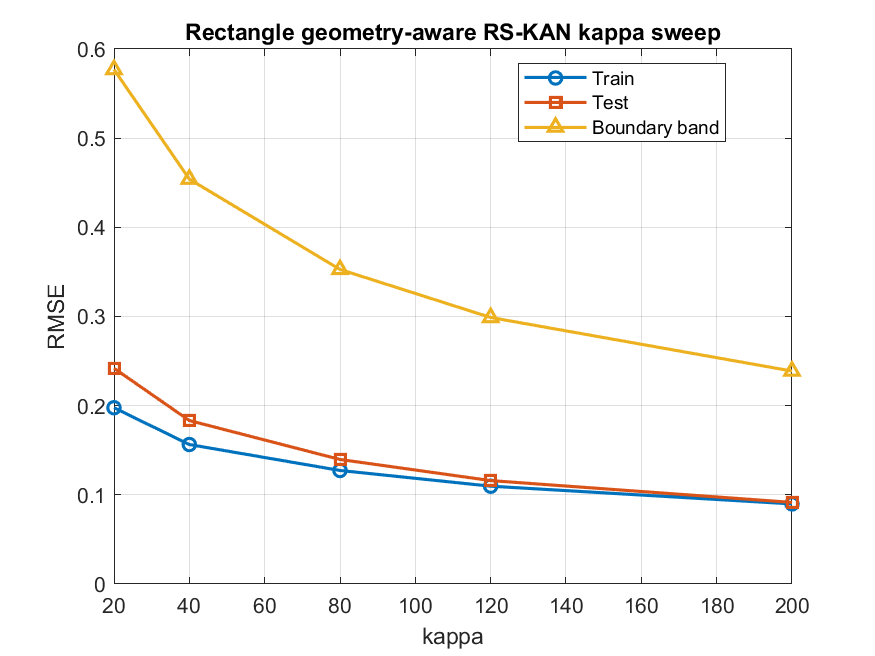
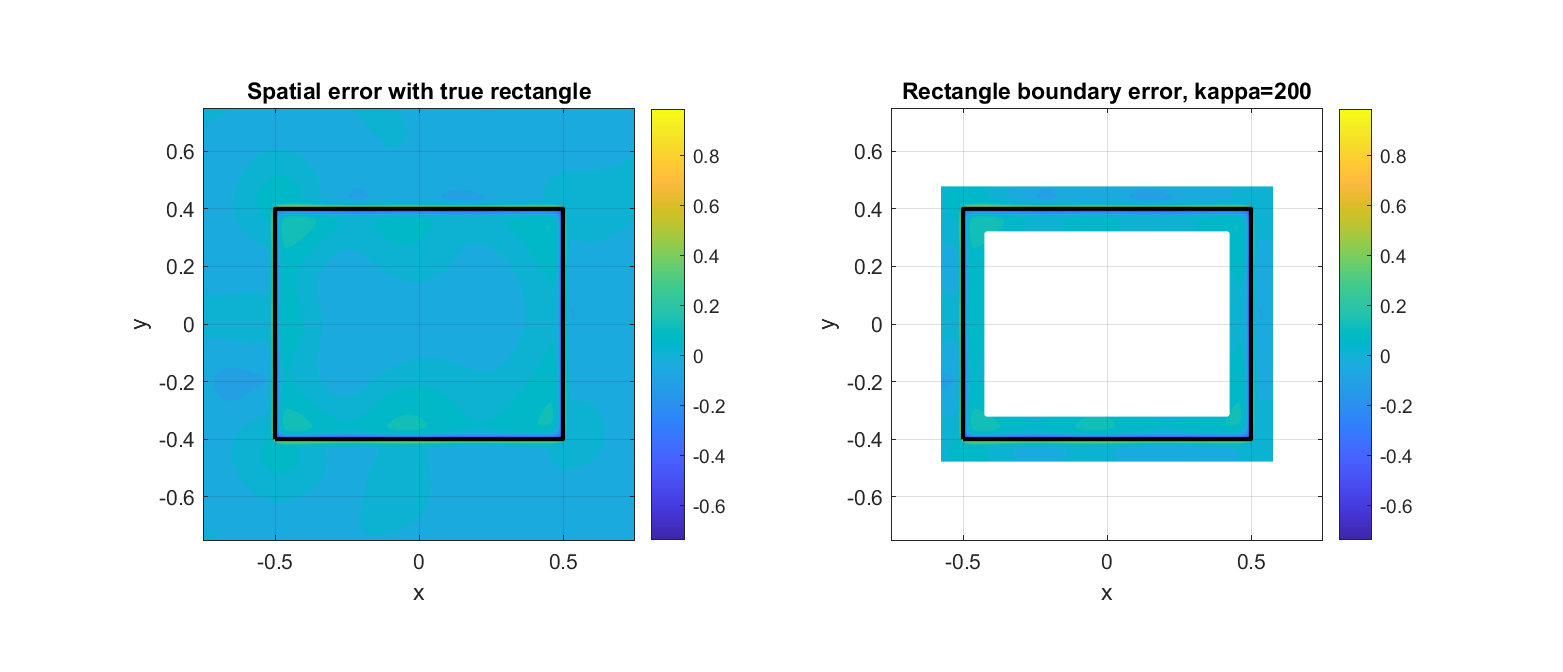
Figure 8: Train, test, and boundary-band RMSE versus kappa.
Domain Masking/Multiplicative Support
A masked product (e.g., f(x,y)=xyI((x,y)∈D)) is considered. The multiplicative GRS-KAN efficiently isolates the geometric support, yielding sharper transitions and lower errors than purely data-driven methods, with boundary errors concentrated (as expected) near the geometric discontinuity.
Agnostic Model and Automatic Structure Discovery
The agnostic GRS-KAN learns the appropriate architecture on each problem. For pure geometry-governed tasks, it converges to a nearly pure multiplicative geometry-aware form; for unconstrained smooth tasks, the geometry branches are suppressed (f(x)=fsmooth(x)+cI(x∈D)0, f(x)=fsmooth(x)+cI(x∈D)1).
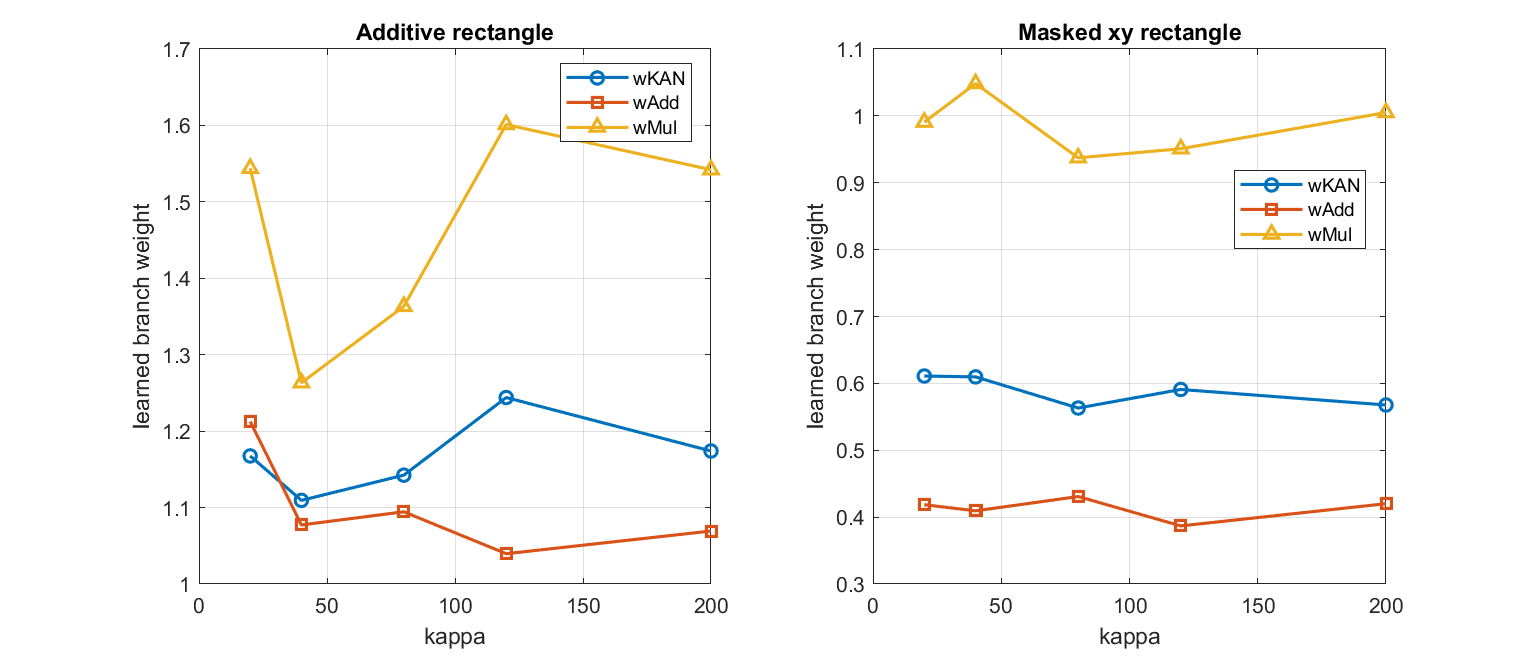
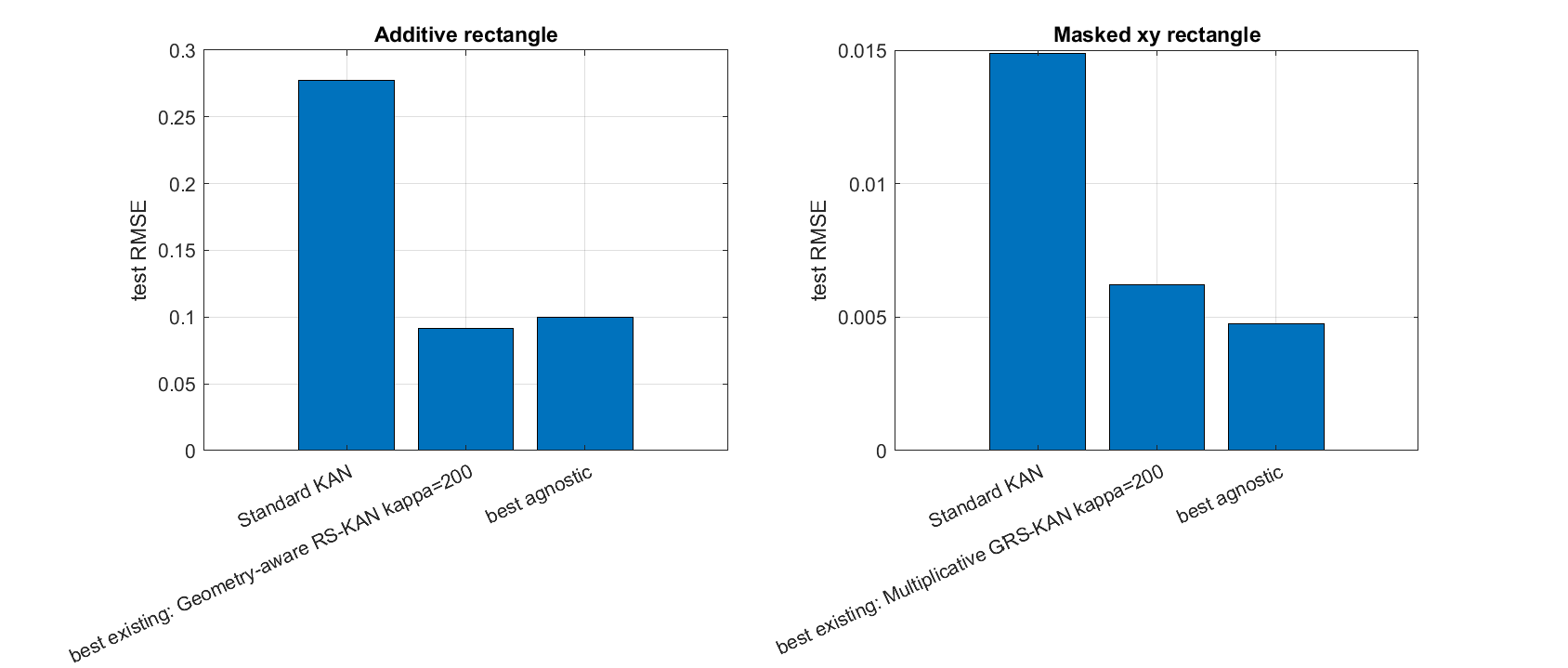
Figure 10: Learned f(x)=fsmooth(x)+cI(x∈D)2, f(x)=fsmooth(x)+cI(x∈D)3, and f(x)=fsmooth(x)+cI(x∈D)4 during agnostic GRS-KAN training.
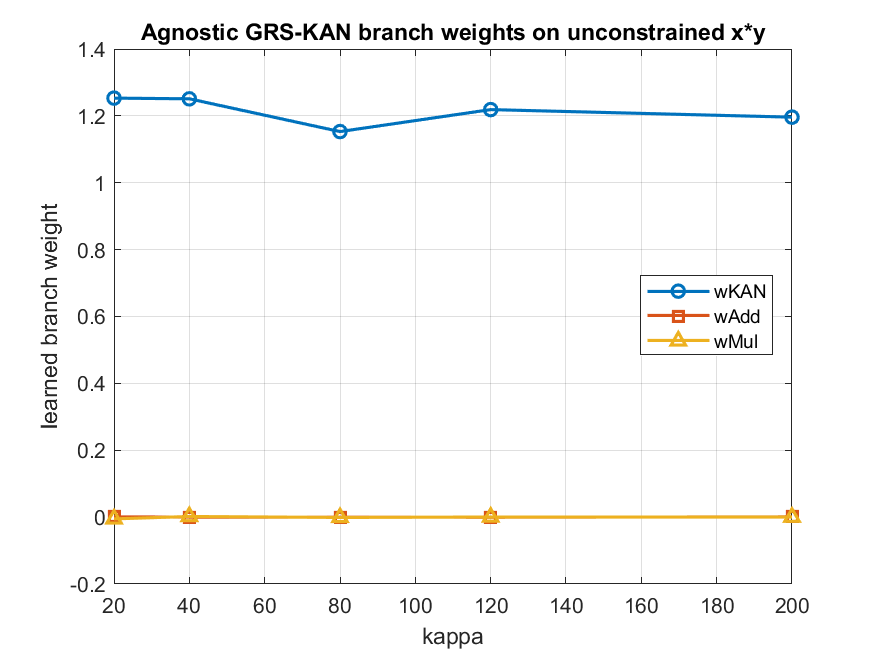
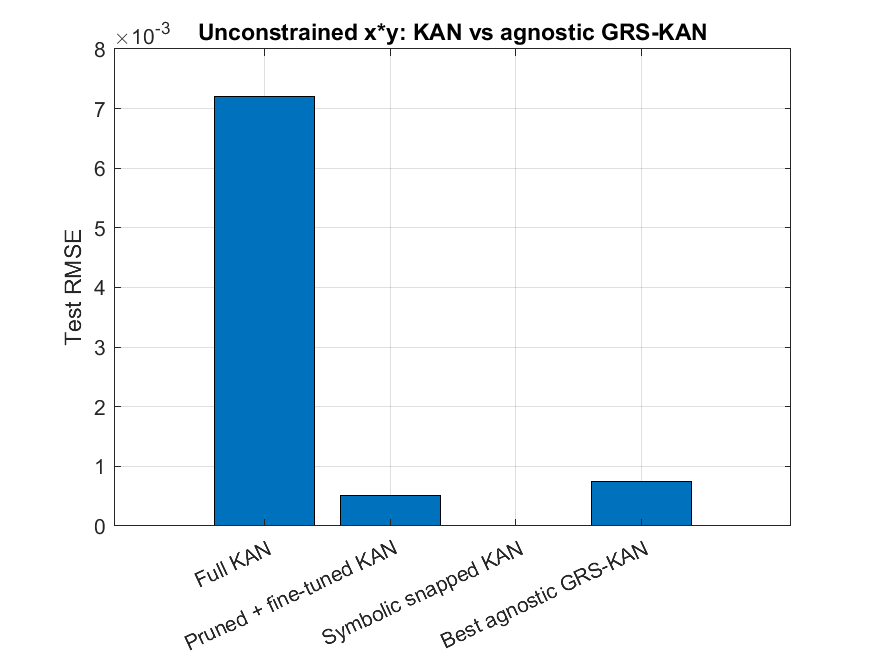
Figure 11: Learned branch weights for an unconstrained target.
Interpretability and Structural Insights
A critical implication of GRS-KAN is the interpretability of the learned models:
- The distinct separation of smooth and geometric components allows direct manipulation, symbolic recovery, or verification of the geometry-aware components (region indicators, discontinuities).
- The architecture exposes whether prior geometric knowledge is actually informative for the regression problem at hand, mitigating the risk of misspecified inductive biases.
Applications and Further Implications
Practically, GRS-KANs are applicable in any scenario where geometric or logical structure is explicit or obtainable from domain knowledge—process control, design optimization, physics-informed regression, or any setting requiring interpretability (e.g., regulatory compliance in engineering systems).
Theoretically, these results indicate that the fusion of analytic geometry (R-functions) and modern neural methods can yield provably structured models that outperform generic data-driven architectures on structured tasks, while retaining flexibility (as in the agnostic variant) when the form of geometric interaction is unknown.
Future research directions include:
- Extension to general, complex, multi-region supports (non-convex, disconnected domains).
- Integration of real-world geometric constraints from scientific and engineering domains.
- Adaptive geometric gating, hierarchical geometry-aware factorization, and symbolic regression over both functional and geometric primitives.
Conclusion
The GRS-KAN architecture systematically augments KAN-based models with explicit, differentiable analytical geometry through R-functions, demonstrating strong improvements in accuracy and structural interpretability on both discontinuous and regionally supported regression tasks. The agnostic variant endows the network with inductive flexibility, learning automatically the appropriate interaction between prior geometry and smooth functional representations. This work opens a rigorous path toward scientific machine learning models that jointly leverage data-driven learning and principled, analytical priors for geometric structure.