- The paper demonstrates that incorporating a bounded future look-ahead during training yields significant F1 and precision improvements in causal gaze estimation.
- It introduces a dual-branch transformer framework where a future-aware teacher guides a strictly causal student using KL-divergence for effective distillation.
- Empirical results on EGTEA Gaze+ and Ego4D datasets reveal improved accuracy and efficiency, underscoring the method’s real-time feasibility.
Future-Privileged Supervision in Strictly Causal Egocentric Gaze Estimation: A Controlled Analysis
Egocentric gaze estimation seeks to localize the attention focus of a first-person camera wearer, underpinning applications in real-time AR assistance, robotics, and human-computer interaction. While most benchmarks and methods exploit offline settings with bidirectional temporal access, actual deployment scenarios necessitate strictly causal, online inference—i.e., predictions must be based solely on past and current observations, not future frames. This establishes a fundamental mismatch between existing evaluation protocols and real-world latency constraints.
The core scientific questions addressed are:
- To what extent is future visual context informative for current gaze estimation?
- If useful, how much future look-ahead optimally contributes to causal model supervision without test-time leakage?
Controlled Future-Privileged Training Framework
To disentangle the effects of future context from representational capacity, the authors propose a framework comprising two temporally masked forward passes of an identical lightweight spatiotemporal transformer decoder: a strictly causal "student" and a future-aware "teacher" with a tunable look-ahead horizon.
The frozen DINOv3-ViT encoder, robust to varied visual semantics, ensures visual features remain unaffected by temporal manipulation. Only the attention masks differ—future-aware masks permit each token to attend up to H future frames during training, whereas strictly causal masks enforce a lower-triangular structure.
During optimization, the student receives both standard ground-truth supervision and a future-privileged distillation loss that aligns its softened predictions to those of the teacher, using a KL divergence with a stop-gradient on the teacher branch to mitigate capacity confounds.
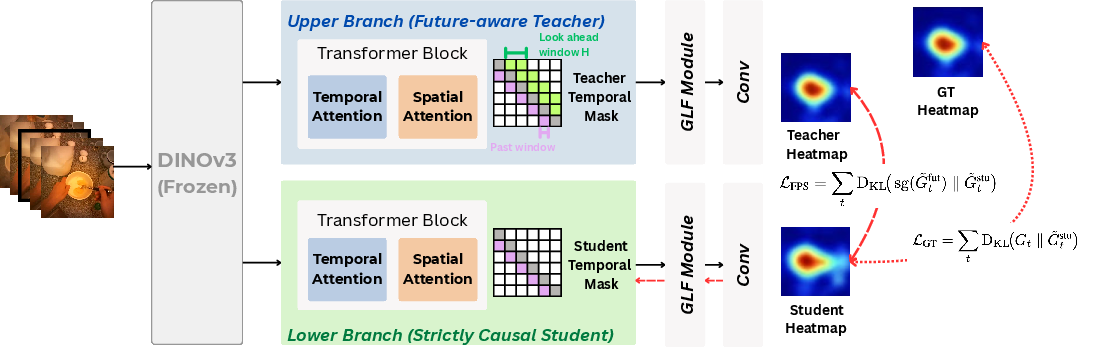
Figure 1: Overview of the future-privileged training framework with masked attention for future-aware teacher (look-ahead H) and strictly causal student branches.
Empirical Evaluation: Quantifying the Value of Future Context
Experiments are conducted on EGTEA Gaze+ and Ego4D datasets, leveraging fixed video sampling and clip strides to precisely map look-ahead H to temporal duration. Performance is evaluated in terms of Adaptive F1, Precision, and Recall—thresholded overlap metrics between predicted and ground-truth gaze heatmaps.
Strictly causal baselines (H=0) are compared against models trained with future-privileged supervision at increasing look-ahead horizons (H∈{1,3,5,7,10,15}). Results demonstrate that while any nonzero H provides a consistent F1 boost, the improvement does not increase monotonically. There exists a bounded optimal window (EGTEA: H=5,10, roughly 1.7–3.3s; Ego4D: H=10, ~2.7s) beyond which the distillation signal degrades, likely due to action drift and diminishing contextual relevance.
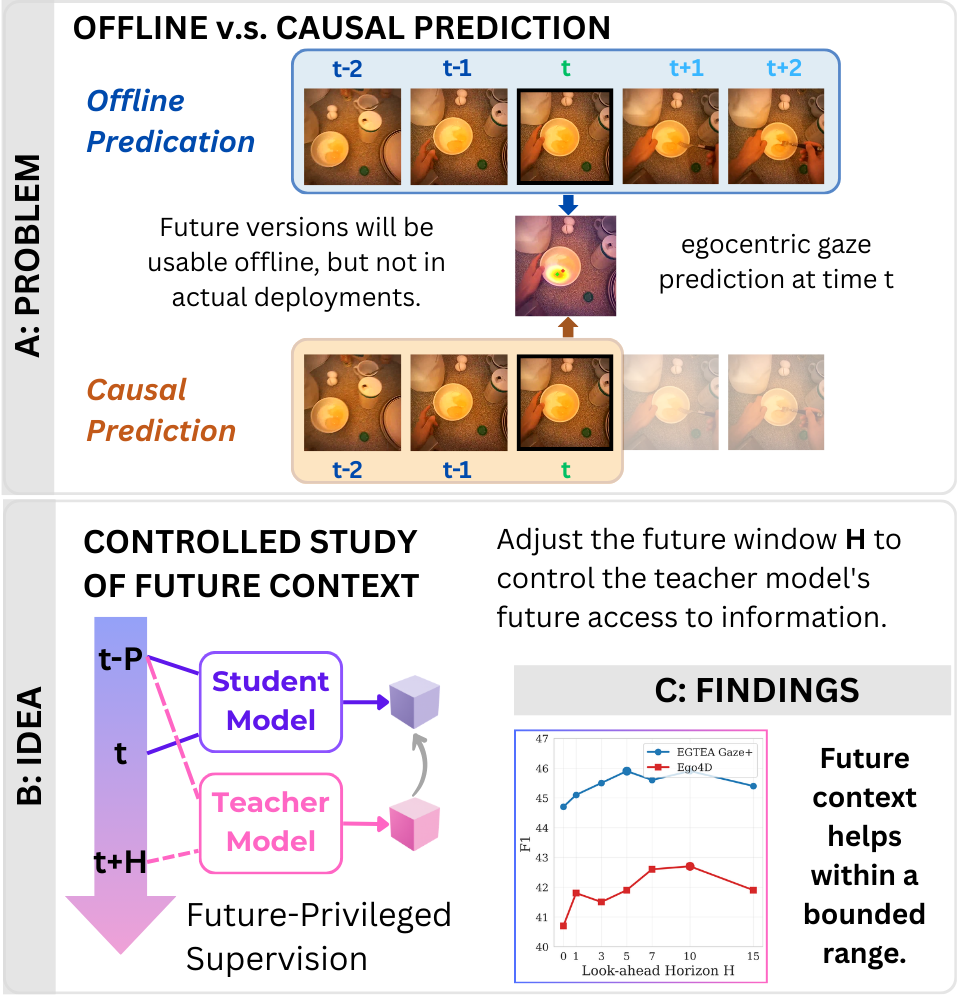
Figure 2: Causal online gaze estimation mandates strictly past-present inputs at inference. Training with future-privileged branches yields improvements concentrated within a temporal window, not monotonically increasing with H.
Qualitative and Comparative Analysis
Qualitative visualizations confirm that the strictly causal student internalizes future-guided attention dynamics, yielding sharper spatial heatmaps than causal-only baselines and often approaching or matching the teacher's accuracy even without test-time access to future frames.

Figure 3: Comparison of gaze predictions: causal GLC baseline, future-aware teacher (H>0), and strictly causal ECOGaze, illustrating improved focus transfer from teacher to student.
Comparative benchmarking places the proposed ECOGaze framework (optimal H0 per dataset) substantially ahead of prior state-of-the-art causal models; e.g., on EGTEA Gaze+ (F1: 45.9 vs. 41.6 for GLC-causal), and with marked model compression (H15× fewer parameters, 2× inference speedup), establishing practical feasibility for low-overhead real-time deployment.
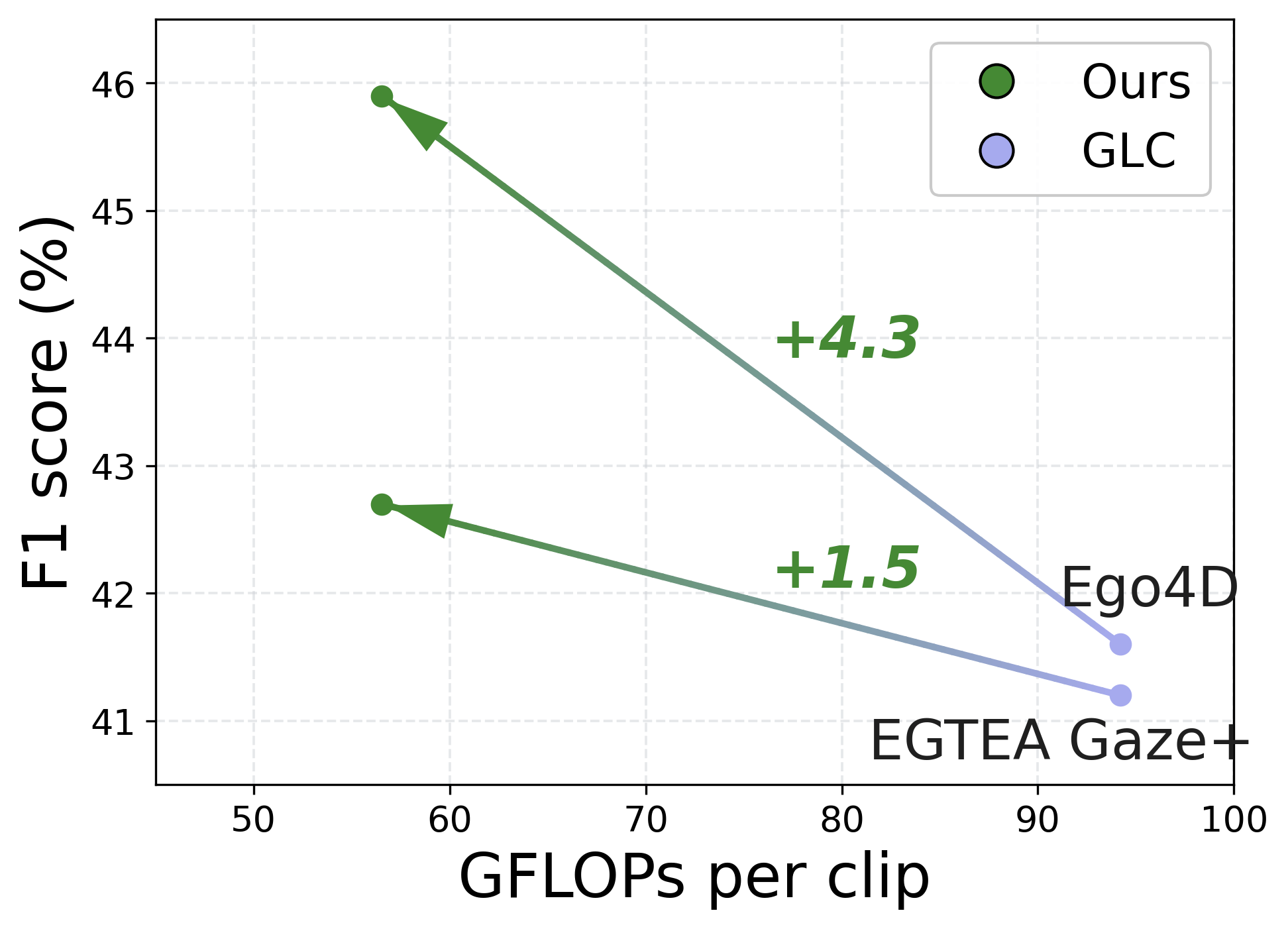
Figure 4: ECOGaze achieves superior F1/GFLOP trade-off relative to the causal GLC baseline.
Ablation and Architectural Analysis
Component-wise ablations isolate the gains attributable to spatial attention, temporal attention, the global-local focusing (GLF) module, and the future-privileged supervision signal. Notably, future-privileged supervision remains the dominant factor driving F1 and precision increases.
GLF design variants are evaluated, contrasting the GLC-style dense cross-attention (computationally expensive) with ECOGaze's per-frame dot-product approach. The lightweight dot-product achieves comparable or better accuracy with >250× reduction in FLOPs and parameter count.
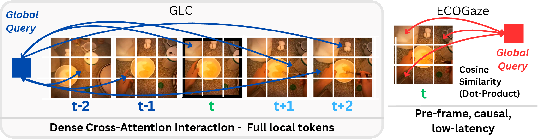
Figure 5: GLF mechanisms—GLC's dense cross-temporal attention (left) vs. ECOGaze’s intra-frame dot-product refinement (right) offering efficiency without accuracy compromise.
Three spatiotemporal aggregation schemes (GRU+spatial, Joint Spatio-Temporal attention, and Divided Temporal+Spatial attention) are assessed; the latter yields the strongest F1 and lowest memory requirements, justifying its adoption.
Failure cases are identified where absence of future context hampers prediction, especially during gaze search in ambiguous scenes, under rapid head motion (feature corruption), and in visually cluttered environments.
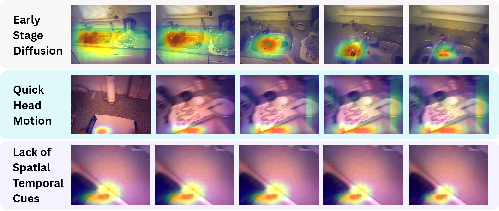
Figure 6: Failure scenarios for strictly causal ECOGaze: gaze diffusion prior to fixation, motion blur-induced degradation, and ambiguous target selection.
Implications, Theoretical Insights, and Future Directions
The controlled study directly answers the motivating questions: future context is consistently beneficial for causal egocentric gaze estimation, but only within a bounded temporal window that appears to reflect the time scale of task-relevant hand-object interactions and scene transitions. These results validate and extend findings from cognitive science (anticipatory gaze and eye-hand coordination) into a scalable machine learning context.
Practically, the findings advocate for distillation-driven usage of moderate future look-ahead for training, eliminating the need for complex offline inference architectures, and enabling deployment in latency-sensitive scenarios.
Theoretically, the boundedness result suggests intrinsic constraints on the temporal integration horizon for anticipation in dense prediction tasks. Future research could examine cross-task generalization, variation across backbone architectures, and the extension to multimodal and plug-and-play memory-augmented systems. The framework can also inspire analogous controlled privileged-distillation methodologies in other domains where test-time causality and train-time future context are in tension.
Conclusion
This work systematically quantifies, under tightly controlled conditions, the utility and limits of future-privileged supervision for strictly causal egocentric gaze estimation (2607.01437). The results show measurable, saturating benefits within a short temporal window, deliver a highly efficient and competitive causal predictor, and establish principled guidance for bridging the gap between evaluation protocols and online deployment realities.