- The paper demonstrates that vacuum polarization in strong magnetic fields increases the refractive index, enabling ultrarelativistic particles to emit Cherenkov radiation.
- Using the Euler-Heisenberg Lagrangian across weak and strong field regimes, the study derives effective optical metrics to quantify photon propagation and determine Cherenkov thresholds.
- The analysis reveals that in supercritical fields, vacuum Cherenkov emission may surpass synchrotron radiation in the radio frequency range, offering valuable insights for astrophysical observations.
Vacuum Cherenkov Radiation in Supercritical Magnetic Fields: Analysis and Implications
Overview
The study "Vacuum Cherenkov radiation in supercritical magnetic fields" (2607.01419) rigorously examines the conditions under which Cherenkov radiation can be emitted by charged particles traversing regions of vacuum subjected to extremely intense magnetic fields, specifically those exceeding the Schwinger critical field (Bcr). Employing the formalism of nonlinear electrodynamics (NLED)—with particular focus on the Euler-Heisenberg (EH) Lagrangian in weak (wEH) and strong (sEH) field regimes—the authors derive effective metrics for photon propagation, quantify modifications in the vacuum refractive index, and contrast the characteristics and dominance of Cherenkov versus synchrotron radiation in such extreme astrophysical environments.
Nonlinear Electrodynamics and the Polarized Vacuum
Quantum electrodynamics (QED) predicts that sufficiently strong electromagnetic fields induce vacuum polarization, thereby endowing the vacuum with a refractive index n>1. In such a scenario, photons propagate at a reduced phase velocity vph, opening the possibility for ultrarelativistic particles with speeds exceeding vph to emit Cherenkov radiation.
The analysis distinguishes between:
- Weak-Field Regime (wEH): Applies for B≲Bcr; vacuum polarization is described by EH corrections to first order in α.
- Strong-Field Regime (sEH): For B≫Bcr (∼102Bcr or ∼1011T), the sEH Lagrangian governs, yielding qualitatively different refractive properties and NLED effects.
The effective 'optical metric' approach underpins the computation of photon null geodesics in these NLED-modified vacua, capturing both the refractive index (birefringent for the wEH case) and phase velocity corrections as a function of external magnetic field strength and photon polarization.
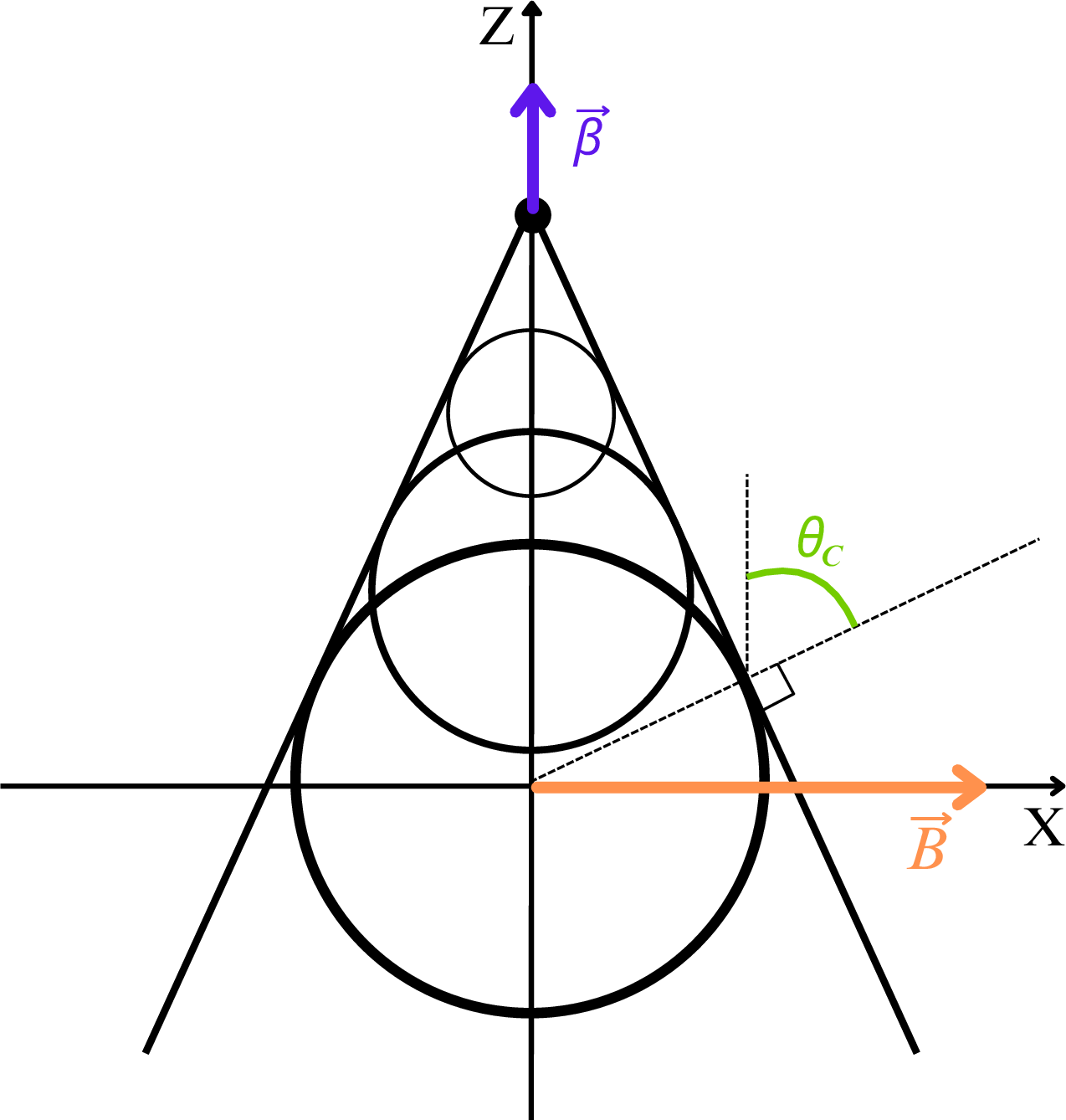
Figure 1: Cherenkov cone for a particle moving in the z-direction with velocity n>10, perpendicular to an external magnetic field n>11; wavefronts (circles) and Cherenkov angle (green) illustrate the geometry relevant for vacuum Cherenkov emission.
Cherenkov Thresholds and Vacuum Refractive Index
The refractive index n>12 and corresponding phase velocity n>13 are directly computed for both wEH and sEH regimes. Notably, the sEH regime can render the vacuum comparably refractive to materials like water for n>14, with distinct implications for the Cherenkov threshold:
- In wEH, birefringence causes distinct thresholds for parallel and orthogonal polarizations; parallel mode threshold is systematically lower.
- In sEH, only one polarization mode is affected due to conformality of the effective metric in the pure magnetic case; the phase velocity drops more rapidly with increasing n>15 compared to wEH.
Cherenkov emission is possible when n>16, where n>17 is the particle velocity. The explicit expressions derived demonstrate that the minimum velocity required for emission decreases with increasing n>18 (especially in the sEH regime), and the corresponding Cherenkov angle increases accordingly.
Power Spectra: Cherenkov vs. Synchrotron Radiation
The analysis proceeds to compare radiative power emitted via Cherenkov and synchrotron processes for ultrarelativistic electrons in strong-field regimes. Key results include:
- The vacuum Cherenkov power spectra, incorporating MacLeod et al.'s polarization-dependent formulas, are systematically computed for both polarizations and regimes.
- Synchrotron emission follows the standard Schwinger expression, with critical frequency scaled by n>19 and the particle's Lorentz factor.
- Dominance relations: In the sEH regime, vacuum Cherenkov emission overtakes synchrotron emission at lower frequencies (GHz range); for wEH, the crossover lies at much higher frequencies (vph0).
- The intensity and frequency range for Cherenkov dominance are strongly magnetic-field-dependent; higher fields enhance the vacuum's dielectric properties, favoring Cherenkov power.
Visualizations from the original work illustrate these crossover points and spectral behaviors across field strengths, providing quantitative guidance for observational strategies in astrophysical settings.
Astrophysical and Theoretical Implications
The findings have direct implications for high-field astrophysics, particularly in the context of magnetars, whose vph1 fields approach or exceed sEH conditions. The strong suppression of photon phase velocity and corresponding reduction in the Cherenkov threshold velocity suggest that vacuum Cherenkov emission could contribute substantially to observed low-frequency photon excesses, particularly in the radio regime. This extends the relevance of QED-induced NLED effects beyond traditionally anticipated spectral domains.
On a theoretical level, the work clarifies the smooth transition between wEH and sEH regimes in refractive properties and Cherenkov conditions. The approach via the optical metric framework consolidates our understanding of photon propagation in polarized vacua, highlighting the utility and limitations of the vph2 approximation as the refractive index approaches unity for extremely strong fields.
Conclusion
This comprehensive analysis delineates the conditions for vacuum Cherenkov radiation in the presence of supercritical magnetic fields using the effective metrics of NLED. The study robustly demonstrates that, for vph3, vacuum Cherenkov emission can outpace synchrotron emission in astrophysical scenarios, especially in the radio regime. These findings indicate that forthcoming observations of compact objects could detect signatures of vacuum polarization and nonlinear electrodynamics, offering a direct probe of QED in extreme magnetic environments. Future work may refine these predictions with higher-order corrections, frequency-dependent refractive indices, and self-consistent treatments for dynamic background fields.

