- The paper presents GPUAlert, a process-boundary monitor that requires zero instrumentation to diagnose GPU training-job failures due to hardware and software faults.
- Its methodology employs pre-launch log guarantees, notifier isolation, and a regex-based classifier, achieving Macro-F1 scores above 0.997.
- Empirical evaluation shows GPUAlert reduces wasted GPU-hours with near-perfect accuracy and negligible overhead, enhancing operational efficiency.
GPUAlert: A Zero-Instrumentation Monitor for GPU Training-Job Failure Diagnosis
Motivation and Problem Statement
Large-scale ML workloads executed on GPU clusters exhibit failure rates where approximately 40% of training jobs terminate prematurely, predominantly due to hardware and system faults such as CUDA errors, ECC events, and NCCL failures. Latency in failure detection leads directly to significant wasted GPU-hours, as jobs may remain idle for hours after failure before detection. Existing solutions are either intrusive—requiring code instrumentation and external connectivity (e.g., MLflow, Weights & Biases)—or provide insufficient diagnostic context (e.g., scheduler mail hooks delivering only exit status).
GPUAlert is presented as a process-boundary monitoring solution, requiring zero instrumentation, fully decoupled from the workload code, for rapid, automated notification and structured diagnosis of GPU training-job failures. It targets scenarios where experiment scripts are inherited, clusters are air-gapped, or administrative privilege for daemons is unavailable.
System Design
The system wraps any user-specified command as a child process without source modification or dependency injection. The design is predicated upon three reliability primitives:
- Pre-launch Log Guarantee: Before the target process is spawned, log files for stdout, stderr, and combined output are touched on disk. This ensures diagnostics survive even if the child fails catastrophically at launch, sidestepping the classic race with shell-based redirectors.
- Notifier Isolation: Notification handling is robust to channel failures (e.g., email server unreachable) as exceptions are caught and logged locally, never polluting the exit code or process identity of the wrapped job.
- Non-silent Artifact Budget: Output artifacts are transmitted up to a strongly bounded per-file size, with any excess logged (never dropped without trace), ensuring graceful degradation under heavy output.
The wrapper enforces strict equivalence: the child runs as if unmonitored, with the return code always that of the underlying job, even on SMTP or notification failures.
Failure Mode Classification
GPUAlert uses a priority-ordered, regex-based classifier over logs, spanning 15 failure modes. Specific errors (CUDA OOM, NCCL errors, Python assertion failures, OOM-killer events) are matched before generic runtime or traceback rules. This schema supports deterministic, debuggable, dependency-free operation, providing both a structured cause and actionable remediation hints alongside attached logs and artifacts. The classifier was constructed and prioritized a priori and evaluated on an open corpus.
Empirical Evaluation
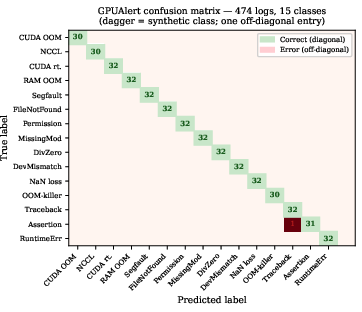
The evaluation is conducted on 474 logs across 15 failure classes, using both fault injection and public issue tracker logs. Twelve classes are hardware-reproduced; three synthetic classes remain due to limitations of the hardware environment.
Classification Performance:
The off-diagonal entry—an assertion classified only by a generic traceback—is the sole adversarial case, underscoring the effectiveness of rule prioritization.
Reliability and Overhead:
- Pre-launch Guarantee: Ensures log existence in all exec-failure scenarios, addressing a failure mode unhandled by shell-based methods (Fisher exact, p=1.45×10⁻¹¹).
- Notifier Isolation: SMTP failures never alter the wrapped job’s exit code in 15/15 modes tested.
- Overhead: The process adds a constant $2.6$–$3.8$ ms per job, negligible for any realistic training workload.
Artifact Handling: Artifacts >25 MB are never silently dropped; instead, their omission and location are enumerated for operator retrieval.
Comparative Positioning
GPUAlert is unique among per-job monitoring solutions, offering zero code modification with high-fidelity, structured failure cause classification, durable logging, and robust process equivalence. Cluster-level monitoring tools such as NVIDIA DCGM and Elasticsearch/Loki are complementary, providing device-level visibility but not per-job causal analysis. Decorator packages (e.g., knockknock) require code changes and do not address log durability or exit-code preservation. Experiment trackers target instrumented pipelines with persistent outbound connectivity.
Limitations and Future Work
Hardware Coverage: The evaluation is restricted to a V100 environment due to resource constraints, with three classes using synthetic signals. Generalization to A100/H100 and broader software stack diversity must be empirically established.
Surface of Failures: Regex-based classification, while auditable and robust, defaults to generic traceback matching on uncaptured/new failure signatures. Non-canonical errors (e.g., custom frameworks or novel hardware) may require future corpus extension and, potentially, learned classifiers.
Multi-Node Training: GPUAlert as presented monitors a single process boundary, and is thus insufficient for distributed job execution (e.g., torchrun, MPI-based multi-rank jobs), wherein failures may be nonlocal or silent. Extensions aggregating collective statuses or interfacing with launchers are necessary for comprehensive distributed-job diagnostics.
Live Anomaly Detection: The system currently triggers on process exit. Incorporating in-flight anomaly detection—e.g., stalled metric lines or loss plateaus—would further shrink dead-running times and reclaim wasted resources.
Delivery Channels: Email is the only notification channel supported. Integrating chat (Slack, Teams), HTTP endpoints, and scheduler-epilog invocation would increase applicability in heterogeneous environments.
Practical and Theoretical Implications
Prompt and automated failure classification with robust artifact delivery directly minimizes wasted GPU time and aids fast remediation. At scale, this contributes to operational efficiency and energy savings, underscoring the environmental footprint of ML training. The process-boundary monitoring paradigm establishes a practical baseline for reproducible, non-intrusive observability in unmodified workloads, and the open corpus fosters community-driven expansion in capabilities.
Conclusion
GPUAlert exemplifies a principled middle ground between intrusive instrumentation and low-information scheduler mail hooks for GPU job failure diagnosis. It delivers robust, structured failure notification without modifying training scripts or requiring persistent connectivity, achieving near-perfect classification accuracy with negligible overhead on representative hardware. Its process-boundary primitives—pre-launch log guarantee, notifier isolation, and artifact bounding—are individually standard but, in aggregate, guarantee strong correctness and usability at the per-job level. The limitations pertain primarily to hardware diversity and distributed executions, both of which are well-scoped targets for future development.
In environments with high job failure rates and operational latency sensitivity in ML workflows, GPUAlert provides a provably reliable, zero-instrumentation diagnostic framework that bridges a critical observability gap.