- The paper introduces rooted motif signatures to extend latent position identifiability beyond conventional degree-based methods in graphon models.
- It demonstrates that a finite collection of rooted path densities can exactly recover spectral coordinates in finite-rank graphons.
- Empirical results reveal that motif-based features effectively distinguish community structures in SBMs with indistinguishable degrees.
Rooted Motif Signatures and Latent Position Identifiability in Graphon Models
Motivation and Limitations of Degree-Based Identifiability
Graphon inference suffers from intrinsic non-identifiability due to symmetry under measure-preserving transformations of the latent space. Standard practice enforces identifiability via strictly monotonic degree functions, using the expected degree as a canonical coordinate for latent position ordering. This assumption is non-generic: large classes of graphons, including stochastic block models (SBMs) with equal block degrees and finite-rank graphons with non-injective degree functions, cannot be resolved by degree information alone. The paper proposes to move beyond such limitations by employing higher-order local structures—rooted motif signatures—as node-level representations.
The rooted motif signature of a given latent position u in the unit interval is defined as the collection of motif densities
ΦW(u)={t((F,r),W)(u)}(F,r)∈F∞
where (F,r) is a rooted motif (finite subgraph with a distinguished node) and t((F,r),W)(u) measures the conditional density of such a motif rooted at u. The degree is recovered as the rooted edge motif K2∙:
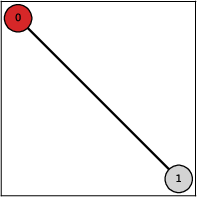
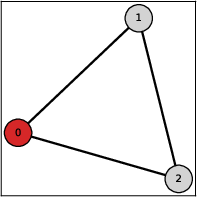
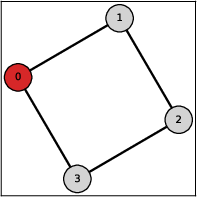
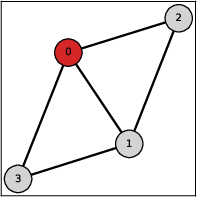
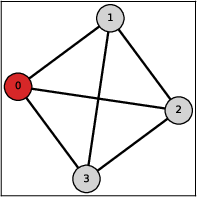
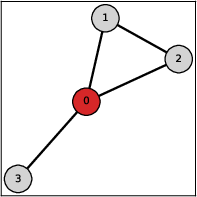
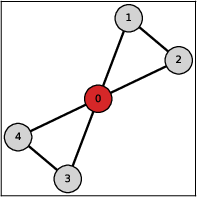
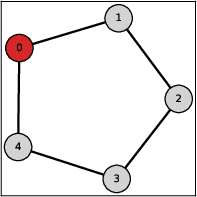
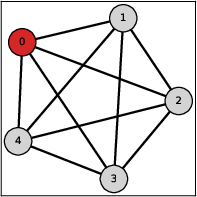
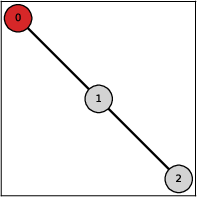
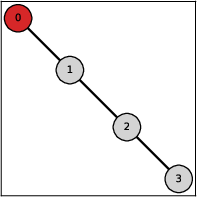
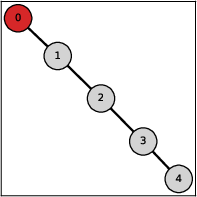
Figure 1: The rooted edge motif K2∙—the simplest nontrivial local motif, corresponding to the degree function.
These signatures can include more expressive motifs (e.g., triangles, paths, cycles), allowing for finer discrimination in connectivity profiles.
Identifiability via Rooted Motif Signatures
The paper establishes that for finite-rank graphons, a finite collection of rooted path densities suffices to identify the spectral coordinates of a latent position. Specifically, for a rank-m graphon with m nonzero, distinct eigenvalues, the vector of densities for paths of lengths $2$ to ΦW(u)={t((F,r),W)(u)}(F,r)∈F∞0 rooted at ΦW(u)={t((F,r),W)(u)}(F,r)∈F∞1 is invertibly related to the coordinate representation of ΦW(u)={t((F,r),W)(u)}(F,r)∈F∞2, and thus determines ΦW(u)={t((F,r),W)(u)}(F,r)∈F∞3. This formally extends the identifiability concept from scalar degrees to ΦW(u)={t((F,r),W)(u)}(F,r)∈F∞4-dimensional motif-based coordinates.
However, for arbitrary graphons, motif signatures may coincide for positions not related by a measure-preserving transformation (internal symmetry of ΦW(u)={t((F,r),W)(u)}(F,r)∈F∞5). The non-injectivity can manifest even within twin-free graphons, as demonstrated by the symmetry in ΦW(u)={t((F,r),W)(u)}(F,r)∈F∞6.
Given a single observation of a random graph generated from a graphon, the local rooted motif densities can be estimated empirically. The authors define precise estimators for empirical rooted motif signatures (vectors of empirical motif densities per node) and prove that, uniformly over all nodes and a fixed motif family ΦW(u)={t((F,r),W)(u)}(F,r)∈F∞7,
ΦW(u)={t((F,r),W)(u)}(F,r)∈F∞8
with high probability. Analogous uniform bounds are established for empirical motif-based distances between all pairs of nodes, controlling the error between estimated and population-level distances.
Experimental Evidence: SBMs and Continuous Graphons
The empirical benefits of rooted motif signatures emerge concretely in the analysis of SBMs with equal block degrees, where degree-based procedures fail. In these settings, projection onto the principal components of empirical motif signatures achieves block separation far beyond what can be gleaned from degrees alone.
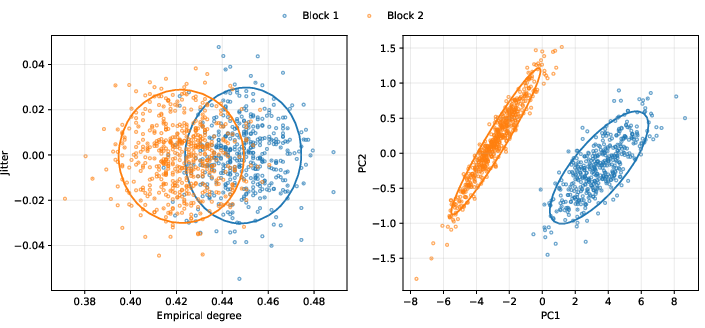
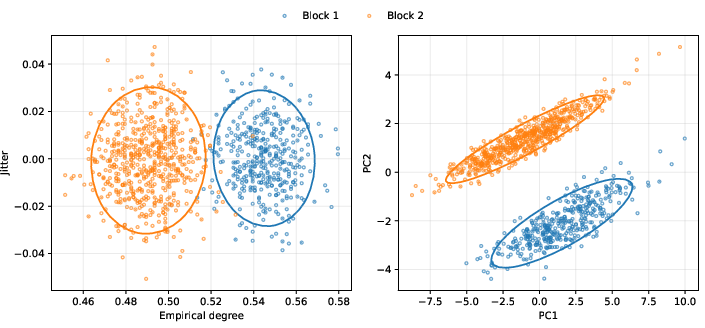
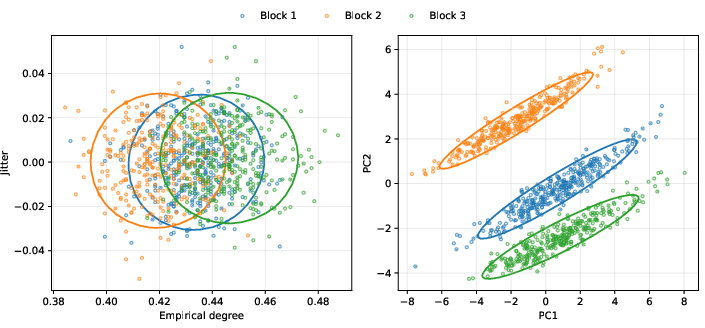
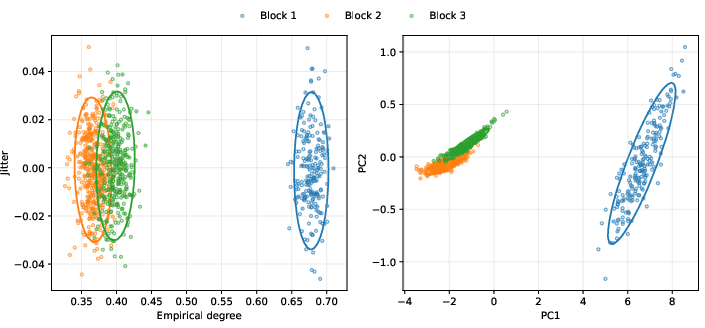
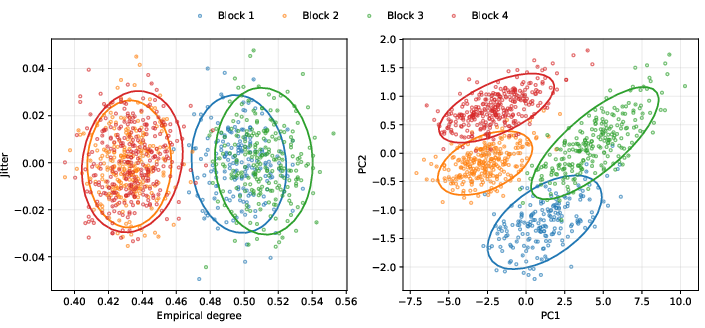
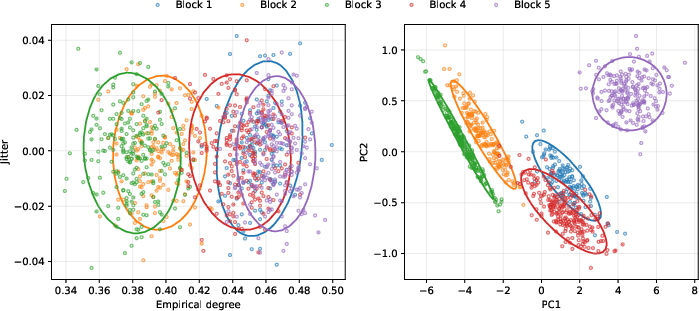
Figure 2: A two-block SBM (Assortative-2) where empirical rooted motif signatures discriminate block structure beyond degree information.
Additionally, for continuous finite-rank graphons designed with degree flat regions ("plateaux"), the population motif curves show variation across the latent space where the degree profile is essentially constant. This substantiates the theoretical claim that higher-order local structures can reveal heterogeneity latent to degree-based representations.
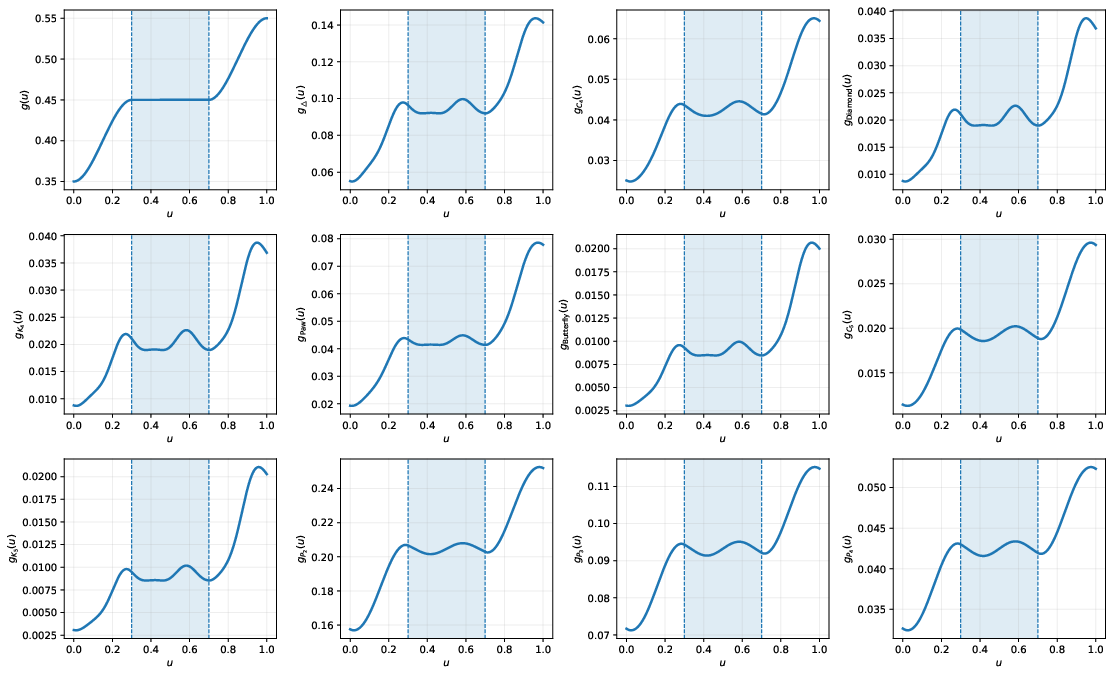
Figure 3: Population rooted motif signature curves for a finite-rank graphon ΦW(u)={t((F,r),W)(u)}(F,r)∈F∞9, illustrating that, within degree plateau regions, motif signatures provide discriminative variability.
Implications and Future Directions
By introducing rooted motif signatures for latent position identifiability, this work supplies a nonparametric, local, and statistically consistent framework for node-level representation in exchangeable graph models. It subsumes degree-ordering as a special case and systematically extends identifiability to a broader class of graphons—importantly, to all generic finite-rank graphons and rich classes of SBMs with indistinguishable degrees.
Practically, motif-induced node distances admit direct use in algorithms for graphon estimation, community detection, clustering, or as features for GNN architectures, especially where degree-based features are insufficient. The results motivate further exploration of automated motif selection practices for adapting signatures to the intrinsic structure of observed networks, and open significant questions about the expressivity and limitations of motif-based identifiability under various forms of latent symmetry.
Conclusion
The paper rigorously demonstrates that rooted motif signatures provide both a theoretical and algorithmic route to latent position identifiability in graphon models beyond scalar degree-based methods. The approach supplies precise guarantees, strong empirical support, and broadens the scope of identifiability in statistical network analysis. The implications are substantial for graphon estimation, block detection, and the broader theory of exchangeable random graphs (2607.01358).