- The paper demonstrates that quantum tunneling in a modified SSH chain drives the hybridization of Jackiw-Rebbi zero modes with coherent Rabi-type oscillations.
- Analytical and numerical methods reveal that domain wall parameters critically control energy splitting, wavefunction overlap, and sublattice polarization of the zero modes.
- The study establishes a robust platform for topological quantum state transfer and engineered quantum devices through tunable interface dynamics.
Quantum Tunneling and Hybridization of Jackiw-Rebbi Zero Modes in a Modified SSH Chain
Introduction and Model Framework
This work analytically and numerically investigates the hybridization and coherent dynamics of Jackiw-Rebbi (JR) zero modes within a modified Su-Schrieffer-Heeger (SSH) chain. The modified SSH model studied here exhibits a richer bulk phase structure compared to the conventional SSH chain due to the presence of both quadratic- and Dirac-type gap closings at different momenta. Specifically, a quadratic gap closing occurs at k=0, and Dirac gap closings at k=±π/4a (Figure 1).
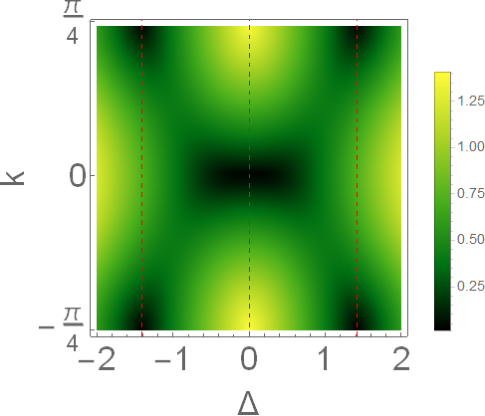
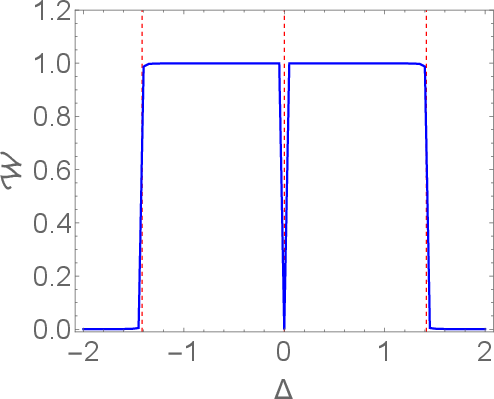
Figure 1: Bulk gap closing in the Δ–k parameter space. Panel (a) shows regions of gap closing at k=0 and k=±π/4a.
The periodic modulation of nearest-neighbor hopping creates a four-sub-lattice unit cell (for θ=π/2), resulting in novel domain wall (DW) structures. Crucially, the Dirac-type points at k=±π/4a support topological mass inversion via a domain wall, enabling the realization of spatially separated zero-energy JR modes at two interfaces.
Topological Domain Walls and Zero Modes
Analytical expansion of the Bloch Hamiltonian around k=0 yields a position-dependent Dirac mass, M(x)=−Δ(x)2, which does not undergo a topological sign change under kink-type profiles. Thus, no topological JR zero mode arises from the quadratic point. In contrast, expansion around the Dirac points leads to an effective mass k=±π/4a0, which supports mass inversion at two separate interfaces for sufficiently large domain wall amplitude, k=±π/4a1 (Figure 2). Each interface hosts a JR mode with sublattice polarization: one localized on A,C sublattices, the other on B,D.
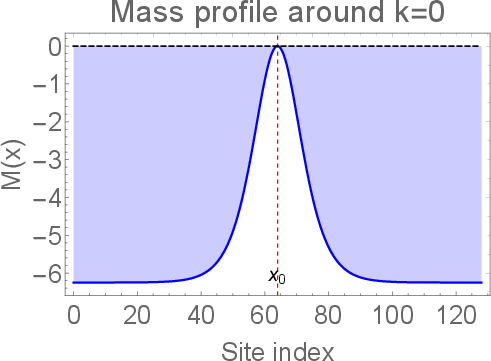
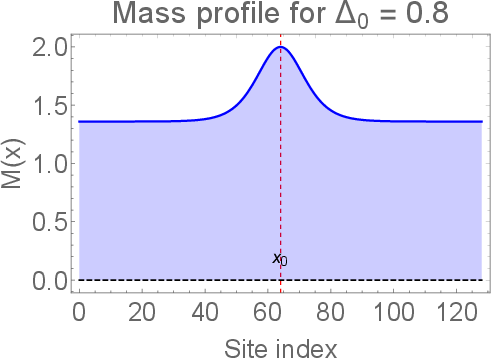
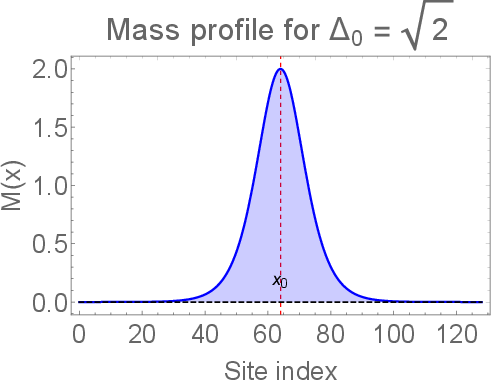
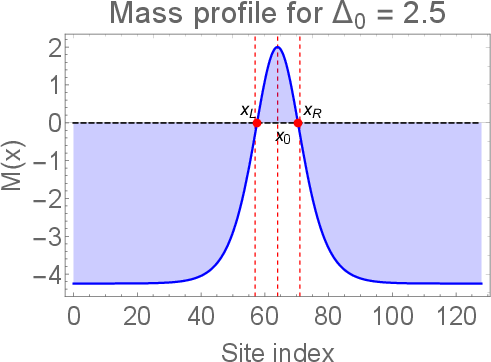
Figure 2: Profiles of the effective Dirac mass k=±π/4a2 near k=±π/4a3 and k=±π/4a4, highlighting the emergence of two mass zeros (interfaces) for k=±π/4a5.
Analytical envelope solutions in the continuum regime confirm that, for infinite interface separation, zero-mode wavefunctions are strictly localized with negligible overlap. However, for finite separation, tail overlap leads to exponentially small—but nonzero—matrix elements between the modes (Figure 3).
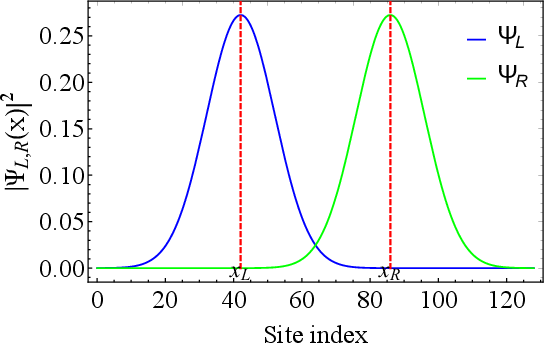
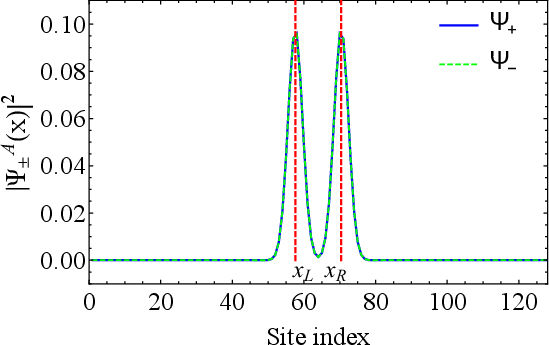
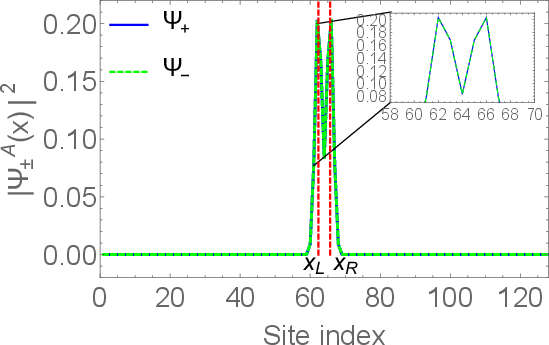
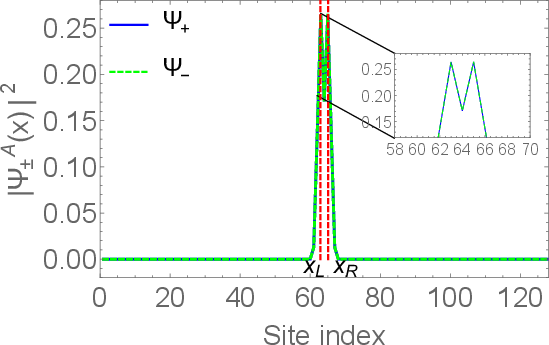
Figure 3: Analytical probability density of JRMs k=±π/4a6. Modes are strongly localized at the respective interfaces with negligible overlap for large separation.
Quantum Tunneling, Hybridization, and Energy Splitting
When interface separation decreases, quantum tunneling between the two JRMs becomes significant. Projecting the full Hamiltonian onto the two-mode subspace yields an effective two-level system, akin to a double-well potential. The energy splitting due to tunneling is k=±π/4a7, where k=±π/4a8 is the overlap matrix element. The symmetric and antisymmetric hybridized states form bonding and antibonding combinations, with their splitting k=±π/4a9 scaling exponentially with interface parameters:
Δ0
where Δ1 is the interface separation (Figures 4 and 5).
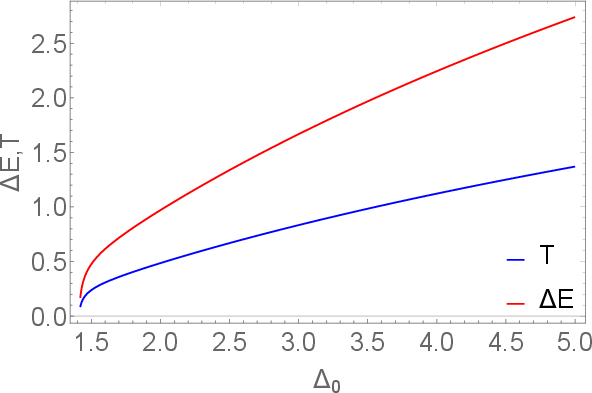
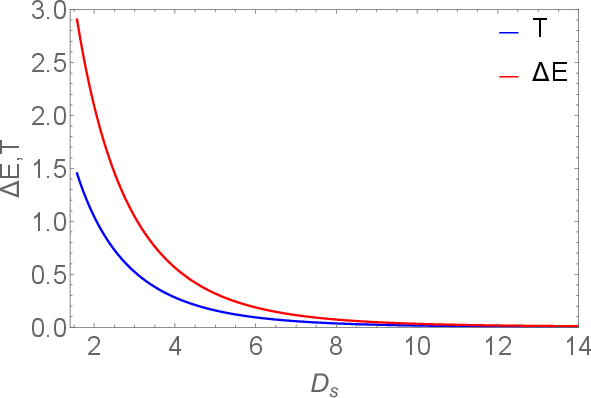
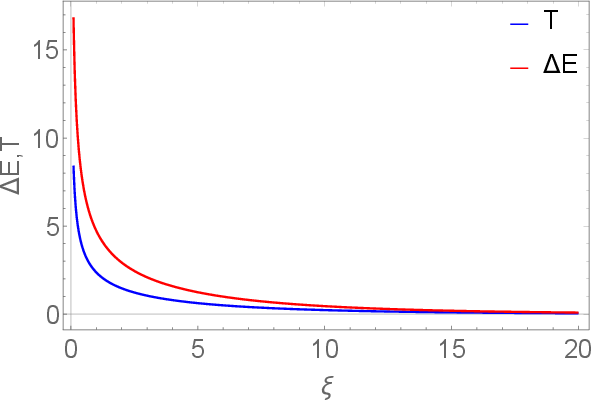
Figure 4: Tunneling matrix element and energy splitting as functions of domain wall amplitude and separation. Exponential suppression of tunneling for large separation.
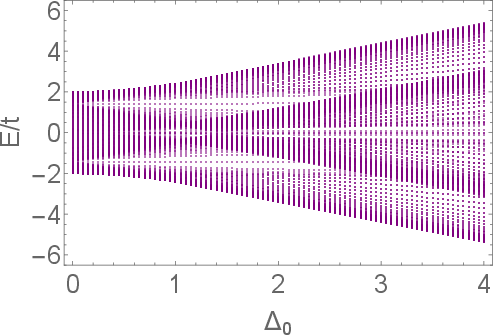
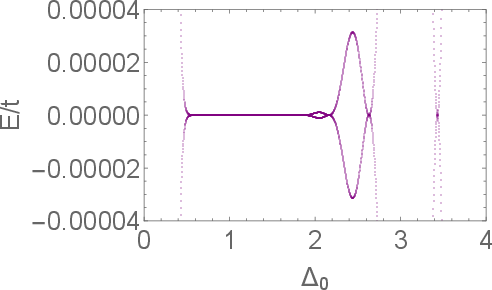
Figure 5: Real-space energy spectra versus domain wall amplitude Δ2. Panel (b) highlights the low-energy splitting of the near-zero modes.
Numerical diagonalization of the real-space Hamiltonian corroborates the analytic findings: exact zero modes appear for Δ3, and split near-zero in-gap states emerge for Δ4 (Figure 6).
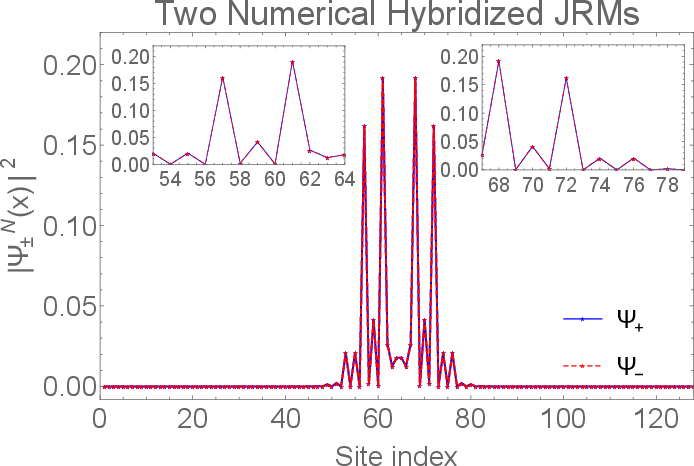
Figure 6: Numerical probability density of the two hybridized JRMs. The interface-localized character and sublattice polarization are apparent.
Coherent Dynamics and Tunneling Oscillations
Dynamically, the system exhibits coherent Rabi-type oscillations between the two hybridized JRMs (Figure 7). Preparing an initial state localized at one interface leads to periodic transfer of occupation probability and sublattice polarization to the other interface, with the oscillation period set by the tunneling-induced energy splitting Δ5 (Figures 8 and 9). In the long separation limit, the oscillation period diverges, freezing the modes.
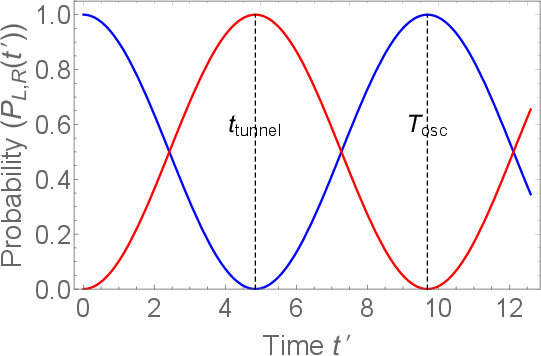
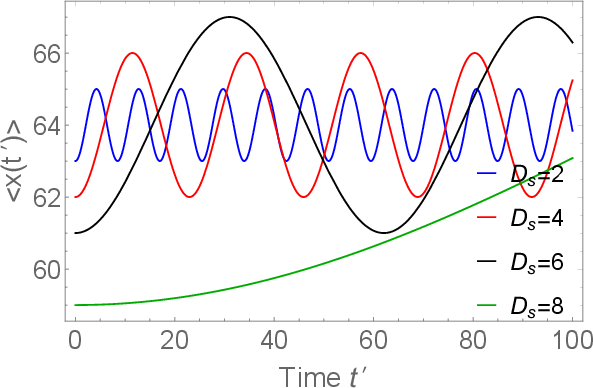
Figure 7: Probability amplitude dynamics: Δ6 and Δ7 as functions of time show coherent oscillation between JRMs and corresponding expectation value Δ8 transfer.
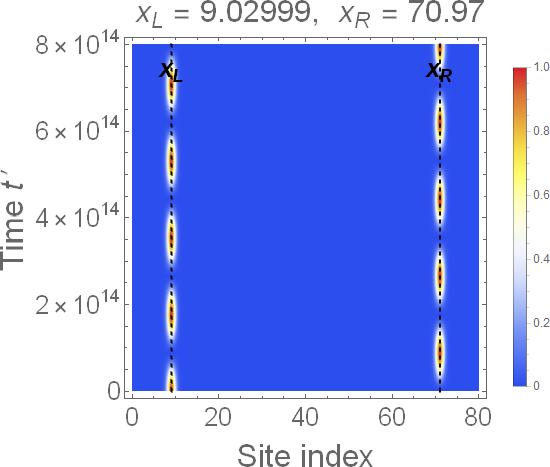
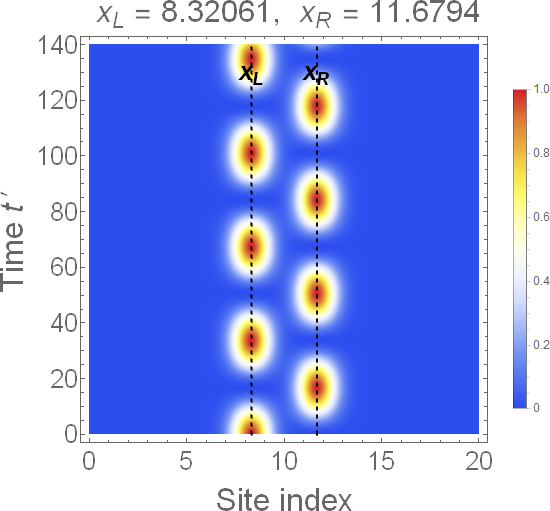
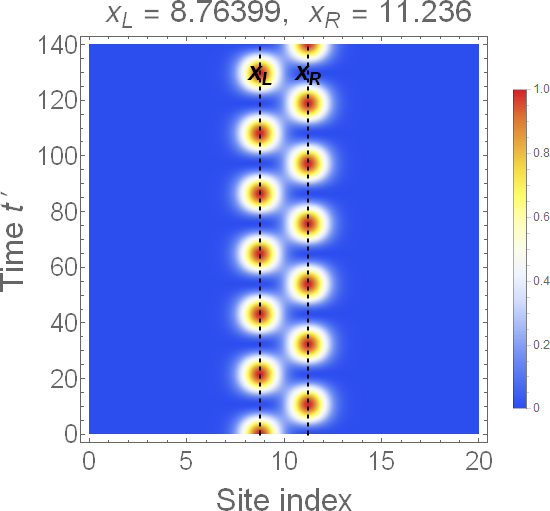
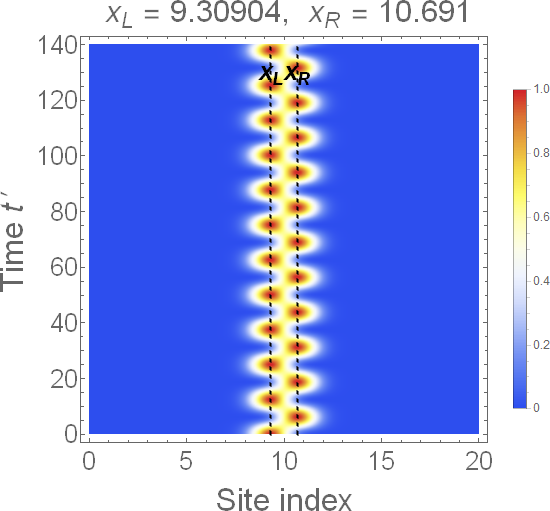
Figure 8: Probability density Δ9 as a function of position and time, visualizing coherent tunneling between the JRMs for various interface separations and amplitudes.
The exchange of sublattice character during tunneling is visualized via the sublattice polarization density k0, further characterizing the topological hybridization process (Figure 9).
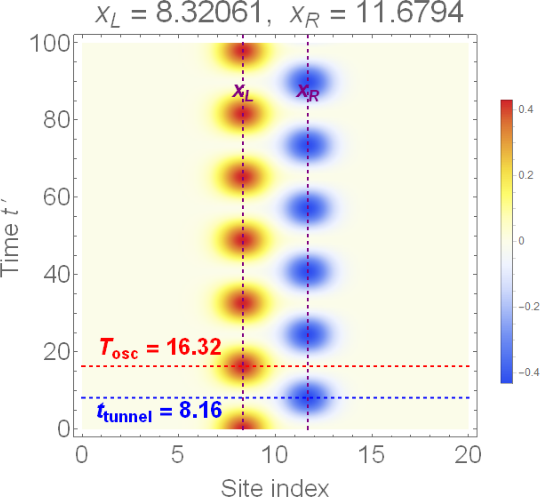
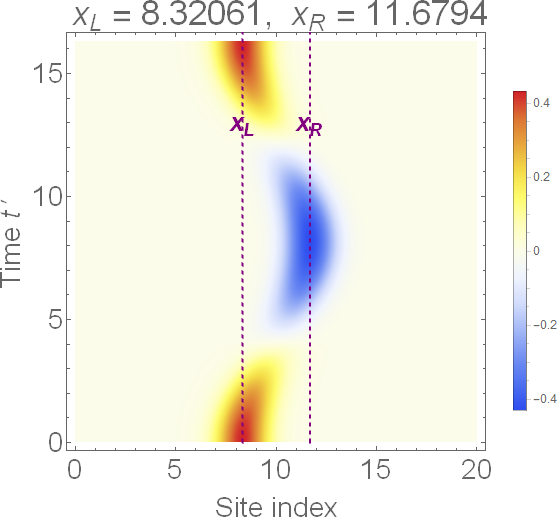
Figure 9: Spatiotemporal evolution of sublattice polarization density k1, quantifying the periodic transfer of localization and sublattice occupation between JRMs.
Topological Invariants and Bulk-Defect Correspondence
The topological protection and emergence of the JRMs are connected to changes in bulk winding number across the domain walls (Figure 10). The bulk-defect correspondence guarantees the existence of these modes, not as edge-localized but rather as domain-wall-excitation-bound states, distinguishable by their sublattice sector and spatial separation.
Figure 10: Winding number evolution with domain wall parameters underpins the existence of JRMs at interfaces.
Scaling of Tunneling Dynamics
The tunneling period k2 increases exponentially with both interface width and separation (Figure 11), confirming that coherent quantum-state transfer via JRMs is tunable by system geometry and the domain wall profile.
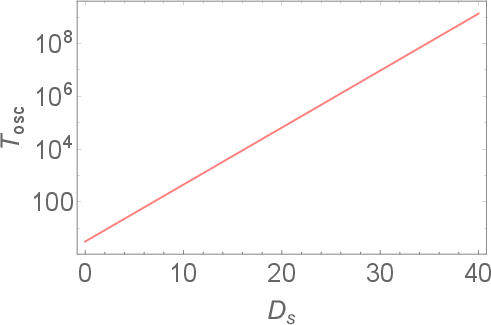
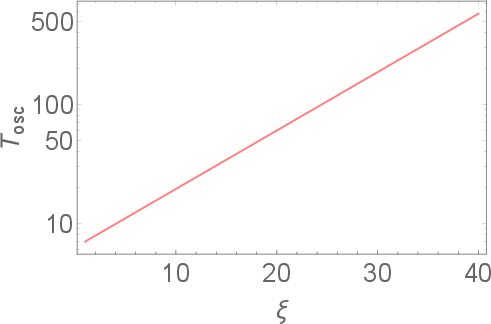
Figure 11: Tunneling period (log scale) as a function of interface separation and width, illustrating exponential scaling.
Implications and Outlook
This unified framework for JR mode hybridization in modified SSH systems is of direct relevance for engineered topological quantum-state transfer and information storage. The ability to tune the energy splitting and oscillation period via the domain wall amplitude and separation provides avenues for manipulating localized quantum information in synthetic quantum systems. Experimental observation of these coherent dynamics is feasible in photonic, atomic, and quantum-dot SSH chains where spatially modulated lattice parameters can be precisely engineered.
Theoretically, the model links relativistic field-theoretical concepts (e.g., solitonic mass inversion and fractionalization), symmetry-protected topology, and quantum tunneling phenomena. Future developments may target Floquet engineering, interaction or disorder effects on JR mode hybridization, non-Hermitian extensions, and many-body generalizations for applications in quantum devices and robust quantum transport.
Conclusion
The study demonstrates that in a modified SSH chain, tunneling-induced hybridization of spatially separated JRMs leads to coherent, tunable quantum oscillations analogous to Rabi dynamics in double-well systems, enriching the landscape of topological bound-state dynamics. The platform serves as a promising building block for topological quantum devices and coherent information transfer, and provides a concrete setting for exploring the interplay of topology, quantum mechanics, and engineered lattice defects.
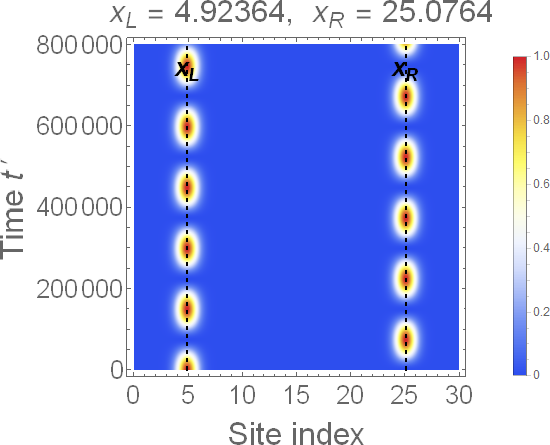
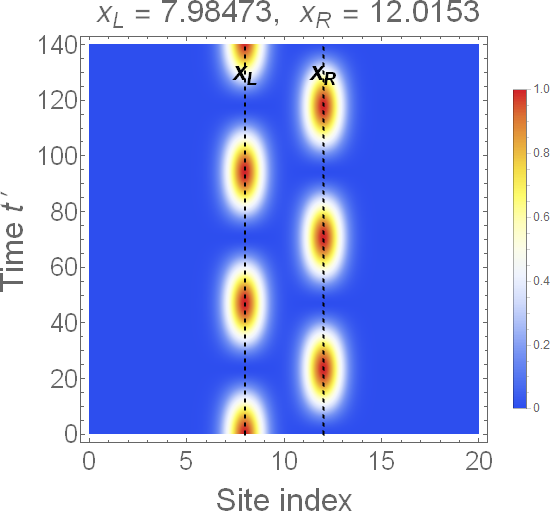
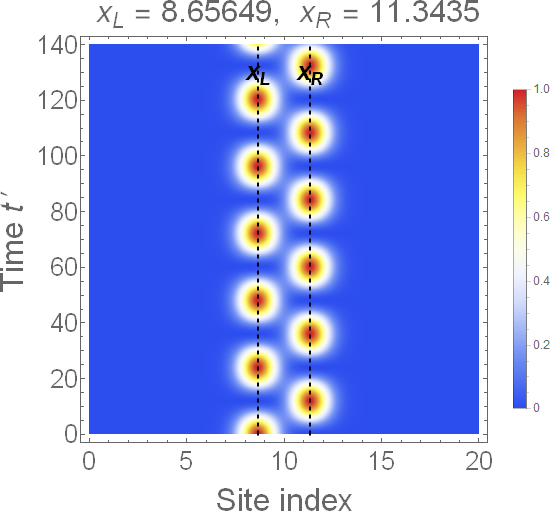
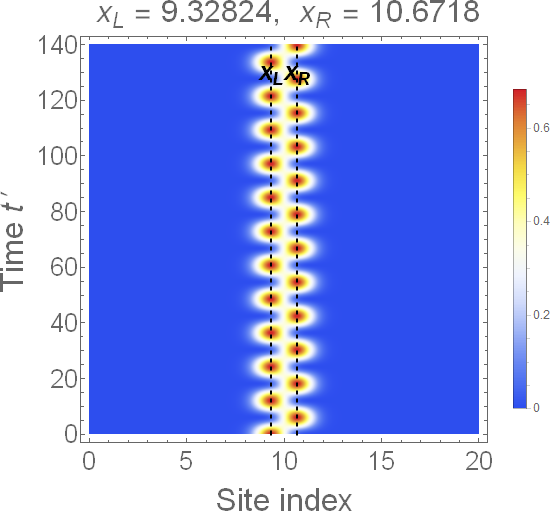
Figure 12: Probability density k3 illustrating coherent tunneling between two JRMs localized at the interfaces for various domain wall widths, revealing the dependence of hybridization strength on the sharpness of the interface.