- The paper shows that logarithmic negativity equals the PPT entanglement cost for large Haar-random mixed states, with only O(1) corrections in specific regimes.
- It employs detailed combinatorial and spectral analysis, including replica analytic continuation and Monte Carlo validation, to examine the binegativity spectrum.
- The results provide an operational, experimentally accessible entanglement quantifier, with implications for quantum computation, condensed matter physics, and quantum gravity.
Logarithmic Negativity and the Exact Entanglement Cost: Generic Equality in Random Mixed States
Context and Motivation
Characterizing quantum entanglement in many-body mixed states is a foundational challenge for quantum information theory with direct implications for quantum computation, condensed matter physics, and quantum gravity. The operationally meaningful measures—distillable entanglement and entanglement cost—are central to resource theories, but are computationally intractable for large systems. By contrast, the logarithmic negativity is efficiently computable via matrix diagonalization, but its precise operational status for generic states has been unclear, particularly regarding its connection to state preparation cost under positive partial transpose (PPT)-preserving operations.
Main Results
This paper rigorously establishes, for large random mixed quantum states, that the logarithmic negativity E generically equals the exact PPT entanglement cost Eppt, with only O(1) corrections in a narrow parameter regime. The work operates by analyzing the spectral properties of random induced density matrices and, crucially, their so-called binegativity spectra. The primary result is that for Haar-random induced mixed states, the following holds in the large-dimensional limit:
- In the Positive Partial Transpose (PPT) phase: both E(ρAB)=Eppt(ρAB)=0.
- In the Maximally Entangled (ME) phase: E(ρAB)=Eppt(ρAB)=logdB(1+o(1)), where dB is the Hilbert space dimension of the smaller subsystem.
- In the Entanglement Saturation (ES) phase: E diverges logarithmically with system size, and Eppt/E→1, with at most a fixed, dimension-independent additive gap of ≈0.22 (see below)—this gap becomes negligible for large systems.
This phase structure is governed by the ratios of subsystem dimensions and is summarized in the main phase diagram of the paper Figure 1.
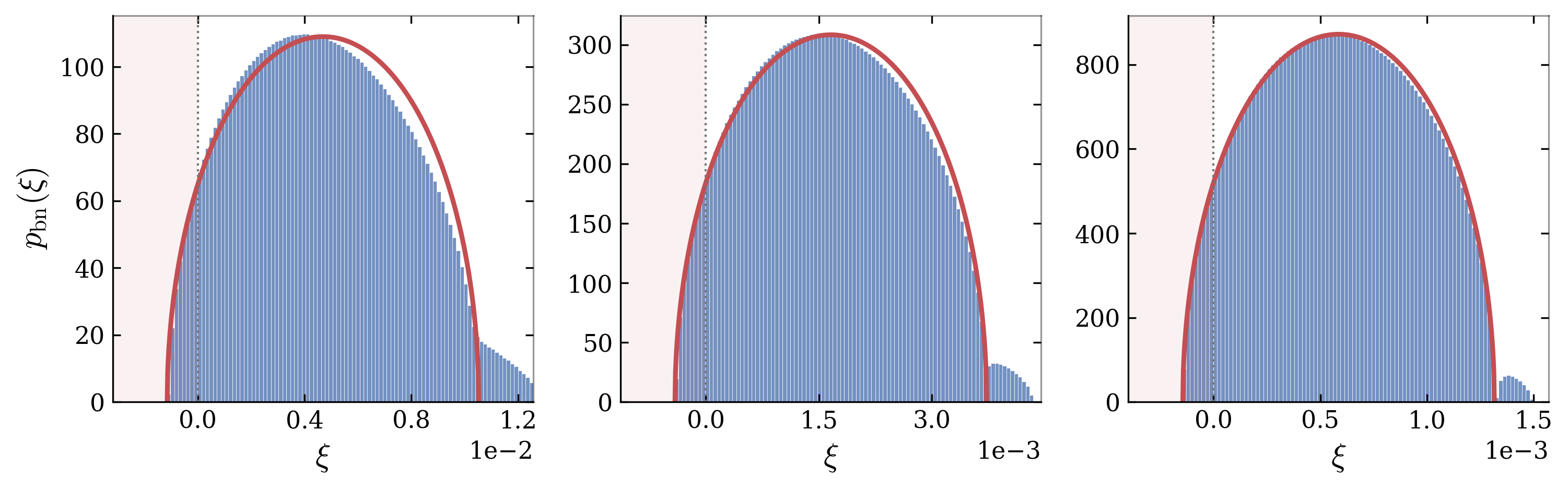
Figure 2: Entanglement-saturation-phase binegativity spectrum (ξ) at Eppt0 for Eppt1; the semicircle law is depicted as the red curve.
The operational equivalence between logarithmic negativity and PPT entanglement cost renders the former both meaningful and practical as a resource quantifier for generic, large mixed states.
Theoretical and Numerical Analysis
The proof strategy involves a detailed combinatorial and spectral analysis of the operator Eppt2, the "binegativity" operator. Central theoretical advances include:
- Calculation of the full binegativity spectrum by combinatorial enumeration utilizing a two-parameter sequence, connected to generalized Motzkin numbers.
- Replica analytic continuation techniques, supported by explicit Monte Carlo validation, confirm the spectral hypothesis for both the logarithmic negativity and binegativity moments.
Three distinct entanglement phases emerge based on subsystem size ratios:
- PPT Phase (Eppt3): No entanglement; spectrum strictly positive; both Eppt4 and Eppt5 vanish.
- Maximally Entangled Phase (Eppt6 or Eppt7): The logarithmic negativity saturates; the binegativity spectrum is strictly nonnegative.
- Entanglement Saturation Phase (intermediate regime): The spectrum develops a small negative tail (visible in Figure 2), responsible for the small possible gap between the upper and lower operational bounds; this gap is strictly Eppt8 and negligible asymptotically.
Numerically, the mean and fluctuations of the gap, as well as the spectral features of the binegativity, concentrate tightly around their average for increasing Hilbert space dimension, demonstrating that these conclusions hold not just on average, but for almost every state.
Implications and Experimental Accessibility
The identification of logarithmic negativity as the operationally exact entanglement cost for generic random states provides a robust, tractable tool for quantifying entanglement in complex quantum systems where direct evaluation of Eppt9 is computationally prohibitive. Experimental protocols, including randomized measurement techniques, can access the partial-transpose moments required for entanglement characterization, validating the practical significance of the result.
Of note, the methodology of this work—permutation-sum techniques and spectral analysis—extends naturally to random tensor network states, holographic duality settings, and models of evaporating black holes. Thus, the results have implications for a broad class of quantum statistical and gravitational systems.
The analysis also highlights phase transitions in entanglement structure: from separable to maximally entangled regimes, as subsystem ratios are tuned, with the sharpness or smoothness of the transition determined by the positivity of the binegativity spectrum.
Future Prospects
Open directions include generalizing these equivalences to more structured classes of states (e.g., generic many-body pure states at high energy, non-Haar-random ensembles), and exploring whether the operational equality between logarithmic negativity and entanglement cost holds in more general resource-theoretic settings. Extending the present formalism to accommodate tensor network descriptions and investigating the interplay with measurement-induced transitions are also promising lines of inquiry.
Conclusion
This work demonstrates that, for large Haar-random mixed quantum states, the logarithmic negativity is not only efficiently computable but also coincides with the exact PPT entanglement cost, thereby providing a clear operational interpretation. The approach, grounded in detailed spectral and combinatorial analysis, confirms that negativity is an optimal entanglement quantifier in generic many-body settings, with foundational and practical implications for quantum information theory, experimental protocols, and theoretical studies of complex quantum systems (2607.01320).