- The paper establishes that a global TFIM with a non-monotonic drive can simulate universal quantum circuits with only global control and polynomial overhead.
- The authors construct a detailed reduction where any p-gate, n-qubit circuit is efficiently simulated using domain-wall encoding and precise phase scheduling.
- Numerical validation supports the resource bounds and implies that analog devices like quantum annealers and neutral atom systems can, in principle, achieve universal computation.
Polynomial Equivalence of the Global Transverse-Field Ising Model and the Gate Model of Quantum Computation
Introduction and Context
The paper "Polynomial equivalence of the global transverse-field Ising model and the gate model of quantum computation" (2607.01227) addresses a longstanding open question in quantum computing theory: whether the globally controlled transverse-field Ising model (TFIM), with only homogeneous time-dependent transverse control (i.e., a global drive), is computationally equivalent to the standard gate-model of quantum computation. This question is highly relevant for quantum technologies that naturally implement global Ising interactions—such as quantum annealers and neutral atom systems—where fine-grained local control is limited. The results provide a constructive, resource-aware reduction showing that any quantum circuit can be simulated in the global-TFIM setting with polynomial overhead.
Model Definition and Computational Setting
The global-TFIM considered operates under the Hamiltonian
Ht=Γtm∑Xm+m∑hmZm+(m,n)∈E(G)∑JmnZmZn,
where Xm and Zm are Pauli matrices for qubit m, with the full system evolving under time-dependent Γt acting identically on all qubits. The coupling constants (local “longitudinal fields” hm and pairwise Ising interactions Jmn) are static and, crucially, the only dynamical input is the global schedule Γt. The question of universality is then: does this model suffice to efficiently (i.e., with at most polynomial overhead) simulate universal, gate-based quantum computation, provided Γt is allowed to be general (not just monotonic, as in standard annealing)?
Summary of Main Results
The core theorem (Theorem 1, informal version) established in the paper is:
The global TFIM with non-monotonic schedule is polynomially equivalent to the gate model of quantum computation.
This is realized constructively, with explicit resource counting:
- Any p-gate, Xm0-qubit quantum circuit can be simulated by a global-TFIM (with time-dependent but global-only Xm1) using Xm2 physical qubits, interaction strength Xm3, and total runtime Xm4 for any Xm5 and error tolerance Xm6.
This establishes a theoretical foundation for two significant conclusions:
- Universality of Analog Quantum Simulators: Any quantum device implementing global Ising-type evolution with a programmable, time-dependent Xm7 (such as D-Wave's annealers, Rydberg-atom arrays, or superconducting processor architectures with limited local control) is, in principle, universal for quantum computation.
- Classical Intractability: Assuming Xm8, the result provides a no-go theorem for efficient classical simulation of global-TFIM dynamics with non-monotonic Xm9, equating their hardness to universal quantum computation.
Technical Approach and Methods
The proof utilizes and generalizes a technique inspired by the Cesa-Pichler (CP) method for universal computation with global Rydberg drives [Cesa & Pichler, 2023]. The core challenge addressed is the translation of logical circuits into programmable sequences of global pulses and static local offsets, without site addressability. The technical steps are:
- Encoding Logical Qubits: Logical states are encoded in the boundary between domains on “wires” of physical qubits (Figure 1).
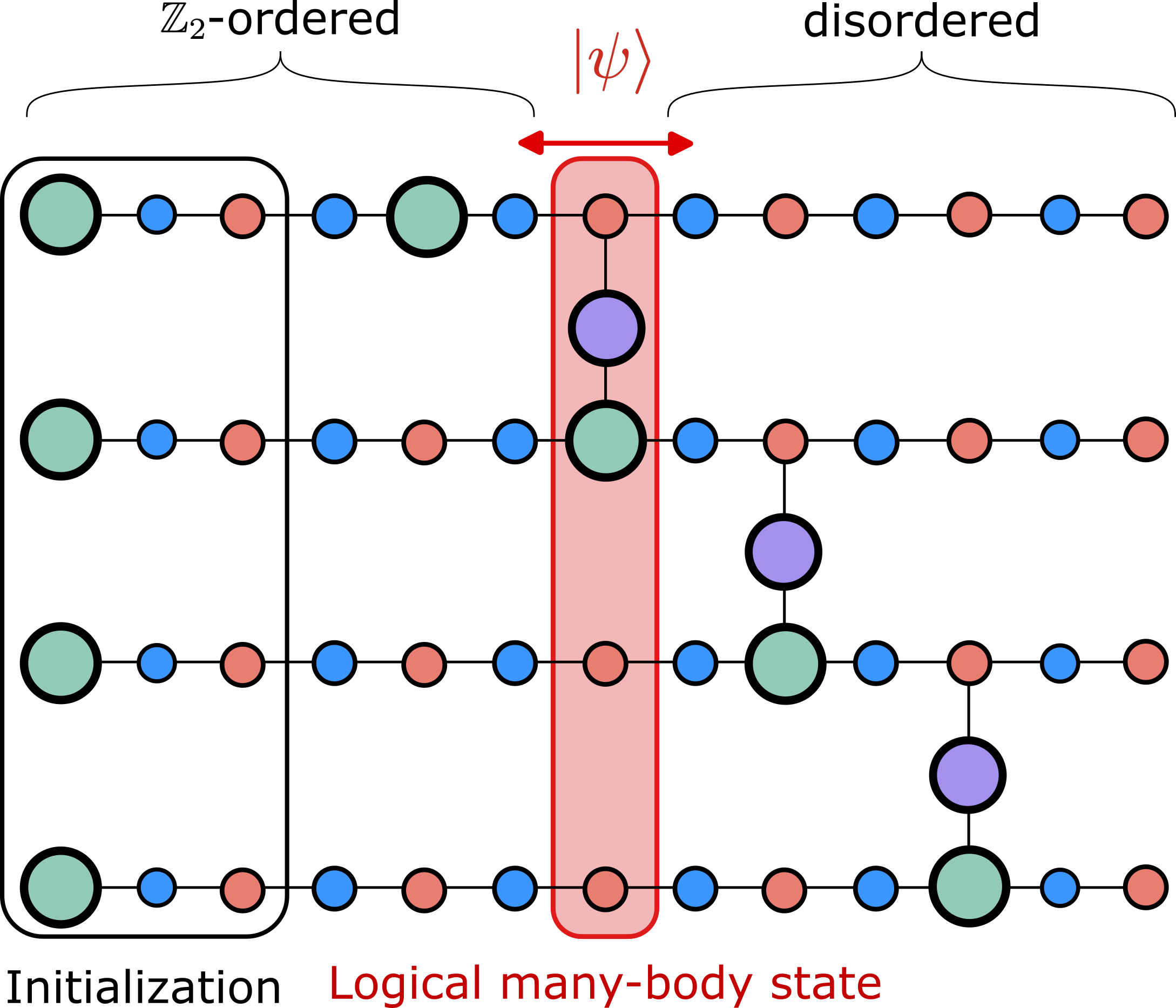
Figure 1: Graph Zm0 of the universal arrangement, where logical “wires” facilitate movement and manipulation of logical qubits via blockade and global operations.
- Propagation and Gate Operations: Logical information is moved along wires using sequences of global pulses, with entangling and single-qubit gates being mediated via engineered impurities (different species or static field configurations) and the exploitation of the Rydberg blockade, generalized here to large but finite Ising couplings.
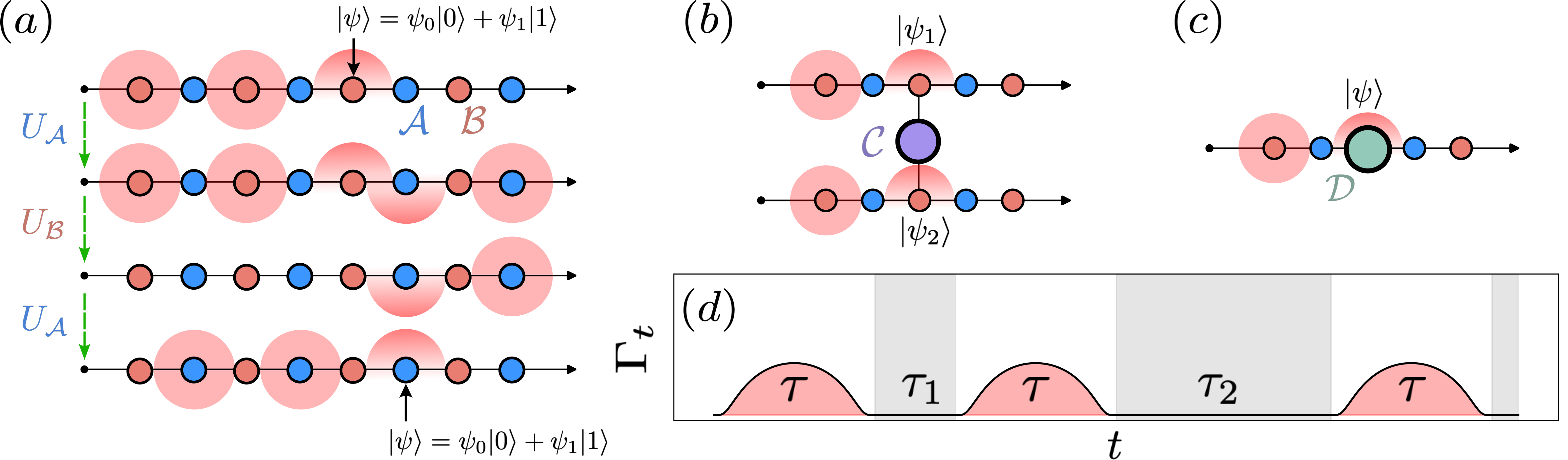
Figure 2: Schematic of the basic CP mechanism for moving information and implementing gates via blockaded transitions under global drives.
- Global Control Synthesis: By using phase evolution (waiting under local Zm1 fields) between global pulses, independent control over distinct groups of physical qubits is synthesized, despite only having global Zm2 control.
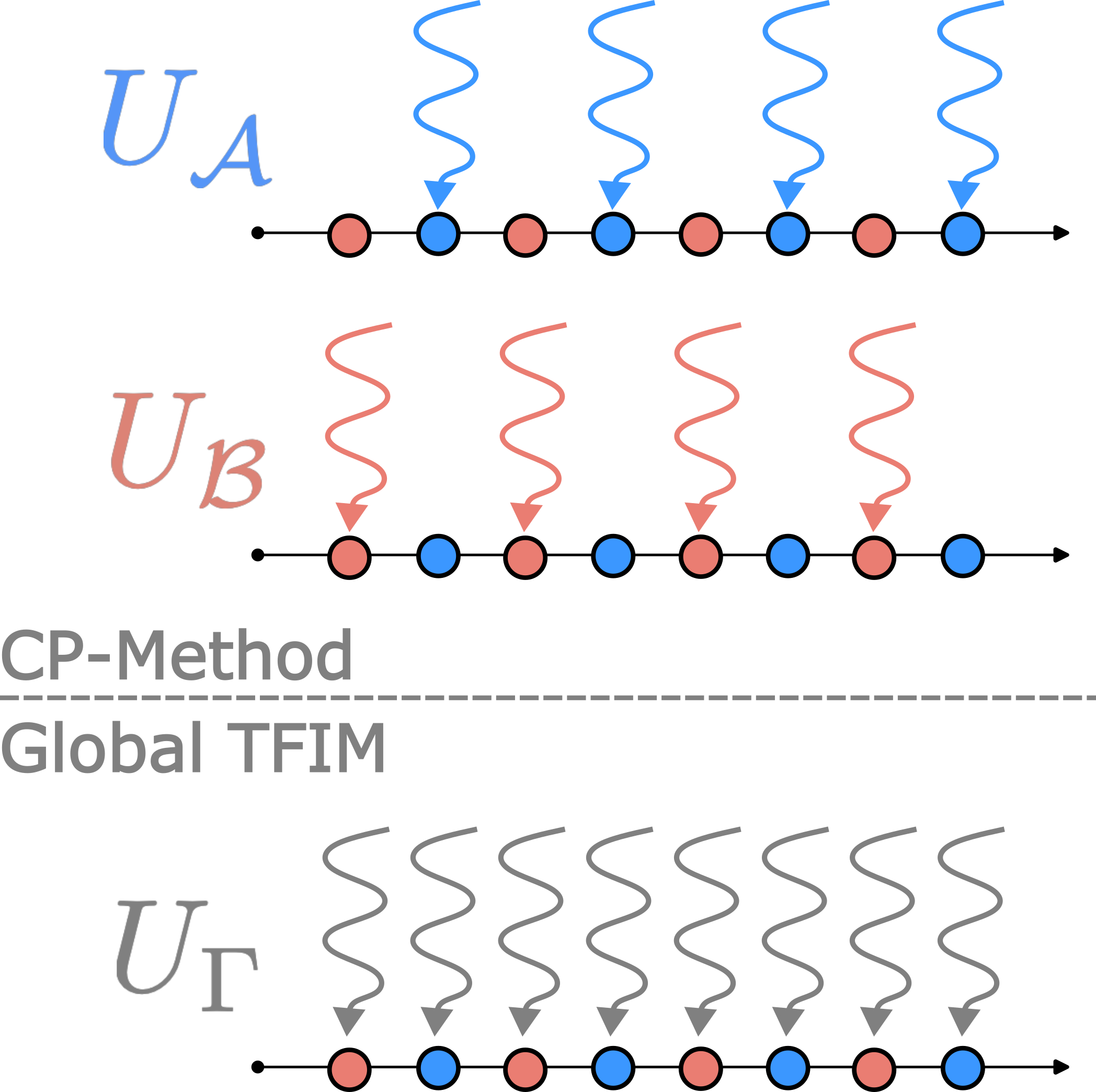
Figure 3: Comparison of the CP-method's semi-global assumptions with the restrictive case of a fully global transverse-field drive and the attainable logical control via interference.
- Error Analysis and Resource Bounds: Sequence compilation is achieved via a combination of Lie-algebraic control arguments and constructive bounding, with detailed union bounds on errors accrued at each step. The overall error can be made arbitrarily small by polynomial increases in evolution time and coupling strength. The main technical overheads stem from (i) the need to “wrap” phase evolution to single out logical groups and (ii) error suppression under imperfect blockade (finite Zm3).
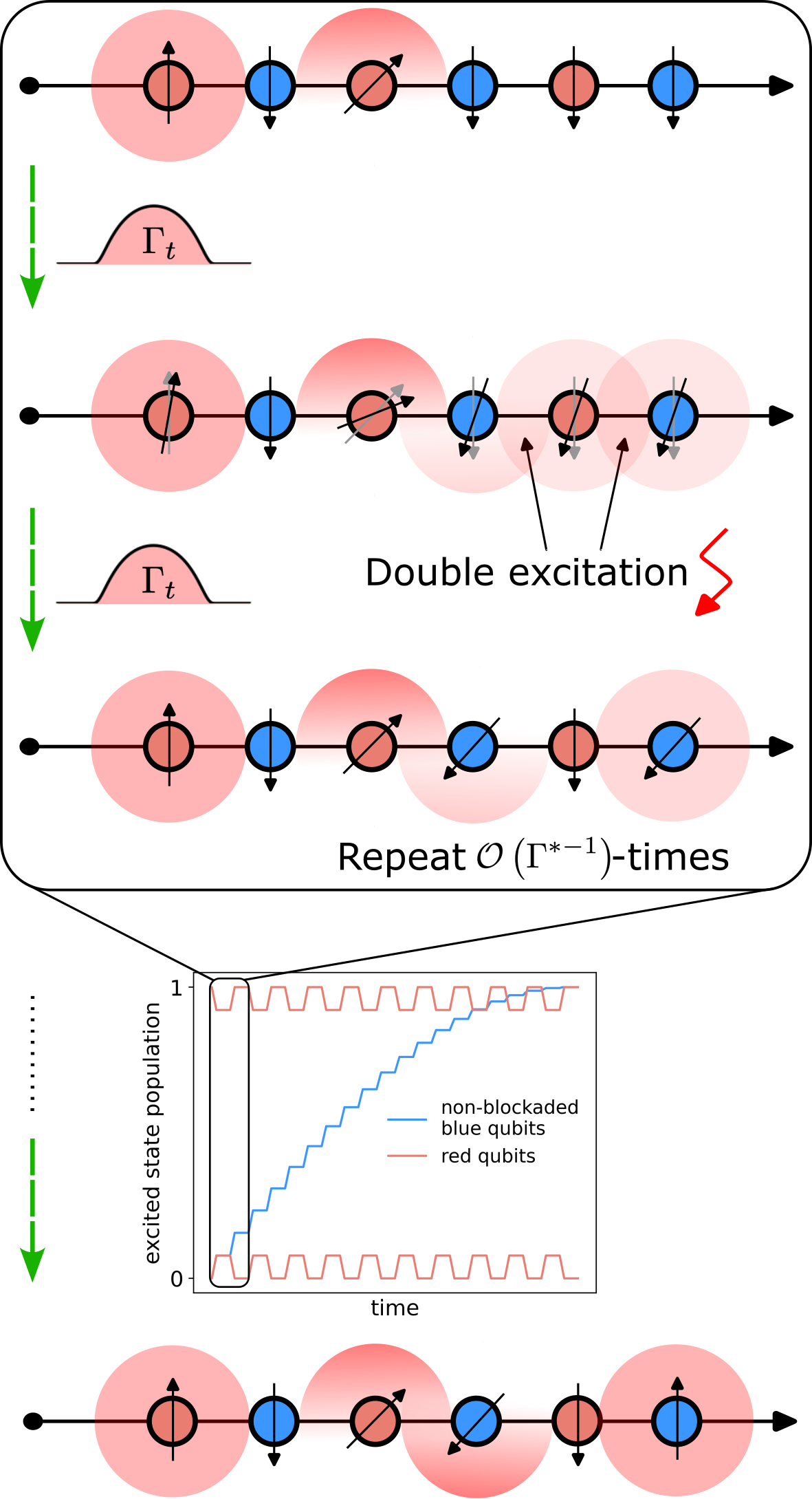
Figure 4: Illustration of recovering group-level control from global drives. Desired and undesired transitions in adjacent qubits are suppressed or enhanced via carefully timed phase gates and pulse sequences.
Numerical Validation
Key steps of the reduction are validated numerically, notably the movement of the logical domain wall (the propagation sequence) for varying parameters, confirming the predicted polynomial scaling of infidelity with drive strength and system size.
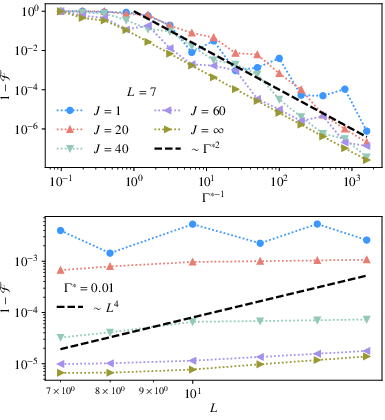
Figure 5: Infidelity Zm4 of a compiled propagation cycle versus inverse maximum transverse field Zm5 and system size, matching analytical bounds.
Implications and Outlook
Practical Implications: While the construction is not immediately practical due to high polynomial exponents in resource scaling (chiefly time and energy overheads), it clarifies that the limitation to fully global control is not a “hard” computational limitation—universality (in a complexity-theoretic sense) is retained, negating the common belief that global-only TFIM is fundamentally weaker than the universal gate set. This opens possibilities for device architectures with dramatically reduced control wiring and prompts reconsideration of hardware simplification strategies [Planckian_2025, Planckian_2026a, Planckian_2026b].
Complexity and Simulation: The result enables the use of global-TFIM devices as “witnesses” for generic quantum computational hardness, with direct implications for claims of quantum advantage in analog quantum simulation and annealing settings. It also situates the global-TFIM within the landscape of Hamiltonian complexity theory, highlighting how out-of-equilibrium, time-dependent control overcomes classical simulability typically associated with stoquastic Hamiltonians [Bravyi_2017].
Possible Future Directions: Several natural directions are identified:
- Improved Compilation: Reducing exponents by exploiting more efficient phase-wrapping, local Schrieffer-Wolff transformations, or alternative encodings (e.g., those used in conveyor-belt and other globally driven schemes [Planckian_2025, Planckian_2026b]).
- Generalization to Strict Annealing Regimes: Addressing universality and simulation complexity under additional constraints such as strictly monotonic Zm6 evolution (relevant for some quantum annealing hardware).
- Error Mitigation and Fault Tolerance: Incorporating measurement and reset capabilities for error mitigation strategies adapted to this globally controlled paradigm.
Conclusion
This work rigorously establishes that the globally controlled, time-dependent transverse-field Ising model is polynomially equivalent to the standard quantum gate model. The result is achieved via a detailed, resource-sensitive reduction leveraging domain-wall encoding, group-wise control by phase scheduling, and robust error analysis. Key implications include the theoretical universality of a broad class of quantum annealing and analog simulation devices and a strong, complexity-theoretic no-go result for their efficient simulation by classical means when non-monotonic global control is admitted. While practical implementation is far from immediate due to current technological limitations, the formal universality demonstrated here highlights the foundational potential of globally controlled architectures and motivates the search for more efficient realizations and embeddings in near-term quantum hardware.

