- The paper introduces a sensorless four-channel control architecture leveraging inverse dynamics to replace force/torque sensors, enhancing bilateral teleoperation transparency.
- It employs rigorous parameter identification using Fourier-based excitation to achieve low torque estimation error and high performance in both free-motion and contact tasks.
- Experimental results demonstrate significant improvements in leader impedance and maximum transmittable impedance compared to traditional two-channel methods.
Sensorless Four-Channel Control via Inverse Dynamics for Human-Scale Bilateral Teleoperation
Introduction
Transparent bilateral teleoperation is central to applications requiring high-fidelity operator-environment interaction, particularly in hazardous or constrained environments. For human-scale manipulation, challenges such as high inertial loads, robot dynamic complexity, and the limitations or absence of force/torque sensing impede ideal transparency and operational efficiency. This paper introduces a sensorless four-channel bilateral teleoperation architecture that leverages identified inverse dynamics models to replace external force/torque sensors. The system is instantiated on a dual-WAM teleoperation platform and subject to extensive empirical analysis, including both standard system identification and a realistic door-opening manipulation scenario (2607.01201).
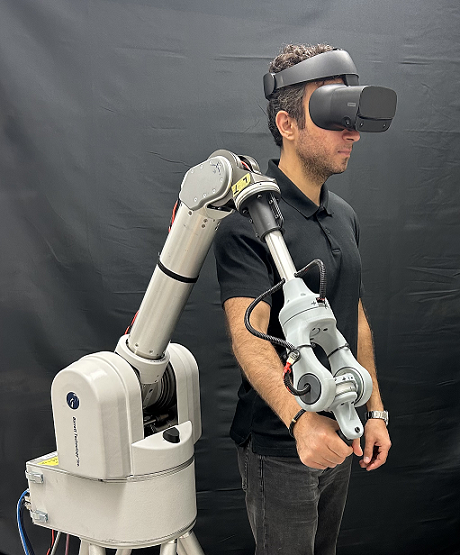
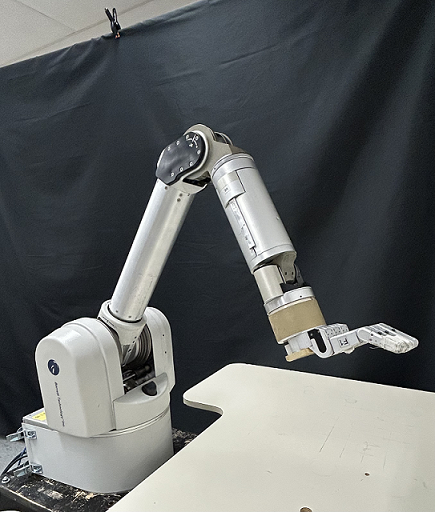
Figure 1: WAM bilateral teleoperation system setup: (a) 4-DOF leader arm with custom haptic wrist, (b) 7-DOF follower arm.
Methods
Four-Channel Architecture and Transparency Metrics
This architecture leverages four bidirectional communication channels: dual position (command/feedback) and dual torque/force (command/feedback) pathways. The methodology formalizes the system in the two-port/hybrid-matrix modeling framework, quantifying transparency by metrics such as free motion position tracking, leader impedance, hard-contact force tracking, and maximum transmittable impedance. The canonical performance optimum maps to hybrid matrix
H=[01 10]
yielding zero leader impedance and perfect environment-force rendering, but practical challenges necessitate concessions, especially in high-DOF, high-inertia settings.
Sensorless Torque Feedback via Inverse Dynamics
Robot parameter identification underpins inverse dynamics feedback. Rather than end-effector force estimation, joint torques are estimated using a least-squares base parameter identification via Fourier-based excitation trajectories. Only viscous friction is retained for passivity, with stiction and Coulomb friction excluded for energetic stability. At runtime, joint torques are estimated as:
τ^ext=τ−Yb(q,q˙,q¨)π^b
enabling sensorless feedback at the controller.
System Implementation and Gain Tuning
A 7-DOF WAM arm serves as the follower, with a 4-DOF WAM and custom 3-DOF haptic wrist as leader. Controller development and real-time teleoperation execute at 500 Hz, with system parameter estimation performed offline. Critical passivity constraints dictate acceleration signal scaling and force feedback gain bounds, with a selected value of Cf=0.5 for all joints, balancing transparency and energetic safety.
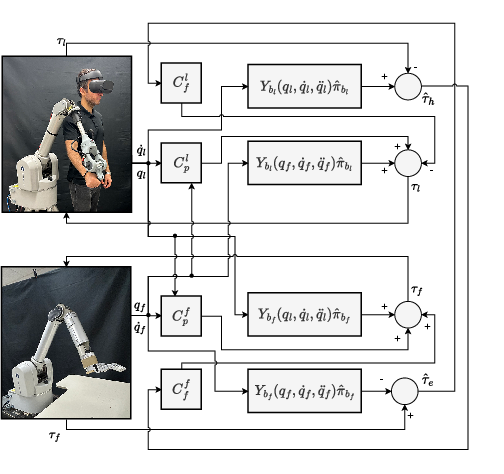
Figure 2: Schematic of the four-channel control architecture on the WAM bilateral teleoperation system.
Experimental Evaluation
Transparency Metrics and System Comparison
Experimental protocol follows established quantitative transparency frameworks, using autonomous (no human operator) joint excitation and comparative assessments versus conventional two-channel position-position architectures, both with and without dynamics compensation, as well as transparency-enhancement baselines (force feedforward and local force feedback). Performance is computed on both free motion and constrained/contact tasks. Metrics of interest include tracking NRMSE, leader impedance, force tracking in hard contact, and the maximum transmittable impedance.
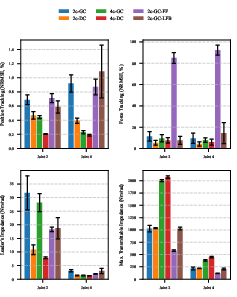
Figure 3: Transparency performance metrics across different teleoperation systems. Metrics: free motion position tracking, leader's impedance, hard contact force tracking, and maximum transmittable impedance.
The sensorless four-channel inverse dynamics approach (4c-DC) outperforms all baselines in free-motion position tracking and leader impedance (p<0.05), and achieves the highest maximum transmittable impedance in hard contact, without sacrificing force tracking accuracy. Improvements are consistent across both standard task execution and more challenging, whole-body contact tasks.
Model Identification and External Torque Estimation
Identified base parameter models resulted in mean joint torque NRMSE values below 6% for major joints, confirming accurate dynamic prediction. In task evaluation, sensorless torque estimation error (NRMSE between estimated and ground-truth torques) remains low across architectures and task conditions, with typical values of 3-12% depending on joint and method.
Realistic Manipulation: Door-Opening Task
A door-opening task, involving both distal and distributed contacts, demonstrates the utility of sensorless four-channel control. Superior position and force tracking during both free-motion and contact phases confirm the approach’s efficacy in realistic, highly constrained settings.
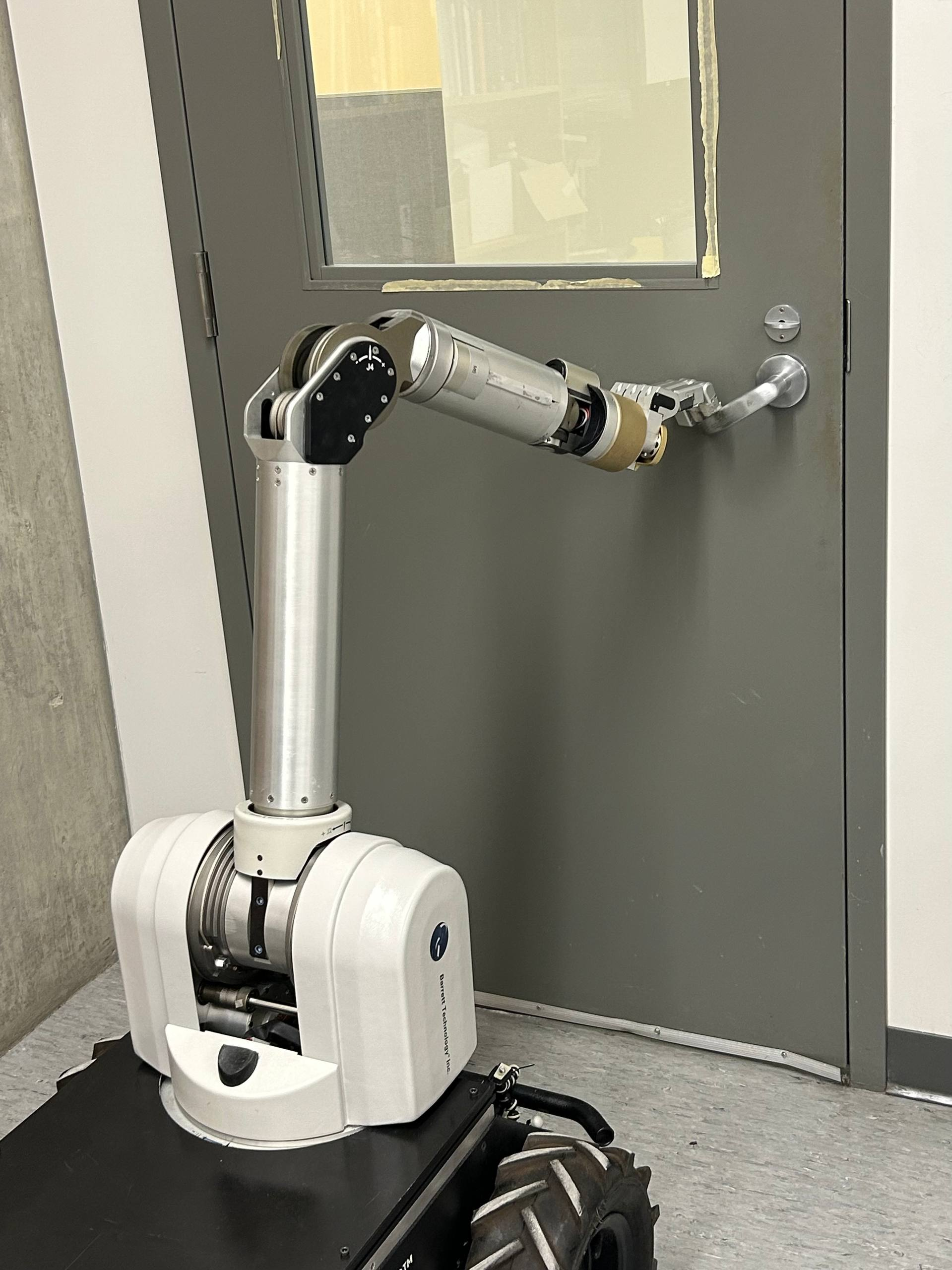
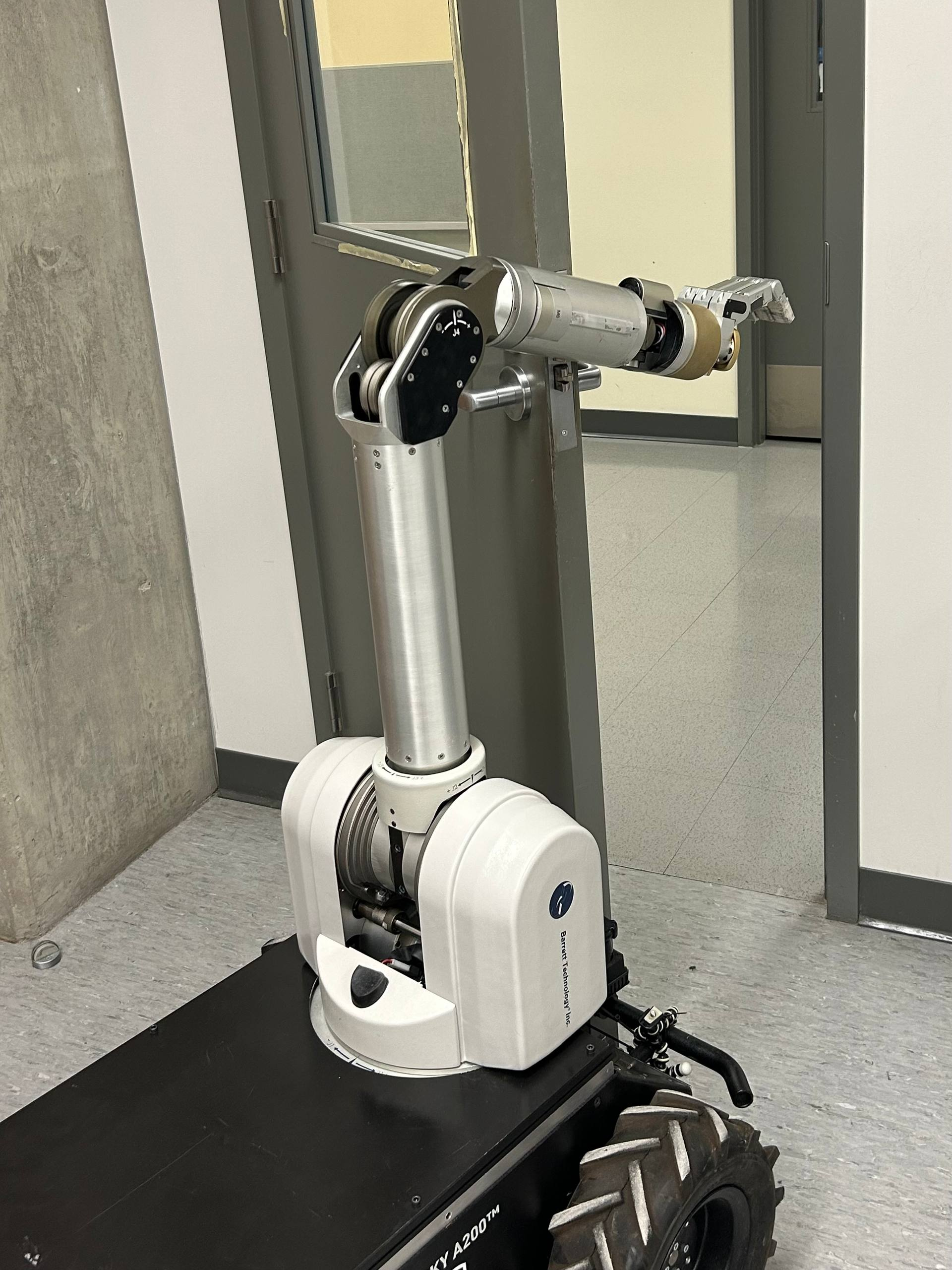
Figure 4: Door-opening task: (a) follower arm manipulating the door handle; (b) whole-body contact along the follower arm while pushing the door open.
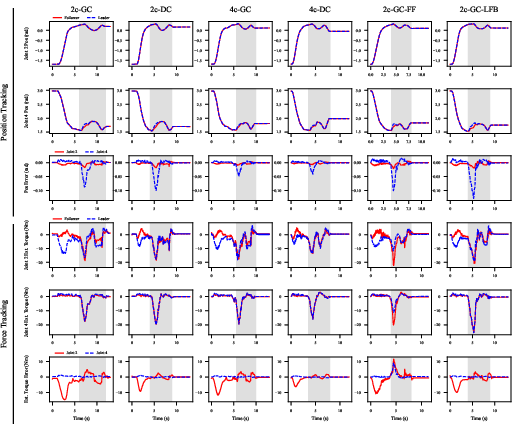
Figure 5: Comparison of teleoperation systems for the door-opening task using joint positions for position tracking and external joint torques for force tracking. Gray regions indicate the contact period.
Discussion
The results underscore the efficacy of joint-space inverse dynamics parameterization in providing accurate, real-time, sensorless torque feedback for teleoperation—mitigating the cost, integration complexity, and spatial limitations of force/torque sensors, particularly for contact along the manipulator body. Contrasted with approaches such as local force feedback or force feedforward, which marginally improve free motion but do not address hard-contact transparency, the presented four-channel architecture sustains high transparency across operational regimes. Performance holds without the need for high-gain force feedback that would compromise passivity, maintaining stability throughout realistic human-scale manipulation.
The theoretical implication points toward the robustness of model-based architectures for sensorless teleoperation, provided base parameter estimation is rigorous and friction modeling is passivity-aware. The practical ramification is a step toward scalable haptic-enabled teleoperation for environments where sensor integration or maintenance is infeasible.
Future Directions
Key future research trajectories include: adaptive modeling for stiction and Coulomb friction compensation, online real-time parameter adaptation to compensate for unmodeled dynamics, robustification to communication delays, and generalization to heterogeneous master-slave setups. Extending the system to hybrid data-driven/model-based approaches (e.g., incorporating PINNs or deep Lagrangian networks) could further refine dynamic estimation under evolving operational or environmental variation.
Conclusion
This study formally demonstrates that a sensorless four-channel bilateral teleoperation control strategy, grounded in parametric inverse dynamics estimation, achieves superior transparency, tracking, and force rendering for human-scale manipulators without force/torque sensors. The approach realizes high operational transparency even in distributed contact tasks and upholds passivity constraints. These findings set a precedent for robust, scalable, cost-effective teleoperation for advanced human-robot interaction, especially in high-DOF, physically interactive scenarios.

