- The paper introduces EquiSteer, a training-free method that intervenes in cross-attention activations to reduce demographic biases in text-to-image diffusion models.
- It utilizes a gating mechanism, steering vector construction, and attribute subspace orthogonalization to achieve per-sample debiasing without affecting explicit prompt integrity.
- Empirical results show significant reductions in gender and race parity gaps while maintaining image quality and alignment with prompt specifications.
Cross-Attention Steering for Fair Text-to-Image Diffusion: An Analysis of EquiSteer
Introduction
"EquiSteer: Cross-Attention Steering Towards a Fairer Text-Guided Image Generation" (2607.01147) addresses the persistent demographic biases in text-guided diffusion models, specifically stereotyped generation with respect to protected attributes such as gender, race, and age. The paper advances the field through a sample-level, training-free debiasing algorithm—EquiSteer—that operates via direct intervention in the model's cross-attention (CA) activations at inference time. This approach is fundamentally orthogonal to existing prompt or embedding manipulation and retraining-based methods, focusing on altering internal model representations linked to attribute presence.
Motivations and Background
Extensive audits have consistently demonstrated that SOTA text-to-image diffusion models (Stable Diffusion, SDXL, SANA) systematically perpetuate biases present in their training sets. For instance, for prompts such as "A photo of a nurse" or "A photo of a CEO," the outputs default heavily to female and male subjects, respectively, irrespective of the prompt's neutrality regarding gender. These failures in demographic parity are widespread and pose concrete risks in deployed generative visual systems.
Existing countermeasures fall into three classes: (1) model retraining/finetuning using fairness objectives or custom datasets, (2) post-hoc distributional guidance at the batch level using attribute classifiers, and (3) prompt or text embedding interventions. While (1) attains the highest debiasing, it negates accessibility and broad deployment; (2) is non-sample-specific and fails at finer prompt-attribute interdependencies; (3) is sensitive to phrasing and lacks spatial/semantic control. The explicit steerability of semantic attributes within CA activations, established in CASteer and related works, enables a fundamentally different, per-sample, per-attribute debiasing mechanism.
Methodology: EquiSteer
EquiSteer leverages the linear separability and localized semantic encoding of protected attributes within cross-attention activations. The full pipeline is as follows:
- Steering Vector Construction: For each target attribute ai in concept X (e.g., "male" and "female" for gender), attribute-directing vectors sltai are constructed for all CA layers l and denoising steps t. These are derived by averaging differences in CA outputs over matched pairs of contrastive prompts.
- Gating Mechanism: At test time, attribute specificity is detected by thresholding the maximal dot product between current CA activations and the per-attribute steering vector in a chosen early block and timestep. If an attribute is already specified in the prompt (e.g., "male nurse"), no debiasing is performed—preserving prompt fidelity.
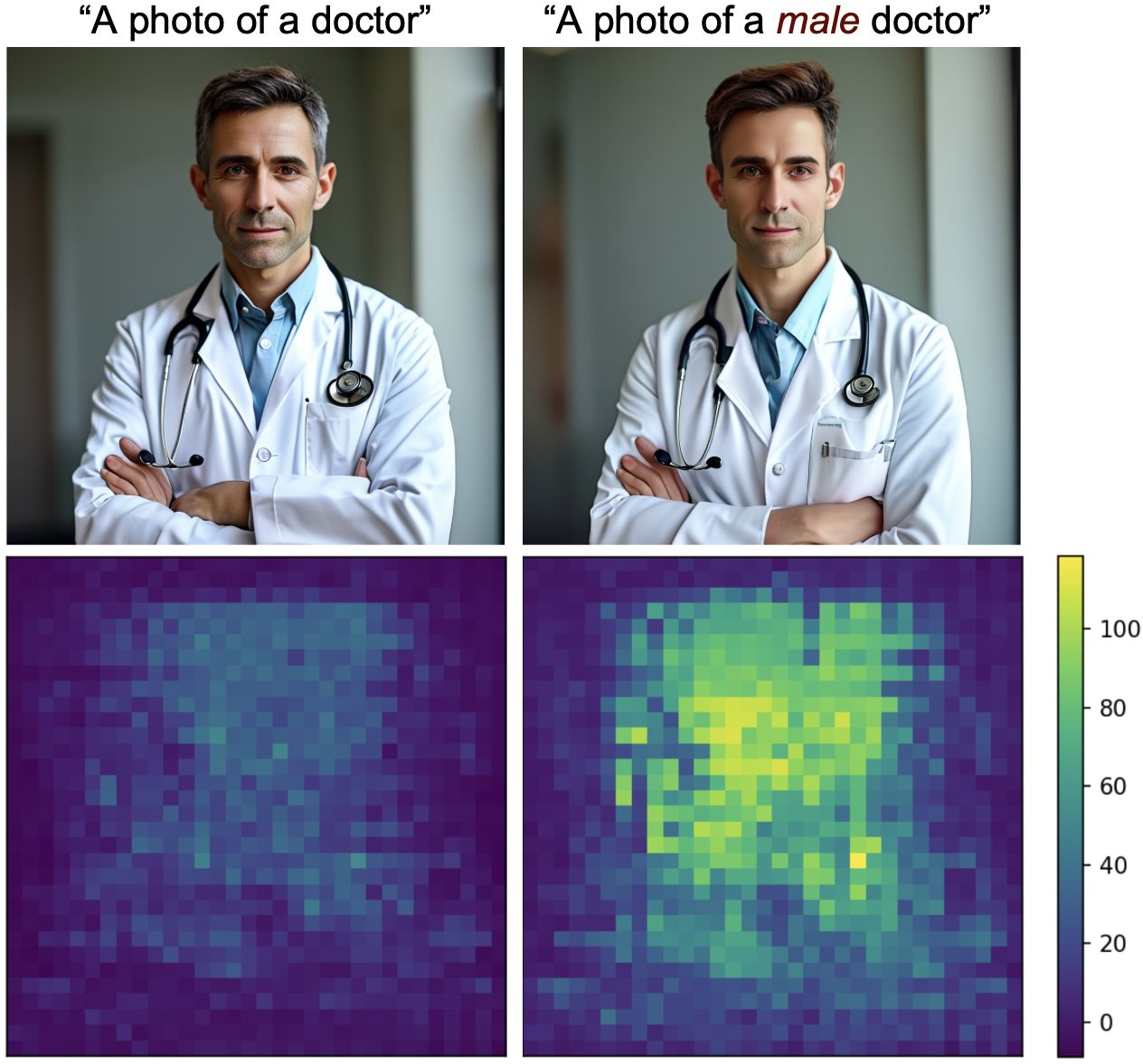
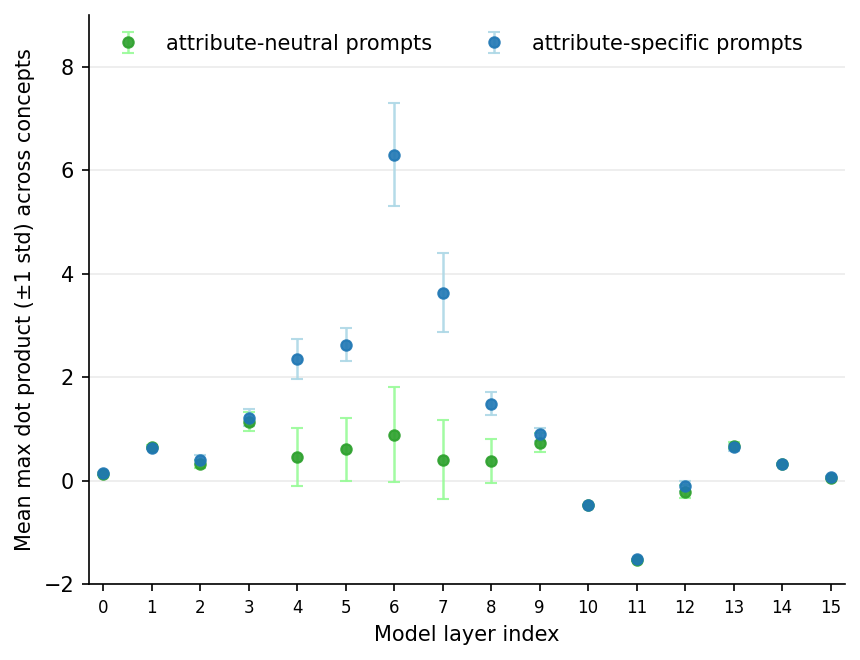
Figure 1: Example generated images and corresponding dot-product heatmaps (SANA) highlight the separation of attribute-neutral and attribute-specific prompt responses, justifying the gating signal.
- Attribute Signal Removal and Injection: For attribute-neutral prompts, the CA output is first orthogonalized with respect to all attribute steering vectors, ensuring removal of any latent attribute signal. The target attribute is then injected with calibrated strength, derived to match the observed activation magnitude on explicit prompts for the same attribute.
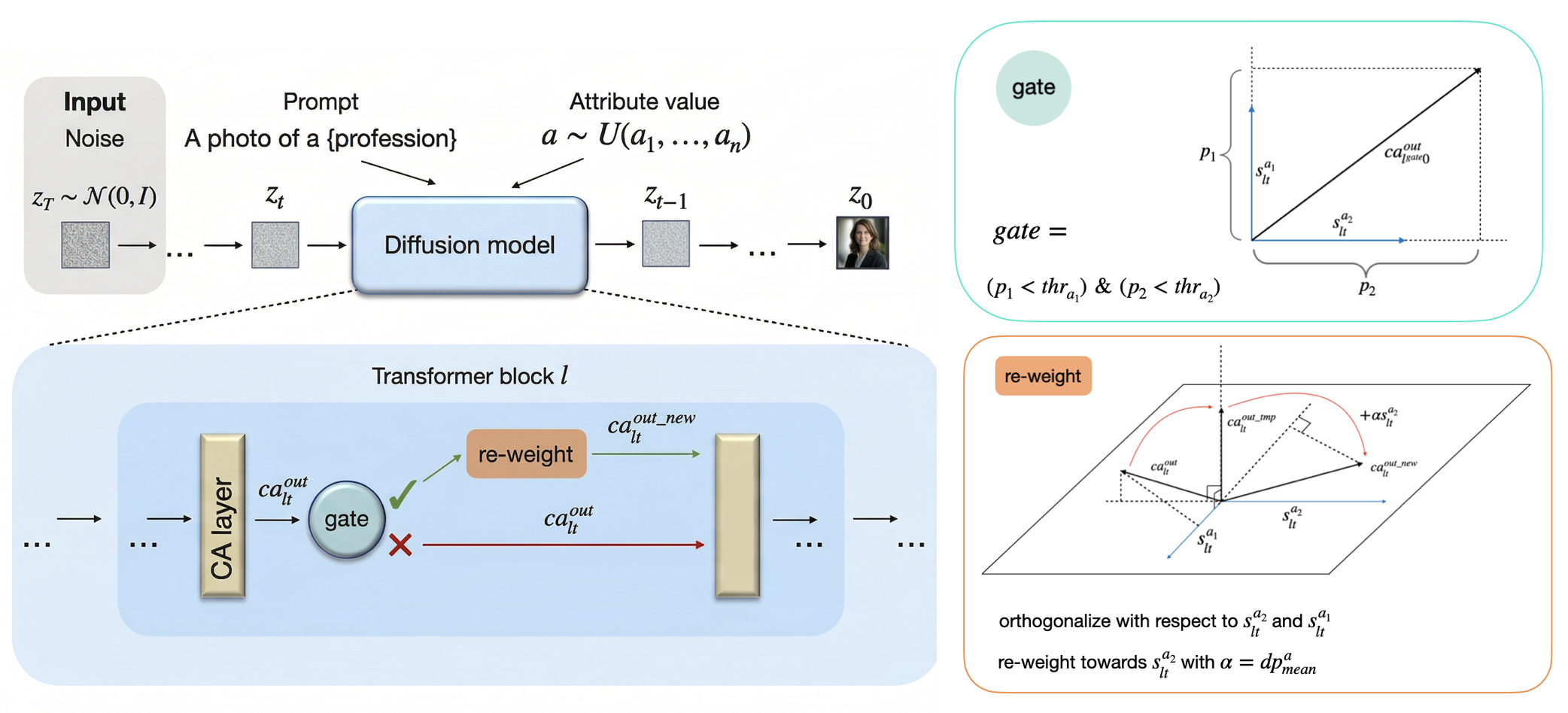
Figure 2: EquiSteer’s three-stage process: gated detection, attribute subspace orthogonalization, and adaptive re-injection at each denoising layer.
- Quality and Stability Measures: All updates are accompanied by CA output norm preservation, with the entire mechanism executed only once per generation, imposing negligible computational overhead relative to the overall denoising process.
Notably, EquiSteer neither requires model retraining nor modulates the prompt or token embeddings—it manipulates the model’s internal semantic alignment with persistent efficacy across architectures.
Empirical Results
EquiSteer is benchmarked across four diffusion backbones (SD-1.5, SD-2.1, SDXL, SANA) and a suite of demographic concepts: gender (binary), race (5-way), age (3-way), body type (3-way), and the presence of eyeglasses (binary). The evaluation employs a CLIP-based classifier (or VQA-based for eyeglasses), with parity measured across diverse professional contexts known for strong occupational stereotypes.
Debiasing Gender
On the canonical occupational prompts, EquiSteer consistently reduces the parity gap—defined as the mean absolute deviation of attribute proportions from the uniform target—by 73–87% compared to the vanilla model, outperforming all prior training-free debiasing baselines including TEI. There is no observed degradation in attribute recall for explicit prompts: attribute-specific generations remain at fidelity ∼1.0 across all models.


Figure 3: Generations for A photo of a nurse'' (SANA) andA photo of a CEO'' (SDXL): vanilla (top row), EquiSteer (bottom row); major reduction of gender bias is evident.
Cross-Architecture and Multi-Attribute Generalization
EquiSteer generalizes robustly to SDXL and SANA, reducing the gender parity gap from 0.381 to 0.075 and from 0.473 to 0.097, respectively. The method delivers parallel performance gains on race, age, body type, and eyeglasses, with race parity gap reduced by up to 78%.


Figure 4: Race debiasing on SANA for "A photo of a librarian": vanilla (top row) vs. EquiSteer (bottom row), showing successful distribution across five attributes.
Simultaneous, multi-attribute debiasing (gender, race, age, body type) is also effective: EquiSteer yields uniform attribute distributions in all tracked categories in a single pass.
Fairness-Quality Trade-off
Text-image alignment (CLIPScore) and overall sample realism (CMMD) either remain stable or slightly improve under EquiSteer interventions. There is no measurable degradation in alignment or visual quality across all tested settings.
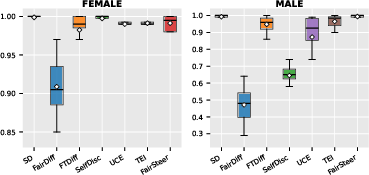
Figure 5: Top – Attribute preservation for attribute-specified prompts remains optimal under EquiSteer. Bottom – Text-image alignment and fidelity metrics (CLIPScore, CMMD) indicate no loss in quality compared to vanilla and prior methods.
Prompt Transferability and Robustness
Debiasing efficacy is robust to extensive prompt variation, including paraphrased templates, longer contextual prompts, and multi-entity scenes, with gender parity gap reductions always above 48% and up to 89% for complex prompts.
Mechanistic and Empirical Analysis
Ablation studies indicate each core component—gating, attribute subspace orthogonalization, and adaptive-strength steering—is essential for optimal parity reduction and preservation of explicit prompt fidelity. Without gating, attribute-specific prompts are erroneously debiased; without orthogonalization, mixed-attribute artifacts arise.
The choice of CA layer for the gating statistic is critical. Automated analysis identifies early-to-mid CA blocks as reliably encoding attribute specificity across architectures. The statistical separability (AUROC ≥0.99 across attributes and backbones) guarantees high-confidence gating decisions.
Classifier calibration experiments (human, CLIP, VQA, and GPT-4o) further establish that EquiSteer's effect on true demographic parity is at least as large as measured by CLIP, with CLIP often underestimating the actual bias reduction.
Implications and Future Directions
Practically, EquiSteer provides a deployable, training- and data-free, per-sample intervention for reducing bias in text-to-image pipelines. Its architecture-agnostic mechanism suits both open and closed-source distributional models, facilitating fairness improvements even in the absence of model weights or access to retraining.
Theoretically, these results demonstrate the functional decoupling between explicit prompt intent and model-internal attribute signals. The explicit steerability of demographic attributes within CA layers raises significant questions for future mechanistic transparency and the design of broader semantic controls, both for mitigation and targeted concept manipulation. Additionally, as EquiSteer operates at the level of CA-layer group directions, its basic methodology is extensible to any attribute with persistent latent representation, subject to development of appropriate prompt-contrast pairs and classifier support.
Key limitations persist: the gating mechanism, while robust, does not yet localize in multi-entity prompts, meaning per-entity debiasing remains unsolved. Sampling overhead, though modest, could challenge ultra-low-latency use cases. Moreover, successful extension to low-prevalence or less salient social attributes is an open research direction.
Conclusion
EquiSteer establishes cross-attention activation steering as a high-precision, deployable, and quality-preserving mechanism for fairness control in text-to-image diffusion models. It consistently outperforms all prior training-free debiasing approaches both in parity gap reduction and in preserving explicit prompt-specified attributes. The demonstrated generalizability across models, attributes, and prompt structures positions EquiSteer as a practical baseline for future research into inference-time fairness interventions in generative image synthesis.

