- The paper introduces a dual-constrained latent diffusion model that jointly decodes 3D molecular structures and synthesis pathways conditioned on pharmacophore profiles.
- It employs a VAE-based encoder with transformer decoders ensuring geometric fidelity and valid, multi-step synthesis route generation.
- Experimental results show competitive hit rates, robust pharmacophore alignment, and enhanced synthesis efficiency compared to traditional methods.
SynLaD: Latent Diffusion for Synthesizable Molecule Generation Conditioned on 3D Pharmacophore Profiles
The SynLaD framework establishes a dual-constrained generative paradigm for molecular design, explicitly coupling 3D pharmacophore feature alignment with synthetic tractability within a single unified latent representation. Traditional ligand-based drug design (LBDD) leverages known bioactive scaffolds by optimizing 3D pharmacophore similarity, while state-of-the-art generative models typically address either ligand feature mimicry or synthetic accessibility, but seldom both. Previous models achieve 3D-conditioned generative output with weak or absent synthetic route guarantees, or else complete serializations of realistic reactions with insufficient geometric fidelity. The primary objective of SynLaD is to reconcile these competing desiderata by constructing a latent diffusion model that decodes simultaneously into 3D atomic coordinates and explicit, multi-step synthesis pathways, both conditioned on pharmacophore representations.
SynLaD Model Architecture
SynLaD is a two-stage conditional latent diffusion model. At its core is a VAE-based encoder trained jointly with two decoder heads: one reconstructs atom types and atomic coordinates (geometric/3D head), and the other generates serialized synthesis plans (autoregressive synthesis head) as reaction graph sequences.
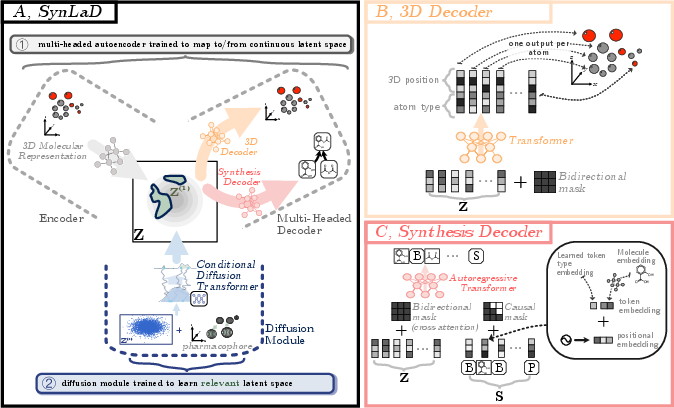
Figure 1: Overview of SynLaD architecture, illustrating the joint latent representation decoded into both 3D molecular geometry and reaction-based synthesis sequences.
Stage one trains the joint latent representation to be maximally informative for both molecular structure and synthetic pathway reconstruction. The geometric head uses a bidirectional transformer to decode per-atom features, ensuring equivariance to molecular symmetry and translational invariance via random rotation augmentation. The synthesis decoder is an autoregressive transformer that outputs molecular building blocks and reaction steps in a DAG-serialized language, using beam search optimized on cross-entropy over next-token prediction.
Stage two applies a conditional diffusion transformer (DiT) trained by flow matching, which samples from the learned latent space in a manner explicitly conditioned on pharmacophore embeddings. This process leverages classifier-free guidance and self-conditioning to yield detailed, pharmacophore-specific generations. Notably, the pharmacophore input is processed through a dedicated transformer, encoding both interaction types and precise 3D coordinates.
Synthesis Plan Representation and Inference
Synthesis plans are represented as serialized token sequences encoding building block selection, reaction application, and product tracking in a bottom-up graph format. At inference, the synthesis decoder's ability to produce valid synthetic routes is decoupled from target-specific reaction templates, employing a transformer-based reaction oracle (built on BART) to infer reaction products given reactants, thus eliminating template-induced combinatorial bottlenecks and enhancing generalization.
Experimental Protocols and Evaluation Metrics
Empirical validation of SynLaD is performed using a curated subset of the USPTO reactions corpus, filtered for products of 10–40 heavy atoms and supporting multi-step synthesis chains. The evaluation comprises unconditional generation, pharmacophore-conditioned generation, and out-of-distribution (OOD) diversification from bioactive ligands (using Lit-PCBA benchmarks).
Key metrics include:
- Validity (percentage of RDKit-processable molecules),
- Internal diversity (1 - mean pairwise Tanimoto similarity),
- Uniqueness and Murcko scaffold counts,
- Synthetic accessibility (AiZynthFinder and Ertl–Schuffenhauer SA score),
- PoseBusters for 3D conformation realism,
- ROCS Tanimoto shape/color and Tanimoto combo for 3D pharmacophore alignment,
- Hit criteria (TanimotoCombo≥1.2).
Results and Analysis
Joint Latent Space and Decoding Consistency
Latent representations reconstructed by the geometric and synthesis heads display high decodability (3D RMSD: 0.05 Å, atom type match rate: 98.5%, Table 1). Beam search yields an overview match of 63.4% to ground-truth sequences, reflecting strong coupling between modalities.
Cross-decoder analysis reveals that molecules decoded from the same latent by 3D and synthesis paths exhibit a scaffold match rate of 54.9% and substantial ROCS agreement, far exceeding random pairs. This demonstrates effective alignment of chemical and synthetic features in the shared latent.
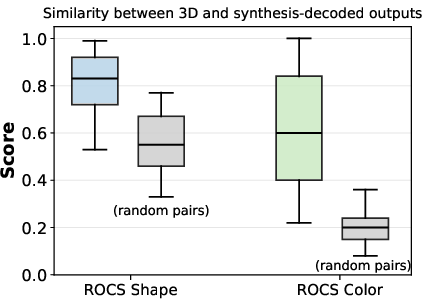
Figure 2: Cross-decoder agreement between 3D- and synthesis-decoded molecules from a common latent, showing high shape/feature similarity and scaffold consistency.
Pharmacophore-Conditioned Generation
On held-out pharmacophore profiles, SynLaD outperforms a brute-force screening baseline by an order of magnitude in sample count efficiency, producing a median of 29–37 hits per query with superior shape and color overlap scores. Synthesis decoder outputs display enhanced synthesizability (AiZynthFinder rate: 0.80) while maintaining competitive 3D alignment.
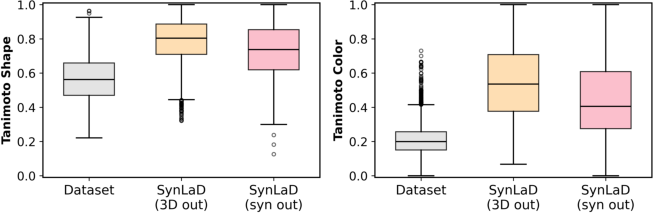
Figure 3: Distribution and median of ROCS shape and color similarities for pharmacophore-conditioned samples; SynLaD generates highly pharmacophore-aligned and synthesizable hits.
In a library screening proxy (67k molecules per query), SynLaD recovers more hits with only 1.6 GPU hours versus the baseline's 25 CPU hours (Table 2; Figure 4), demonstrating high amortized efficiency and tractable inference.
Hit Diversification and Out-of-Distribution Analogues
On the Lit-PCBA OOD bioactive set, SynLaD (synthesis decoder) achieves 17.9 hits/query and 6.9 unique scaffold hits per query, outperforming prior synthesis-constrained models (e.g., SynFormer, ShEPhERD) in both pharmacophore mimicry and synthesizability. The 3D decoder produces even more diverse analogues (38.1 hits/query), but with somewhat reduced validity, appropriate for applications prioritizing novelty.
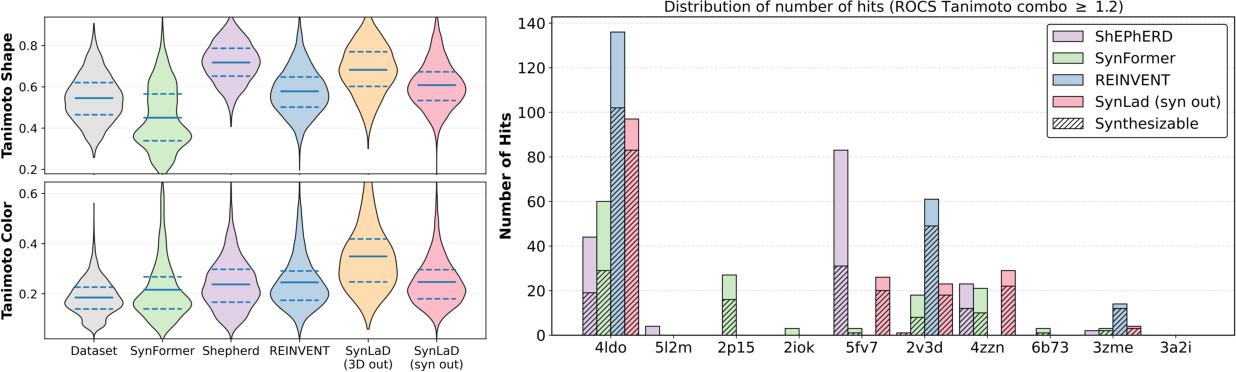
Figure 5: Comparison of Tanimoto shape/color similarity distributions and hit counts for SynLaD and baselines in the bioactive diversification benchmark.
Molecules generated by SynLaD, when docked, display high pharmacophore and shape overlap with target ligands, emphasizing the model's efficacy in practical lead optimization and scaffold-hopping tasks.
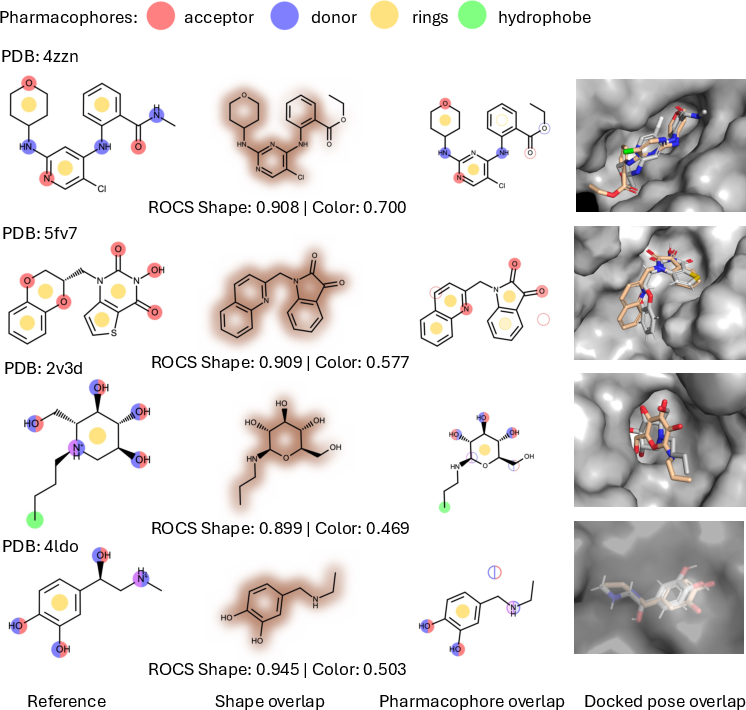
Figure 6: Example of generated analogue with annotated 3D pharmacophore and shape overlap, visually overlaid with the native bioactive ligand.
Theoretical and Practical Implications
SynLaD's explicit joint modeling of 3D molecular structure and reaction-based synthetic constraints in a unified latent leads to several unique advantages:
- All models in the comparison that do not perform joint 3D+synthetic latent diffusion show marked decreases in hit diversity, pharmacophore alignment, or route plausibility.
- The ablation removing the 3D diffusion module collapses to low-diversity generations and weak conditional control, underscoring the necessity of coupled multi-modal learning (Figures 13–15).
- SMILES-based latent models preserve some diversity but suffer loss in 3D-aligned performance.
Practically, because SynLaD's synthesis decoder tracks reaction networks independently of template enumeration, it extrapolates beyond pre-specified chemistry and supports diverse, novel chemical region discovery. This is crucial for de novo design, where synthesizability is non-negotiable for realistic medicinal chemistry scenarios.
Limitations and Outlook
The current approach remains sensitive to the accuracy of the reaction predictor oracle. Expansion to larger, chemically richer datasets (e.g., Pistachio) is expected to enhance model generalizability. Addressing cross-decoder disagreement and integrating contrastive or consistency-regularization objectives could further improve the expressivity and reliability of latent mappings.
Conclusion
SynLaD establishes a new standard for multi-objective, pharmacophore-guided de novo molecule generation by integrating latent diffusion over a dual-constrained representation that prioritizes both geometric (3D) alignment and synthetic feasibility. Across unconditional, conditional, and OOD settings, SynLaD yields highly valid, synthesizable, and 3D-aligned chemistries with superior sample diversity and amortized generation efficiency. This framework directly addresses the core problem of reconciling ligand-based design goals with practical synthesis limitations, and provides a foundation for further exploration of joint structure-retrosynthesis generative paradigms.
References to figures correspond to those in (2607.01105). For complete details, see (2607.01105).