- The paper shows that chiral nematic liquid crystals mediate inter-valley optical coupling, achieving robust room-temperature valley coherence in monolayer WSe₂.
- It details how aligned photonic bandgaps and CLC-induced spin-flip reflection generate a macroscopic linear polarization of about 30%, confirming experimental coherence.
- The study uses Maxwell-Bloch formalism and FDTD simulations to reveal a Purcell factor enhancement of approximately 20%, paving the way for scalable valleytronic applications.
Introduction
The realization of robust valley coherence in monolayer transition-metal dichalcogenides (TMDs) at room temperature remains a cornerstone for valleytronic and quantum photonic applications. Valley coherence, denoting a phase-coherent superposition of excitonic states at distinct momentum valleys (K and K′) in the Brillouin zone, enables the encoding and manipulation of quantum information in atomically thin semiconductors. However, ultrafast valley pseudospin dephasing, stemming from phonon scattering and disorder, typically limits coherence lifetimes to sub-picosecond scales except under cryogenic conditions or specialized photonic environments.
This paper demonstrates that a chiral nematic liquid crystal (CLC) substrate, exploiting intrinsic circular Bragg reflection and associated photonic spin–orbit interactions, can mediate inter-valley optical coupling in monolayer WSe₂. This architecture yields observable, strongly linearly polarized emission, evidencing inter-valley coherence at ambient conditions—a regime previously inaccessible without intricate nanophotonic structuring or cryogenic stabilization (2607.01098).
Device Construction, Spectral Characterization, and Selection Rules
Monolayer WSe₂ flakes were transferred onto planar glassy CLC substrates with tunable helical pitches and corresponding photonic bandgaps (PBGs) either spectrally aligned ("in") or misaligned ("out") with the WSe₂ photoluminescence (PL). The experimental scenarios included the CLC-in and CLC-out configurations, as well as a glass reference.
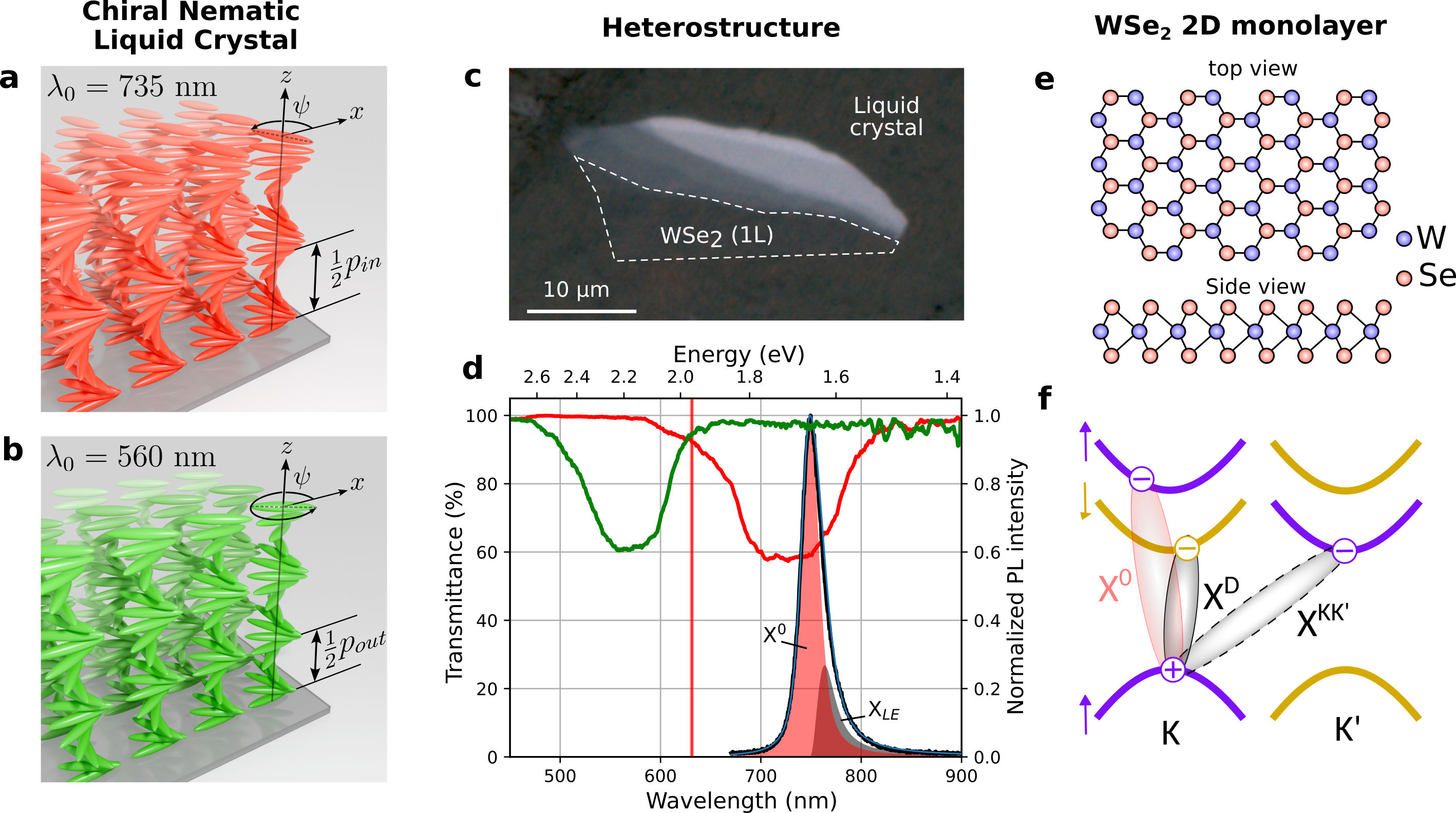
Figure 1: (a–b) Schematics of CLCs with PBGs at 735 nm and 560 nm; (c) micrograph of the heterostructure; (d) PL revealing bright and spin-dark excitons; (e) TMD chemical structure; (f) electronic structure and excitonic states.
The relevant circular dichroism in TMDs derives from optical selection rules: recombination of K (K′) valley excitons yields right-handed (left-handed) circularly polarized photons. CLCs, with their selective Bragg reflectance, operate as distributed chiral mirrors—flipping the photon spin angular momentum, and thus reversing the valley character for re-injected photons. This mechanism forms the essential basis for optical valley coupling.
Circular Polarization and Photonic Valley Selection
Circularly polarized PL was measured across the reference, out-of-bandgap, and in-bandgap photonic environments. While both the glass and "out" configurations displayed symmetric σ± emission spectra with negligible circular dichroism, the spectral overlap of the CLC PBG with the excitonic emission in the "in" configuration resulted in a pronounced degree of circular polarization (DoCP≈0.2).
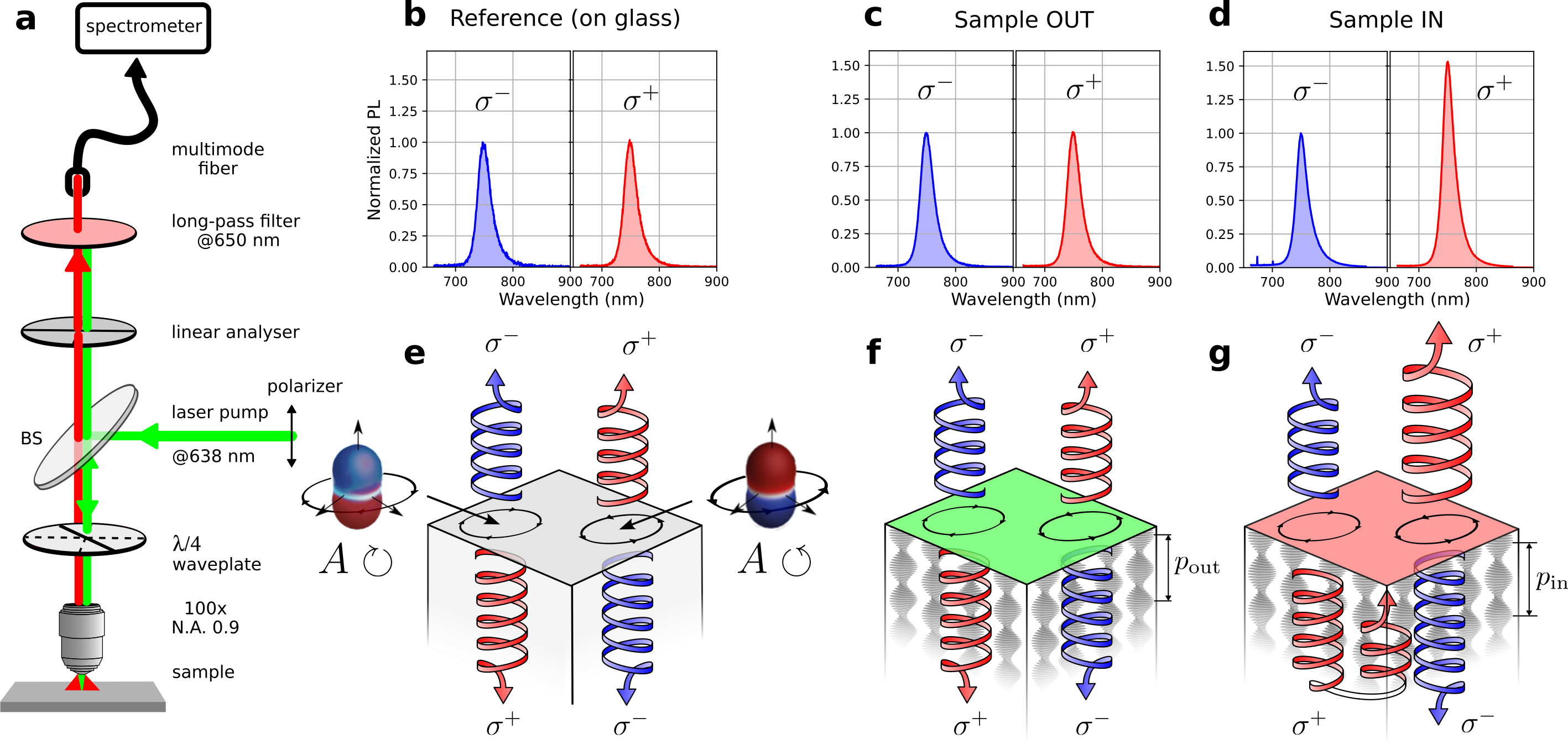
Figure 2: (a) Circularly polarized PL setup; (b–d) experimental PL for glass, out-of-gap CLC, and in-gap CLC configurations; (e–g) schematic emission patterns and chiral interface interactions.
This circular dichroism arises from the CLC's Bragg reflection, which preferentially reflects light of a specific helicity with a spin-flip, enhancing the left-handed emission in the upward (detected) direction when the PBG and excitonic transitions overlap.
Experimental Observation of Inter-Valley Coherence
Linear polarization-resolved PL established the emergence of a finite, robust linear polarization component (≈30%) exclusively in the “in” CLC configuration—unequivocally signifying inter-valley coherence at room temperature. No intrinsic or trivial anisotropy-induced linear polarization was observed in either the glass or out-of-gap CLC control experiments.
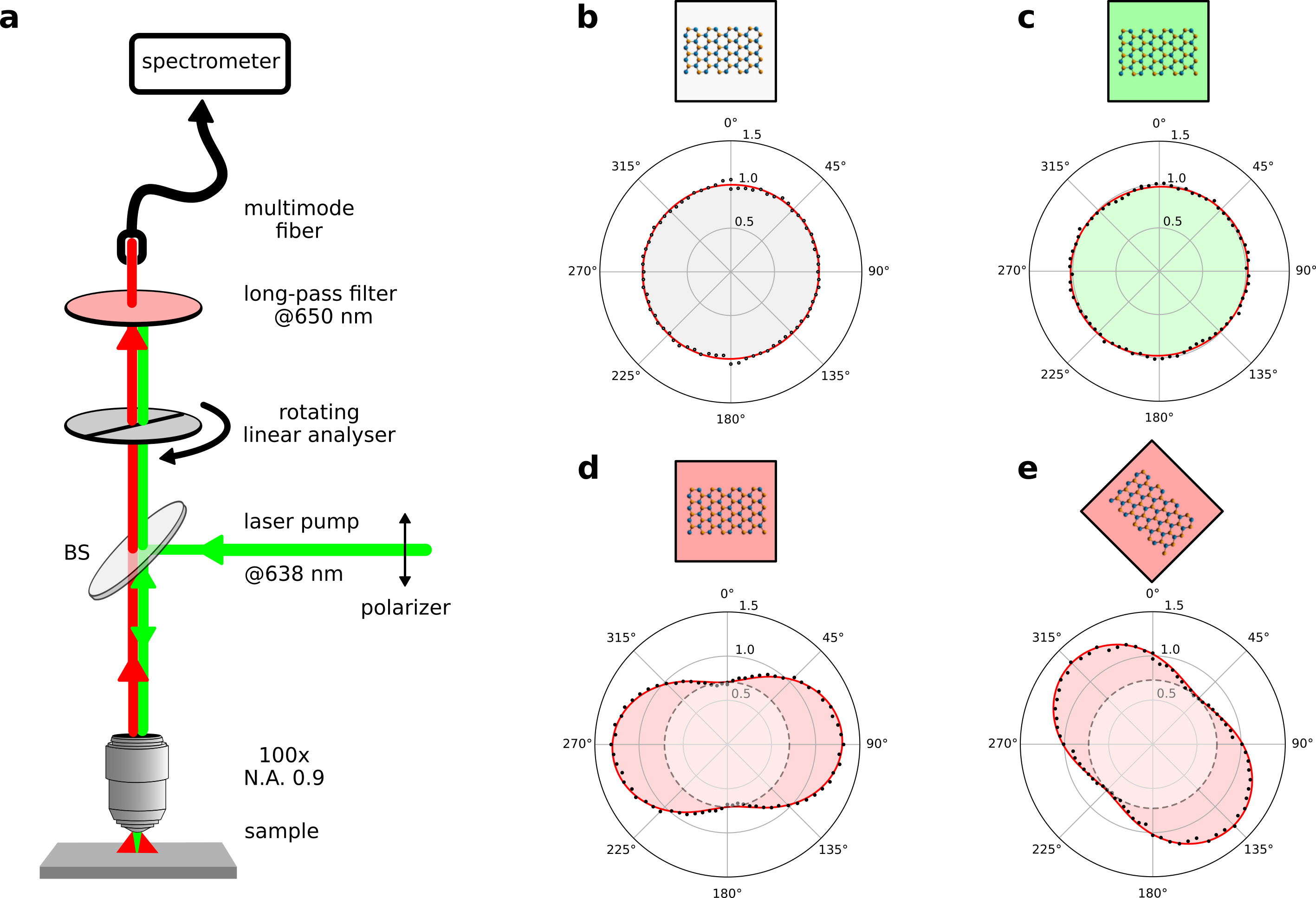
Figure 3: (a) Polarization-resolved PL setup; (b–e) substrate-dependent polar diagrams: only the in-gap CLC yields significant linear polarization aligned with the local CLC director and co-rotating upon sample rotation.
The orientation of the linear polarization directly follows the CLC director, confirming that the symmetry breaking enabling a macroscopic polarization axis is imposed extrinsically by the photonic environment, with no detectable intrinsic linear dichroism of WSe₂ itself.
Theoretical Model for Chiral Photonic Inter-Valley Coupling
The coupled Maxwell-Bloch formalism encapsulates the system: excitonic populations in K and K′ are dynamically linked via a unidirectional, spin–flip-mediated feedback from CLC-reflected photons. The feedback coupling parameter β, proportional to the photonic spin-flip reflection efficiency, must exceed the excitonic dephasing rate γϕ for phase-coherent superpositions to emerge. FDTD simulations of the electromagnetic response fine-tuned estimates of β: the photon spin–flip feedback occurs with delay times (∼5 fs) two orders of magnitude shorter than the typical WSe₂ excitonic coherence time, satisfying β≫γϕ.
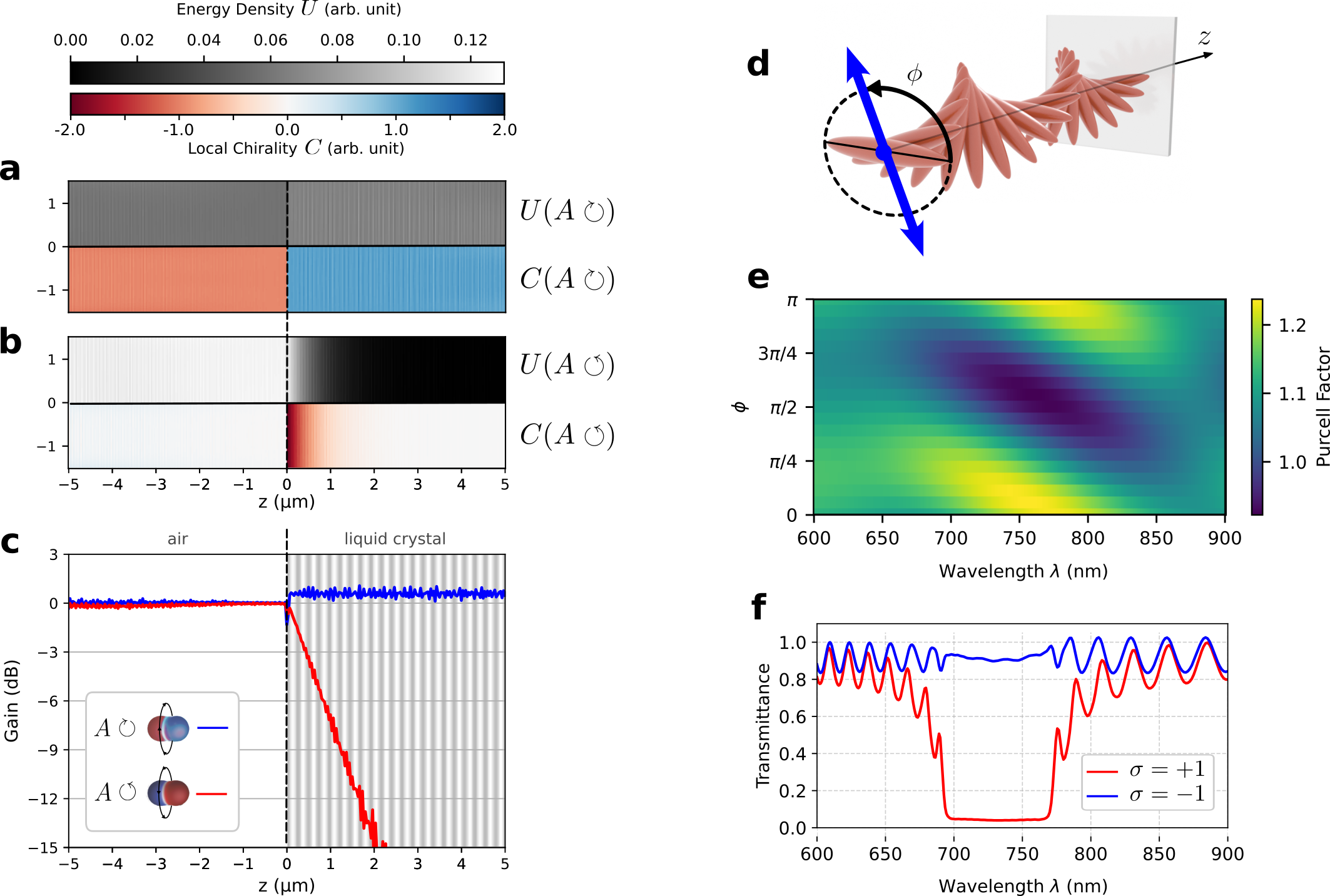
Figure 4: (a–b) FDTD simulation of energy density and chirality for right- and left-circular dipoles at the interface; (c) energy density decay into the CLC; (d) interface dipole schematic; (e) angle/wavelength-dependent LDOS; (f) transmittance spectra for circular polarizations.
This efficient, cavity-free feedback preserves phase and polarization, establishing coherent valley superpositions. Crucially, LDOS calculations revealed a Purcell factor anisotropy (∼20% enhancement) tied to the dipole orientation relative to the CLC director, explaining the observed macroscopic alignment of the linear polarization axis.
Implications and Outlook
The CLC-mediated platform provides a scalable, nanofabrication-free pathway for engineering photonic valley coupling at ambient temperatures. It demonstrates that mirrorless, chiral photonic feedback is sufficient for dynamical phase-locking of TMD valley excitons, yielding coherently polarized emission controlled by the CLC axis.
Practically, this inherently robust effect can be extended to dynamic control by leveraging the solid-to-liquid crystalline phase transition of CLCs, whose PBG is tunable via electric fields, temperature, or other external stimuli. This suggests future prospects for electrically switchable, room-temperature valleytronic emitters and heterostructures with dynamically reconfigurable opto-valleytronic properties. Moreover, the demonstration of chiral near-field engineering provides a blueprint for integrating topological and nonreciprocal photonic effects into atomically thin semiconductor technologies.
Conclusion
This work establishes that chiral nematic liquid crystals enable and control room-temperature valley coherence in monolayer WSe₂ through unidirectional spin–flip optical feedback, without the need for nanostructured photonic cavities. The approach is inherently scalable, tolerant to geometric and fabrication imperfections, and immediately compatible with large-area 2D optoelectronic platforms. These findings open new fundamental and technological avenues in the design of chiral, topological, and valley-coherent quantum photonic devices operating at ambient conditions (2607.01098).