- The paper introduces ROSA, which centralizes robotics foundation model serving to enhance GPU utilization and throughput in heterogeneous robot fleets.
- It leverages a robotics-aware API and advanced scheduling algorithms to balance safety, performance, and economic priorities in factory environments.
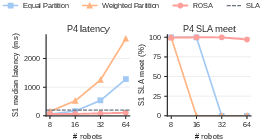
- ROSA demonstrates up to 12.06× productivity gains and 99.96% SLO compliance through profiling-guided batching and optimized resource allocation.
ROSA: A Robotics Foundation Model Serving System for Robot Factories
Motivation and Problem Context
The growing sophistication of robotics foundation models (RFMs)—notably vision-language-action (VLA), planning, safety, and monitoring models—has catalyzed the practical deployment of general-purpose robots in industrial settings, such as manufacturing and warehousing. However, the traditional paradigm for model inference in robotics treats serving as a per-robot edge problem, tightly coupling each robot to a dedicated accelerator. This leads to suboptimal GPU utilization, limited scalability, and higher operational costs, especially when robot fleets are confronted with heterogeneous, multi-model inference pipelines and stringent per-task service-level objectives (SLOs).
The paper presents ROSA (Robotics Oriented Serving Architecture), a system designed to address these challenges by reformulating RFM serving as a centralized, factory-scale problem. ROSA rejects the conventional focus on minimizing latency for individual robotic actions, instead optimizing for factory-level productivity—action throughput weighted by task value—subject to diverse SLOs and resilience to failures.
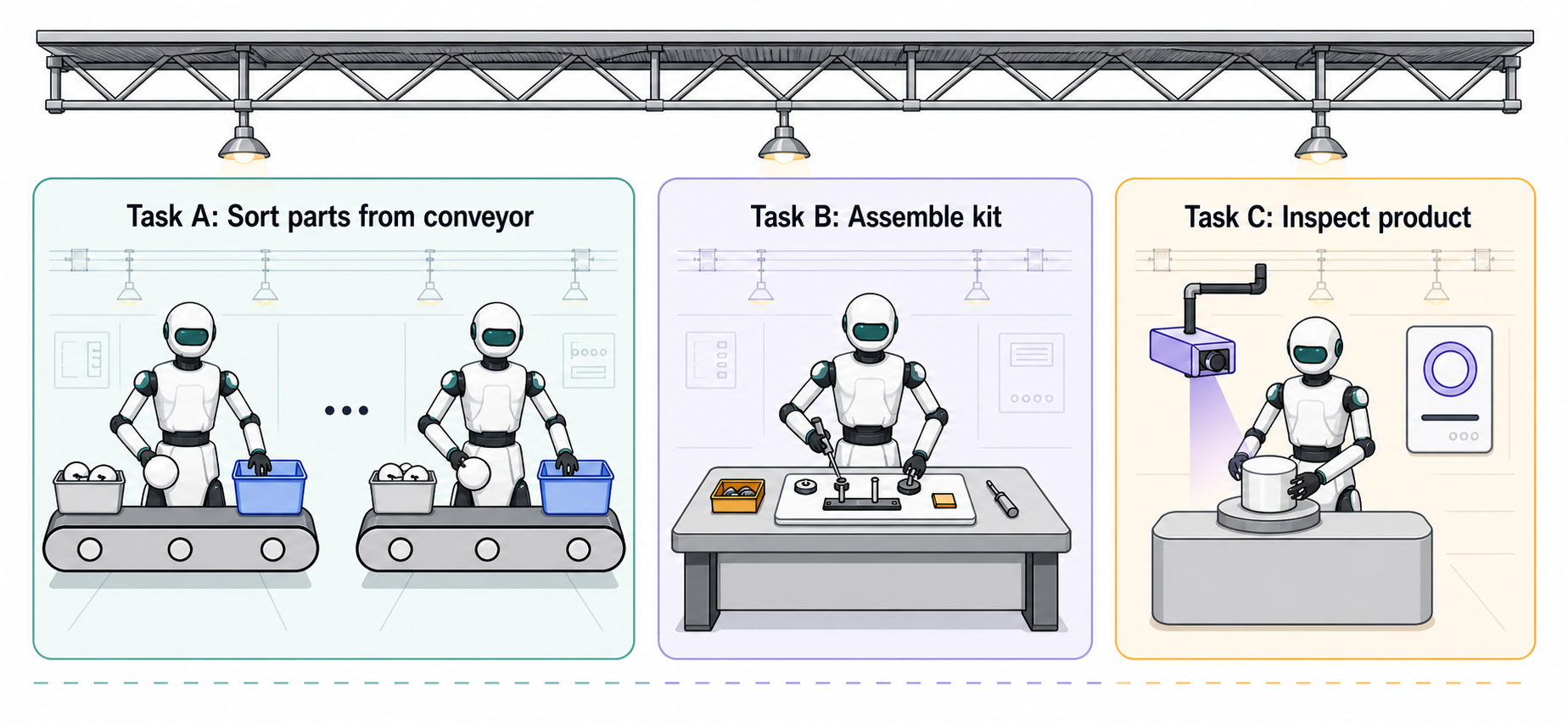
Figure 1: Robots working on various tasks in a factory.
System Architecture and Design Principles
ROSA is constructed around three critical principles:
- Shared GPU-Pool Serving Infrastructure: Instead of one-to-one robot-to-GPU mapping, ROSA consolidates compute in centralized GPU clusters, accessible via high-speed networking. This enables large-scale inter-robot batching, improved GPU utilization, and facilitates serving RFMs that exceed the capacity of traditional edge compute.
- Robotics-Aware Programming Abstraction: The declarative configuration API captures heterogeneous task profiles, specifying the composition of model components (action, reasoning, safety, monitor), invocation frequencies, latency targets, and explicit fallback and retry behaviors in case of SLO or safety violations.
- Factory-Objective-Driven Scheduling: The scheduler's objective is weighted factory action throughput, not individual latency minimization. It combines heuristics and integer linear programming (ILP) to maximize the number of SLO-compliant robot actions across the fleet, balancing throughput among tasks of varying economic priority and hardware requirements.
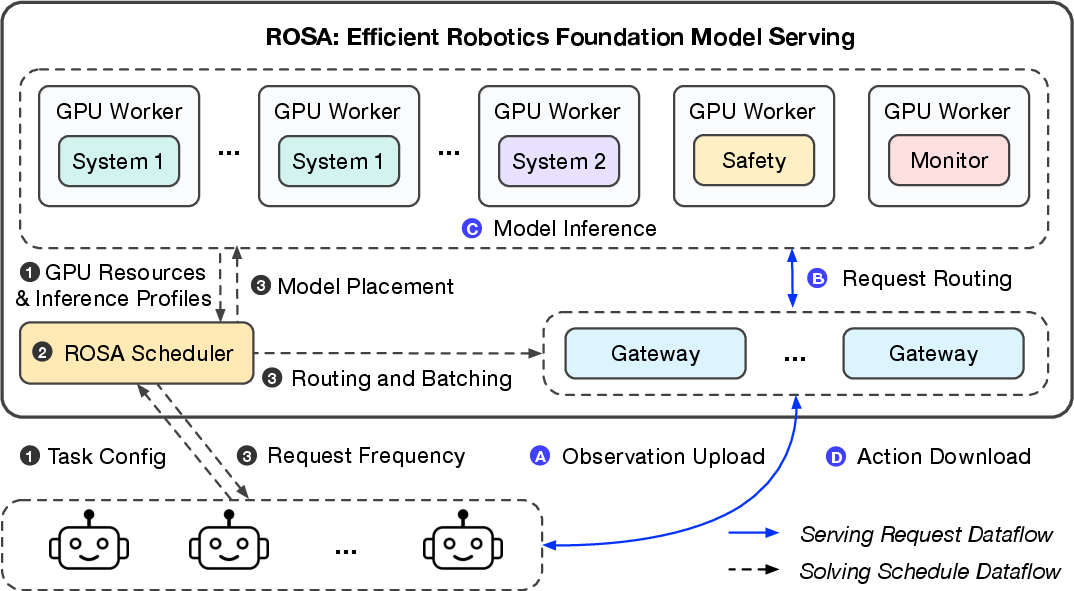
Figure 2: ROSA system overview.
Multi-Component Model Pipelines
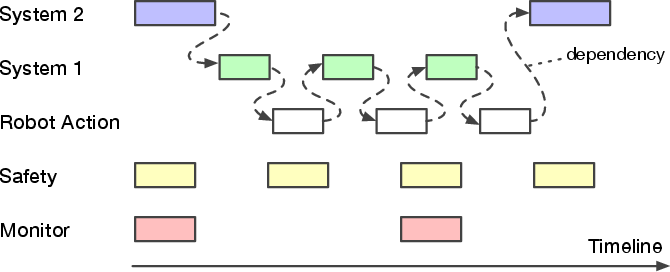
ROSA is engineered for multi-model inference pipelines, typical in modern robotics deployments:
The configuration abstraction enables explicit specification of differing frequencies and SLOs for each component, capturing the requirements for highly orchestrated, robust robotic operations.
Scheduling Algorithms
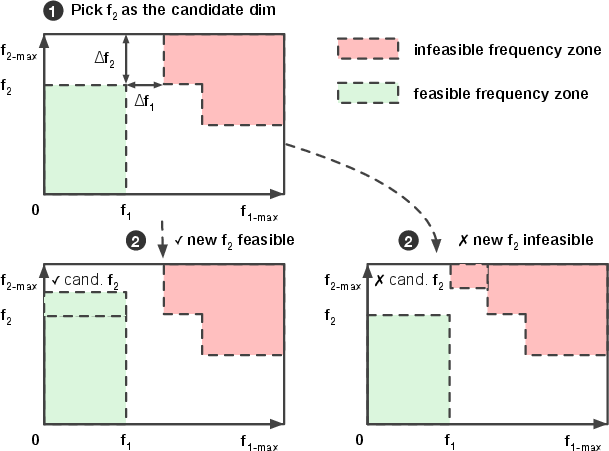
The core scheduling challenge is to partition servers, determine batching strategies, and route requests so as to maximize SLO-qualified action throughput for both homogeneous and heterogeneous fleets. Key features include:
Experimental Evaluation
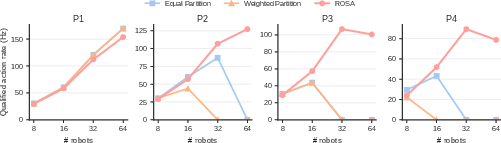
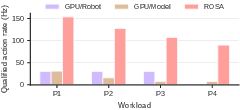
ROSA is evaluated using both real Franka Panda robot deployment and large-scale synthetic workloads, stressing the system with up to 64 virtual robots across 8 NVIDIA H200 GPUs.
Factory Productivity
ROSA achieves strong, robust improvements over dedicated and naively-shared baselines:
Heterogeneous Task Scheduling
For scenarios with mixed task pipelines, ROSA's scheduling further outpaces baselines due to superior cross-task resource allocation.
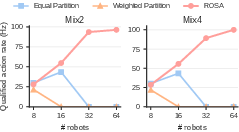
Figure 7: Heterogeneous-task end-to-end performance.
Ablation and Scheduling Insights
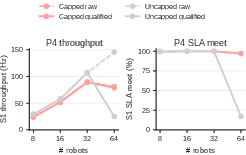
Experimental ablation underscores the importance of each scheduling component:
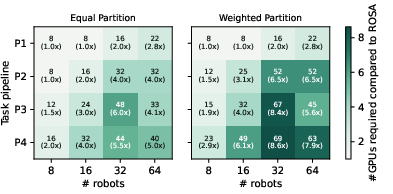
Figure 9: Effect of request-rate control on P4.
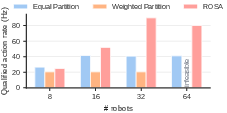
Figure 10: Performance of different resource allocations on P4.
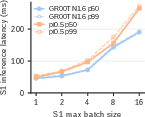
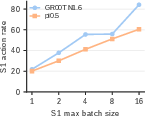
Figure 11: System 1 performance under different batch sizes.
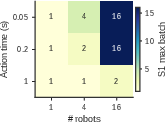
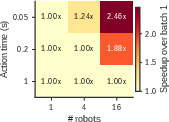
Figure 12: System 1 batching decision: the optimal batch sizes in various configurations and their speedup over batch size one.
Real-Robot Validation
ROSA is demonstrated in real-world operation, orchestrating a Franka Panda arm through complex pick-and-place tasks with active progress monitoring and safety detection via VLM subcomponents.

Figure 13: Real-robot execution trace: the action model drives a Franka Panda arm to place tools into a bucket.
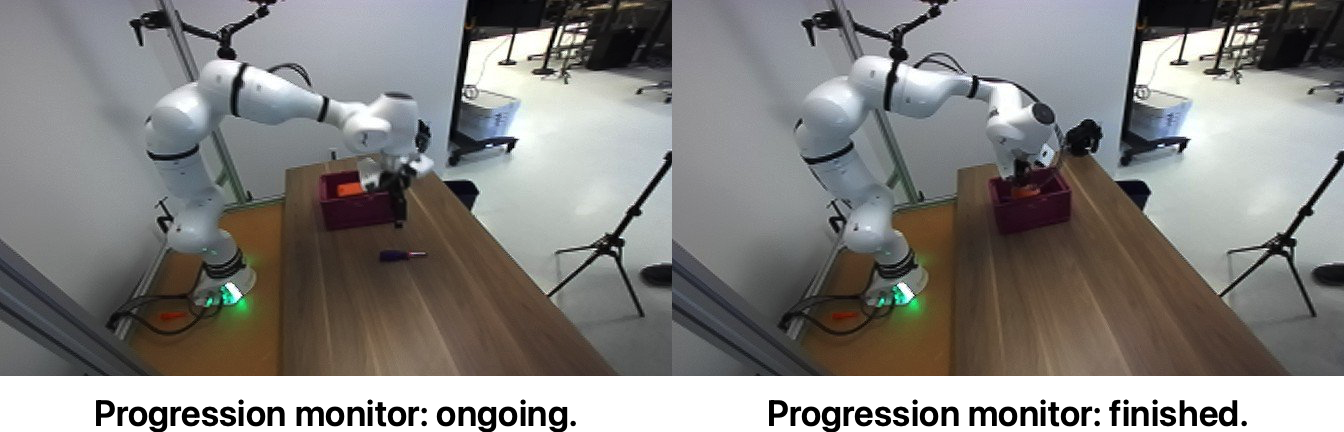
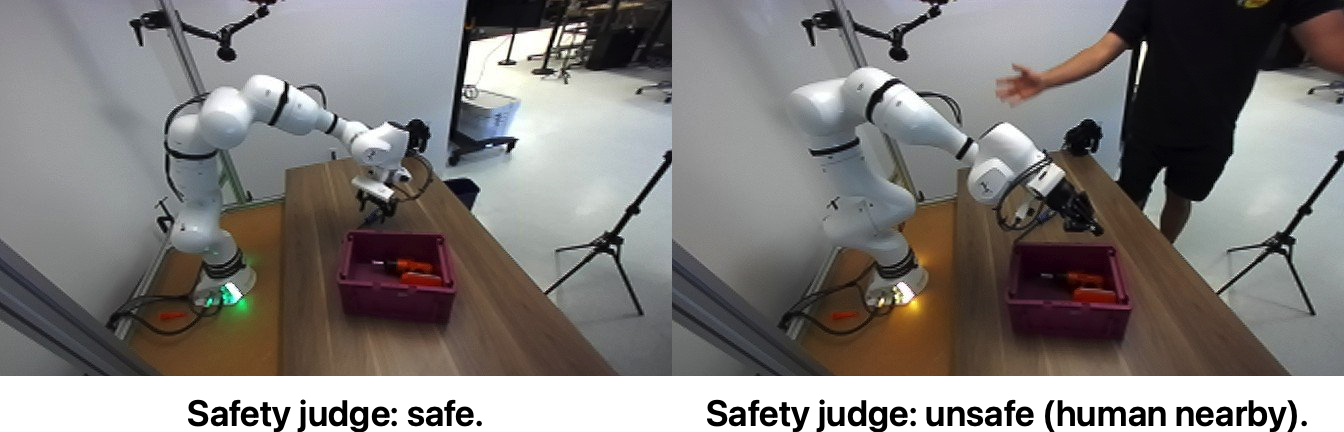
Figure 14: VLM judges for monitoring task completion (left) and detecting nearby humans for safe operation (right).
Practical and Theoretical Implications
ROSA's approach imposes a new systemic abstraction for embodied AI deployment in industrial robotics: shifting the serving bottleneck from individual inference latency to global resource coordination in a pooled architecture. This unlocks practical scalability, improved economic efficiency (via shared hardware), and extensibility toward future, rapidly-evolving RFM architectures. The formulation of serving as an SLO-qualified throughput maximization under constraints is general and can be directly ported to other real-time, multi-agent embodied AI domains.
Theoretically, ROSA demonstrates that judicious orchestration of model composition, batching, and request rate—grounded in accurate, profiling-driven scheduling—enables resource pools to serve large robot fleets with complex, heterogeneous task structures at far higher efficiency than previously believed achievable under the one-robot/one-model/one-GPU conventions.
Future directions include more dynamic online adaptation to unpredictable workloads, tighter coupling between robot local control stacks and server-side inference for emergent behaviors, and feedback-driven learning to improve fallback and failure handling in closed-loop operation.
Conclusion
ROSA augments robot-factory deployments with a model-agnostic, server-scale RFM serving substrate, underpinned by robotics-aware abstractions and factory-level scheduling. This enables substantial productivity gains for large, heterogeneous robot fleets while robustly satisfying safety and latency constraints. As embodied AI continues to advance, the design principles and architectural strategies instantiated by ROSA offer a generalizable foundation for next-generation RFM serving solutions in complex, multi-agent, real-world environments.