- The paper introduces a unified framework that determines exact dimer ground states by deriving precise conditions on coupling parameters in spin chains and ladders.
- It utilizes pseudospin representations and a frustration-free operator approach to extend dimerization criteria to long-range, anisotropic, and bond-alternating models.
- Numerical validations via exact diagonalization confirm the analytical predictions, mapping robust dimer regions in various spin geometries.
Exact Dimer Ground States in Long-Range Spin Chains and Ladders
Introduction and Model Construction
The study presents a unified analytical framework for identifying precise regions in the parameter space of quantum spin chains and ladders where the ground state is an exact dimer product state. The models generalize canonical systems such as the Majumdar-Ghosh (MG) chain—where the ground state is a valence-bond solid formed by nearest-neighbor singlets (dimers)—to include arbitrary-range, bond-alternating, and anisotropic couplings. The general Hamiltonian considered takes the form
H=j=1∑Ln≥1∑L−1JnSj⋅Sj+n+KnSj⋅Sj+n
with Jn and Kn independently parameterizing couplings for the two sublattices/sites per unit cell. The models also encompass ladder-type geometries with couplings along rungs and legs.
The question is: for which values of {Jn,Kn} is the exact dimer state
∣D⟩=i=1⨂L/2∣di,i+1⟩
(where each ∣di,i+1⟩ is a two-spin singlet) the unique ground state?
A schematic of the general long-range chain and ladder geometries is shown below.
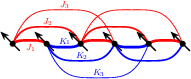
Figure 1: Structure of a J1--K1--J2--K2--Jn0--Jn1 chain with alternating even/odd-site couplings.
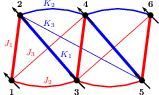
Figure 2: Corresponding ladder architecture, mapping to the same couplings as the chain.
Sufficient and Necessary Dimerization Criteria
The authors employ a two-step analytical approach:
- Eigenstate Condition: Using a pseudospin representation, they determine linear constraints on the couplings such that the product dimer state is an exact eigenstate. This generalizes the MG point Jn2 and extends to anisotropic and bond-alternating models.
- Semi-positivity and Ground State Verification: A crucial result is recasting the Hamiltonian (shifted by the exact dimer energy) as a non-negative sum of frustration-free operators (generalized "linear exchange models", LEMs). Explicitly, the ladder Hamiltonian is represented in terms of LEMs with coefficients Jn3 and Jn4 linear in the original coupling constants.
The sufficient conditions for the existence of a dimer ground state are:
- Jn5, Jn6, and Jn7, where Jn8 and Jn9 are specific combinations of the Kn0 and Kn1.
- These conditions, for the isotropic chain (Kn2), reduce to a convexity constraint and self-averaging relations on the Kn3.
Necessary conditions involve comparison with ferromagnetic states to rule out parameter regimes where the dimer state cannot be the ground state.
A geometric framework emerges: the set of dimer-stabilizing parameters forms a polytope (convex region) in coupling space, as visualized for both chain and ladder in the following figure.
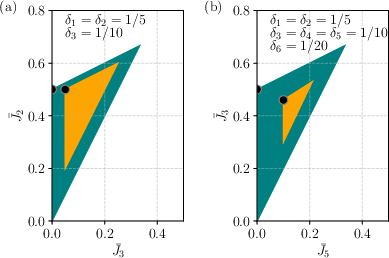
Figure 3: (a) Positivity polytope in Kn4 space for chain and ladder; (b) Dimerization region for Kn5--Kn6 models.
Anisotropy and Long-Range Interaction Generalization
An important extension explicitly treated is to XYZ- and XXZ-type anisotropies. Dimerization survives moderate anisotropy, provided the couplings' anisotropic components respect revised convexity/invariance conditions. For example, in the XXZ case, the minimal ratio for Kn7 guaranteeing semi-positivity is derived exactly as a function of the interaction range.
Critical lines for positivity of anisotropic LEMs are numerically calibrated for varying interaction ranges, showing the dimer region shrinks with increasing anisotropy or interaction length.
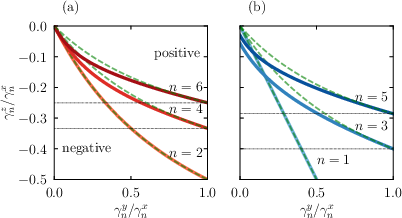
Figure 4: Critical lines in Kn8 parameter space for even/odd Kn9; shaded region supports dimer states.
Additionally, mapping the dimer region with respect to ground state energy and their evolution under anisotropy highlights the transition from dimerized to partially or fully polarized phases.
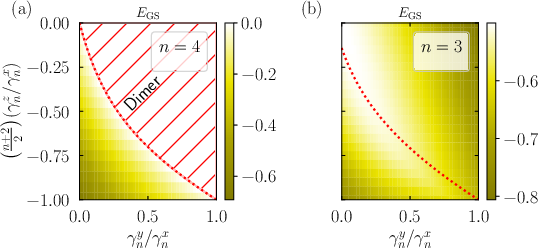
Figure 5: Ground state energy density and phase boundaries upon variation of anisotropy for {Jn,Kn}0 (left) and {Jn,Kn}1 (right).
Numerical Validation and Phase Diagrams
The analytic predictions are rigorously tested with exact diagonalization across multiple paradigmatic models:
- Extended MG Chains ({Jn,Kn}2--{Jn,Kn}3): The study confirms that exact dimerization persists over a convex set in {Jn,Kn}4 parameter space, broader than predicted by earlier sufficient-only criteria. It is also robust against moderate ferromagnetic longer-range couplings until the system polarizes.
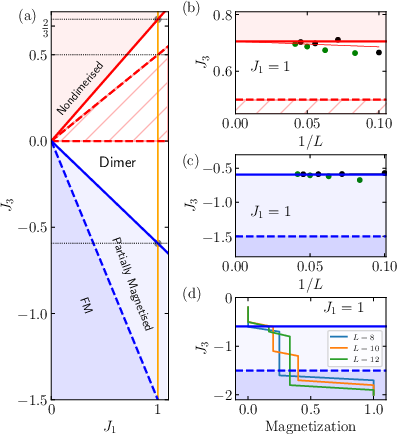
Figure 6: (a) Numerically determined dimer, polarized, and partially polarized phases for the {Jn,Kn}5--{Jn,Kn}6 chain. (b,c) Finite-size scaling, (d) Magnetization profiles.
- Anisotropic Chains: The region predicted by the generalized dimerization conditions is found strictly sufficient but not necessary; numerics reveal the dimer phase survives somewhat outside the analytically derived region.
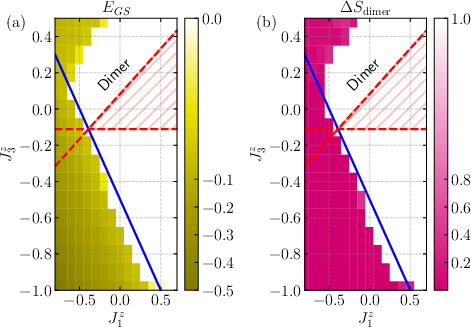
Figure 7: Phase diagram via ground state energy and dimer entropy for {Jn,Kn}7--{Jn,Kn}8 XXZ chain ({Jn,Kn}9), indicating both theoretical (dashed lines) and numerically determined (solid lines) boundaries.
- Ladders (∣D⟩=i=1⨂L/2∣di,i+1⟩0--∣D⟩=i=1⨂L/2∣di,i+1⟩1--∣D⟩=i=1⨂L/2∣di,i+1⟩2--∣D⟩=i=1⨂L/2∣di,i+1⟩3): Dimerized phases are analyzed for pronounced rung/leg alternation and their robustness under anisotropy and imposed spin flips.
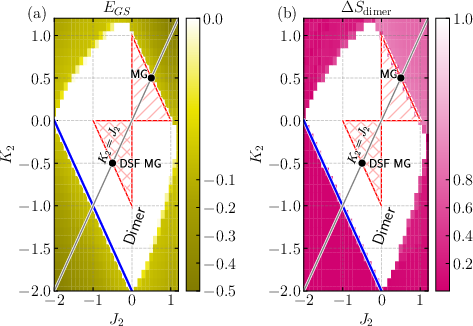
Figure 8: Phase diagrams of ∣D⟩=i=1⨂L/2∣di,i+1⟩4--∣D⟩=i=1⨂L/2∣di,i+1⟩5--∣D⟩=i=1⨂L/2∣di,i+1⟩6--∣D⟩=i=1⨂L/2∣di,i+1⟩7 ladder model for ground state energy (a) and dimer entropy (b).
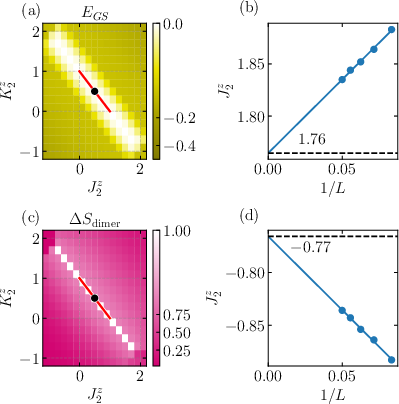
Figure 9: Dimerization region for anisotropic ∣D⟩=i=1⨂L/2∣di,i+1⟩8--∣D⟩=i=1⨂L/2∣di,i+1⟩9--∣di,i+1⟩0--∣di,i+1⟩1 ladders in (a) ground state energy and (b) dimer entropy.
- Long-Range Models: The Inozemtsev model (interpolating between Heisenberg and Haldane-Shastry limits) is shown not to possess a dimer ground state, but a related, "self-averaged" odd-coupling deformation can realize exact dimerization.
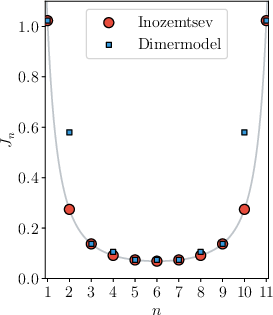
Figure 10: Comparison of Inozemtsev chain couplings and the corresponding dimer chain with enforced self-averaging for odd couplings.
- Triplet Dimer Ground States: The approach generalizes to triplet-product phases via local unitary rotations, as quantitatively evidenced by projection operator measurements.
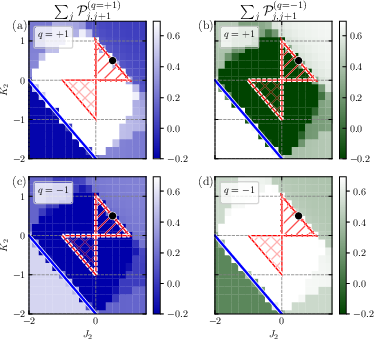
Figure 11: Operator expectation values for singlet and triplet projectors, demonstrating change in dimer structure upon phase rotation.
Implications and Perspectives
This work provides a comprehensive analytic characterization of parameter regions supporting exact dimer product ground states in complex low-dimensional quantum magnets, extending beyond previously known instances and encompassing long-range, bond-alternating, and anisotropic couplings. The identification of convex polytopes in coupling space realizing such phases establishes robust reference points for both theoretical phase diagram mapping and material exploration in spin-Peierls compounds, spin ladder systems, and designer quantum simulators.
Practically, dimer product states, especially singlet-based, are valuable for quantum information due to their rotational invariance, noise resilience, and potential for encoding decoherence-free subspaces. The conditions elaborated in this study aid the engineering of robust, gapped quantum magnets for these technologies.
Theoretically, the framework is extensible to higher-spin chains, more complex valence bond and finitely correlated states, and frustration-free constructions in search of exotic quantum order or quantum criticality. Future research should probe the excitation spectra and gap scaling at the boundaries of these dimerization polytopes, as well as the interplay with topological phases and symmetry-protected orders.
Conclusion
This paper unifies and generalizes the theory of exact dimerization in quantum spin chains and ladders, deriving and verifying explicit geometric conditions on couplings for dimer ground states via both analytic and numerical methods. The results substantially broaden the landscape of rigorously understood quantum magnetic ground states and provide a foundation for future investigations into quantum materials, simulator design, and entanglement structure in correlated spin systems (2607.01081).

