- The paper introduces an optimization procedure that selects symmetry measurements to minimize sample overhead for unbiased error estimates.
- It formalizes symmetry measurement selection as a constrained set cover problem to balance error suppression with noise and circuit complexity.
- Empirical results on GHZ state preparation and Fermi-Hubbard simulations demonstrate that PEC+QED significantly reduces total square error compared to traditional PEC.
Introduction and Framework
The paper "Optimizing Symmetry Informed Probabilistic Error Cancellation" (2607.01072) provides a formal analysis and empirical investigation of quantum error mitigation (QEM) strategies that combine probabilistic error cancellation (PEC) with quantum error detection (QED) leveraging circuit symmetries. These approaches are positioned as practically important for near-term quantum devices that lack fully fledged fault-tolerance, where reducing the exponential sampling overhead of standard QEM is essential.
The central contribution is the introduction of an optimization procedure that selects symmetry measurements to minimize the mitigation cost—quantified as the sample overhead required to achieve unbiased noise-free observable estimates. The methodology emphasizes the balance between the error suppression capabilities afforded by measuring more symmetries, the induced bias and variance from noisy symmetry measurements, and the increased circuit depth and complexity.
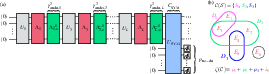
Figure 1: Schematic illustrating the PEC+QED protocol in multi-layer circuits, including the trade-offs in symmetry measurement choices and resulting sampling costs.
Background: PEC and Symmetry-Based QEM
PEC achieves unbiased estimation under well-characterized noise by inverting a stochastic noise model (typically, a sparse Pauli-Lindblad (SPL) model), with a sample cost that grows exponentially with system size and total error weight. QED, in contrast, enforces symmetry constraints (often associated with Pauli stabilizer relations), post-selecting circuit outcomes where no symmetry violation is detected. QED can only address errors that anti-commute with the set of measured symmetries. QED introduces bias in the presence of undetectable errors and residual noise from state preparation and measurement.
The composition of QED and PEC—denoted as PEC+QED—applies PEC only to the undetectable error channels, post-selecting on symmetry measurements, and thus efficiently exploits available symmetry. The paper argues that this hybrid approach reduces the variance of the estimator and the sampling overhead, compared to vanilla PEC, but only if the selection and scheduling of symmetry measurements is optimized to the specific circuit and hardware noise profile.
Symmetry Optimization as a Set Cover Problem
A core part of the paper is the formalization of symmetry measurement selection as an optimization problem. Symmetry measurements are identified with group generators (e.g., stabilizer generators), and each possible measurement detects a subset of errors. The minimization of the total mitigation cost—defined as the sum of the residual undetectable error weights and the explicit penalty for noisy or deep symmetry measurements—is mapped to a constrained set cover problem.
The optimization objective precisely incorporates (1) the exponential suppression of sampling overhead achieved by detecting error syndromes and (2) the cost associated with noisy symmetry measurements and possible circuit parallelism or idling. Under plausible noise models, the objective is submodular, thereby enabling efficient greedy and idling-aware search heuristics. The method generalizes to "deferred" symmetry measurement strategies that delay measurements to the end of the circuit when possible.
Numerical Results: GHZ State Preparation
The numerical experiments begin with the GHZ state preparation—a sensitive diagnostic for many-body entanglement and a stringent noise test. Two families of circuits are considered: linearly and logarithmically scaling CNOT-depth implementations. The effect of different symmetry verification strategies is analyzed, with an explicit search for stabilizers that minimize the PEC+QED overhead.
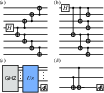
Figure 2: (a) Linear-depth and (b) logarithmic-depth GHZ state preparation for n=8 qubits, highlighting architectural differences relevant to error propagation.
Optimization results indicate that—contrary to naive expectations—selecting only standard local ZiZi+1 stabilizers does not generally yield a sampling advantage for PEC+QED unless the measurement noise contribution is carefully controlled; instead, non-local low-weight stabilizers (e.g., Z0Zn−1) are often optimal. The cost–benefit analysis depends crucially on the interplay of circuit structure, error cross-talk, and qubit idling.
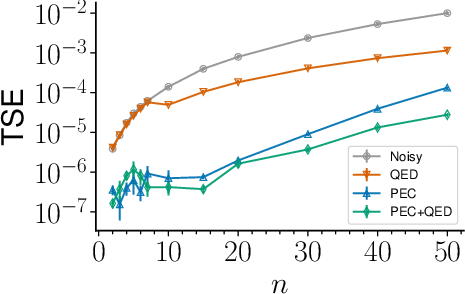
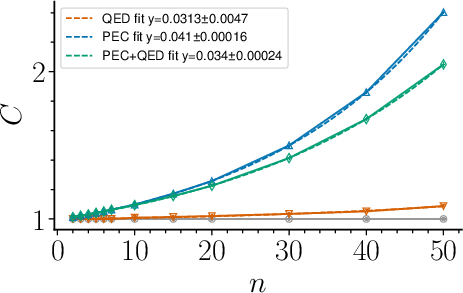
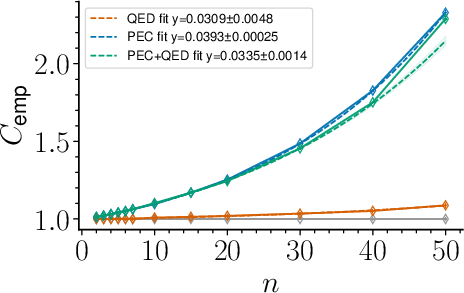
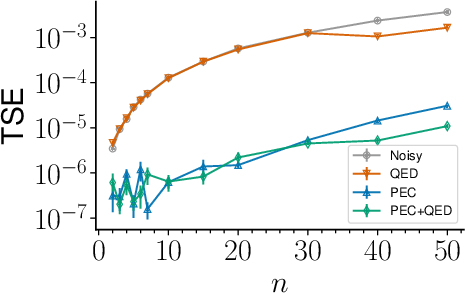
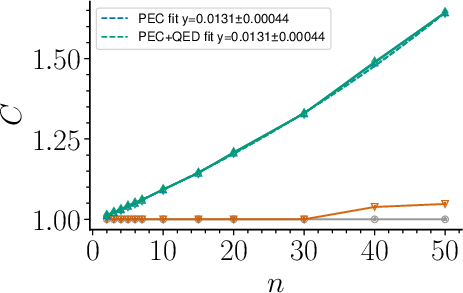
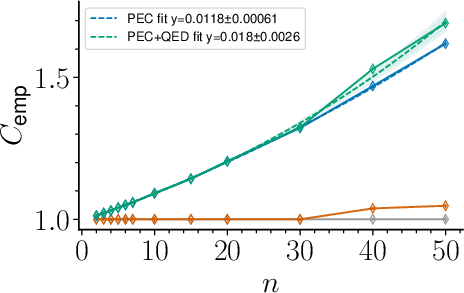
Figure 3: Mitigation performance for linear and logarithmic GHZ circuits: total square error (TSE) and effective sampling cost versus qubit count for Noisy, QED, PEC, and PEC+QED approaches.
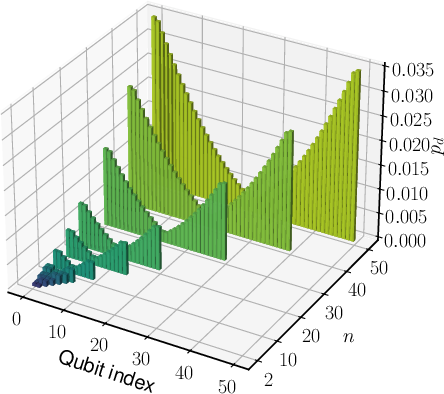
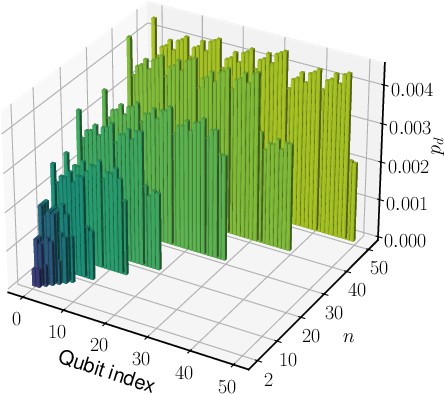
Figure 4: Distribution of detectable error probability across qubits after error propagation; "hotspot" concentration apparent in linear-depth circuits.
PEC+QED emerges as clearly advantageous for large n in linear-depth GHZ circuits, reducing the TSE by up to an order of magnitude compared to PEC. For logarithmic-depth circuits, the improvement is more modest and restricted to certain n due to the more uniform error propagation and reduced idling.
Application: Fermi-Hubbard Simulation with Error-Detecting Encoding
The authors further assess PEC+QED in the context of digital simulation of Fermi-Hubbard dynamics, employing a generalized superfast fermion-to-qubit encoding that naturally supports stabilizer-based QED.
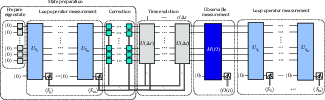
Figure 5: Circuit schematic for Fermi-Hubbard time evolution, including encoded state preparation, Trotterized evolution, and symmetry measurements.
Mitigation strategies were benchmarked across various observables, including multi-site correlators relevant for quantum phase characterization. Results for small 2×2 lattices show all error mitigation techniques dramatically outperforming the unmitigated baseline. However, PEC's variance increases steeply with circuit depth, and PEC+QED consistently achieves the lowest root mean square error across all observables and times, as the suppression of undetectable error channels through symmetry measurements delays the exponential variance blow-up.
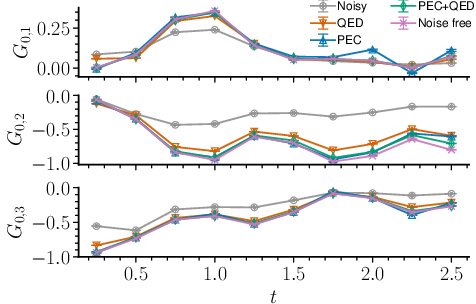
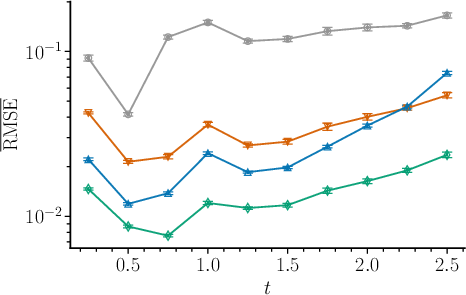
Figure 6: Comparison of two-point charge correlator mitigation; PEC+QED maintains accuracy at longer evolution times compared to QED or PEC alone.
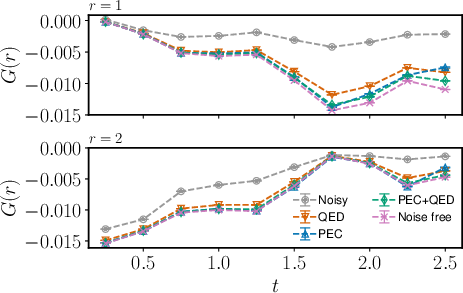
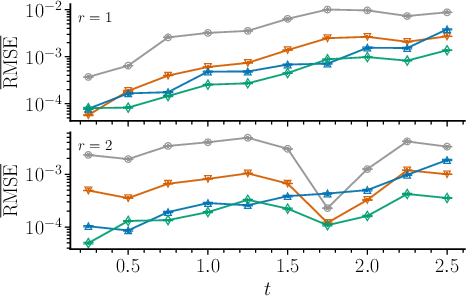
Figure 7: Radial charge correlator mitigation accuracy; again, PEC+QED achieves robust error suppression with increasing circuit depth.
Sampling overhead analysis as the system size grows reveals that optimized partial stabilizer measurement can further reduce the cost; for m=6 ($36$ qubits), overhead drops by around 27% versus the full-stabilizer approach.
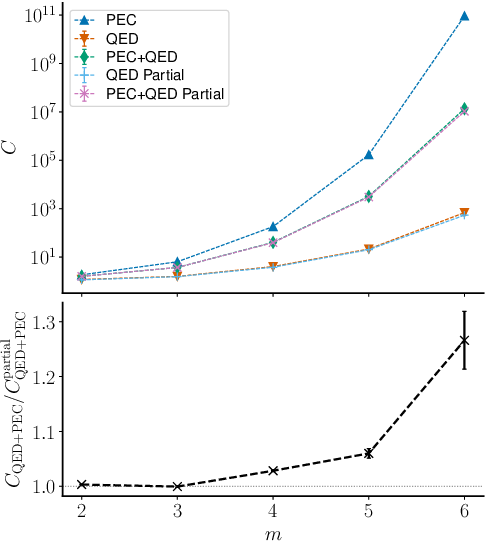
Figure 8: Scaling of sampling overhead for various mitigation strategies as a function of lattice size in Hubbard simulation, showing efficiency gains from partial symmetry measurements.
Theoretical and Practical Implications
The results present clear evidence that circuit-specific, symmetry-aware optimization is crucial for effectively reducing the exponential sample cost of error mitigation in large, noisy circuits. The optimal configuration frequently involves nonstandard subsets of symmetries, and the advantage grows with system size and circuit depth under representative noise models.
Critically, the methods presented are aligned with hardware constraints and experimentally validated PEC protocols, as the SPL model has been observed to capture realistic device error [bergProbabilisticErrorCancellation2022]. Moreover, the framework is compatible with further cost reductions via lightcone and operator support analysis [eddinsLightconeShadingClassically2024].
These advances suggest a hybrid QEC–QEM architecture: leveraging error detection and symmetry constraints for scalable post-fault-tolerance error suppression, and offering a practical bridge until full QEC becomes affordable. Open questions include automating symmetry discovery/placement, handling higher-order undetectable errors, and efficient propagation of error syndromes through non-Clifford gates.
Conclusion
This paper demonstrates that optimizing the selection and scheduling of symmetry measurements in a PEC+QED framework yields substantial, quantifiable reductions in estimation error and required sample complexity for noise mitigation. The combination of analytical and empirical results grounds this approach as a practical path forward for high-fidelity near-term quantum computations and as an essential hybrid strategy in early-fault-tolerant and intermediate-scale devices. The formalism also supplies algorithmic and conceptual tools for integrating error mitigation with logical-level QEC, supporting the continued development of scalable quantum computing.

