- The paper presents the main contribution: establishing that every missing edge in a separable graph encodes a conditional independence via a novel separational criterion.
- It develops canonical representative forms and a constraint-based SGI algorithm that efficiently identifies equivalence classes in mixed graphical models.
- The study advances causal discovery by unifying diverse graphical models, accommodating cycles, latent confounders, and feedback mechanisms.
Characterizing and Identifying Separable Graphical Models
Introduction
This essay provides a technical review of "Characterizing and Identifying Separable Graphical Models" (2607.01057), focusing on the development, characterization, and structure learning for a broad class of graphical models represented by mixed graphs with directed, undirected, and bidirected edges. These models subsume independence structures induced by latent, selection, and feedback mechanisms. The authors introduce the notions of separable and essentially separable graphs—key constructs that unify and generalize numerous prior graphical model families. The paper presents new theoretical characterizations, develops canonical representations for equivalence classes, and proposes a constraint-based structure identification algorithm. The discussion and results have direct implications for causal discovery and statistical modeling of complex systems in the presence of cycles and hidden variables.
Preliminaries and Expressivity of Graphical Model Families
The paper reviews graphical models in terms of mixed graphs, allowing multiple edges per vertex pair (directed, undirected, bidirected). Independence is characterized via generalized separation criteria, including extensions of classical d-separation—enabling the modeling of feedback, latent confounding, and selection bias. Various graph families (undirected, DAGs, chain graphs, ancestral, anterial, chain mixed) are positioned in terms of their ability to represent conditional independence (CI) statements. The expressivity of these families is dissected along both graphical and separational axes (the latter modulo separation equivalence).
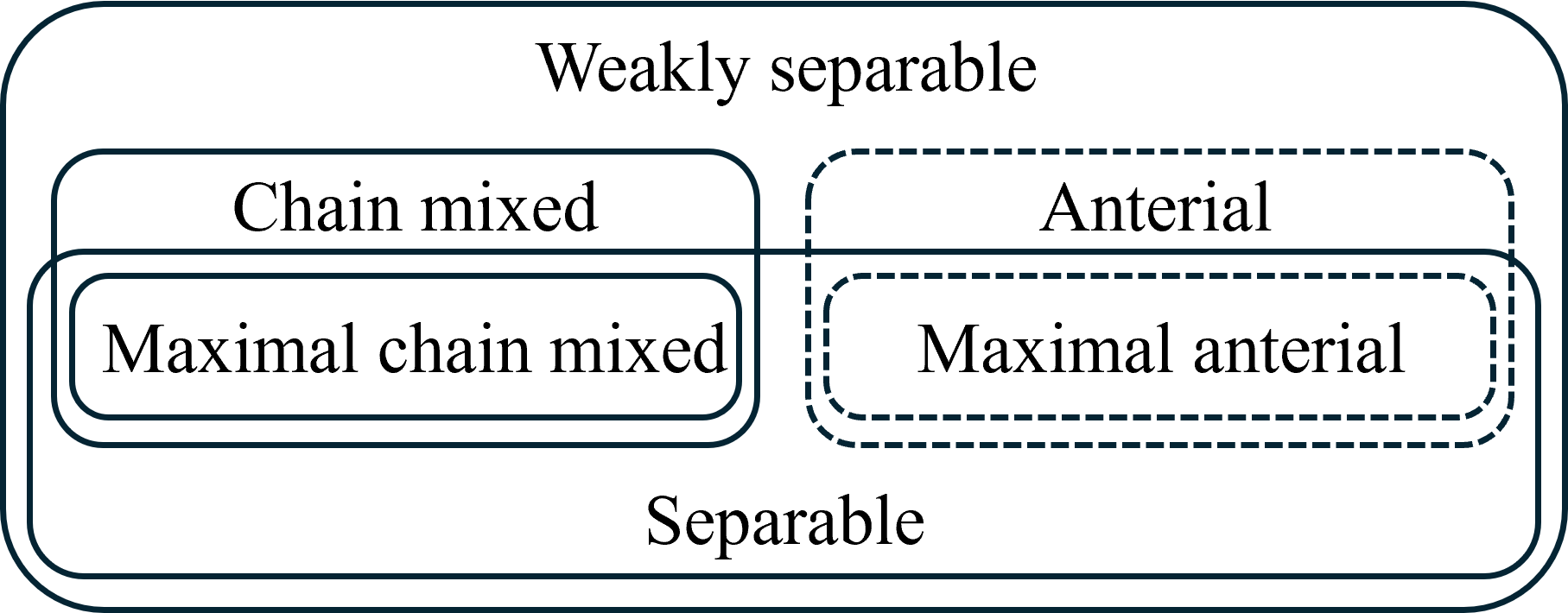
Figure 1: Venn diagram depicting the relationships between undirected, directed, chain, and mixed graph families in terms of their graphical expressivity. Simple families (no multi-edges) are dashed, multigraph families are solid.
The authors formalize separation equivalence (G≡H iff I(G)=I(H)) and introduce essential families, which are closures under this equivalence. This sets the stage for their unification and generalization results.
Separable and Essentially Separable Graphs
A separable graph is defined as a mixed graph where every missing edge corresponds to a separating set for its endpoints—i.e., every absent edge directly encodes a CI. This property, which arises as an emergent property in the maximally augmented versions of many graph families (MAGs, maximal chain mixed graphs), is here made foundational and extended to cyclic and multigraph settings.

Figure 2: Separable graph G1 (left) and an essentially separable but non-separable graph G2 (right). G2 becomes separable after adding a single edge, demonstrating the closure property inherent in essential separability.
Essentially separable graphs are those that are equivalent (in the CI sense) to some separable graph; i.e., their CI structure can be realized by a separable graph, possibly after appropriate edge additions or modifications. Notably, these classes capture certain cyclic mixed graphs not addressed in prior frameworks.

Figure 3: An essentially separable graph, illustrating equivalence to separable structures by edge augmentation.
The main graphical characterization proves that essentially separable graphs are always essentially acyclic—that is, they are equivalent to some acyclic mixed graph. This fact underpins modeling equivalence between graphical models based on separable and acyclic representations, dramatically generalizing prior results on chain, ancestral, and anterial graphs.

Figure 4: A cyclic graph G4 (left) and an equivalent acyclic graph G5 (right), foundational for the essentially acyclic characterization.
Inducing Walks, Self-Inducing Walks, and Separability
To characterize separability, the authors generalize the notion of inducing walks—collider walks between nonadjacent vertices that induce dependence in the absence of a direct edge. The key theorem states that a graph is separable if and only if it does not contain a self-inducing walk—an inducing walk where all collider sections are anterior to an endpoint. This tight condition generalizes previous results on maximality and primitive inducing walks in specific graph subclasses.
Graphical and Separational Characterizations of Equivalence
The equivalence (in the CI sense) of separable graphs is analyzed through several lenses:
These results subsume and extend prior equivalence characterizations for DAGs, chain graphs, ancestral graphs, and chain mixed graphs.
Canonical Representations and Structure Identification Algorithm
The authors construct a canonical representative of each separation equivalence class—the graph retaining only the induced arrowheads as determined by the separational characterization. This representative, obtained via the InducedArrowheads algorithm, is always an anterial graph and unique among simple (no multi-edges) graphs in its class.
They develop the SGI algorithm, a constraint-based structure identification procedure that recovers the canonical equivalence class representative from conditional independence tests. SGI generalizes the PC and FCI families of algorithms and is shown to be sound and arrowhead-complete under perfect CI testing, with a polynomial bound (in the number of variables) on the required tests. Its correctness relies only on separational properties, aligning with the separational characterization and thus robust to equivalence closure.

Figure 6: Intermediate graphs (G≡H0 and G≡H1) during execution of the SGI structure identification algorithm, illustrating arrowhead and adjacency discovery.
Families of Models: Expressivity and Modeling Equivalence
The framework positions separable and essentially separable graphical models as unifying numerous prior families. They are shown to be as statistically expressive (in terms of induced CI models) as chain mixed models, and the canonical representation in terms of anterial graphs enables computationally efficient learning and equivalence testing.

Figure 7: An essentially undirected graph G≡H2 and its corresponding undirected equivalent G≡H3, demonstrating separational and graphical characterization alignment.
Implications and Future Directions
The formalization and identification of separable and essentially separable graphical models systematize the treatment of CI structures in the broadest class of mixed graphs relevant for causal and statistical inference in the presence of cycles, hidden variables, and selection. The canonical representations and separational equivalence criteria support well-founded, computationally feasible structure learning.
Numerical and Theoretical Implications:
- The strict equivalence between modeling families implies that inference or learning under the separable/essentially separable framework achieves the same statistical fidelity as in maximal ancestral, chain mixed, or anterial graphs, with associated computational guarantees.
- The identification of the essentially acyclic closure avoids pathologies where maximality does not guarantee representability, especially in cyclic settings.
Future Directions:
- Generalization to all mixed graphs (including essentially cyclic cases), potentially requiring new separation criteria or extensions of G≡H4-separation [see e.g., "Causal calculus in the presence of cycles..." (Forré, Mooij, UAI 2019)].
- Development of sound and complete orientation rules for essentially separable and cyclic graphs, paralleling those for DAGs and MAGs.
- Detailed analysis of statistical faithfulness and the measure-theoretic prevalence of perfect distributions for these families [cf. Sadeghi, JMLR 2017].
Conclusion
The paper advances the theory of graphical models by characterizing the broadest class of mixed graphs that admit a direct separation-to-adjacency correspondence and devises both graphical and separational equivalence characterizations. The SGI structure identification algorithm operationalizes these results for constraint-based learning, offering efficiency guarantees and conceptual clarity. This framework robustly subsumes previous model classes, provides unique canonical representatives, and opens avenues for further generalization to settings involving arbitrary cycles and richer forms of conditional independence.