- The paper rigorously constructs exact interlayer triplet-pairing eigenstates within the extended Hubbard model for bilayer and trilayer geometries.
- It employs a restricted spectrum-generating algebra to demonstrate off-diagonal long-range order and the interplay between singlet and triplet pairing.
- Numerical simulations confirm that triplet eigenstates remain robust for two to three layers while dynamical instabilities arise with additional layers or nonzero interlayer interactions.
Exact Interlayer Triplet-Pairing Eigenstates in the Extended Hubbard Model
Introduction
The extended Hubbard model serves as a paradigmatic framework for exploring strongly correlated electronic phases on lattice systems, including unconventional superconductivity, charge ordering, and exotic quantum orders. Central to recent progress is the understanding of exact eigenstates exhibiting off-diagonal long-range order (ODLRO), notably the η-pairing states, which provide explicit routes to superconductivity outside the standard BCS paradigm. However, the introduction of interlayer couplings in multilayer systems breaks the conventional η-pairing symmetry, challenging the construction of exact correlated pair states in physically relevant scenarios such as bilayer and trilayer cuprates, nickelates, and engineered cold atom platforms. This work presents a rigorous construction of interlayer triplet-pairing eigenstates in the extended Hubbard model, demonstrating their exactness for specific multilayer geometries and parameter regimes. The interplay between singlet and triplet pairing, their consequences for ODLRO, and dynamical instabilities under perturbations are elucidated through a combination of spectrum-generating algebra and numerical simulations.
Model, Symmetries, and Interlayer Pairing
The authors consider an extended Hubbard Hamiltonian defined on a multilayer bipartite lattice, incorporating intralayer and interlayer hopping (t, t⊥), on-site interaction (U), and nearest-neighbor interlayer interactions (V) of the form:
H=−t⟨ij⟩,m,σ∑ci,m,σ†cj,m,σ−t⊥i,m,σ∑ci,m,σ†ci,m+1,σ+Ui,m∑ni,m,↑ni,m,↓+Vi,m∑ni,mni,m+1.
Interlayer interactions naturally break the established η-pairing symmetry (which is responsible for constructing singlet η-pairing eigenstates in the original one-layer model). The study introduces three operator sets—SU(2) spin, singlet η-pairing, and critically, interlayer triplet-pairing operators—to analyze the emergent symmetry structure and seek new exact eigenstates.
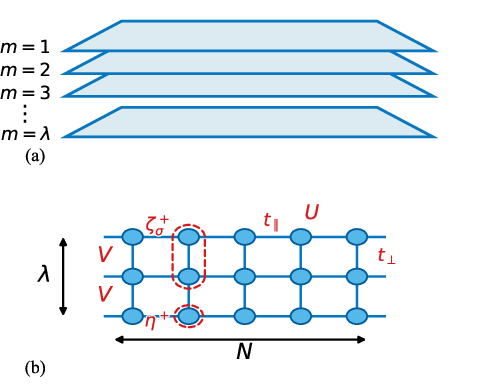
Figure 2: Schematic of a multi-layered bipartite lattice system, with triplet interlayer pairs (across layers) and singlet on-site pairs annotated; nearest-neighbor interactions and model parameters are indicated.
The crucial insight is that interlayer triplet-pair operators—which combine fermions from adjacent layers into spin-aligned (or symmetrized spin) pairs—can generate nontrivial eigenstates when applied to the vacuum, provided the system is restricted to two or three layers and the interactions η0 and η1 are both nonzero. The relevant commutator algebra closes only in this restricted case, underpinning the construction of exact eigenstates with ODLRO arising from a restricted spectrum-generating algebra (RSGA)—a generalization of the usual spectrum-generating algebra (SGA).
Construction of Exact Triplet-Pairing Eigenstates
Explicit construction proceeds by acting with triplet pair creation operators η2 or their η3-rotated forms on the vacuum. The main result asserts that for bilayer (η4) and trilayer (η5) geometries, the states
η6
are exact eigenstates of η7 with nonzero η8, η9 (see details in Eqs. 16–18 of the paper). These states display ODLRO, characterized by the persistence of pair correlation functions at arbitrary distance, confirming their condensate nature. The conditions on t0, t1, t2 are shown to arise from the combinatorial structure of the operators: for t3, unavoidable interaction terms destroy the algebraic closure and thus the eigenstate property.
Moreover, the existence of both singlet and triplet symmetry operators allows for a broad family of eigenstates featuring coexistence of singlet and triplet pairs when t4, but this coexistence becomes dynamically unstable as soon as interlayer interactions are nonzero due to non-commuting operator structure.
Numerical Characterization and Dynamics
The stability and physical content of the triplet-pairing states is further probed through quench dynamics simulations. Beginning from a triplet-paired initial state, time evolution under the post-quench Hamiltonian is computed, focusing on the fidelity t5 (overlap with the initial state), and singlet/triplet correlators as functions of time and interlayer coupling.
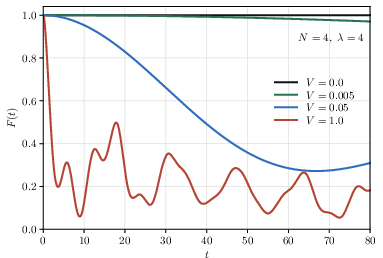
Figure 1: Fidelity t6 for initial triplet-pair states on a t7 lattice, highlighting perfect stability (t8) for t9 and rapid decay with t⊥0 and t⊥1.
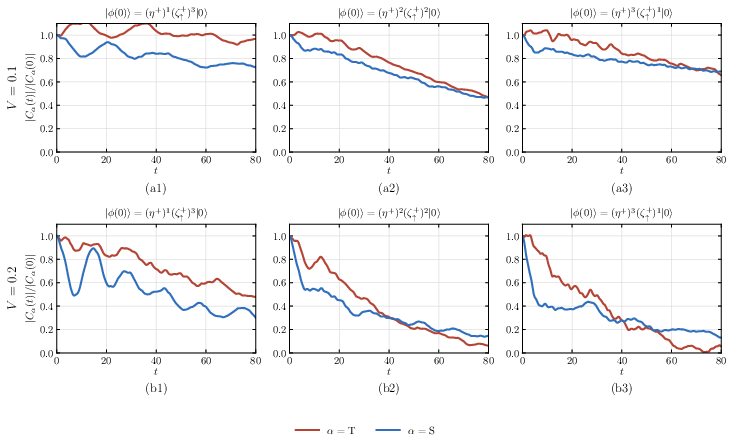
Figure 3: Time evolution of singlet and triplet pair correlation functions t⊥2 and t⊥3 for various initial configurations and interlayer interaction strengths.
Key findings chronicle the rapid decay of initial-state fidelity and correlation functions for t⊥4 or mixed singlet/triplet pair condensates with t⊥5, confirming that exactness and coexistence are strictly constrained by the algebraic structure of the underlying model. Notably, the triplet-pair sector remains robust for t⊥6, and loses stability otherwise. The indirect coupling between singlet and triplet sectors via t⊥7 is evident in the decay of both correlation measures when both pair types are present.
Implications and Outlook
The formal demonstration of exact interlayer triplet eigenstates for bilayer and trilayer extended Hubbard models represents a novel advance, with implications on several fronts:
- Extension of On-site t⊥8-Pairing: The results provide a concrete, algebraically controlled extension of t⊥9-pairing concepts to triplet condensates in multilayer geometries with interlayer interactions—a regime previously intractable for analytical eigenstate construction.
- Experimental Realizability: Owing to rapid progress in quantum simulation platforms (e.g., ultracold atom optical lattices with single-site and layer control), these exact states and their ODLRO properties may be accessible to direct measurement and manipulation, particularly in bilayer/trilayer setups.
- Theoretical Generalization: The restricted spectrum-generating algebra paradigm offers a blueprint for seeking further classes of exact correlated eigenstates in interacting systems with nontrivial coupling between spatial and internal degrees of freedom.
- Dynamical Instabilities: The dynamical results highlight the inherent fragility of condensate states to symmetry-breaking perturbations, and suggest that only pure singlet or triplet condensation can be stabilized in the presence of both interlayer and on-site interactions.
Future directions may include exploring the thermodynamic stability and excitation spectra above these exact condensate states, investigating their topological or transport properties in tailored geometries, and extending the approach to models with non-bipartite or frustrated intralayer topology.
Conclusion
This study establishes a rigorous framework for constructing and analyzing exact interlayer triplet-pairing eigenstates in the extended Hubbard model, subject to strong algebraic and geometrical constraints. These states generalize conventional U0-pairing physics to the domain of multilayer correlated systems and elucidate both their persistence regimes and dynamical instabilities. The results offer a concrete route for bridging analytic results in strongly correlated models with realistic experimental architectures, and open perspectives for further classification and engineering of exotic quantum condensates in correlated matter.
Reference:
"Exact interlayer triplet-pairing eigenstates in the extended Hubbard model" (2607.01038)

