- The paper presents a unified security and privacy framework for AI-native 6G networks by integrating threat taxonomy, countermeasures, and standards harmonization.
- The paper systematically analyzes fragmented vulnerabilities across infrastructure, network, AI, privacy, and security management layers.
- The framework provides actionable insights for developing resilient, trustworthy, and adaptive defense mechanisms through cross-layer integration and automated orchestration.
Toward a Unified Security and Privacy Framework for AI-Native 6G Networks
Introduction
As wireless networks evolve towards the sixth generation (6G), the convergence of AI, communication, sensing, and computing yields highly heterogeneous, autonomous, and AI-native systems. These systems introduce complex dependencies and interconnections that markedly increase the risk of security and privacy violations. The paper "Toward a Unified Security and Privacy Framework for AI-Native 6G Networks" (2607.01019) presents a systematic analysis of the fragmented security and privacy landscape in 6G networks and proposes a unified framework that integrates threat taxonomy, countermeasures, and standards harmonization to address cross-layer security and privacy challenges.
Fragmentation in 6G Security and Privacy
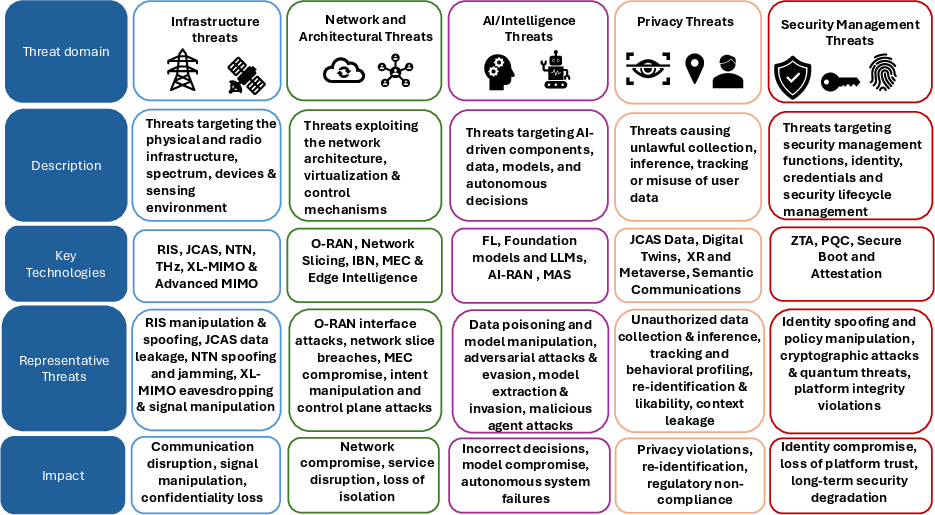
The fragmentation of security and privacy in AI-native 6G networks arises due to the heterogeneity across enabling technologies (e.g., RIS, JCAS, NTNs, THz communications), novel architectural paradigms (O-RAN, network slicing, edge intelligence), AI-driven functionality (federated learning, foundation models, AI agents), inconsistent standardization, and divergent security management approaches. The lack of holistic, end-to-end security solutions and unified governance exacerbates interoperability gaps and induces emergent threat vectors spanning physical to application layers.
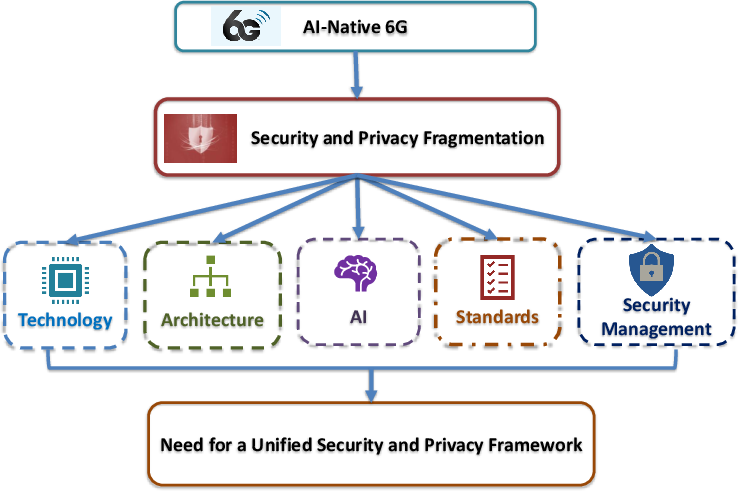
Figure 1: Fragmentation in security and privacy across technology, architecture, intelligence, standards, and management disrupts consistent 6G protection.
Unified Security and Privacy Framework
The paper proposes a defense-in-depth unified framework organizing requirements into five domains: Infrastructure Security, Network and Architectural Security, AI Security, Privacy Protection, and Security Management. Cross-layer functions—including Identity and Access Management, Security Orchestration and Automation, AI Governance and Assurance, Privacy Governance and Compliance, and Standards Harmonization—provide continuous, coordinated enforcement.
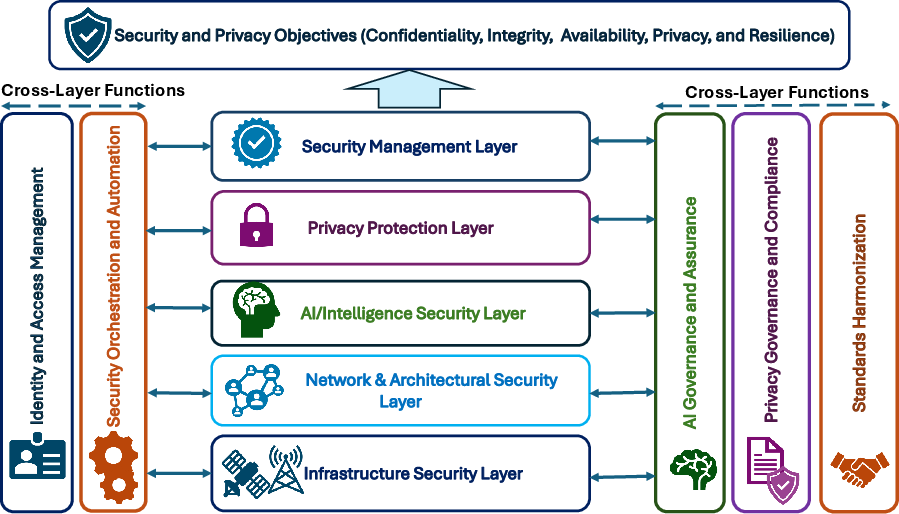
Figure 2: Unified security and privacy framework integrating taxonomy and countermeasures across domains and layers.
By mapping domain threats to cross-layer countermeasures, the framework achieves confidentiality, integrity, availability, privacy preservation, resilience, trustworthiness, and regulatory compliance throughout the AI-native 6G ecosystem.
Cross-Layer Threat Taxonomy
Building on this framework, the paper presents a comprehensive taxonomy covering:
Countermeasures and Standards Harmonization
Countermeasures are systematically mapped: physical-layer security, AI governance, privacy-preserving ML (e.g., DP, FL, HE), post-quantum cryptography, secure attestation, identity management compatible with iZTA, and automated orchestration mitigate threats at each layer. The authors highlight the necessity of standards harmonization—current initiatives by 3GPP, ETSI, ITU, NIST, IETF, O-RAN, and AI-RAN alliances often partially overlap, yet critical gaps (e.g., federated identity, AI trust, cross-layer interoperability, unified JCAS/NTN trust) remain. A standards unification and certification roadmap is advocated.
Implications and Future Research Directions
The unified framework has direct implications for the deployment of resilient, trustworthy, and privacy-preserving infrastructures. Practically, the need for multi-layer, automated, and adaptive defense is stressed, especially as edge intelligence, digital twins, and foundation models expand the attack surface. Theoretically, quantifying cross-layer risk propagation and formalizing security guarantees for collaborative, autonomous, and AI-driven agents becomes paramount.
Future research challenges include:
- Testbed validation and deployment at operational scale;
- Achieving autonomous, explainable, and self-healing security via trustworthy AI and secure multi-agent reinforcement learning;
- Establishing globally harmonized standards and security benchmarks;
- Formal methods for continuous risk assessment, cross-domain trust management, and quantitative evaluation of adversarial and privacy risks.
Conclusion
AI-native 6G networks introduce unprecedented interconnectedness and intelligent automation but drastically elevate the complexity of the security and privacy landscape. The paper provides a rigorous, cross-layer taxonomy and a unified framework that integrates identity, orchestration, governance, and compliance with standards harmonization as core attributes for secure, privacy-preserving, and trustworthy next-generation 6G deployments. Only a holistic, coordinated approach, integrating technical and organizational advances, can counter the emergent, multi-domain threats associated with 6G.
Reference:
"Toward a Unified Security and Privacy Framework for AI-Native 6G Networks" (2607.01019)