- The paper demonstrates that incorporating double occupancy with Curie-Weiss attraction yields rich phase behavior, including unique gas–liquid and liquid–liquid transitions.
- The analysis employs a saddle-point expansion and mapping to the Blume-Capel model, providing an exact mean-field framework for multifluid coexistence.
- The findings highlight how local repulsion and infinite-range attraction interact to stabilize triple points and integer-density phases in soft-matter systems.
Phase Diagram and Critical Properties of the Double-Occupancy Cell Model with Curie-Weiss Interaction
Introduction and Model Mapping
The double-occupancy cell model is a minimal lattice-gas system where each cell can host up to two particles. The Hamiltonian incorporates global (Curie-Weiss) attraction between all particles and a local repulsion penalizing double occupancy. This framework is directly mapped, via nl=Sl+1, to the Blume-Capel model on a complete graph, establishing isomorphism between mean-field spin-1 systems and multiple-occupancy lattice gases. The local repulsion strength a=Δ/J is the key parameter controlling the competition between bounded repulsion and unbounded attraction, directly affecting the emergent phase behavior.
The model is treated in the grand-canonical ensemble, with the partition function reduced, via a Gaussian integral representation and a saddle-point (Laplace) expansion, to a parametric mean-field equation of state governed by an effective single-cell partition function K0(T∗;z). This function accounts for the occupancy constraint (nl≤2) and explicitly couples to the temperature and chemical potential. The thermodynamic observables, such as reduced density and pressure, are expressed in terms of ratios of Kj special functions, analogous to moments of the occupancy distribution.
Distinct formulations are presented for distinguishable and indistinguishable particles, the latter enforcing the appropriate symmetry for direct comparison with the Blume-Capel model.
Phase Diagram Topology and Criticality
The interplay between a and T∗ leads to a rich, nontrivial structure in the (T∗,ρ∗,a) phase space. For distinguishable particles, three primary regimes are identified:
- Low repulsion (a<atc): The model exhibits a single fluid critical point at ρc∗=1, with the coexistence line resembling that of a standard mean-field lattice gas. The critical temperature a=Δ/J0 increases as a=Δ/J1 decreases.
- Intermediate regime (a=Δ/J2): A tricritical point emerges at a=Δ/J3. Here, two distinct critical points exist, corresponding to two first-order transitions—gas–liquid and liquid–liquid—terminating at their respective critical endpoints. Between these, a triple point is realized where three fluid phases (gas, low-density liquid, and high-density liquid) coexist.
- Strong repulsion (a=Δ/J4): The coexistence region splits into two, with two critical points persisting at low a=Δ/J5. The triple point vanishes; at low a=Δ/J6, integer-density phases (a=Δ/J7, a=Δ/J8, a=Δ/J9) are stabilized due to the occupancy cut-off.
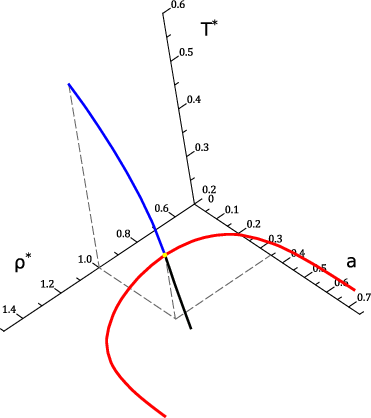
Figure 1: Phase diagram of the double-occupancy cell model for distinguishable particles, illustrating the critical line (K0(T∗;z)0), two critical lines (K0(T∗;z)1), and the tricritical/triple-point lines in K0(T∗;z)2 space.
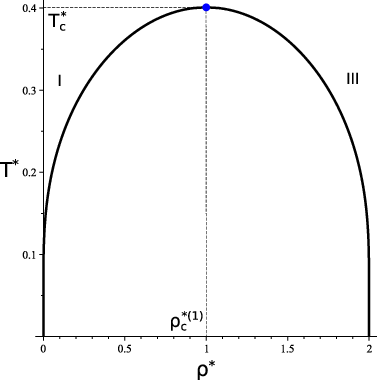
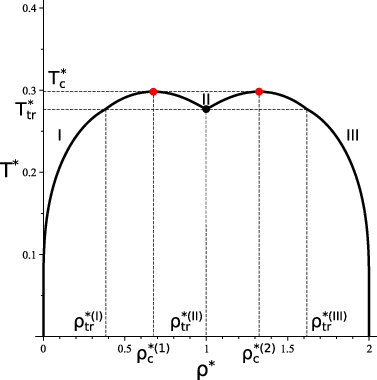
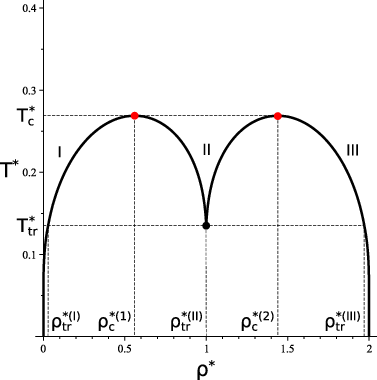
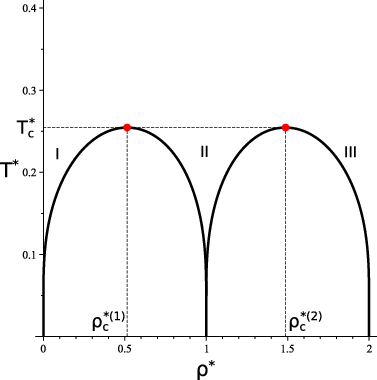
Figure 2: Example K0(T∗;z)3 phase diagram at K0(T∗;z)4, displaying the single critical point and the corresponding coexistence region.
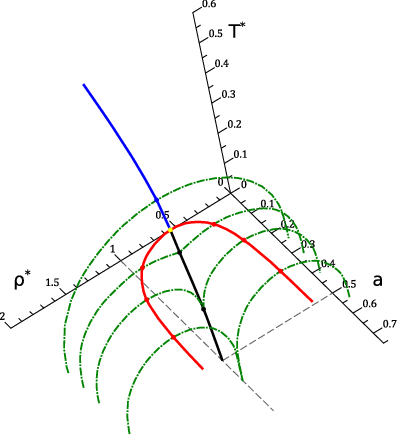
Figure 3: Combined 3D K0(T∗;z)5 representation showing coexistence lines, critical points, and the triple-point line.
For indistinguishable particles, the phenomenology is topologically similar, but the location of the tricritical point and critical temperatures shift, with K0(T∗;z)6 and K0(T∗;z)7 values matching those of the mean-field Blume-Capel model. This confirms particle indistinguishability as the proper prescription for alignment with the spin-1 canonical ensemble.
The absolute values for critical densities and temperatures, as well as the boundaries of the triple-point regime, are provided in detail in the paper; e.g., for large K0(T∗;z)8, the critical densities converge to K0(T∗;z)9 and nl≤20 at nl≤21.
Triple Points and Multiphase Coexistence
The interval nl≤22 (distinguishable particles) is characterized by the presence of a triple point where three distinct phases coexist at a common nl≤23 and nl≤24. As nl≤25 increases, nl≤26 rapidly decreases and vanishes for nl≤27. The triple-point densities smoothly interpolate between nl≤28 (at nl≤29) and Kj0 (as Kj1). This behavior is absent in single-occupancy lattice gases, underlining the essential role of multiple occupancy in producing gas–liquid–liquid transitions.
Physical and Theoretical Implications
The model demonstrates that a minimal extension of the lattice-gas paradigm (allowing Kj2) suffices to generate not only a gas-liquid critical point, but also a distinct liquid–liquid phase transition and associated criticality, as well as genuine triple points—a hallmark of core-softened and ultrasoft matter systems. The results reveal that mean-field competition between finite local repulsion and infinite-range attraction is a sufficient mechanism for stabilizing multiphase coexistence phenomena previously observed in models of soft-matter clustering, penetrable spheres, and the Gaussian core fluid.
These findings supply a tractable analytical benchmark for more realistic simulations and for validating approximate treatments of liquid–liquid criticality.
Structural Interpretation
The analysis of the pair distribution function Kj3 further corroborates the interpretation of the high-density phase as a fluid and not a crystalline state. In all phases, Kj4 exhibits mean-field character—stepwise behavior determined by the occupancy constraint—with no indication of periodic spatial order typical of crystalline phases.
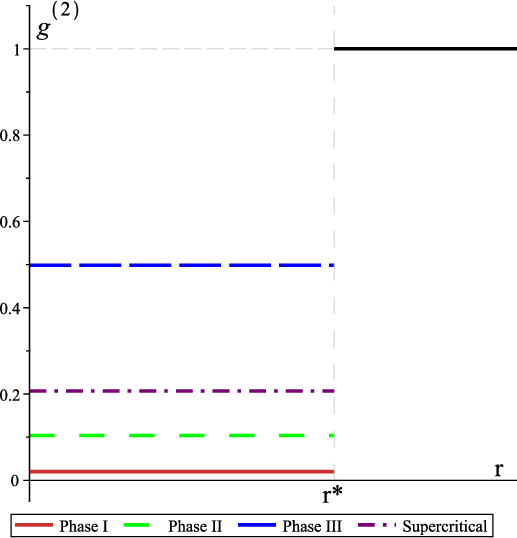
Figure 4: The pair distribution function Kj5 as a function of separation, displaying stepwise mean-field fluid behavior in all thermodynamic phases.
Conclusions
The double-occupancy cell model with Curie-Weiss attraction and local bounded repulsion admits an exact mean-field treatment exhibiting canonical features of ultrasoft matter: multiple critical points, a liquid–liquid transition line, triple points, and coexistence of three distinct integer-density fluid phases in certain regions of parameter space. Mapping to the Blume-Capel model on the complete graph guarantees thermodynamic consistency and places this lattice gas in the context of well-studied spin systems. The explicit analytical results establish this model as a minimal, analytically tractable template for theoretical studies of multiphase soft matter systems, and a reference point for more complex or microscopic modeling approaches. The demonstrated phenomenology motivates further study into extensions (unrestricted occupancy, finite-range interactions, off-lattice generalization) to quantitatively capture the full range of density anomalies and clustering inherent in soft-matter systems.
Reference:
"Phase diagram of a double-occupancy cell model of a fluid with Curie-Weiss interaction" (2607.01009).