- The paper demonstrates that dissipative coupling in exciton-polaritons creates tunable exceptional points through the interplay of coherent and dissipative interactions.
- It employs finite-temperature Green’s function formalism and T-matrix approximation to extract complex dispersion relations and define EP conditions.
- The paper reveals that adjusting biexciton resonance and decay rate imbalance can engineer non-Hermitian effects with promising applications in quantum sensing and device control.
Exceptional Points in Dissipative Coupling Polaron-Polaritons
Introduction
The interplay between coherent many-body interactions and environmental dissipation is rapidly emerging as a central topic in non-Hermitian quantum many-body physics. This work addresses the formation and control of exceptional points (EPs) embedded in the quasiparticle spectrum of exciton-polaritons undergoing dissipative light-matter coupling, and demonstrates that polaron-polaritons in the presence of a biexciton resonance constitute a platform where non-Hermitian physics and strong correlations are fundamentally intertwined (2607.00994).
Theoretical Model
The system considered is a semiconductor microcavity hosting two circularly polarized exciton-polariton species. A dilute concentration of minority (↑) polaritons interacts with a BEC of majority (↓) polaritons. The Hamiltonian comprises three terms: the non-interacting part including distinct decay rates for excitons (γx) and cavity photons (γc), a complex light-matter coupling ΩRe−iΩIm embodying both coherent and dissipative interactions, and an exciton-exciton interaction written in terms of the biexciton binding energy ϵB.
Polaron-polariton quasiparticles emerge from this model when a polaron impurity state interacts with the BEC under the presence of a biexciton resonance. The many-body problem is treated via finite-temperature Green's function formalism, leading to a matrix propagator whose spectral poles yield the complex dispersion relations. Analytical continuation combined with the T-matrix approximation for the self-energy allows the extraction of intricate effects of both interaction- and dissipation-induced non-Hermiticity.
Dissipative Coupling and Polaritonic Branches
In the absence of interactions, dissipative coupling is found to induce qualitative modifications in polariton dispersions. While the conventional result consists of two polariton branches with avoided crossings, the inclusion of non-Hermitian coupling terms, comparable in magnitude to their coherent counterparts, introduces curvature changes (negative effective mass) and energy level attraction between branches. This ultimately drives the spectrum towards EPs, identified as points where eigenvalues coalesce.
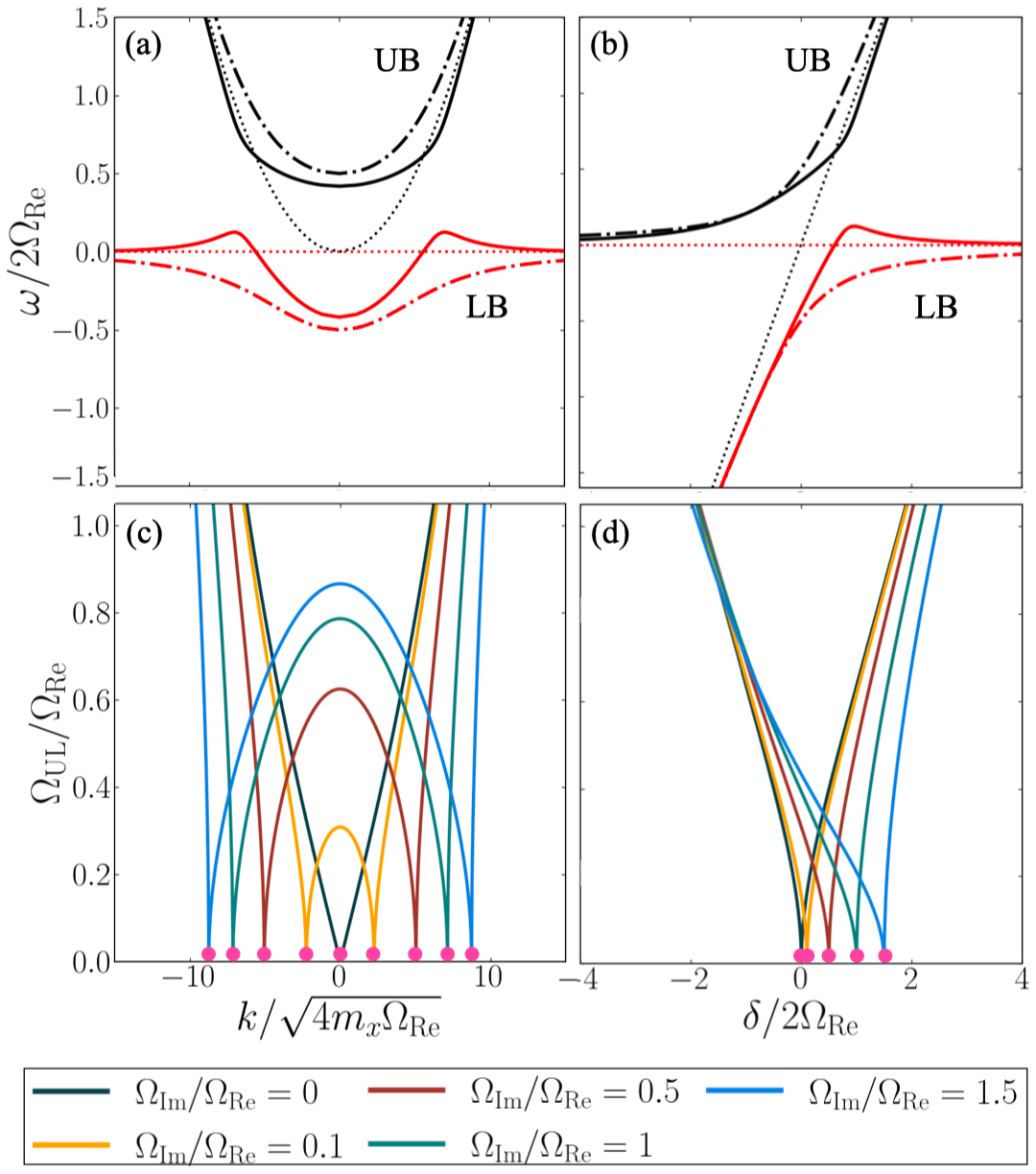
Figure 1: Dissipative coupling reorganizes polariton branches, shifting dispersions and inducing exceptional points as a function of momenta, detuning, and losses.
EPs arise when EkLP=EkUP, which is determined by both the dissipative part of the coupling and the decay rate imbalance between excitonic and photonic constituents. The presence and location of EPs can be manipulated via these system parameters.
Polaron-Polariton Dispersion and Dissipative Effects
Upon adding biexciton-mediated interactions, the lower (LB), middle (MB), and upper (UB) polaron-polariton branches are recovered. These branches, in the Hermitian limit, correspond to light-matter-dressed versions of attractive and repulsive polarons. When dissipative coupling is introduced, substantial deformation of these branches occurs, especially for increasing ΩIm/ΩRe.
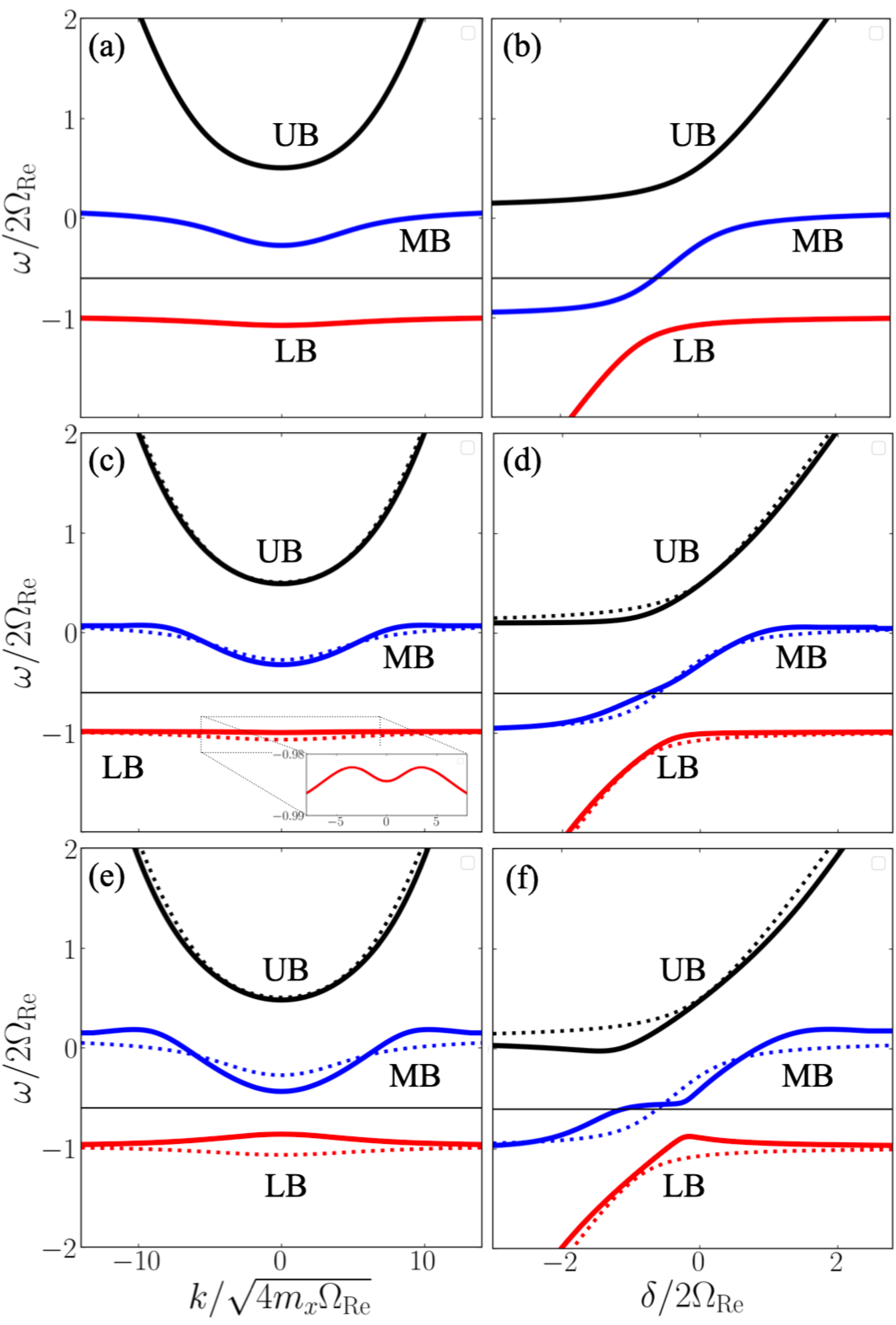
Figure 2: Dissipative coupling enhances deformation, level attraction, and curvature changes for polaron-polariton branches as a function of momentum and detuning.
The most pronounced anomalies appear in the MB and LB, including effective mass sign reversal and instability for specific parameter regimes. As the dissipative coupling is ramped, distinct branches approach each other and transverse level attraction regions, resulting in the onset of EPs that move through parameter space depending on detuning and decay rate ratio.
Exceptional Points in Many-Body Non-Hermitian Quasiparticles
The manuscript offers a detailed analysis of the conditions for EP emergence among polaron-polariton branches. EPs may be formed by coalescence of MB with LB or UB, and the criteria for their existence involve both the real and imaginary components of the polaron self-energy and system detuning. Notably, multiple sets of EPs can coexist, each associated with different branch pairings, leading to a rich phase diagram of non-Hermitian many-body spectra.
(Figure 3)
Figure 3: EPs emerge and shift as a function of the decay rate imbalance Δγ, with possible coexistence of EPs involving different branch pairs.
Increasing the density of the BEC reveals an even richer phenomenology: simultaneous level attraction among all three polaron-polariton branches, continuously tunable by the detuning and dissipation parameters.
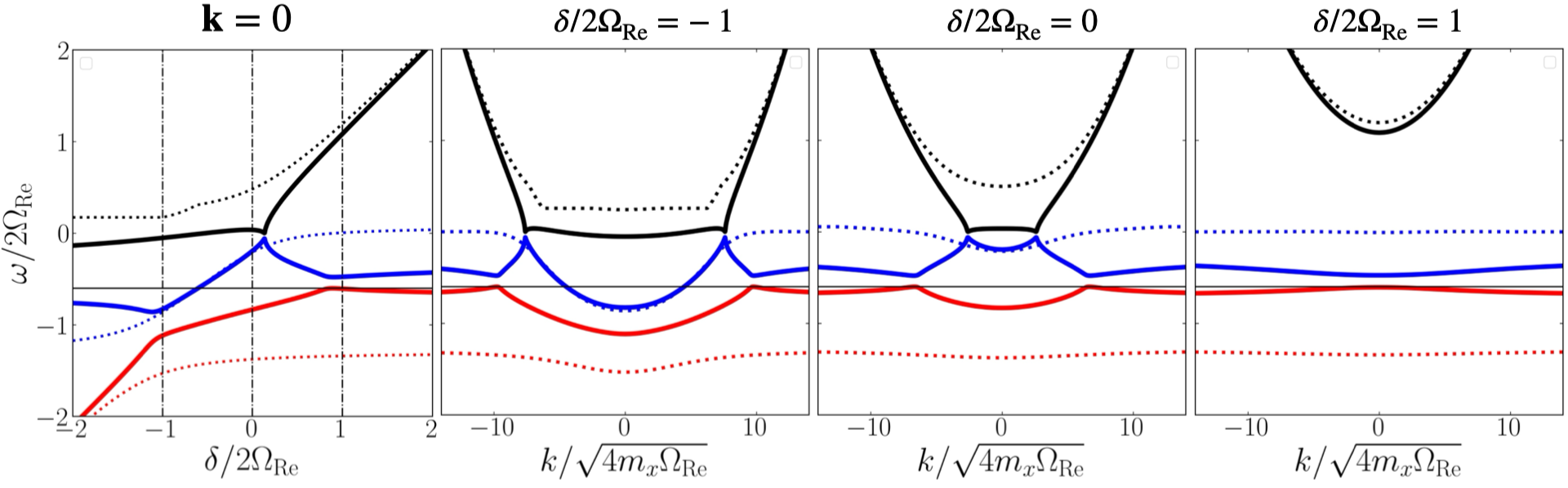
Figure 4: At high BEC density and large exciton decay, dissipative coupling produces broad level attraction and topological deformation of polaron-polariton dispersions.
Numerical and Analytical Results
Quantitative calculations show that for ΩIm/ΩRe≳1 and ↓0, anomalous dispersion and multiple EPs are robust and tunable features. Analytical expressions for the EP conditions in terms of system parameters facilitate identification across momentum and detuning axes.
Implications and Future Development
This research demonstrates the capacity to engineer non-Hermitian properties—specifically EPs and anomalous dispersion—in quasiparticles arising from strong correlation and light-matter coupling. The tunability via dissipative coupling, decay rates, and detuning provides a versatile landscape for exploring the topological implications of EPs in quantum materials. Potential future avenues include leveraging these effects for enhanced sensing, non-reciprocal devices, and the realization of quantum many-body phases with intrinsically non-Hermitian excitations. The results also connect to emerging platforms, such as polariton crystals, perovskite microcavities, bilayer and hybrid organic-inorganic settings, each promising for the exploration and exploitation of non-Hermitian quantum many-body phenomena.
Conclusion
This work establishes dissipative polaron-polaritons as a fertile platform for the study of non-Hermitian quantum many-body physics. The analysis elucidates how strong correlations, biexciton resonance, and tunable dissipative light-matter coupling conspire to restructure the quasiparticle spectrum, control the appearance and nature of EPs, and induce novel dispersion phenomena. These findings pave the way toward programmable topological manipulations in quantum optical platforms with strong many-body and environmental couplings.

