- The paper introduces a unified tensor network method that compresses and solves billion-site tight-binding Hamiltonians using QTT and MPO encodings.
- It demonstrates efficient computation of spectral, topological, and dynamical observables through fast Chebyshev recursion and native quantum Fourier transforms.
- The approach, implemented in the open-source TensorBinding.jl, offers scalable simulations for complex quantum materials like moiré superlattices and quasicrystals.
Unified Tensor Network Solvers for Large-Scale Tight-Binding Quantum Systems
Introduction and Motivation
The exponential scaling of Hilbert space in quantum materials presents substantial computational obstacles, especially for spatially inhomogeneous or long-wavelength systems where explicit matrix representations become prohibitive. Conventional tight-binding methodologies encounter memory and time bottlenecks when handling systems with N≳109 sites, limiting the ab initio modeling of moiré superlattices, quasicrystals, and driven or dissipative phenomena in real space. The presented work introduces a unified tensor network (TN) methodology that enables the direct solution of ultra-large tight-binding Hamiltonians by mapping real-space lattices onto pseudospin chains and employing controlled tensor decompositions for operator compression. This approach is operationalized in the open-source Julia package #1{TensorBinding.jl}, which encompasses a wide range of observables and model geometries.
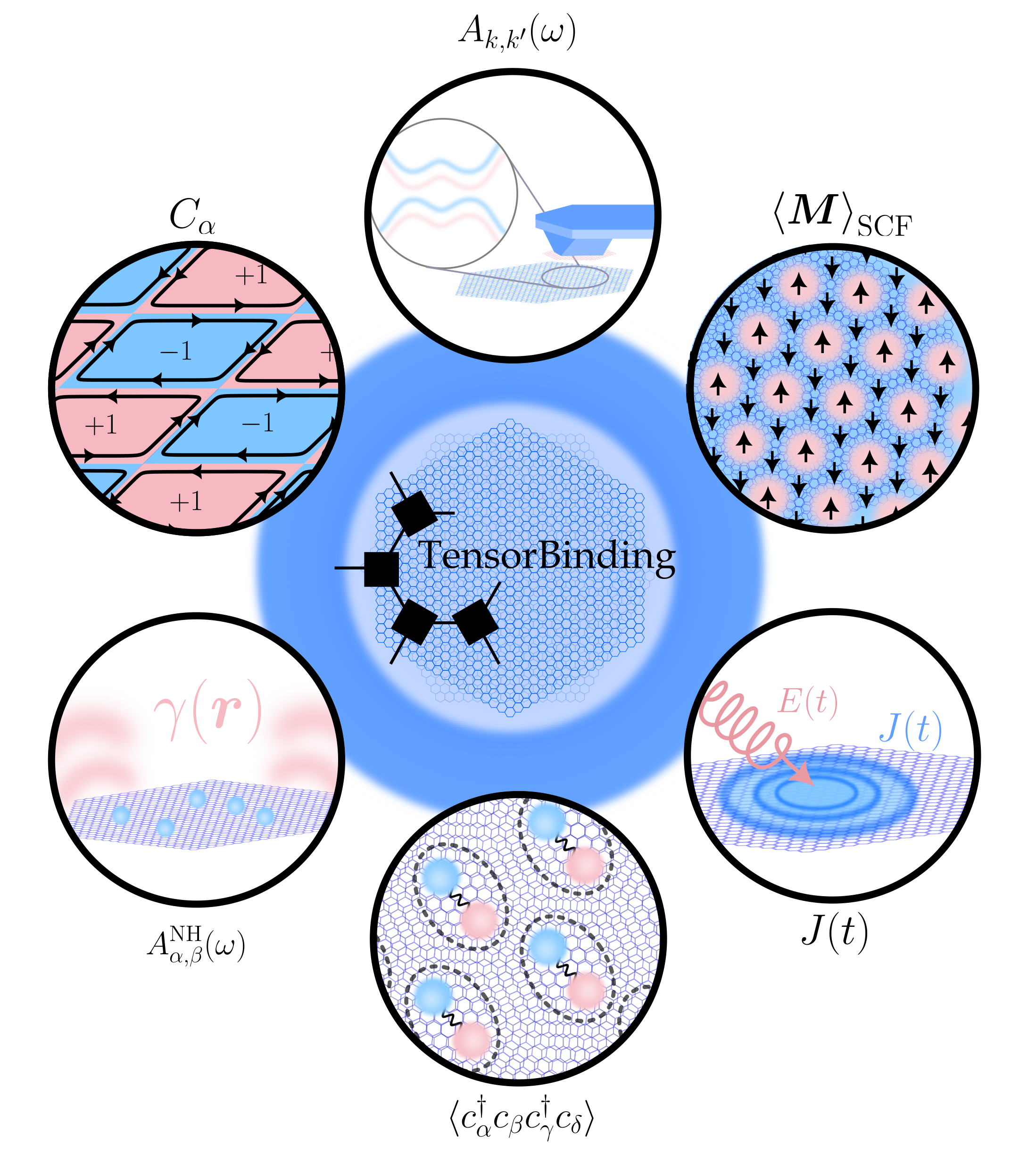
Figure 1: #1{TensorBinding.jl} enables a spectrum of applications: momentum-resolved spectral functions, real-space topological markers, mean-field correlated phases, driven observables, few-particle correlations, and non-Hermitian spectra.
Tensor Network Representation and Algorithmic Framework
Tight-Binding MPO Encoding
The foundation of the approach is the encoding of a tight-binding system with N=2L sites as a many-body problem of L pseudospins via quantics tensor train (QTT) representation [khoromskij2011, oseledets2011]. Arbitrary two-body hopping and on-site terms are implemented as Matrix Product Operators (MPOs), with QTCI (quantics tensor cross interpolation) providing efficient compression for smooth or structured couplings. Notably, the bond dimension χ remains modest for a broad range of physical systems, resulting in logarithmic scaling in memory and allowing the representation of billion-site Hamiltonians with χ∼10−50.
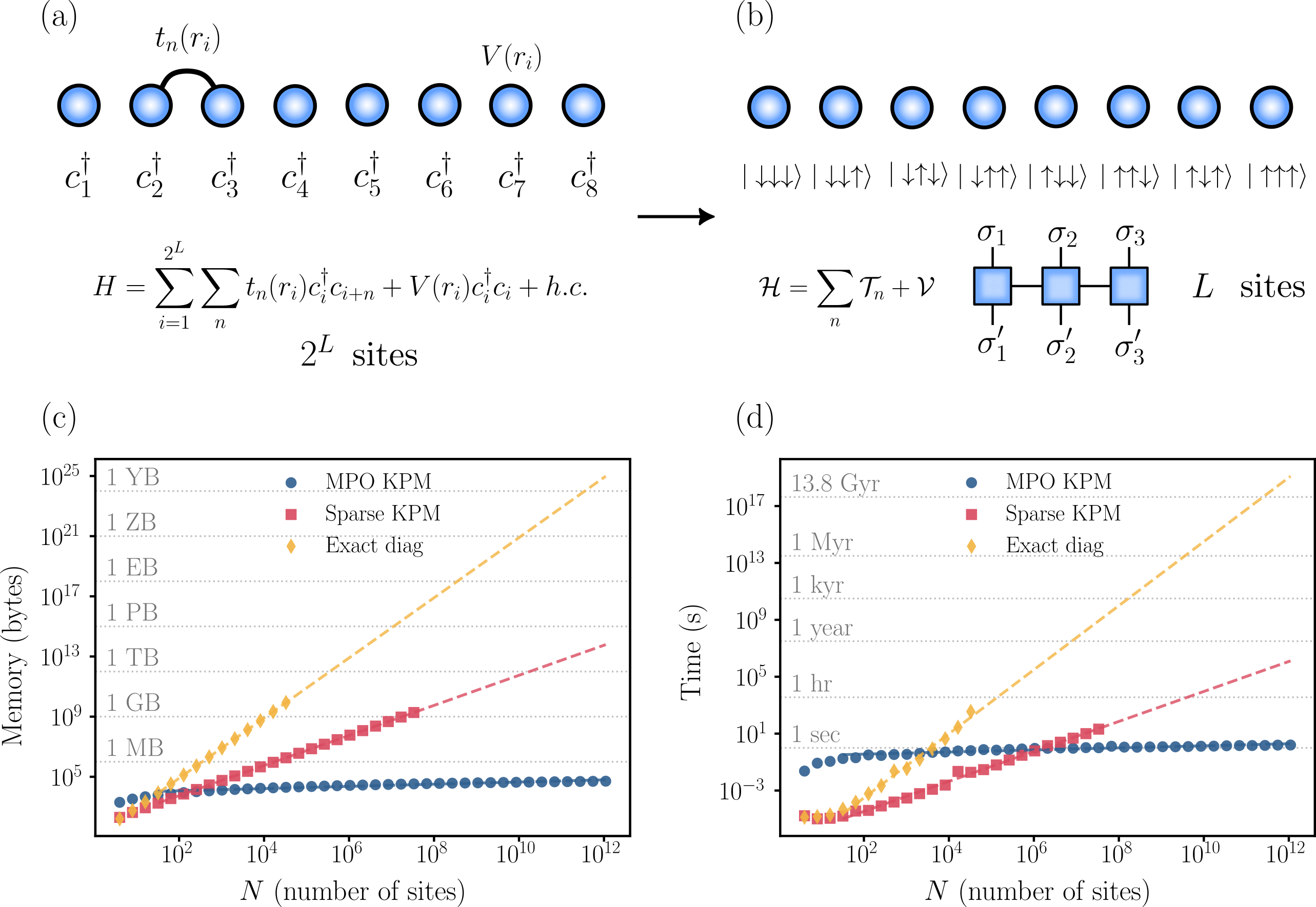
Figure 2: Mapping of an 8-site tight-binding chain to pseudospins and the scaling of memory/computation for full, sparse, and MPO representations.
Modular Model Building
The codebase supports a range of standard and exotic geometries: 1D/2D Bravais lattices (chain, square, honeycomb, kagome), multi-sublattice configurations, T-junctions, and constructs for spin, Nambu, and layer degrees of freedom. Arbitrary hopping range and structure can be encoded dynamically. The row-major quantics encoding, with careful boundary masking, generalizes to higher dimensions without performance penalty.
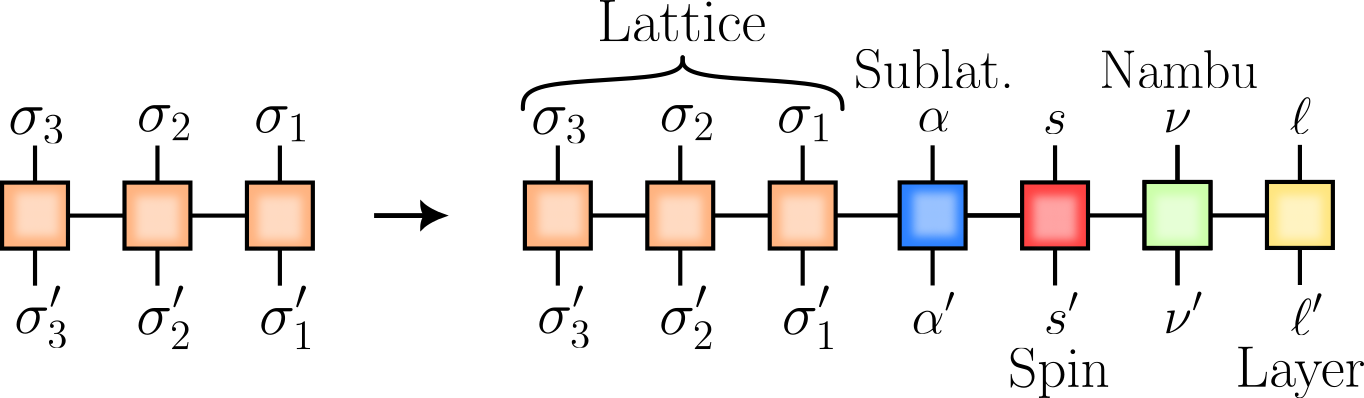
Figure 3: MPOs can be extended to include auxiliary indices for sublattice, spin, Nambu, and layer degrees of freedom, supporting rich model classes.
Algorithmic Modules
- Hamiltonian construction: On-site and hopping tensor networks sum to yield the full MPO, supporting flexible extension to custom models.
- Spectral solvers: Fast Chebyshev recursion (KPM) in full operator space, vector space, or diagonal extraction.
- Quantum Fourier Transform: Native MPO implementation enables rapid k-space spectral function calculation without explicit Brillouin zone unfolding.
Computation of Physical Observables
Spectral and Band Structure Evaluation
Spectral properties are accessed by explicit KPM expansions in the TN algebra, circumventing limitations of vector-based KPM/sparse approaches. The QFT MPO enables direct calculation of momentum-resolved spectral functions and band structures in inhomogeneous superlattice models.
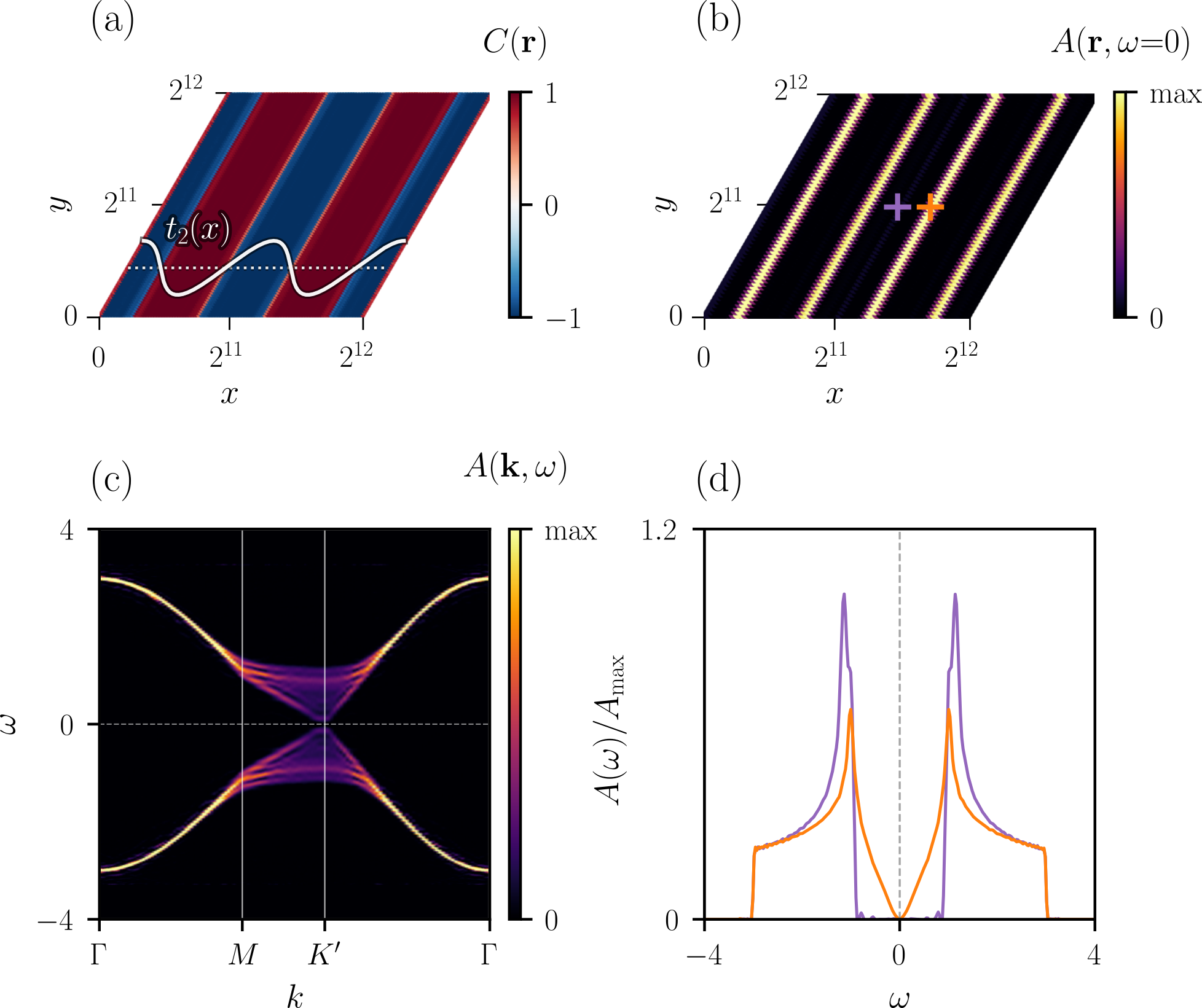
Figure 4: Spatially modulated Haldane models showcase the utility of real-space markers, momentum-resolved LDOS, and folded band structures at superlattice scales.
The implementation allows local-probe band structure extraction, efficiently resolving miniband folding and chiral edge states amid domain-wall structures—highlighting the ability to treat systems that invalidate reciprocal-space quantization.
Real-Space Topological Invariants
The TN formalism evaluates projector-based markers (e.g., Chern and winding number densities) entirely in real space, leveraging MPO-purified density matrices via KPM or McWeeny/SP2 purification. This is critical for quasicrystals or disordered systems, allowing spatial maps of topological order over system sizes (N>108) inaccessible to diagonalization.
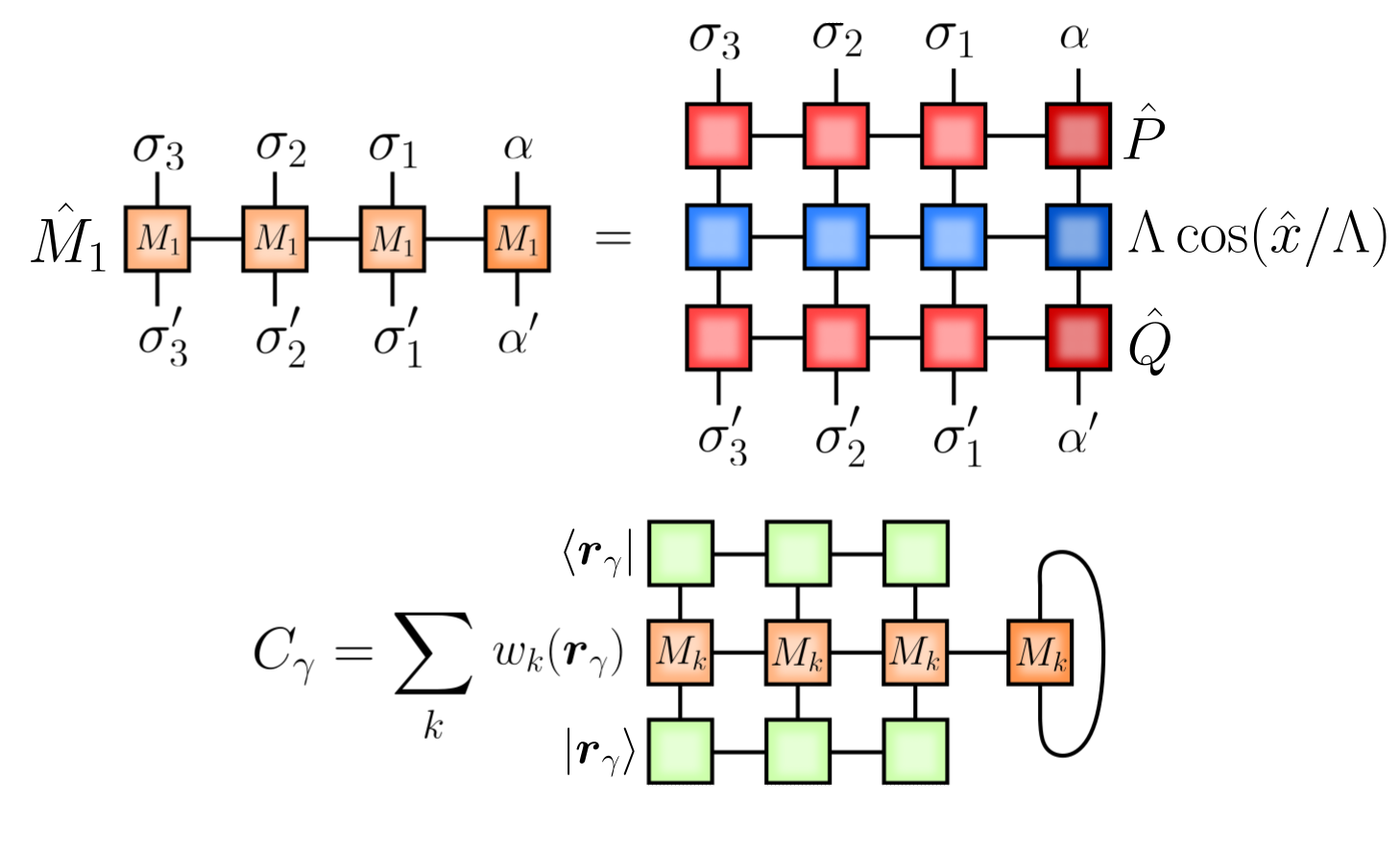
Figure 5: Tensor network construction of projector-based topological markers, supporting local real-space diagnostics in inhomogeneous or aperiodic materials.
Non-Hermitian and Out-of-Equilibrium Dynamics
Non-Hermitian phenomena are addressed via hermitization (doubling algorithms in the auxiliary index) and KPM-derivative expansions, obtaining full spectral and dynamical data at system sizes beyond traditional approaches.
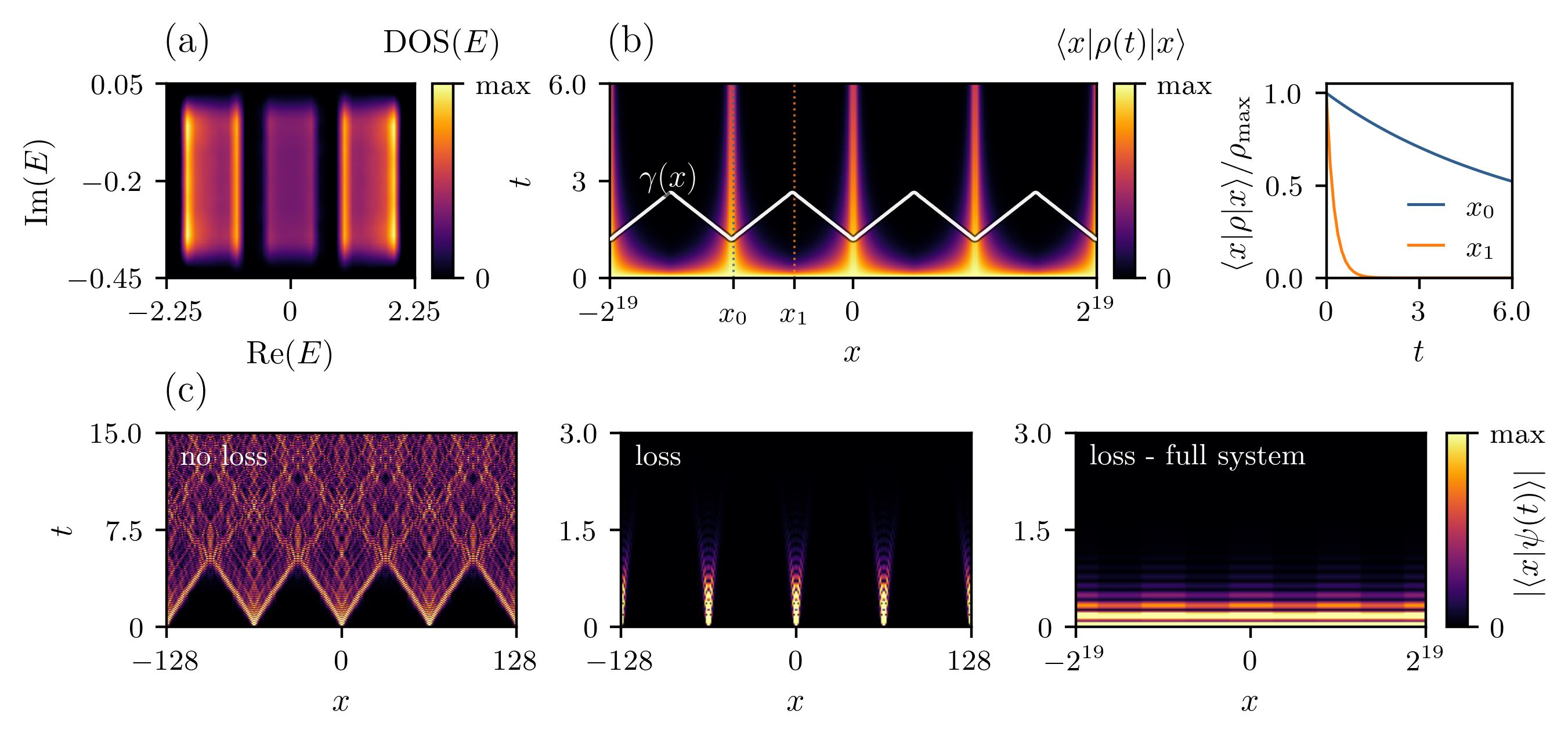
Figure 6: Spectral and dynamical observables for 1D Aubry-André-Harper chains with spatially modulated loss, demonstrating TN non-Hermitian KPM capabilities.
Time-evolution is computed using both TDVP for MPS (Schrödinger evolution) and RK4 integration of the von Neumann equation for density matrices, all within the MPO/MPS algebra, supporting both closed and driven open quantum systems.
Correlated and Few-Particle Phenomena
Self-Consistent Mean-Field and Exciton Physics
Correlation-induced order is treated using Hartree-Fock SCF loops with MPO-encoded kinetic and interaction terms. Local observables and quasiparticle spectra (via converged density matrices) capture stripe/magnetization patterns and gap formation in modulated superlattice problems.
Exciton Calculations
Two-body excitonic Hamiltonians are formulated as interleaved MPOs on $2L$ sites, with interaction terms efficiently compressed via QTCI. KPM-MPS enables calculation of exciton spectral functions for 109 electron-hole pairs, resolving the spatial modulation and energy-resolved structure of bound and continuum states.
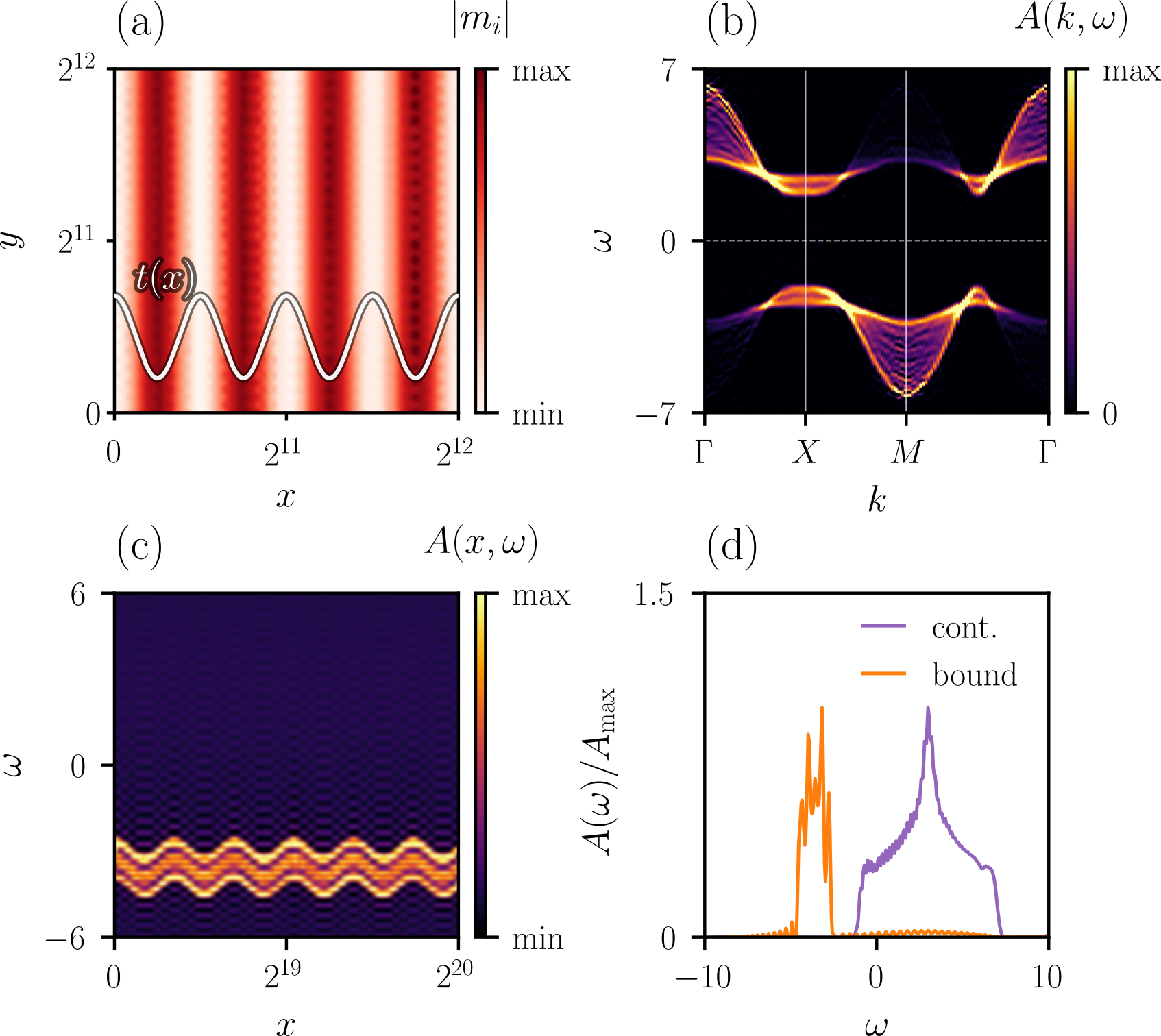
Figure 7: Mean-field Hubbard magnetization, correlated quasiparticle spectra, and exciton local density of states, illustrating the multi-particle TN framework in spatially modulated systems.
Implications, Scalability, and Outlook
While the methodology is highly effective for compressible Hamiltonians (limited χ), excess disorder or highly nonlocal models could overwhelm the TN representation, raising contraction costs to N=2L0. The energy resolution is constrained by KPM/recursion order. The theoretical extension towards strongly correlated physics (beyond few-body or mean-field regimes) remains an open direction, as does further development for multi-orbital, Floquet, and real-space transport physics.
Conclusion
This work establishes the feasibility and detailed implementation of large-scale, real-space tensor network simulation for tight-binding quantum models, enabling billion-site calculations of spectral, topological, dynamic, and correlated observables (2607.00991). The open-source platform #1{TensorBinding.jl} offers a unified, extensible solution for the study of meso- and macroscopic quantum matter—from spectral and topological characterization of superlattices to dynamical response and exciton formation—substantially expanding the computational reach of condensed matter theory.

