- The paper presents a cascade MiLAC design that integrates analog-domain channel estimation with regularized zero-forcing beamforming to reduce RF chain count and computational cost.
- It proposes both virtual and global channel estimation schemes that achieve near-digital MMSE performance, realizing up to 1540× complexity reduction in certain configurations.
- The cascade architecture delivers identical sum rate as full-digital systems while offering up to 16108× reduction in complexity, indicating strong potential for scalable 6G networks.
Introduction and System Motivation
This paper presents a comprehensive framework for channel estimation and beamforming in multiuser MISO (MU-MISO) systems augmented by microwave linear analog computers (MiLACs). The motivation lies in the limits imposed by hardware complexity, computational cost, and the prohibitive number of required RF chains in gigantic MIMO deployments. MiLACs offer a programmable, low-complexity, and energy-efficient analog alternative for enabling high-dimensional beamforming, but the integration of channel estimation and beamforming with MiLACs in multiuser setups remains unresolved.
The proposed architecture employs MiLACs for both analog-domain dimensionality reduction during channel estimation and for efficient implementation of regularized zero-forcing beamforming (R-ZFBF). A key contribution is the cascade MiLAC design, which further enhances the practical realization of beamforming from compressed, low-dimensional channel estimates.
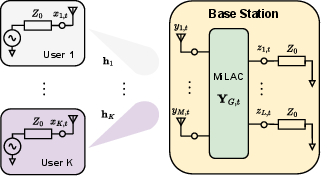
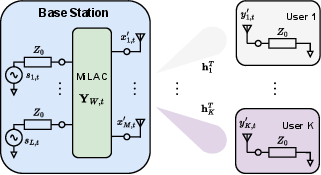
Figure 1: System architecture integrating a MiLAC with uplink channel estimation and downlink beamforming.
Channel and Signal Modeling
The system considered comprises a base station (BS) with M antennas and L=K RF chains, serving K single-antenna users possibly grouped into G clusters (users per group: Kg). Channel vectors are modeled as spatially correlated Rayleigh fading with group-wise common correlation matrices, exploiting the Karhunen-Loève representation. This yields group-based subspaces of dimension rg, often rg≪M. The group-based model supports operation for scenarios from full individualization (G=K) to strong grouping (G=1).
The uplink model involves analog compression via MiLAC before digital processing, whereas the downlink uses MiLAC for analog beamforming. Training is performed in Tu symbol durations, partitioned into frames (each of length L=K0), with orthogonal training sequences, followed by data transmission in the remaining block slots.

Figure 2: Transmission protocol, detailing uplink training and downlink data phases.
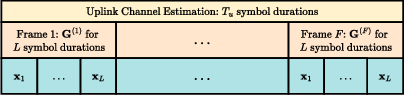
Figure 3: Temporal structure for uplink channel estimation, detailing frames, combiner configurations, and temporally interleaved pilots.
MiLAC-Aided Channel Estimation
Analog Projection and Compression
By leveraging channel correlation matrices, MiLAC implements frame-wise combiners (analog projections) that form group-specific low-dimensional observations, matching the subspace in which the users’ channels reside. The full-dimensional received signal at the BS is never explicitly digitized; only compressed projections are exposed to the digital domain.
Virtual and Global Channel Estimation Schemes
- Virtual Channel Estimation: For small L=K1, where group subspaces are linearly independent, MiLAC applies group orthonormal projectors L=K2, reducing estimation to L=K3 dimensions per user. This subspace separation is optimal in regimes with limited group overlap.
- Global Virtual Channel Estimation: For larger L=K4, with subspace overlap, the method computes the SVD of the collection of all group bases, selecting a full-column-rank projection L=K5 of rank L=K6, optimally spanning the union of all group subspaces. This suppresses redundant channel parameters and controls training overhead.
Estimation is performed by either LS or MMSE estimators in the low-dimensional domain. For MMSE, the resulting normalized MSE is shown analytically to match that of conventional full-dimension digital MMSE estimation.
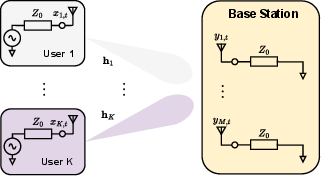
Figure 4: Digital MU-MISO uplink channel estimation scheme, contrasting with MiLAC-based analog compression.
Computational Efficiency Analysis
MiLAC-aided designs yield substantial reductions in computational complexity. For channel estimation:
- Analog-domain processing (via MiLAC) accomplishes the most demanding matrix-matrix operations.
- Digital computation is limited to efficient low-rank matrix-vector products and per-user LS/MMSE updates.
Numerical results highlight:
- Up to L=K7 complexity reduction for MMSE channel estimation in small-L=K8 settings compared to digital baselines.
- Complexity scales with the aggregate subspace rank (L=K9), which grows sub-linearly with user grouping, versus linear scaling with K0 in digital systems.
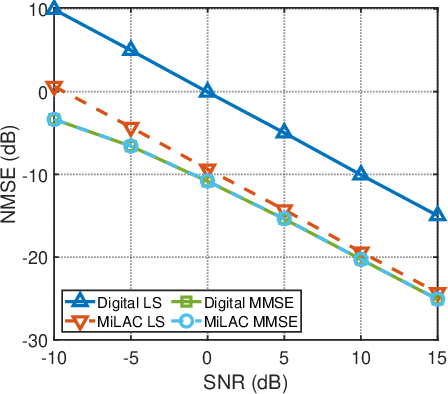
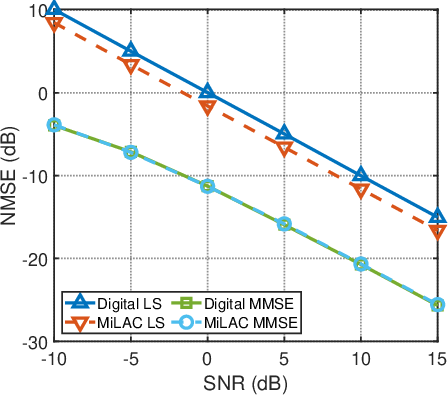
Figure 5: NMSE performance comparison for digital and MiLAC-aided channel estimation across SNR.
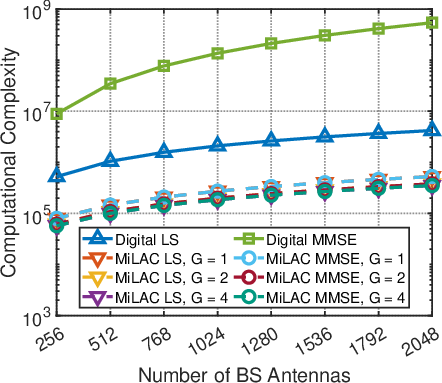
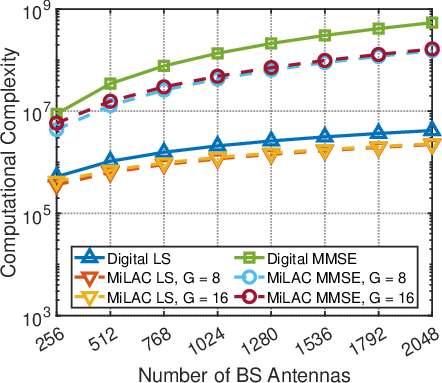
Figure 6: Computational complexity evaluation for channel estimation as a function of BS array size.
Regularized ZFBF from compressed channel statistics cannot be efficiently realized via a single MiLAC due to the embedded requirement for high-dimensional matrix synthesis. The paper advances a cascade MiLAC architecture:
- Two MiLAC layers are interconnected through internal ports, separating analog computation into tractable stages.
- The first MiLAC performs subspace mapping; the second finalizes the beamforming transformation.
This design translates the algebraic factorization of R-ZFBF matrices into physical interconnections and port mappings. Implementation complexity remains low, as the critical computation is offloaded to MiLAC reconfiguration.
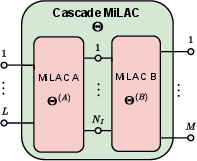
Figure 7: Schematic of the K1-port cascade MiLAC structure, realizing composite analog computation for beamforming.
- The MiLAC cascade enables direct application of R-ZFBF on low-dimensional channels, without reconstructing full-dimension CSI in the digital domain.
- Achieves identical sum rate as full-digital R-ZFBF with perfect MMSE channel estimates.
- Training overhead does introduce a minor reduction in effective sum rate, contingent on subspace dimension and user group structure.
Numerical analysis indicates:
- Up to K2 reduction in computational complexity for beamforming.
- Performance of MiLAC-aided LS estimation nearly matches digital MMSE in regimes of strong group-wise separability.
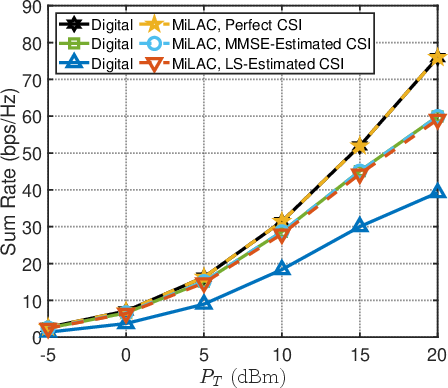
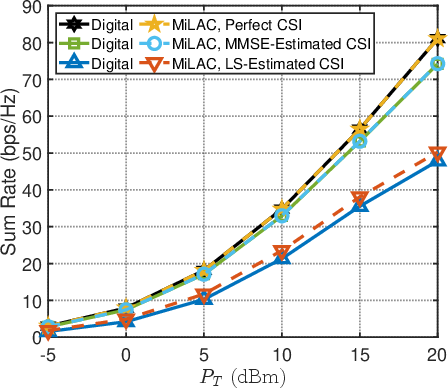
Figure 8: Sum rate performance comparison for digital and MiLAC-aided beamforming as a function of transmit power.
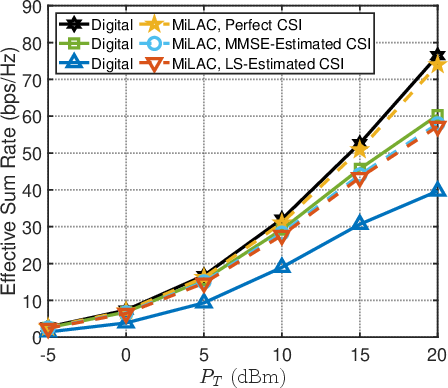
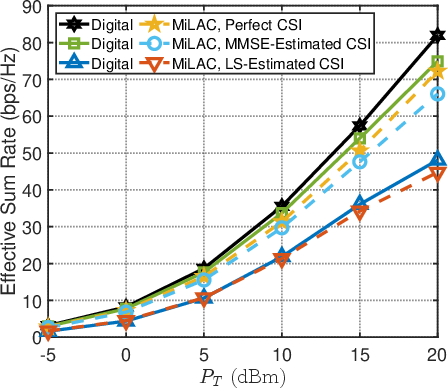
Figure 9: Effective sum rate versus transmit power, highlighting modest overhead-induced performance gaps.
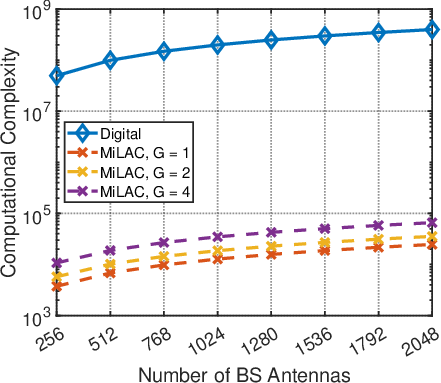
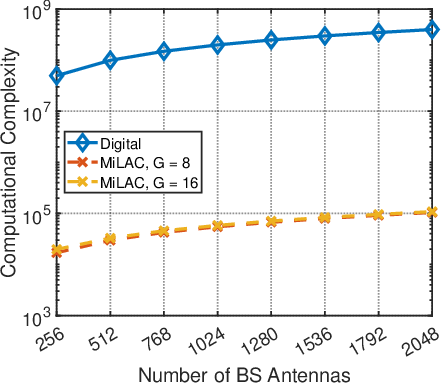
Figure 10: Computational complexity comparison for beamforming versus BS antenna count.
Theoretical and Practical Implications
The framework demonstrates that in MU-MISO settings with realistic spatial channel correlation:
- Analog computing (MiLAC) architectures can fundamentally shift the computation and hardware paradigm in massive and gigantic MIMO, making digital baseband processing scalable even at thousands of antennas.
- The analog domain realization of subspace projections and beamforming critically reduces both RF chain count and computation, shifting the principal complexity to infrequent MiLAC reconfiguration.
- There exists a quantifiable complexity-training-overhead-performance trade-off as a function of grouping granularity (K3) and subspace rank, which can be optimized for specific network requirements.
Future Directions
The analysis assumes a fully reconfigurable MiLAC. Further research is required to:
- Incorporate physical constraints such as lossless and reciprocal MiLAC hardware.
- Extend to wideband, multi-carrier, or frequency-selective MIMO channels.
- Integrate further with other physical-layer analog computing elements (e.g., RIS, stacked intelligent metasurfaces) for holographic MIMO scenarios.
Conclusion
The paper rigorously establishes the analytical and empirical superiority of MiLAC-aided MU-MISO in both computational efficiency and performance, provided channel correlation structure is leveraged. Strong complexity reductions are shown for both channel estimation and beamforming, with minimal performance penalty when optimized groupings and analog projections are applied. The cascade MiLAC architecture translates algorithmic matrix decompositions to physical analog computation, providing a blueprint for scalable, RF-efficient massive MIMO deployments, pointing toward practical implementations for 6G-era networks and beyond (2607.00954).