- The paper employs spatially resolved VLT/MUSE and JWST MIRI spectroscopy to link the Ansky outburst with ongoing accretion processes.
- The analysis demonstrates that either persistent low-level AGN or a long-lived TDE remnant can explain the emission-line structures and dust features.
- The study identifies a minor merger and counter-rotating stellar components as key factors fueling the SMBH and triggering quasi-periodic eruptions.
Spatially Resolved Constraints on Nuclear Activity and the Nature of the Ansky Event in SDSS1335+0728
Introduction
The transient Ansky event (ZTF19acnskyy) marked a luminous nuclear outburst in SDSS J133519.91+072807.4 (SDSS1335+0728; z=0.024), followed by the detection of extreme X-ray quasi-periodic eruptions (QPEs) of uncertain origin. This work (2607.00921) presents a joint analysis of VLT/MUSE optical and JWST MIRI/MRS mid-infrared spatially resolved integral field spectroscopy to characterize the host galaxy, accretion history, and circumnuclear environment, tracing both the persistent and transient phases of nuclear activity. The analysis leverages kinematics, nebular diagnostics, Balmer-line light echoes, emission-line mapping across a broad dynamic range in ionization potential, and silicate MIR features to infer the evolutionary context and physical origin of the Ansky event.
Multiwavelength Activity and Nuclear Transients
SDSS1335+0728, previously quiescent, erupted optically in December 2019, with subsequent discovery of long-duration (∼1.5–4 d), high-energy (∼1048 erg per burst) QPEs that recur on timescales of $4.5$–$10$ d. The first major brightening and the subsequent QPE regime are evidenced in the forced ZTF g/r light curve, where the nucleus has not yet relaxed to pre-2019 quiescent levels.
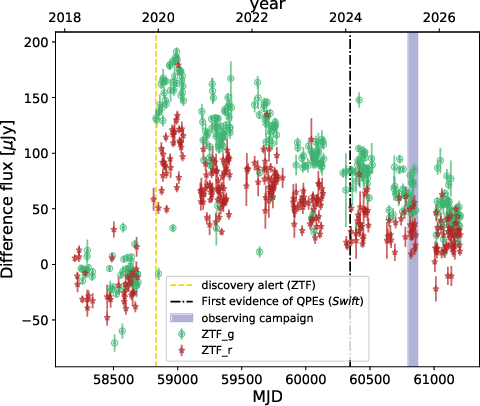
Figure 1: ZTF g and r light curve of Ansky showing the chronology of the optical outburst and recurrent X-ray QPEs.
The absent prior QPE detection is inconclusive due to the lack of sensitive coverage; however, the delayed appearance of QPEs post-optical outburst suggests a connection between disc reconfiguration and the onset of QPE-sustaining conditions, as predicted in the disc-orbiter collision framework [Linial23b].
Host Galaxy Gas and Stellar Kinematics: Evidence for a Minor Merger
Stellar kinematic maps reveal a distinct inversion of rotation with radius, indicating the presence of two counter-rotating stellar components. The ionized gas exhibits coherent, low-dispersion rotation, misaligned with stellar kinematics, and a dynamically cold state (σgas≲60 km/s), closely paralleling the paradigm of gas-rich minor mergers that trigger nuclear gas inflow and potentially supply fuel for both star formation and SMBH accretion.
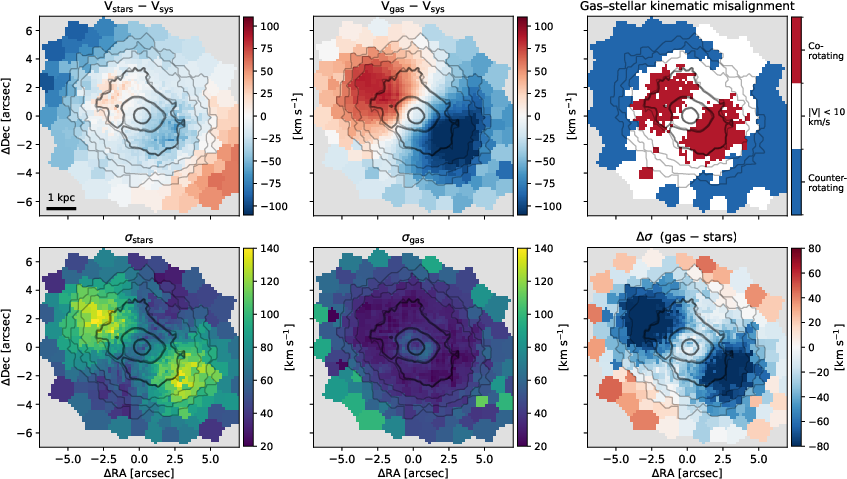
Figure 2: Kinematic maps illustrating stellar/gas velocity, misalignment, and dispersion, with accreted gas dynamically colder and misaligned from both stellar components.
The kinematic features, together with a distinct ring of enhanced star formation at intermediate radii, validate a merger-driven environmental history and provide a direct channel for replenishing nuclear gas reservoirs and stirring up the loss cone, conditions favorable for both TDEs and QPE progenitors.
Emission Line Diagnostics: Tracing the Nuclear Ionization Structure
Spatially resolved BPT diagnostics and nebular line mapping demonstrate a characteristic three-zone structure:
- A Seyfert/AGN nucleus dominated by hard ionizing continuum (coronal and high-IP lines),
- An intermediate (1–3 arcsec, ∼00.5–1.4 kpc) ring energized by star formation,
- Outermost regions with LINER-like line ratios, inconsistent with photoionization by young stars.
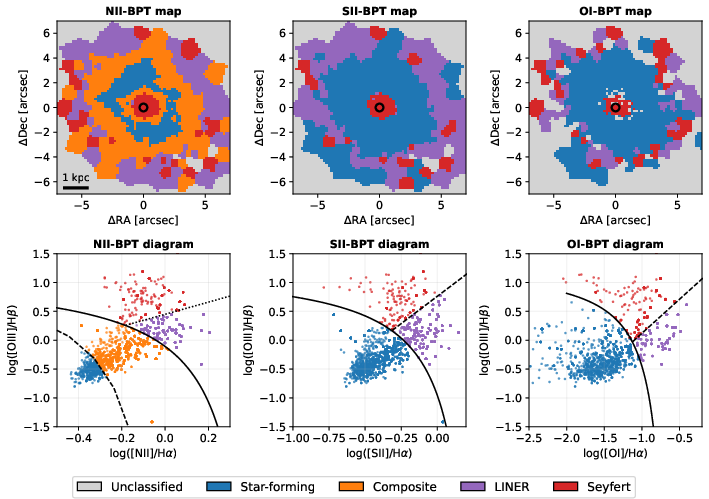
Figure 3: BPT maps (top: [NII], [SII], [OI]) and diagnostic planes (bottom), delineating AGN, star-formation, composite, and LINER domains.
This structure is mirrored in the spatial distribution of both optical and MIR nebular lines. High-ionization coronal lines ([NeVI], [NeV], [OIV]) are compact, nuclear, and require an accretion-powered ionizing source, while low-IP ISM and star-formation tracers (e.g., [NeII], [SIII]) are extended and ring-like, corresponding to the star-forming region.
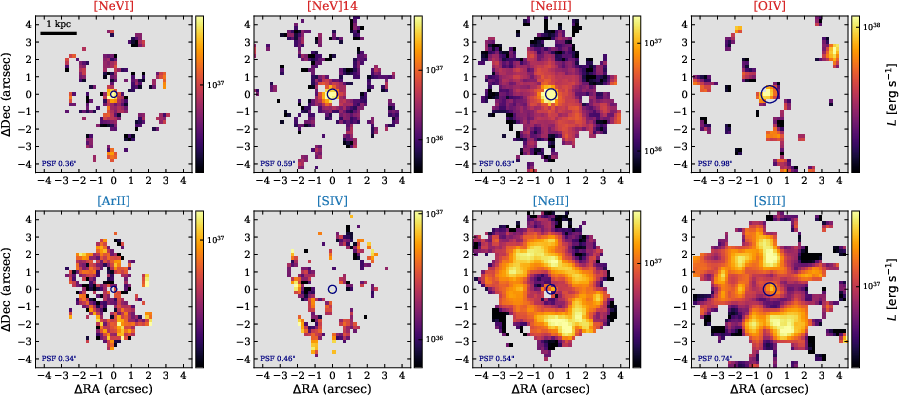
Figure 4: MIR emission line maps, with high-IP lines centrally concentrated and low-IP lines tracing an extended star-forming ring.
The ∼1 map segregates AGN- from star-formation-driven regions, again confirming a spatially compact zone of hard photoionization.
Historic Ionizing Luminosity from Balmer Light Echoes
A Balmer recombination-light-echo technique constrains the minimum nuclear ionizing luminosity (∼2) required to sustain observed line emission at varying light-travel times. Bins with AGN/LINER-like line ratios at ∼3 radius infer ∼4 erg/s sustained for at least ∼5 yr. No evidence exists for a previously much brighter AGN; the extended ∼6 is naturally explained by a source persistent at ∼7 erg/s over ∼8–∼9 yr.
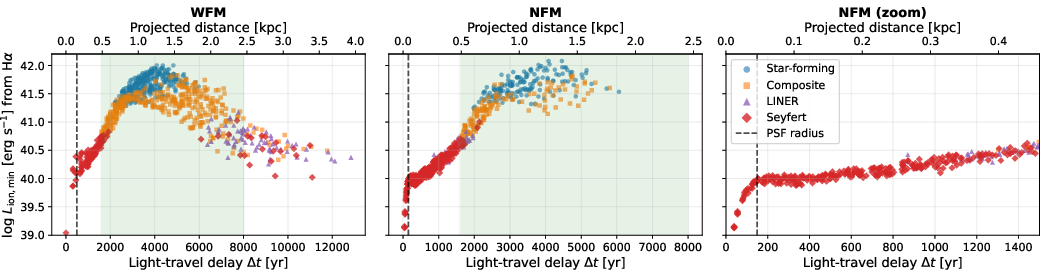
Figure 5: Minimum ionizing luminosity ∼10480 as a function of light echo delay (projected lookback time and radius), highlighting persistent nuclear output.
The requirement of long-lived, sub-quiescent ionizing emission breaks degeneracy between faint/dormant AGN and scenarios with continuous, low-level accretion or TDE disk irradiation, providing a critical fossil record spanning millennia.
Mid-Infrared Spectroscopic Diagnostics
The JWST MIRI/MRS spectrum features very strong, broad silicate emission at ∼10481 and ∼10482m and a lack of substantial obscuration or classical torus structure. High-IP coronal lines and weak PAH emission—typical in star-forming galaxies—further indicate dominance by a hard accretion-driven continuum rather than star formation.
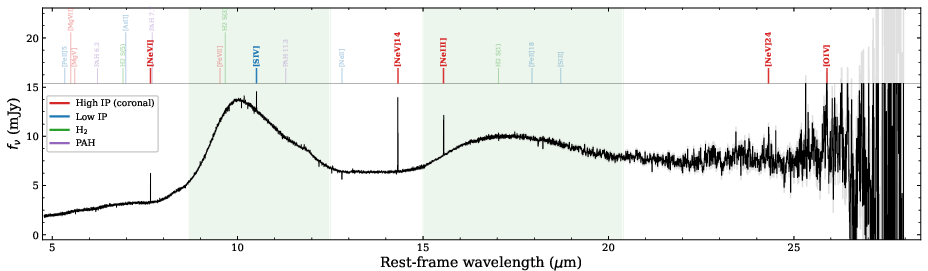
Figure 6: MIRI/MRS nuclear spectrum dominated by broad silicate emission and high-IP coronal lines; line identifications color-coded by category.
The silicate feature strengths (∼10483) align more closely with optically thin dust exposed during a TDE flare or the dissipating dust remnants of a low-luminosity AGN (LLAGN), inconsistent with classic AGN torus.
Stellar Populations
Stellar population synthesis demonstrates a quiescent, old mass-weighted host with evidence for recent star formation confined to an intermediate-radius ring, further matching the predictions of merger-driven rejuvenation in S0 or post-starburst galaxies.
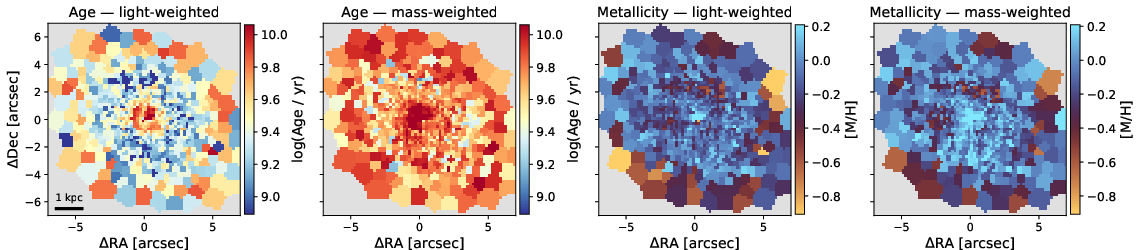
Figure 7: Spatially resolved light- and mass-weighted age/metallicity maps, pinpointing an intermediate-age star-forming ring superposed on an old host.
Interpretation and Evolutionary Scenarios
The spatially resolved data are consistent with two principal scenarios for pre-2019 accretion:
- Persistent/Fading LLAGN: Ongoing low-level accretion at ∼10484 (RIAF regime) naturally explains the fossil photoionization, pre-outburst SED (BBB component), optically thin silicate emission, and relatively weak [NeV]. The Ansky event corresponds to a temporary elevation of this baseline but is not a unique sign of AGN reawakening [Goold26].
- Long-Lived TDE Remnant Disc: A TDE disc evolving as ∼10485 over ∼10486 yr, as shown for TDEs in non-active hosts [Mummery25], can likewise power the observed extended emission-line region. The energetics and light-echo chronology are consistent with a single tidal disruption event irradiating the ISM over kpc scales for ∼10487 yr.
Both cases disfavor—but do not strictly exclude—a scenario in which the nucleus was dormant prior to 2019, contradicting the “faded AGN” paradigm recently proposed for EELR/QPE hosts [Jiang25, Xiong25].
Implications for the Quasi-Periodic Eruption Phenomenon
The combination of an extreme, long-duration QPE source and a well-characterized post-merger host environment provides a unique testbed for QPE models. The present data indicate:
- Extended nebular emission, used previously to infer AGN fading, does not discriminate between faded nucleus and persistent low-level accretion.
- Minor-merger history and gas dynamical misalignments likely drive both the supply of accretable material for the SMBH and enhance loss-cone dynamics, increasing rates of TDEs/QPEs [Wevers24b, Wevers24c].
- The absence of pre-outburst QPEs can be explained if the thin disk required for QPEs was established only after the transient, as natural in disc–EMRI or collisional models [Linial23b, Franchini23].
Conclusion
The comprehensive spatially resolved spectroscopic analysis of SDSS1335+0728 demonstrates that neither the classical faded AGN nor dormant TDE scenarios uniquely account for the observed nuclear and host properties. Instead, persistent LLAGN or long-lived TDE remnant accretion, supplied by minor-merger-triggered gas flows, are sufficient to explain the nuclear light-echoes, kinematics, multiwavelength line excitation, and MIR dust properties. The Ansky event corresponds to a slow, faint transient in a low-mass SMBH system with ongoing accretion, providing direct empirical links among galactic dynamical history, fossil accretion, and extreme nuclear transient phenomena such as QPEs. Future high-resolution IFU and MIR studies of additional QPE and TDE hosts will be required to disentangle the evolutionary drivers underlying nuclear activity in low-mass SMBHs and clarify the role of mergers, gas inflows, and past accretion episodes in setting the conditions for such transients.