- The paper introduces a novel recurrent SIR framework that uses a polarized immunity scheme and cross-immunity kernel to recursively calculate the susceptible population before each epidemic wave.
- The paper demonstrates that epidemic size is maximized at intermediate transmissibility due to negative inter-wave immune feedback, challenging traditional single-epidemic models.
- The paper’s bifurcation analysis reveals transitions from stable periodic outbreaks to chaotic dynamics, offering actionable insights for epidemic forecasting and understanding pathogen evolution.
Immune History Modulates Recurrent Epidemics of Antigenically Related Variants
The study introduces an analytically tractable, recurrent SIR framework in which a host population experiences sequential exposures to antigenically related pathogen variants. Each epidemic wave is triggered by the introduction of a new variant, with wave-onset susceptibility fully determined by the immune landscape established by previous waves and their antigenic relationships. The core innovation is the recursive calculation of susceptibilities Si(i)(0) prior to each wave based on a status-based, polarized immunity scheme: a fraction ωi(j) of hosts infected in wave j are completely protected against variant i.
The cross-immunity kernel is parameterized as ωi(j)=(1−σ)∣i−j∣k, consolidating antigenic escape as a function of the stepwise distance between variants, with the shape parameter k modifying the breadth of cross-immunity. Under k=1, multiplicative decay in cross-immunity reduces the multi-variant recursion to a one-dimensional nonlinear map in Si, facilitating mathematical analysis.
The within-wave epidemic dynamics are described by standard SIR equations, with the final susceptible fraction determined by the classic final-size relation. Inter-wave updates of susceptibility across all possible future variants are governed by the cross-immunity kernel and the immunity retention parameter ϕj from each earlier wave.
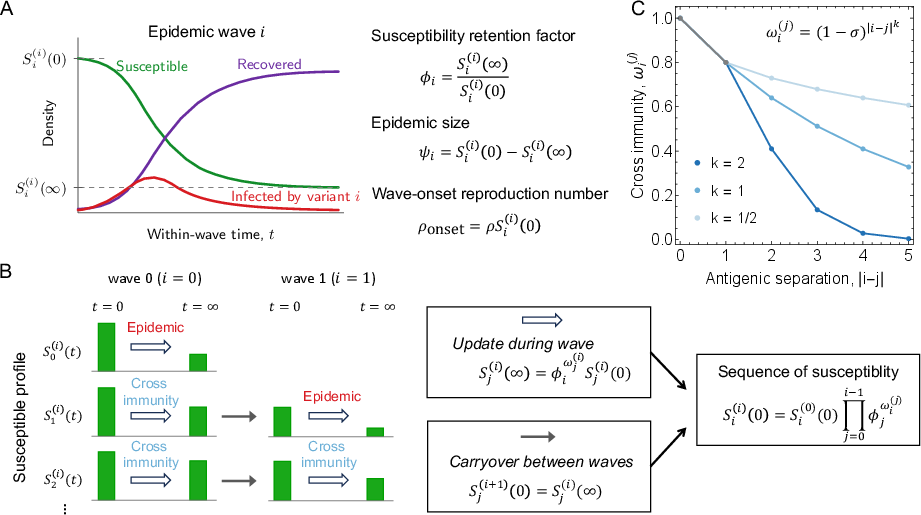
Figure 1: Schematic summary of the recurrent epidemic model, the inter-wave update of susceptibility profiles, and cross-immunity decay with antigenic separation.
Stability and Dynamics of Recurrent Epidemics
Numerical iteration of the model reveals regimes of qualitatively distinct recurrent epidemic dynamics. For broad parameter sets (intermediate transmissibility, broad cross-immunity), the system converges to period-1 recurrence: each wave induces an epidemic of the same final size, regulated by stable, negative feedback imparted by cross-immunity. However, as the basic reproduction number (ρ) increases and cross-immunity escape weakens (ωi(j)0 decreases), this fixed point loses stability via period-doubling bifurcation. The epidemic sequence manifests periodic alternations between large and negligible (immunity-limited) waves (period-2), with further increases in ωi(j)1 (and certain ωi(j)2) yielding higher-period or complex, apparently chaotic sequences.
The bifurcation structure is sensitive to the shape of the cross-immunity kernel (ωi(j)3). When ωi(j)4, which induces narrow and rapidly decaying cross-immunity across antigenic distance, recurrent dynamics become more irregular and higher-period/chaotic behavior is observed at lower ωi(j)5. Conversely, small ωi(j)6 yields longer-lasting immune footprints and stabilizes period-1 recurrence even with larger ωi(j)7.
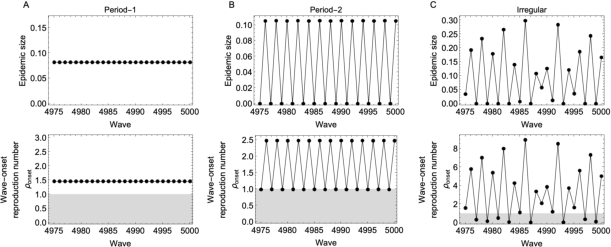
Figure 2: Example epidemic sequences illustrating period-1, period-2, and irregular/chaotic dynamics as a function of transmissibility and cross-immunity kernel shape.
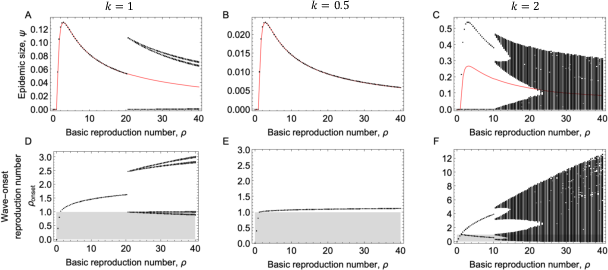
Figure 3: Bifurcation structure of epidemic size and wave-onset ωi(j)8 across ωi(j)9 under various cross-immunity shape parameters, highlighting destabilization routes to complex recurrent dynamics.
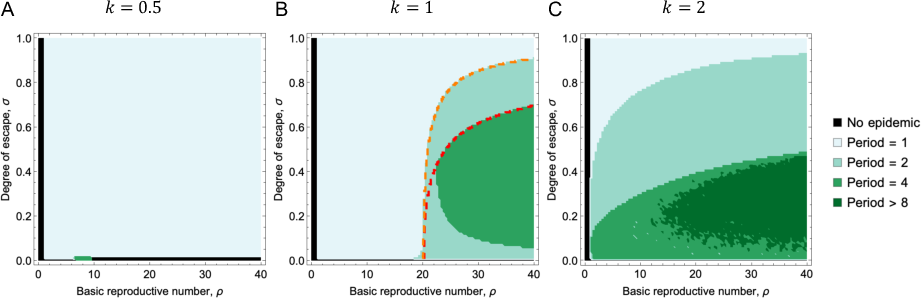
Figure 4: Periodicity diagram in j0; regions of period-1, period-2, and higher-period dynamics, including analytical stability boundaries for j1.
Non-Monotonic Dependence of Recurrent Epidemic Size on Transmissibility
A central and contradictory claim of the study is that the mean size of recurrent epidemics is maximized at intermediate values of the basic reproduction number j2, in stark contrast with single-epidemic intuition wherein epidemic size monotonically increases with j3. This non-monotonicity arises due to negative inter-wave immune feedback: larger j4 increases single-wave attack rate but also depletes the susceptible pool for subsequent, antigenically related variants via stronger cross-immunity, ultimately reducing the size of future epidemics.
Analytical derivations for multiplicative cross-immunity (j5) yield explicit formulas for the maximizing j6 and maximal size j7 in terms of the antigenic escape parameter j8. For small j9, i0—that is, only moderate transmissibility maximizes long-term epidemic size. As i1 increases (immunity between variants decays faster), this optimum shifts to larger i2. The wave-onset reproduction number at maximal recurrent size remains modest for a wide range of parameters, often close to empirical estimates for influenza.
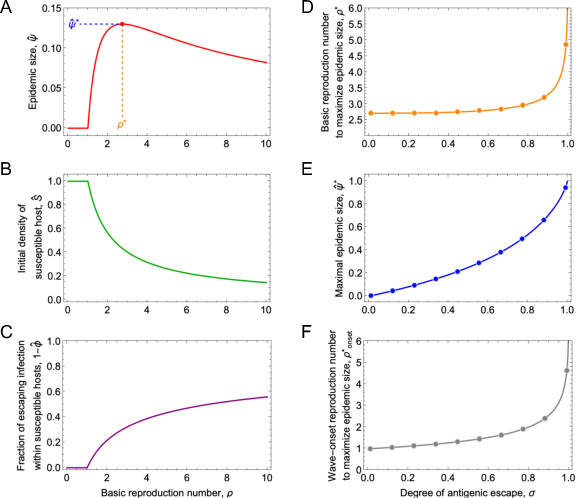
Figure 5: Mean recurrent epidemic size as a function of i3, with decomposed effects of susceptibility and per-susceptible infection probability; dependence of optimal i4 and maximal size on i5.
Implications for Pathogen Evolution and Epidemic Forecasting
The analysis underscores the necessity of accounting for immune history and cross-immunity structure in understanding recurrent epidemic patterns for antigenically variable pathogens such as influenza and SARS-CoV-2. Key practical implications include:
- Epidemic Forecasting: Standard single-epidemic models overestimate future epidemic risk in populations with substantial cross-immunity. Accurate forecasting must couple transmission potential and cumulative immune landscape over variant emergence sequences.
- Pathogen Evolution: The negative feedback identified here imposes strong short-term constraints on the epidemic advantages of increased transmissibility or immune escape for emerging variants. Long-term epidemic success for rapidly transmitting variants may be offset by their propensity to erode future susceptible pools.
- Immune Map Quantification: The specific form and breadth of cross-immunity (parameterized by i6 and i7) strongly influence recurrence, reinforcing the value of fine-grained antigenic cartography for epidemiological prediction.
The model isolates immune-history feedback by fixing the sequence and antigenic relationships of invading variants, leaving open the interaction with evolutionary feedbacks (positive coupling between epidemic size and rate of antigenic escape) and the effects of additional processes such as immunity waning, partial immunity, metapopulation structure, or non-polarized immune effects.
Conclusion
This study provides a systematic theoretical foundation for how immune history governs recurrent epidemics of antigenically related pathogen variants. The framework elucidates how cross-immunity shapes not only epidemic stability and periodicity but also constrains the long-term average epidemic size, often in a non-intuitive, non-monotonic manner with respect to pathogen transmissibility. These results highlight that accurate epidemic modeling, forecasting, and evolutionary inference require explicit quantification of cross-immunity and the cumulative effects of past epidemic waves. Future work extending this approach to incorporate explicit pathogen evolution, metapopulation dynamics, and alternative immune mechanisms will further enhance its value for public health strategy and evolutionary epidemiology.

